
OUI Defenses in Massachusetts: What Can Be Challenged
OUI Defenses in Massachusetts: What Can Be Challenged

An OUI arrest in Massachusetts is not a conviction. The Commonwealth has to prove every element of the charge, and each step between the traffic stop and the verdict is a place where the evidence can be tested. The defenses that matter most usually target the reason for the stop, the field sobriety tests, the breath or blood test, and whether the prosecution can show your ability to drive safely was actually diminished.
This guide walks through those defenses in plain terms, then covers what the court process looks like and what is at stake for your license. It is general information, not advice on your case. The right defense depends on the police report, the video and the test records, so have a Massachusetts criminal defense attorney review them.
TL;DR
- Under M.G.L. c. 90, § 24, the Commonwealth must prove you operated a vehicle on a public way or a place with public access while impaired by alcohol or at a 0.08% blood alcohol concentration or higher.
- Common defenses attack the legality of the stop, how field sobriety tests were given, the reliability and admissibility of chemical tests, and whether impairment was proven.
- Breath test results from Alcotest 9510 devices for tests given between June 1, 2011 and April 18, 2019 are inadmissible in pending OUI prosecutions.
- A first-offense conviction carries a one-year license suspension, and a refusal triggers its own RMV process with a hearing right within 15 days.
- Early review of the evidence matters, because motions to suppress or dismiss are raised at the pretrial stage.
Table of Contents
- What the Commonwealth has to prove
- Challenging the stop and the arrest
- Field sobriety tests
- Breath tests and chemical evidence
- Refusing the chemical test
- How an OUI case moves through court
- What a conviction costs
- Perspective: why we start with the paperwork
- Choosing a lawyer for an OUI charge
- Talk to us about your OUI charge
- FAQ
- Sources
What the Commonwealth has to prove
Every defense starts from the elements. Massachusetts law makes it a crime to operate a motor vehicle on a public way or a place with public access while under the influence of intoxicating liquor, or with a blood alcohol concentration of 0.08% or greater. Each piece is something the prosecution must establish:
- Operation. You were driving or otherwise operating the vehicle. Cases involving a parked car or a driver found asleep turn on this point, which we cover in our piece on when sitting drivers are treated as OUI.
- Location. The operation took place on a public way or a place with public access.
- Impairment. Either your ability to drive safely was diminished by alcohol, or a valid test showed 0.08% or higher.
The jury instructions are worth knowing here. The Commonwealth does not have to prove erratic driving, but it must prove that alcohol diminished your ability to operate safely. That is why a clean stretch of driving doesn't end a case by itself, and also why the officer's observations are so closely examined.
Challenging the stop and the arrest
Before a court gets to the question of whether you were impaired, it asks whether the police were allowed to stop you and detain you in the first place. An officer needs a lawful basis to pull a car over. If the report cites a vague reason, if dash or body camera footage doesn't match the written account, or if an exit order or arrest lacked support, your attorney may file a motion to suppress.
The Massachusetts Trial Court explains that counsel may seek suppression when evidence was obtained in violation of constitutional rights, or dismissal when the evidence is insufficient. In an OUI case, a successful suppression motion can remove the officer's observations, your statements, the field tests and the chemical test, which often ends the prosecution.
Questions a defense lawyer asks about the stop:
- What exactly did the officer say was the reason for the stop, and is it on video?
- How long was the roadside detention, and did it grow beyond the original reason?
- Were you questioned before being told your rights, once you were effectively in custody?
- Does the written report match the recordings and the dispatch log?
Field sobriety tests
Roadside tests are not scientific measurements of blood alcohol. Joseph D. Bernard of MCLE describes them as divided attention tasks that assess an operator's ability to multitask. That framing opens several lines of defense:
- Conditions. Uneven pavement, poor lighting, wet roads, traffic, footwear and weather all affect performance.
- Physical factors. Injuries, age, weight, balance problems, inner-ear conditions or fatigue can look like impairment.
- Instructions. Were the tests explained and scored the way the officer was trained to do it?
- Observations. Bloodshot eyes, an odor of alcohol and slurred speech are subjective, and the officer's account can be compared with video.
You are generally not required to perform roadside tests, and a refusal is treated differently from a chemical test refusal. Massachusetts case law, including Commonwealth v. McGrail (1995), holds that the prosecution cannot comment at trial on a defendant's refusal to perform field sobriety tests. That is a protection a lawyer would enforce at trial. It does not change what happens to your license after a chemical test refusal, covered below.
Breath tests and chemical evidence
A number on a breath machine can feel final, but it is not self-proving. Under the Massachusetts jury instructions, a breath test result of 0.08% or greater is not admissible on the issue of impairment without expert testimony establishing a relationship between the result and intoxication. The per se 0.08% theory depends on a properly administered test on a properly maintained and calibrated machine.
This area has a particular Massachusetts history. After litigation over the state's breath testing program, the courts ruled that Alcotest 9510 breath test results are inadmissible in pending OUI prosecutions for tests administered between June 1, 2011 and April 18, 2019. The rulings in Ananias and Hallinan (2023) grew out of the withholding of exculpatory evidence by the Office of Alcohol Testing. Anyone with an older case, or a prior conviction from that window, should have an attorney check how those rulings apply.
For current cases, a defense attorney typically reviews:
- The 15-minute observation period before the test and whether it was actually observed
- Calibration, certification and maintenance records for the device
- Whether the officer was certified to run the test
- Medical issues, mouth alcohol, or other factors that can affect a reading
- For blood and drug cases, chain of custody and lab procedures (see our guide to OUI drug charges and defenses)
Refusing the chemical test
Refusal is a separate track from the criminal case. After a chemical test refusal, a driver is entitled to an RMV hearing within 15 days. The issues at that hearing are narrow: whether the officer had reasonable grounds to believe you operated under the influence, whether you were placed under arrest, and whether you refused the test. Because the window is short, do not wait to find out what your options are. Our article on implied consent refusals in Massachusetts explains how that process works.
How an OUI case moves through court
Knowing the sequence tells you when each defense is raised.
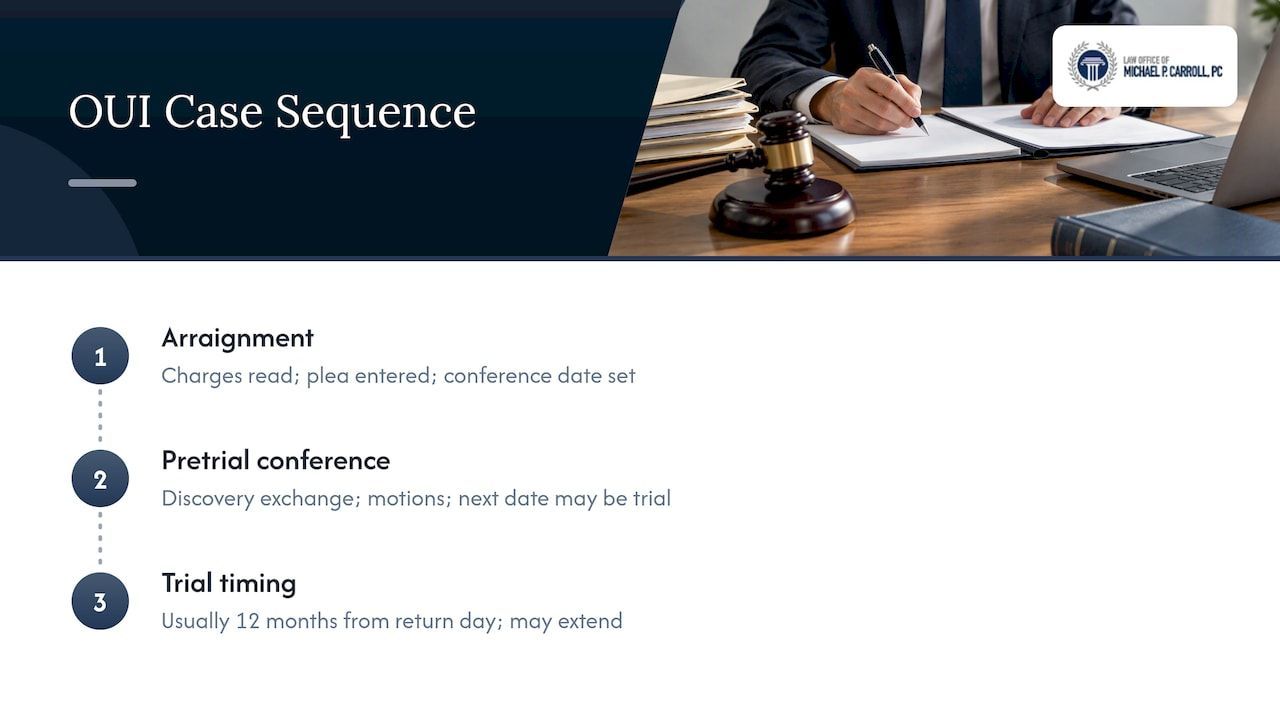
Arraignment. The charges are read, and the clerk either enters a not-guilty plea or asks how you want to plead. If you cannot afford a lawyer and the offense could carry jail time, the judge will appoint one. If the case is not disposed of, the court sets a pretrial conference date.
Pretrial conference. The parties complete a report for the judge, exchange discovery, and may file or schedule motions to dismiss or suppress. The next date may be for motions, trial, or both. The Trial Court describes pretrial as principally about sharing information and narrowing issues, not the trial itself. For a broader view of how defense work unfolds, see this overview of the criminal defense process.
Trial timing. A defendant generally must be tried within 12 months of the return day, but that limit is often extended when the defendant agrees to continuances and for other reasons. We lay out the stages in more detail in the OUI case timeline in Massachusetts.
What a conviction costs
Defenses are worth the effort because the consequences are real. An OUI conviction carries a one-year license suspension for a first offense, two years for a second, eight years for a third, and a lifetime suspension for a fifth. A court-assigned Alcohol Education Program may shorten a first-offense suspension. The RMV also counts convictions and alcohol education assignments from other states when setting suspension periods, which matters if you have an out-of-state history (see our article on an OUI case from another state).
Money adds up too:
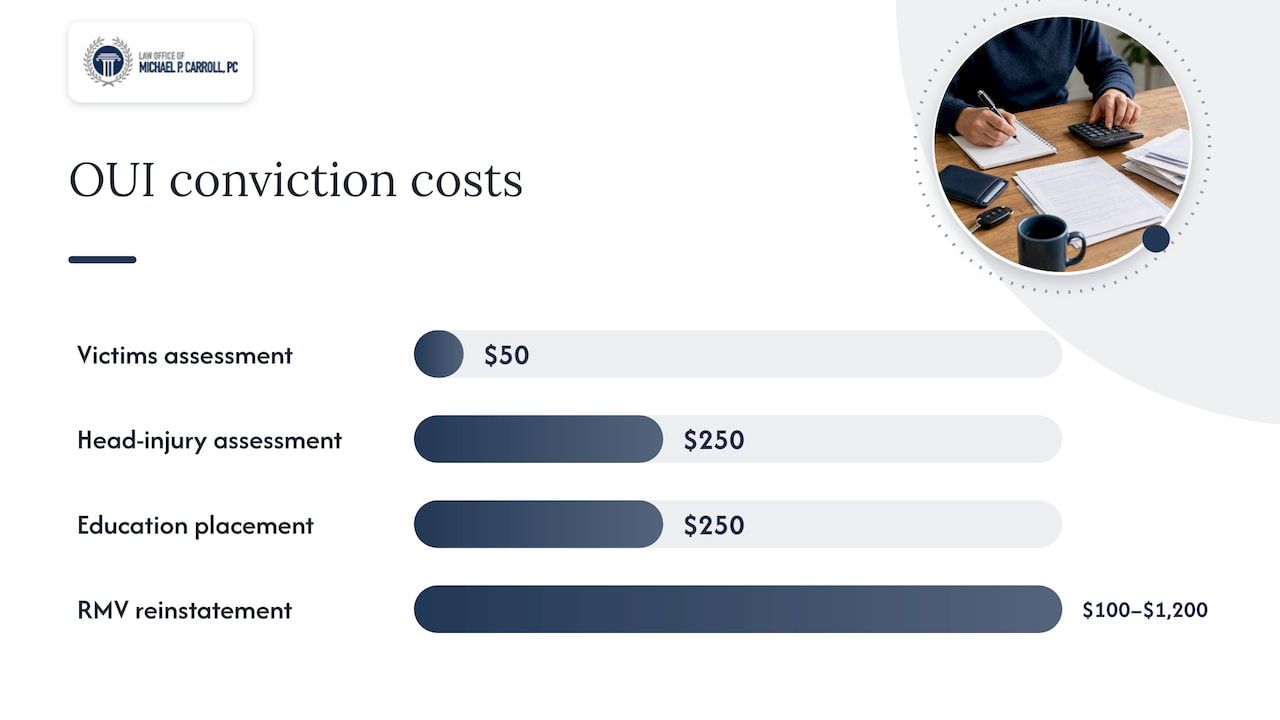
| Item | Amount |
|---|---|
| Victims assessment | $50 |
| Head-injury assessment | $250 |
| Driver alcohol education placement (§24D) | $250, which may be reduced, paid in installments or waived for qualifying hardship |
| RMV reinstatement fee | $100 to $1,200, set by M.G.L. c. 90, § 33 |
Some drivers can ask for a hardship license, which is available only to Massachusetts license holders and issued at the RMV's reasonable discretion based on the facts. We cover the process in getting a hardship license after an OUI, and the fee range in license reinstatement costs. The full picture of sentencing is in our guide to OUI penalties in Massachusetts.
If you drive for a living, the stakes are higher, and a commercial license is treated far more strictly. Read about CDL OUI penalties in Massachusetts before you decide anything about your case. Drivers under 21 face their own rules, described in our piece on underage OUI suspension risk.
Perspective: why we start with the paperwork
We approach every OUI case the same way: before we talk about outcomes, we read what the police wrote and compare it with what the recordings show. Clients often arrive convinced that a test result or an admission at the roadside has settled things. In our experience, that is rarely the whole story. The stop, the questions, the tests and the records each have to hold up on their own.
Because this is an owner-operated firm, you work directly with Michael, not a rotating group of staff. That means the person who reviews your evidence is the person who stands next to you in court, and you can reach him with questions as the case moves. We think that matters most in the first weeks, when the RMV deadlines and the pretrial decisions are made.
— Michael Carroll
Choosing a lawyer for an OUI charge
A defense is only as good as the person raising it. When you compare attorneys, ask direct questions and weigh the answers:
- Who will handle my case? Find out whether the lawyer you meet is the lawyer who appears in court.
- How many OUI cases do you take to a motion hearing or trial? A lawyer who files motions when the facts support them gives you leverage.
- What will you review first? A good answer includes the report, any video, and the breath test and calibration records.
- How will you handle my license? The criminal case and the RMV process run on different tracks and different deadlines.
- How will we communicate, and what will it cost? Ask for the fee arrangement in writing before you sign.
If you cannot afford a lawyer, the court can appoint one at arraignment where jail is possible. If you can hire one, bring your citation, any paperwork from the RMV and a written timeline of the night, written as soon as you can.
Talk to us about your OUI charge
We defend OUI, DUI and DWI charges for clients in Attleboro and surrounding Massachusetts communities. If you have been arrested or have an RMV hearing coming up, contact our OUI attorney page to arrange a consultation with Michael. Bring everything you were given at the time of arrest, and we will go through the evidence with you and explain your options in plain language.
FAQ
Can I fight an OUI if I failed the breath test?
Yes. A breath result of 0.08% or greater is not admissible on the issue of impairment without expert testimony linking it to intoxication. The test itself can also be challenged on how it was administered and how the device was maintained. An attorney needs the records to tell whether those challenges apply.
Do I have to do field sobriety tests in Massachusetts?
The tests are not the same as a chemical test, and Massachusetts case law bars the prosecution from commenting at trial on a refusal to perform them. A chemical test refusal is different and leads to RMV consequences. Speak with an attorney about your specific stop as soon as you can.
What happens at the first court date after an OUI arrest?
At arraignment the charges are read and a not-guilty plea is entered or you are asked how you want to plead. If the case is not resolved, the court sets a pretrial conference. Motions to suppress or dismiss are typically scheduled from there.
How long will I lose my license for a first OUI?
A first-offense OUI conviction carries a one-year suspension, and a court-assigned Alcohol Education Program may shorten it. Separate suspensions can follow a chemical test refusal. The RMV decides the specifics, so confirm your own situation with a lawyer.
Sources
- Mass. General Laws c.90 § 24 | Mass.gov
- Massachusetts OUI jury instructions, GL c. 90 § 24
- Admissibility of breath test results | Mass.gov
- Massachusetts Basic Practice Manual, OUI defenses (MCLE)
- The bail process: Post arraignment | Mass.gov
- Your arraignment or first appearance in court | Mass.gov
- The pre-trial, trial, and verdict process | Mass.gov
- RMV suspension hearings | Mass.gov
- Alcohol and drug suspensions for over 21 years of age | Mass.gov
- Potential money assessments in criminal cases | Mass.gov
- Apply for a hardship driver's license | Mass.gov
- Overview of the criminal defense process
Recommended
This article is general information about Massachusetts law, not legal advice, and reading it does not make you a client of the Law Office of Michael P. Carroll, PC. Every case is different. If you are facing charges in Bristol, Norfolk or Plymouth County, call Mike to discuss your situation.