
0.08% or a Parked Car: When Massachusetts Treats Sitting Drivers as OUI
0.08% or a Parked Car: When Massachusetts Treats Sitting Drivers as OUI

Massachusetts law does not charge anyone with "DUI." The offense on the books is OUI, Operating Under the Influence, and it carries the exact same criminal exposure and license consequences that other states attach to DUI or DWI. The distinction is almost entirely about vocabulary, not legal substance, though how Massachusetts defines "operating" ends up mattering a great deal once you look at actual cases. What follows covers the statute, the penalties, and the practical steps that matter if you or someone you know is facing this charge.
TL;DR:
- Massachusetts law considers sitting in a running or idling vehicle as "operation," making it easier to charge someone in parking lots or private property.
- The law does not require actual motion or driving on public roads for an OUI charge to be valid under Massachusetts standards.
- Prosecutors can rely on observational evidence for impairment in drug cases, as there is no specific roadside chemical test equivalent to a breathalyzer.
- First-time offenders face fines up to $5,000, license suspension, and possible jail time, with higher penalties for repeat offenses and license restrictions like ignition interlock devices.
- Defense strategies often focus on challenging "operation," the accuracy of chemical evidence, and whether proper RMV hearing procedures were followed promptly.
Table of Contents
- What OUI Means Under Massachusetts Law
- Per‑Se BAC Versus Impairment: The Two Ways to Get Charged
- Where the Law Applies: Operation and Public Access
- Penalties and License Consequences by Offense Level
- Common Defenses and What to Do Right After an Arrest
- How Massachusetts OUI Compares With DUI or DWI Elsewhere
- Why Massachusetts Says OUI Instead of DUI
- OUI's Impact on Insurance Rates and Long-Term Costs
- Getting Your License Back After an OUI
- Drug-Related OUI Versus Alcohol-Related OUI
- Mandatory Education and Treatment Programs
- A Practitioner's View on What Actually Moves These Cases
- How the Law Office of Michael P Carroll Can Help
- Primary Statutes and RMV Resources
- Sources
- FAQ
What OUI Means Under Massachusetts Law
Massachusetts prosecutors have to prove three things to convict someone of OUI, all drawn from M.G.L. c. 90, Section 24: the person operated a motor vehicle, did so on a public way or place where the public has a right of access, and was under the influence at the time. Miss any one of those three elements and the case falls apart.
The statute doesn't limit itself to alcohol. It covers impairment from:
- Alcohol
- Marijuana
- Narcotics
- Depressants and stimulants
- Toxic vapors
Jury instructions used in Massachusetts courts walk jurors through these same three elements and remind them that intoxication has to affect the defendant's ability to operate safely, not just be present in some measurable amount. That distinction shows up constantly in OUI drug cases, where a substance being legal to use recreationally or by prescription is not a defense to impairment.
Per‑Se BAC Versus Impairment: The Two Ways to Get Charged
Massachusetts prosecutors can win an OUI case two different ways, and understanding both matters if you're trying to figure out how strong the evidence against you actually is.
The numbers that trigger automatic exposure:
- 0.08% BAC or higher for drivers 21 and older triggers the per‑se violation
- 0.04% for commercial drivers operating a CDL vehicle
- 0.02% for drivers under 21, which triggers administrative license consequences under the state's zero-tolerance approach
The jury instructions that Massachusetts courts use lay out something a lot of first-time defendants don't expect: you don't need a 0.08% reading to be convicted. Prosecutors can build a case entirely on observational evidence: slurred speech, failed field sobriety tests, erratic driving, an officer's testimony. Jurors are instructed to weigh it as evidence of impairment, just not conclusive proof on its own.
Where the Law Applies: Operation and Public Access
Massachusetts courts read the word "operate" broadly, and that's where a lot of confusion between OUI and how other states handle DUI actually starts. You don't need to be driving down a road for the statute to reach you.
Courts have found that sitting in the driver's seat with the engine running, or simply turning the ignition key, can count as "operating" a vehicle under the statute's language. The location requirement is just as broad: it covers roads, but also parking lots, gas stations, and any other place the public generally has access to.
Locations where OUI charges commonly apply:
- Public roads and highways
- Parking lots at bars, restaurants, and retail stores
- Gas station lots
- Private ways open to public travel
Pro Tip: If you've been drinking and need to "sleep it off" in your car, hand the keys to a passenger or leave them somewhere out of reach. Sitting behind the wheel with keys in the ignition, even with the engine off, has been enough for an operation finding in some Massachusetts cases.
Penalties and License Consequences by Offense Level
An OUI charge triggers two separate tracks of consequences: what happens in criminal court, and what the RMV does to your license administratively, often before you've even been convicted of anything.
Criminal penalties escalate fast:
- First offense: a misdemeanor carrying fines of $500 to $5,000, up to 2.5 years in a house of correction, and license loss, though many first-time defendants qualify for a §24D disposition that can reduce jail exposure in exchange for treatment program completion
- Second offense: mandatory minimum jail time, longer suspension, and mandatory ignition interlock installation once driving privileges are restored
- Third and subsequent offenses: felony exposure, with the possibility of state prison time and permanent marks on a driving record
RMV administrative action moves independently of the criminal case:
- Failing a chemical test triggers an immediate suspension, separate from any court outcome
- Refusing a breath or blood test carries its own consequence, commonly a 180-day administrative suspension for drivers over 21, longer for repeat offenders or drivers under 21
- Hardship licenses may be available for essential travel like work or medical appointments, but they come with restrictions and waiting periods
- Under Melanie's Law, repeat offenders face mandatory Ignition Interlock Device (IID) installation, and CDL holders can lose commercial driving privileges even from an incident in a personal vehicle
The IID itself isn't free. Drivers cover installation and ongoing monitoring fees out of pocket for the entire mandated period, on top of court fines, attorney costs, and the increased insurance premiums that follow. For a closer breakdown of what a second offense OUI actually costs, the escalation from a first offense is steep.
Common Defenses and What to Do Right After an Arrest
Not every OUI arrest ends in a conviction, and the strength of the Commonwealth's case often depends on details that fall apart under scrutiny.
Defense attorneys frequently focus on:
- Whether the person actually "operated" the vehicle under the statute's definition
- Whether the breathalyzer or blood test was administered and calibrated correctly
- Whether the arresting officer's field sobriety observations hold up, since these tests have documented reliability problems
- Whether there's a break in the chain of custody for any chemical evidence
There's also a narrow procedural window that matters enormously and gets missed constantly: you must request an RMV hearing challenging an administrative suspension as soon as possible after the arrest. Miss that window and you lose the chance to contest it before your license is already gone.
Pro Tip: Write down everything you remember about the stop within 24 hours, the time, the officer's exact words, weather conditions, what tests you were asked to perform, and whether you were told what refusing a test would cost you. Memory fades fast, and these details often become the foundation of a defense.
Beyond preserving your own account, avoid discussing the incident on social media, gather contact information for any witnesses, and get an attorney involved immediately rather than waiting for an arraignment date.
How Massachusetts OUI Compares With DUI or DWI Elsewhere
Functionally, OUI, DUI, and DWI describe the same conduct. Drive drunk or impaired in Massachusetts, Rhode Island, or Florida, and you're facing a criminal charge with license suspension attached in all three, just under different statutory names.
Where states genuinely differ is in how broadly "operate" or "drive" gets interpreted:
- Massachusetts courts have found operation from someone sitting motionless with the ignition on
- Some other states require the vehicle to be actually in motion, or moving on a public road, for a DUI charge to stick
- That gap means conduct that draws an OUI charge in Massachusetts might not trigger a charge at all somewhere with narrower statutory language
Out-of-state convictions generally still count against a Massachusetts driver's record under the Driver License Compact, provided the other state's statute is similar enough to Massachusetts's own.
Why Massachusetts Says OUI Instead of DUI
The terminology split traces back to how Massachusetts drafted its statute decades ago, choosing "operating" as the controlling verb rather than "driving." That single word choice is why Massachusetts law reaches situations most people wouldn't think of as "driving" at all: sitting in a parked car with the engine idling, or even just having the ignition turned to accessory mode while impaired.
Other states adopted "driving" as their statutory verb, which courts there have generally read to require some degree of actual vehicle movement or at least an attempt to move the vehicle. Massachusetts never made that requirement explicit, and its courts have consistently declined to narrow the definition. The practical result is that "operate" functions as a much wider net than "drive."
This isn't just legal trivia. It explains why someone can be arrested for OUI in a mall parking lot after falling asleep with the car running, a scenario that in a "driving" jurisdiction might never generate a charge at all. It also explains why so many people assume, incorrectly, that DUI and OUI must involve different conduct or different severity. They don't. The word changed; the underlying wrongdoing the legislature was targeting, impaired individuals in control of vehicles capable of causing harm, stayed the same.
Understanding this history matters most when you're evaluating your own situation. If you were arrested somewhere other than a moving vehicle on a road, don't assume that fact alone gets the charge dismissed. Under Massachusetts's operation standard, it often doesn't.
OUI's Impact on Insurance Rates and Long-Term Costs
An OUI conviction follows you well past the courtroom, and for most people, the insurance consequences end up costing more overtime than the fine itself.
Massachusetts insurers classify an OUI conviction as a major violation, which typically triggers a substantial premium increase at the next renewal, and that increase tends to stick around for multiple years rather than fading after a single renewal cycle. Some insurers decline to renew a policy altogether after an OUI conviction, forcing the driver into a high-risk insurance market where premiums run considerably higher than standard rates.
Beyond the premium itself, several costs stack on top of each other:
- SR-22 or similar high-risk filings, if required, often carry their own fees
- A hardship license or reinstated license after suspension frequently requires proof of updated insurance coverage before the RMV will act
- Ignition interlock installation and monthly monitoring fees run for the entire mandated period, regardless of insurance status
- Lost wages from any jail time, license suspension affecting commute ability, or time off work for court dates add an indirect but very real cost
The financial tail on an OUI conviction commonly stretches three to five years once you account for elevated insurance premiums, program fees, and legal costs. For many drivers, that ongoing cost is the argument for fighting the charge aggressively rather than accepting a quick plea, since the conviction itself is what triggers most of the downstream expense.
Getting Your License Back After an OUI
License reinstatement after an OUI runs on its own separate timeline from the criminal case, and it starts as soon as the suspension period begins, not when the case resolves.
The process generally unfolds in stages. First comes the suspension period itself, which varies based on whether the case involved a chemical test failure, a refusal, or a conviction, and whether it's a first or subsequent offense. During that window, a hardship license may be available for work, medical appointments, or alcohol treatment program attendance, though the RMV imposes its own eligibility rules and waiting periods before granting one.
Once the suspension period expires, reinstatement isn't automatic. Drivers typically need to:
- Pay a reinstatement fee to the RMV
- Provide proof of completion for any mandated alcohol education or treatment program
- Show proof of insurance, often at the higher rates that follow a conviction
- Install and verify an ignition interlock device, if Melanie's Law requirements apply based on offense count
For repeat offenders, IID requirements extend well beyond the suspension itself, often requiring a full year or more of interlock use after the license is reinstated before the device can be removed. Skipping steps or missing paperwork deadlines can restart parts of the process, which is why many drivers coordinate directly with an attorney's office to track the timeline rather than handling RMV correspondence alone.
Drug-Related OUI Versus Alcohol-Related OUI
Massachusetts treats OUI-drugs and OUI-alcohol as the same underlying statute, but the evidence used to prove each looks quite different, and that difference shapes how these cases get defended.
Alcohol cases usually come with a breathalyzer reading that gives prosecutors a specific number to build a per-se case around. Drug cases don't have an equivalent roadside chemical test that produces an instant, court-ready number. That means drug-related OUI charges rely almost entirely on the impairment prong: officer observations, field sobriety performance, and sometimes a drug recognition evaluation conducted by a specially trained officer.
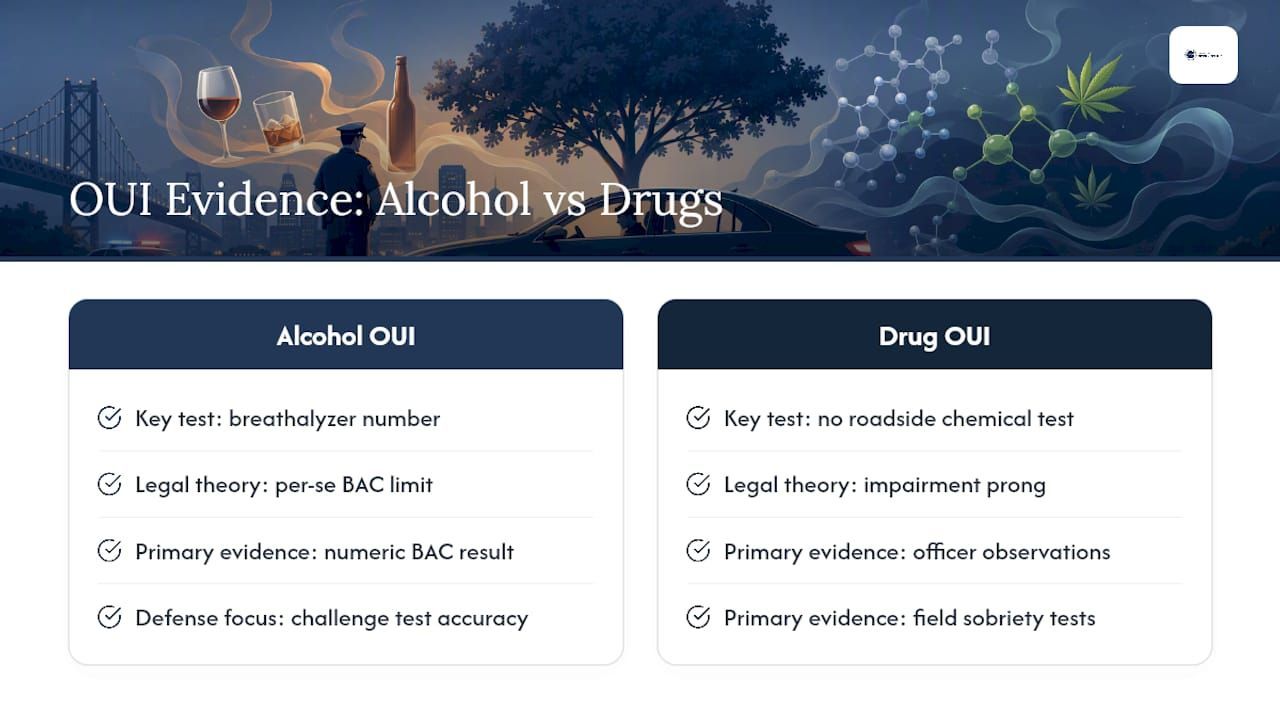
This distinction cuts both ways for defendants. On one hand, the absence of a clean numeric threshold means prosecutors can't point to a single dispositive number the way they can with a breath test. On the other hand, it means the case turns heavily on subjective officer testimony, which opens more room for a defense attorney to challenge the reliability of those observations.
One point worth repeating: legal use of a substance, whether that's recreational marijuana or a validly prescribed medication, provides no defense if the substance impaired the person's ability to drive safely. Prosecutors don't need to prove the substance was illegal to possess, only that it caused impairment while operating a vehicle.
Mandatory Education and Treatment Programs
Nearly every OUI disposition in Massachusetts, whether it's a straight conviction or a §24D alternative disposition, comes with some form of mandatory alcohol or drug education requirement attached.
For many first-time offenders who qualify for the §24D program, completing a 16-week alcohol education program is often part of the disposition, sometimes paired with a shorter license suspension than a straight conviction would carry. Offenders with higher BAC readings or repeat charges may face a longer inpatient or outpatient treatment track rather than the standard weekly program.
These programs aren't optional add-ons. Completion is typically a prerequisite for license reinstatement, meaning a driver can serve out an entire suspension period and still not get a license back until the RMV has proof the program was finished. Fees for these programs come out of the driver's own pocket, stacking on top of court costs, attorney fees, and the insurance increases that follow a conviction.
A Practitioner's View on What Actually Moves These Cases
After more than a decade handling OUI defense across Massachusetts, the pattern I see most often is defendants fixating on the breath test number while ignoring the three things that actually decide outcomes: whether operation can be proven cleanly, whether the chemical evidence was handled correctly, and whether the 15-day RMV hearing deadline got met. Cases won or lost early, before anyone sets foot in a courtroom, more often than clients expect.
— Michael Carroll
How the Law Office of Michael P Carroll Can Help
If you're facing an OUI charge, time-sensitive deadlines may affect your ability to keep your license before your case proceeds to trial. A firm that provides direct attorney access, rather than multiple associates, can ensure continuity in representation throughout your case.

A consultation typically includes a review of your arrest details, chemical test or refusal circumstances, the status of RMV hearing deadlines, and discussion of defenses relevant to your case. Personalized attorney involvement may provide more direct communication compared to responses from non-attorney staff. If you've been arrested for OUI, contact the firm's OUI attorney page as soon as possible. Every day that passes narrows the window to challenge an administrative suspension before it takes effect.
Primary Statutes and RMV Resources
For readers who want to review the underlying law directly: the full statute is at M.G.L. c. 90, Section 24, and the courts' jury instructions are available as a downloadable PDF. RMV suspension and CDL guidance is published on Mass.gov.
This article is general information, not a substitute for advice from a qualified lawyer. Consult a qualified legal professional about your own circumstances before acting on anything here.
Sources
FAQ
Is an OUI or DUI worse?
Neither term is inherently worse; they describe the same offense under different state statutes. In Massachusetts, OUI carries the same fines, jail exposure, and license consequences that DUI carries in other states for comparable facts.
Is an OUI a felony in Massachusetts?
A first OUI offense is a misdemeanor, but third and subsequent offenses, or cases involving serious injury, can be charged as felonies with state prison exposure.
How do you beat an OUI charge in Massachusetts?
Common defense strategies include challenging whether "operation" occurred, questioning chemical test calibration and administration, and disputing the reliability of field sobriety observations; success depends heavily on the specific facts, which is why early attorney involvement through a firm like the Law Office of Michael P Carroll matters.
Is OUI the same as DUI?
Functionally yes. Massachusetts simply uses "Operating Under the Influence" as its statutory term instead of "Driving Under the Influence," though Massachusetts courts interpret "operate" more broadly than some states interpret "drive."