
Act Within 48 Hours After a Probation Violation in Massachusetts
Act Within 48 Hours After a Probation Violation in Massachusetts

A Notice of Probation Violation starts a two-stage court process, not an automatic trip to jail. The court first decides whether a violation actually happened, using the lower "preponderance of the evidence" standard, then decides what to do about it. The single most important move a probationer can make is contacting an attorney immediately or asking the court for appointed counsel, before saying anything to a probation officer about the alleged violation.
TL;DR:
- Most probation violations are triggered by new criminal charges or repeated failure to report, leading to the issuance of a detailed notice that guides the hearing.
- Probation violation hearings involve two phases: determining whether the violation occurred based on evidence, often hearsay, and deciding on the appropriate disposition.
- A violation does not automatically result in jail; courts have four options, including continuing, modifying, terminating, or revoking probation, with judges favoring less severe measures when possible.
- Challenging hearsay, procedural defects, or unauthorized conditions can form effective defenses, especially if evidence is weak or improperly obtained.
- Early legal counsel and thorough documentation are crucial within the first 48 hours to prevent inadvisable stipulations and preserve rights for mitigation and negotiation.
Table of Contents
- Probation Violation Massachusetts Procedures and Timeline
- How Probation Violation Hearings Work in Massachusetts
- Common Alleged Probation Violations and Their Relative Risk
- Court Dispositions and Consequences of a Probation Violation
- Probation Violation Defense Strategies That Actually Work
- What to Do Right After a Notice of Probation Violation
- A Defense Lawyer's View on Handling Probation Violations
- What the Conventional Advice Gets Wrong
- How the Law Office of Michael P Carroll Handles Probation Violation Cases
- Sources
- FAQ
Probation Violation Massachusetts Procedures and Timeline
The process almost always starts with paperwork: a Notice of Surrender or Notice of Alleged Probation Violation, served either in hand or by mail, laying out exactly what the probationer allegedly did wrong and when to appear in court. Superior Court guidelines direct probation officers to be specific about the violation, not vague, because the notice itself becomes the roadmap for the hearing that follows.
Three things typically trigger this notice: a new criminal charge, a technical violation caught during a routine check-in, or a failed drug test reported by a treatment provider. When a probationer picks up a new criminal complaint, the probation department tied to the original sentence must issue a Notice of Probation Violation and Hearing at or before arraignment. That timing matters. It means the violation clock often starts running the same day as the new arrest, sometimes before the new criminal case has even been fully investigated.
A probation officer has three paths once a violation is suspected:
- Summons the probationer to appear voluntarily, used for lower-risk technical violations like a missed appointment or late fee.
- Arrest without a warrant when the officer has reason to believe the probationer poses a flight or safety risk.
- Request a warrant through the court when the probationer cannot be located or has already missed a scheduled surrender.
Timing after that follows a fairly predictable rhythm, though it bends for good cause. Superior Court Guidelines call for an initial hearing generally within 14 days of the notice being served, and a presumptive final hearing within roughly 30 days unless the court finds a reason to extend it. If the probationer is detained rather than released, a preliminary hearing addresses probable cause first. That hearing borrows its logic from Morrissey v. Brewer , the case Massachusetts courts still lean on for the constitutional minimum owed to someone facing revocation, and it exists specifically to test whether custody is justified before the full case gets litigated, according to a Suffolk Law summary of probation revocation procedure.
Bail and detention decisions at this stage hinge on two questions: is there probable cause to believe a violation occurred, and does the probationer present a flight or safety risk if released? Judges weigh the nature of the alleged violation, prior compliance history, and ties to the community. A missed check-in rarely results in continued detention. A new violent offense almost always does. Anyone navigating this stage should also understand what happens at a Massachusetts arraignment, since a new criminal charge often runs on a parallel track alongside the probation surrender.
How Probation Violation Hearings Work in Massachusetts
Every violation hearing splits into two distinct phases, and understanding the difference between them changes how you and your attorney should approach the case.
The adjudicatory phase answers one question: did the violation happen? The probation officer typically presents the evidence, sometimes alongside the district attorney if the violation stems from a new criminal charge. District and Municipal Court Rule 6 governs how this phase runs, and it permits hearsay evidence subject to reliability limits, meaning a probation officer's written report or a lab technician's drug test summary can sometimes come in without live testimony. That is a significant departure from a criminal trial, and it is exactly why cross-examination rights matter so much here.
- The probationer has the right to be present, to be represented by counsel, and to cross-examine adverse witnesses.
- Proceedings are typically recorded, giving both sides a record for any later appeal.
- The probationer can testify but cannot be compelled to, and silence cannot be held against them on the underlying new charge.
- Hearsay is admissible, but a finding built entirely on unreliable hearsay, with no corroboration, is vulnerable to challenge.
Pro Tip: If the only evidence against you is a probation officer's summary of what someone else told them, ask your attorney to request the underlying records and push for live testimony. Hearsay that cannot be corroborated is often the weakest link in the state's case.
The standard of proof for the adjudicatory phase is the preponderance of the evidence, meaning the judge only needs to find it more likely than not that the violation occurred. That is a considerably lower bar than "beyond a reasonable doubt," the standard used in the original criminal case. This gap explains a pattern that surprises a lot of people: a probationer can be acquitted of a new criminal charge and still be found in violation of probation for the same underlying conduct, because the two proceedings run on different evidentiary rules and different judges reach different conclusions from the same facts.
If the judge finds a violation occurred, the case moves to the dispositional phase . Here the court weighs the nature and severity of the violation, the probationer's overall compliance history, input from the probation officer (who may recommend anything from a warning to full revocation), and any mitigating evidence the defense presents. District/Municipal Court Rule 8 requires the court to state its reasons on the record if it decides to revoke probation and execute a previously suspended sentence, according to the rule governing findings and disposition. That requirement is not a formality. Courts balance public safety, prior violations, and rehabilitation prospects when deciding disposition, and a judge who cannot articulate a coherent reason for revocation gives the defense an opening on appeal.
Common Alleged Probation Violations and Their Relative Risk
Some violations move fast toward serious consequences. Others rarely result in more than a stern warning. Knowing where a given allegation falls on that spectrum helps set realistic expectations.
- New criminal charges carry the most weight and often function as a near-automatic trigger for surrender, since the probation office is generally required to act once a new complaint issues.
- Failure to report for scheduled check-ins, especially repeated no-shows, signals to the court that supervision has broken down entirely.
- Positive drug or alcohol tests , particularly for conditions tied to sobriety after an OUI, carry weight proportional to how central sobriety was to the original sentence.
- Nonpayment of fines, fees, or restitution is treated more leniently when the probationer can show genuine inability to pay rather than willful refusal.
- Unauthorized travel outside an approved area, especially leaving the state without permission, is a common technical violation that surprises a lot of first-time probationers.
- Violating a special condition , such as a no-contact order or an ignition interlock requirement, carries extra weight because these conditions are usually tied directly to public safety concerns from the original offense.
Whether a violation is mandatory or discretionary for the probation department to pursue often comes down to whether public safety is implicated. A missed appointment because of a work schedule conflict is discretionary territory. A new charge involving violence or a firearm is not. Readers whose alleged violation touches an OUI-related condition, such as an ignition interlock or breathalyzer compliance issue, should also review how breathalyzer refusal penalties interact with existing probation terms, since these conditions often stack.
Court Dispositions and Consequences of a Probation Violation
Once a judge finds a violation occurred, the law limits what the court can actually do next. There is no menu of arbitrary punishments here.
- Continue probation unchanged , essentially a warning with no new consequence.
- Modify the terms , adding conditions like more frequent check-ins, treatment requirements, or curfews.
- Terminate probation , which can occasionally work in the probationer's favor if the underlying sentence is otherwise complete.
- Revoke probation and execute the suspended sentence , the most severe option, reserved for serious or repeated violations.
District/Municipal Court Rule 8 confirms these are the exclusive dispositional alternatives available to the court. A judge cannot invent a punishment outside this framework, and revocation triggers execution of whatever sentence was originally suspended, sometimes with a stay pending appeal if the defense moves quickly.
One consequence that catches a lot of people off guard involves compliance credits. Under G.L. c. 276, § 87B, probationers earn credits toward reducing their term of supervision, though the schedule is not immediate.
| Time on probation | Compliance credits earned |
|---|---|
| Year one | No credits earned |
| Year two | Five days per month |
| Year three and beyond | Ten days per month |
A finding of violation can suspend or forfeit credits already earned, which means a technical violation late in a long probationary term can cost more than it first appears. This statute is relatively new, added in 2019, and it gives defense attorneys real negotiating leverage: a probationer close to earning meaningful credit reduction has a strong incentive to avoid even minor infractions, and that history can itself become mitigation evidence at a dispositional hearing.
Beyond the court's four formal options, a violation carries collateral weight that outlasts the hearing itself: a criminal record notation, potential restitution orders, extended supervision terms, and, for anyone facing a future criminal matter, a documented history that a prosecutor or judge may reference when weighing how much leniency to extend next time.
Probation Violation Defense Strategies That Actually Work
Not every alleged violation deserves a stipulation. Some do. The skill lies in knowing which is which, and that judgment call should never be made without counsel in the room.
Challenging the reliability of hearsay evidence is often the strongest opening move when the state's case rests on a probation officer's written summary rather than direct testimony. Because Rule 6 permits hearsay with only reliability constraints, the defense's job is to expose gaps: was the drug test properly chain-of-custody documented? Did the officer verify the underlying claim personally, or is it secondhand?

Arguing lack of willfulness works particularly well for technical violations like missed payments or missed appointments tied to a documented hardship. A probationer who missed a fee payment because of a documented layoff has a materially different case than one who simply ignored the obligation.
Attacking notice defects matters more than people expect. If the Notice of Alleged Probation Violation was vague, improperly served, or failed to specify the condition allegedly breached, that procedural failure can undercut the entire proceeding.
Challenging overbroad or unauthorized special conditions is a tactic worth exploring whenever the alleged violation involves a condition the probation officer added administratively rather than one the sentencing judge actually ordered. Comparing the probation contract against the original sentencing docket line by line often reveals conditions that were never judicially authorized, and a violation of an unauthorized condition may not hold up at all.
Here is the tactical fork every probationer eventually faces:
- Stipulating to a violation can open the door to negotiating a non-custodial disposition, especially when the evidence against you is strong and contesting it would only delay an inevitable, worse outcome.
- Contesting the violation makes sense when the evidence is thin, procedurally flawed, or built on unreliable hearsay that will not survive cross-examination.
Both paths carry real tradeoffs. An agreed admission can secure a lighter immediate outcome, but tactical stipulations still carry long-term costs: loss of compliance-credit accrual, a permanent record notation, and the risk that a future violation gets treated more harshly because of this one.
Pro Tip: Never agree to stipulate to a violation during your first conversation with a probation officer, no matter how minor it seems. What sounds like a routine admission on the phone becomes a formal finding on the record, and it forecloses defenses your attorney might otherwise raise.
At the dispositional stage, mitigation evidence carries real weight. Documentation of enrollment in a treatment program, proof of steady employment, letters demonstrating community ties, and a clean compliance record before the alleged violation all give the court a reason to choose modification over revocation. Subpoenaing records, requesting the underlying documentation behind hearsay claims, and prioritizing cross-examination of the probation officer over the probationer's own testimony are the procedural tools that make the difference between a hearing that goes well and one that does not.
What to Do Right After a Notice of Probation Violation
The hours after receiving a notice or being arrested on a surrender warrant matter more than most people realize. Here is the order of operations that protects you best.
- Keep the physical notice and make a copy of your original probation contract, since comparing the two often reveals whether the alleged condition was ever properly authorized.
- Calendar every hearing date immediately , including the initial appearance and any preliminary hearing, and treat missing one as an entirely separate, avoidable violation.
- Preserve chain-of-custody documentation for any drug test result, and gather payment records or pay stubs if the allegation involves unpaid fines or fees.
- Contact a criminal defense attorney immediately , or, if you cannot afford one, request appointed counsel at your first appearance rather than waiting.
- Say nothing substantive to a probation officer or police officer about the alleged violation beyond confirming your identity and requesting an attorney.
- Avoid unauthorized travel and avoid discussing the case on social media , both of which can independently complicate your defense or trigger new allegations.
- Gather mitigation documentation now , including proof of employment, enrollment in treatment programs, and letters from anyone who can speak to your compliance history.
If a probation officer or police officer contacts you before your hearing, the safest response is short: "I want to speak with my attorney before I answer any questions." That single sentence protects far more than a defensive explanation ever will, because anything you say to explain yourself can be used against you at the adjudicatory hearing.
Pro Tip: Bring your original sentencing paperwork, not just the probation contract, to your first meeting with counsel. Discrepancies between what the judge ordered and what probation added administratively are often discovered right there.
Family members should know which hearing dates matter, understand basic bail mechanics if detention becomes a possibility, and have a plan for who handles logistics like transportation and childcare if a hearing runs long. Reviewing general information on factors judges weigh when setting bail can help families set realistic expectations, even though bail decisions in Massachusetts probation matters follow the state's own procedural framework.
A Defense Lawyer's View on Handling Probation Violations
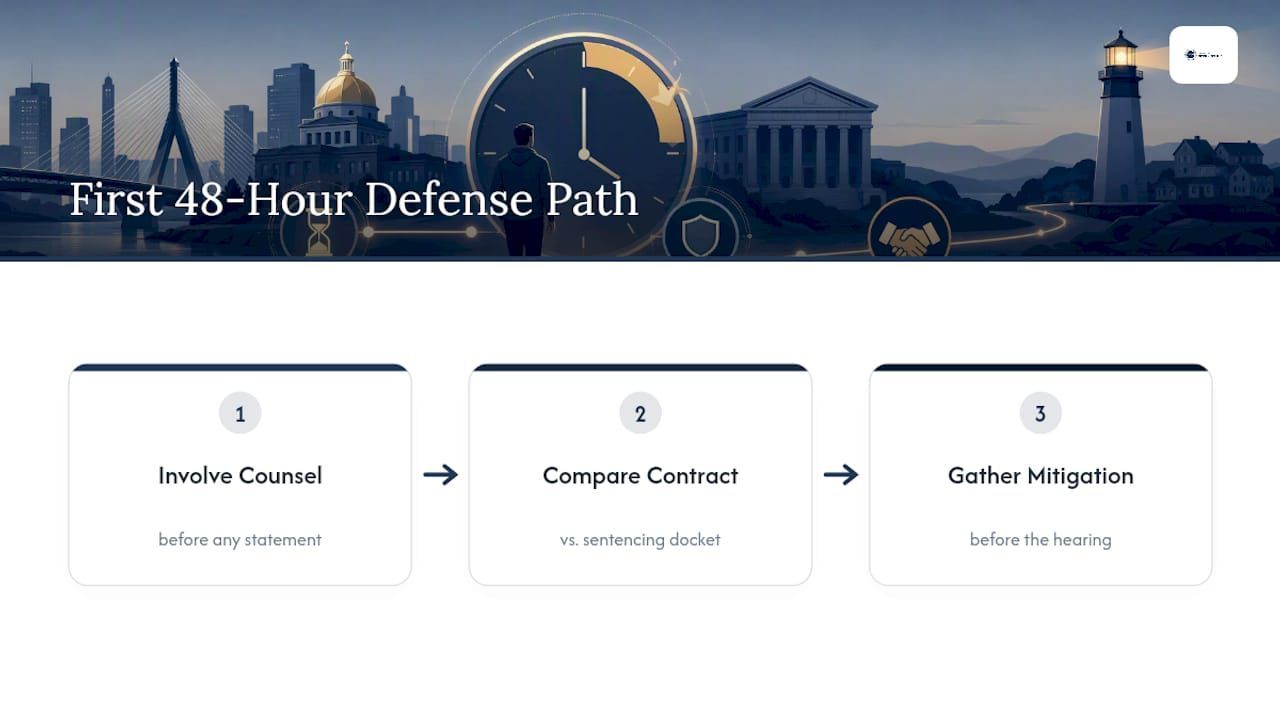
Running an owner-operated criminal defense practice means every probation violation case that comes through the door gets handled directly, not handed off to a junior associate learning the ropes. That matters more in violation proceedings than in almost any other area of criminal defense, because the timeline is tight and the first 48 hours often determine the entire trajectory of the case.
The evaluation process starts the same way every time: pull the original sentencing docket and lay it next to the probation contract on file. Discrepancies between what a judge actually ordered and what a probation officer added administratively show up more often than most people expect, and that gap is frequently where a strong defense begins. From there, the work is timeline reconstruction: when was the notice served, when did the alleged conduct occur, and does the paper trail support the allegation or contradict it?
Mitigation strategy gets built in parallel, not as an afterthought. That means verifying employment status, documenting enrollment in any treatment program, and mapping out compliance history well before the dispositional hearing, because judges respond to concrete evidence of stability far more than they respond to promises.
Early counsel accomplishes something specific: it prevents improvident stipulations made under pressure in a probation office hallway, it opens the door to negotiating alternatives to incarceration, and it protects compliance credits that took years to earn. Once a stipulation is on the record, undoing it is far harder than avoiding it in the first place.
What the Conventional Advice Gets Wrong
Most guidance on probation violations treats the hearing itself as the moment that matters most. It is not. By the time a probationer stands in front of a judge, the outcome is already substantially shaped by decisions made in the first 48 hours: whether counsel got involved before any statement was made, whether the probation contract was compared against the sentencing docket, and whether mitigation evidence was gathered before it was needed rather than scrambled together the night before.
The other misconception worth correcting: people assume a violation finding automatically means revocation. It does not. Courts have four lawful paths, and judges use the lighter ones far more often than popular imagination suggests, provided the defense gives them a documented reason to. A probationer who shows up with proof of treatment enrollment and steady employment is working with a fundamentally different set of odds than one who shows up with nothing.
If there is one priority above all others, it is this: never treat a phone call from a probation officer as a casual conversation. Request counsel first, every time.
— Michael Carroll
How the Law Office of Michael P Carroll Handles Probation Violation Cases
When you are facing a Notice of Probation Violation, the clock is already running, and the choice between calling a defense attorney today versus waiting until your hearing date can shape everything that follows. The Law Office of Michael P Carroll works probation violation matters directly with Michael P. Carroll, not a rotating team of associates, which means the person reviewing your probation contract against your sentencing docket is the same person standing next to you at the hearing.

The firm handles probation violation defense, arraignment representation, and Superior Court advocacy for clients in Massachusetts, including in Bristol, Norfolk, and Plymouth counties as well as Quincy. If your case involves an underlying OUI, DUI, or DWI condition, that overlap gets handled under one roof rather than split between separate attorneys who have never spoken to each other. A first conversation typically covers the notice you received, your original sentencing terms, and what documentation you should gather before your initial hearing. If you are facing a surrender warrant or need guidance before your next scheduled appearance, review the firm's criminal law services for Bristol, Norfolk, and Plymouth counties and reach out to schedule a consultation before your hearing date arrives, not after.
FAQ
What is the most common probation violation in Massachusetts?
New criminal charges and failure to report for scheduled check-ins are among the most frequently alleged violations, though missed drug tests and unpaid fees are also common technical violations.
Is going to jail an automatic result of a probation violation?
No. Courts have four lawful options after a violation finding: continuing probation, modifying conditions, terminating probation, or revoking probation and executing a suspended sentence, and judges use the less severe options often.
Does a probation violation go on your record?
Yes, a finding of violation becomes part of your court record and can affect how future judges and prosecutors view your case, separate from whatever happened with the underlying criminal charge.
What might a judge do if a probation violation is found?
The judge can continue probation unchanged, modify the conditions, terminate probation, or revoke it and impose the previously suspended sentence, choosing based on the severity of the violation and the probationer's compliance history.
How quickly does a probation violation hearing happen in Massachusetts?
Superior Court Guidelines call for an initial hearing generally within 14 days of the notice being served, with a final hearing presumptively within about 30 days absent good cause for delay.