
Avoid Waiver: Massachusetts Suppression Motion Tips by Michael Carroll
Avoid Waiver: Massachusetts Suppression Motion Tips by Michael Carroll

A motion to suppress asks a Massachusetts judge to exclude evidence police obtained by violating your constitutional rights, from an illegal traffic stop to a coerced confession. It must comply with Mass. R. Crim. P. 13, which requires a written motion, a supporting affidavit, and, in most cases, a memorandum of law. Miss that framework or the filing deadline, and you risk waiving grounds you can never raise again.
TL;DR:
- Filing deadlines are strict, with suppression motions in Superior Court due within seven days after the pretrial report, and late filings are routinely denied unless for good cause.
- Motions must be specific, supported by detailed affidavits with exact dates, times, and locations, focusing on a single strong legal ground like an unlawful stop or search.
- The burden of proof shifts depending on the type of evidence challenged, with the prosecution needing to justify warrantless searches by a preponderance of the evidence and defendants bearing initial proof of governmental intrusion.
- Suppression hearings focus solely on whether evidence was obtained from an unconstitutional source, and live officer testimony is often critical to resolving genuine factual disputes.
- Early preparation, thorough documentation, and timely filing are crucial, especially in OUI cases where the validity of the initial traffic stop determines the case's survival.
Table of Contents
- What Are the Legal Grounds for a Motion to Suppress in Massachusetts?
- Filing Requirements and Deadlines Under Massachusetts Rules
- Drafting a Motion and Affidavit That Actually Hold Up
- What Happens at a Suppression Hearing and Who Has to Prove What
- Weighing the Strategic Benefits and Risks of Filing
- How to Prepare for a Suppression Hearing
- Common Mistakes and Practice Insights From Michael P. Carroll
- Do Suppression Rules Differ for OUI, Juvenile, or Felony Cases?
- Why Pre-Trial Hearings Matter So Much in Suppression Practice
- Step by Step: How to File a Motion to Suppress in Massachusetts
- Massachusetts Timelines: When to File and What to Expect
- A Local Attorney's View on Filing Suppression Motions Early
- Get Direct Help With a Massachusetts Suppression Motion
- Primary Sources Worth Reading Directly
- Sources
- FAQ
What Are the Legal Grounds for a Motion to Suppress in Massachusetts?
Every suppression motion in Massachusetts rests on two overlapping sources of protection: the Fourth Amendment to the U.S. Constitution and Article 14 of the Massachusetts Declaration of Rights. Article 14 often provides broader protection than its federal counterpart, which is one reason Massachusetts courts scrutinize police conduct more closely than some other states. Both bar unreasonable searches and seizures, and both make warrantless searches presumptively unlawful unless the Commonwealth can justify an exception.
In practice, most suppression fights in Massachusetts fall into a handful of recurring categories:
- Warrantless vehicle stops and searches — the officer lacked reasonable suspicion for the stop or probable cause for the search that followed.
- Exit orders and pat frisks — the officer ordered a driver or passenger out of the car, or frisked them, without an articulable safety concern.
- Defective search warrants — the underlying affidavit lacked probable cause, or contained material false statements, sometimes called a Franks issue.
- Involuntary statements — police obtained a confession or admission without proper Miranda warnings, or through coercive tactics that make the statement involuntary.
- Unreliable identification procedures — a witness identification came from a suggestive lineup or photo array that tainted the result.
An OUI stop illustrates how these grounds stack up in real cases. If an officer pulls a driver over for a broken taillight but has no actual basis to suspect impairment, everything that follows, the field sobriety tests, the breathalyzer request, the arrest, can become fruit of an unlawful stop. Massachusetts courts also recognize automatic standing under Article 14 for certain possession-based charges, letting a defendant challenge a search even of property that technically belonged to someone else, when they had a possessory interest in it at the time.
Filing Requirements and Deadlines Under Massachusetts Rules
Rule 13 sets the baseline for every pretrial motion in Massachusetts criminal court, and suppression motions are no exception. The rule requires the motion to be in writing, signed, and supported by an affidavit setting out the facts. It also generally requires a memorandum of law, with one carve-out: a motion to suppress evidence from a warrantless search does not need a memorandum unless the court specifically orders one. That exception saves defense counsel real time in the most common category of suppression fights.
If your case is in Superior Court, an additional layer of timing applies. Superior Court Rule 61 requires suppression motions to be verified by affidavit and filed within a short period after the date set for the pretrial conference report, unless the judge allows a different schedule.
Here is the sequence that actually matters when you are staring down a filing deadline:
- Identify the pretrial conference report date in your case, since Superior Court Rule 61's seven-day clock runs from that point.
- Draft the motion and affidavit together , making sure the affidavit is signed and notarized before filing.
- Determine whether a memorandum of law is required or whether the warrantless-search exception applies.
- File and serve the motion on the Commonwealth with enough lead time for a response before any scheduled hearing.
- Calendar the hearing date and confirm whether the court wants argument, live testimony, or both.
Pro Tip: Judges have discretion to accept a late suppression motion "for cause shown," but do not count on that discretion. Courts routinely deny late filings when the defendant reasonably could have raised the issue earlier.
Waiver is the real trap here. Massachusetts case law holds that grounds not raised in a timely motion, if they reasonably could have been known at the time, are deemed waived. That waiver doctrine traces back to decisions like Commonwealth v. Bongarzone , and it means a strong suppression argument can vanish simply because it was filed too late or never renewed at trial.
Drafting a Motion and Affidavit That Actually Hold Up
A motion that says the search "violated the defendant's rights" without more will not survive a hearing, let alone an appeal. Training materials used by Massachusetts prosecutors themselves note that vague motions risk summary denial because they fail to give the Commonwealth fair notice of the specific facts at issue. Specificity is not optional. State who stopped or searched the defendant, what they searched, when it happened, and where, down to the street address or highway mile marker if that detail matters to the legal theory.
Strong motions also tend to be narrow. A focused motion built around the single strongest ground, such as an unlawful traffic stop, generally performs better than a scattershot motion raising five weak theories that read as speculative.
The affidavit itself serves a specific function: it gives the judge a preliminary basis to believe suppression might be warranted, and it puts the Commonwealth on notice of what the defense intends to prove. It is not a substitute for live testimony, and a judge will not treat it as trial evidence. When you draft one, include:
- Specific dates, times, and locations tied to the police encounter.
- References to attached exhibits, such as the warrant, the police report, or body camera footage with timestamps.
- Language identifying the constitutional or rule-based ground being asserted, not just a general objection.
- A closing statement preserving the right to renew the motion at trial if new facts emerge.
Attach whatever documentary support you have. Warrants, incident reports, dashcam or body-cam stills, and dispatch logs all strengthen the affidavit's credibility and give the judge something concrete to weigh before the hearing even starts.
What Happens at a Suppression Hearing and Who Has to Prove What
A suppression hearing is not a mini-trial on guilt or innocence. It is a focused evidentiary proceeding where the judge decides whether specific evidence came from an unconstitutional source. Before testimony begins, the judge typically clarifies the scope of the motion, confirming exactly which evidence and which police conduct are at issue based on the affidavit and the motion itself.
The burden of proof shifts depending on what kind of search is being challenged:
- The defendant's initial burden is simply to show that some governmental intrusion occurred, a stop, a search, an interrogation.
- For warrantless searches , the burden then shifts to the Commonwealth, which must justify the search by a preponderance of the evidence.
- For warrant-based searches , the defendant carries the burden of showing the warrant affidavit lacked probable cause or contained a material false statement under a Franks challenge.
- For statement voluntariness at trial , the Commonwealth must prove beyond a reasonable doubt that any waiver of Miranda rights was knowing and voluntary.
Live testimony from the officers involved is common, and cross-examination often does more work than the written filings. Appellate decisions like Commonwealth v. Santosuosso and Commonwealth v. Mubdi reinforce that affidavits alone cannot replace that live testimony when facts are genuinely disputed. Judges can grant full suppression, partial suppression limited to specific statements or items, or deny the motion outright, and they usually issue written findings explaining which facts they credited.
Weighing the Strategic Benefits and Risks of Filing
Winning a suppression motion can gut the Commonwealth's case. If the excluded evidence was the centerpiece, a positive breathalyzer reading, contraband found in a search, a confession, prosecutors may have little left to work with, and dismissal or a favorable plea often follows. Even a partial win narrows what the jury hears and shifts leverage in negotiations.
Filing is not without cost, though:
- It reveals part of your defense theory to the prosecution before trial, giving them time to shore up weaknesses.
- It takes time and often requires expert affidavits, subpoenas, or transcript review, all of which add expense.
- A denied motion does not just fail. It can create a written record that later hurts your position at trial or on appeal.
- Suppression does not automatically follow from every violation. Courts weigh whether excluding evidence would actually deter police misconduct, and some technical violations do not move the needle.
Pro Tip: In OUI cases especially, the entire prosecution often rides on the initial stop. If that stop cannot be justified, everything downstream, sobriety tests, chemical tests, statements, may fall with it. That is why traffic-stop suppression motions deserve early, careful attention rather than a last-minute filing.
How to Prepare for a Suppression Hearing
Preparation starts well before the hearing date, and the sequence matters:
- Gather every document tied to the stop or search early, including police reports, warrants, booking sheets, and any receipts or property inventories.
- Secure video and photo evidence , from dashcams, body cameras, or surveillance footage, before it gets purged or overwritten.
- Identify witnesses who saw the encounter and confirm current contact information, then plan for subpoenas if they are reluctant to appear voluntarily.
- Build a timeline and exhibit list that lines up with the affidavit's factual claims, so there are no contradictions on cross-examination.
- Confirm filing and service were completed properly , and know the courtroom, the judge, and what documents to physically bring on the hearing date.
Consistency matters more than volume here. A hearing built on a clean, corroborated timeline holds up far better than one supported by scattered, contradictory recollections.
Common Mistakes and Practice Insights From Michael P. Carroll
The suppression motions that fail in Massachusetts courts usually fail for the same reasons every time: vague factual allegations, missed filing deadlines, affidavits that read like boilerplate, and, critically, a failure to renew the motion at trial when the evidence is actually offered. That last mistake can waive an otherwise winning issue for appeal even after a judge already denied it once.
The motions that succeed share a different pattern. They get reviewed early, often at the first client meeting, so the factual record is fresh and specific. They anticipate how the Commonwealth will respond and build the affidavit to preempt those arguments rather than react to them later. And they preserve every objection carefully enough to survive appellate review if the trial judge gets it wrong. Readers dealing with a related timing question may also find our post on the Massachusetts statute of limitations useful, since filing windows across Massachusetts criminal procedure tend to follow the same unforgiving logic.
Do Suppression Rules Differ for OUI, Juvenile, or Felony Cases?
The core legal framework, Rule 13, Article 14, the Fourth Amendment, applies across every Massachusetts criminal case, but the practical emphasis shifts by case type. OUI and DUI cases turn almost entirely on the initial stop and the administration of field sobriety or breath tests, so suppression arguments there focus heavily on reasonable suspicion and testing protocol. A refusal to take a breathalyzer raises its own separate suppression and admissibility questions, which is why OUI defense often treats the stop and the test as two distinct battles.
Juvenile cases carry extra layers because Miranda warnings and consent to search can be complicated by a minor's age, the presence or absence of a parent, and heightened voluntariness scrutiny. Courts tend to ask harder questions about whether a juvenile truly understood their rights before waiving them.
Felony cases often involve search warrants, wiretaps, or multi-agency investigations, which shifts the suppression fight toward Franks challenges and probable cause affidavits rather than roadside stops. Misdemeanor cases, by contrast, more frequently hinge on brief police encounters, stops, pat frisks, and consent searches, where the factual record is thinner and credibility disputes carry more weight. The legal test does not change by case type, but where you aim the motion absolutely does.
Why Pre-Trial Hearings Matter So Much in Suppression Practice
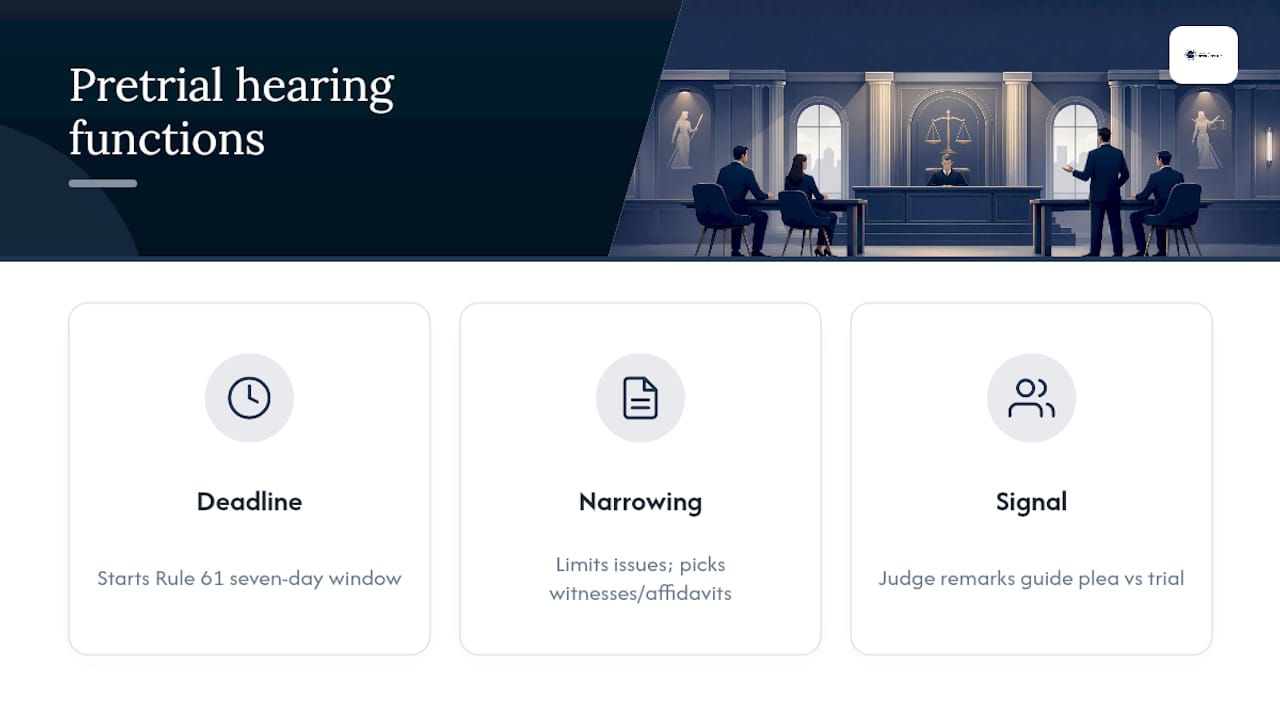
Pre-trial hearings are where suppression motions live or die, long before a jury is ever seated. The pretrial conference itself sets the clock running under Superior Court Rule 61, which makes it the first real deadline pressure point in the process. Miss that marker without a good reason, and the seven-day filing window can close before the defense has fully investigated the strongest grounds.
Beyond timing, the pretrial hearing is where the judge narrows the scope of what will actually be litigated. Prosecutors and defense counsel often use this stage to identify which witnesses need to testify, whether affidavits alone will suffice, and whether an evidentiary hearing is even necessary. A well-run pretrial hearing can resolve some suppression questions on the papers, saving both sides time, while flagging the genuinely disputed facts that require live testimony later.
For defendants, this stage also offers an early read on how the case is likely to go. A judge's comments or preliminary rulings at a pretrial hearing often signal how they view the strength of the suppression argument, information defense counsel can use to decide whether to push for trial or explore a plea. Readers who want more background on how early hearings unfold in Massachusetts should see our explanation of what happens at a Massachusetts arraignment, since the sequencing there feeds directly into suppression timing.
Step by Step: How to File a Motion to Suppress in Massachusetts
Filing correctly is mostly a matter of following the rule mechanics without shortcuts. The motion itself must be typed, captioned with the correct court and docket number, and signed by counsel. It needs a clear statement of the relief requested, typically the exclusion of specific evidence, along with the factual and legal grounds supporting that request.
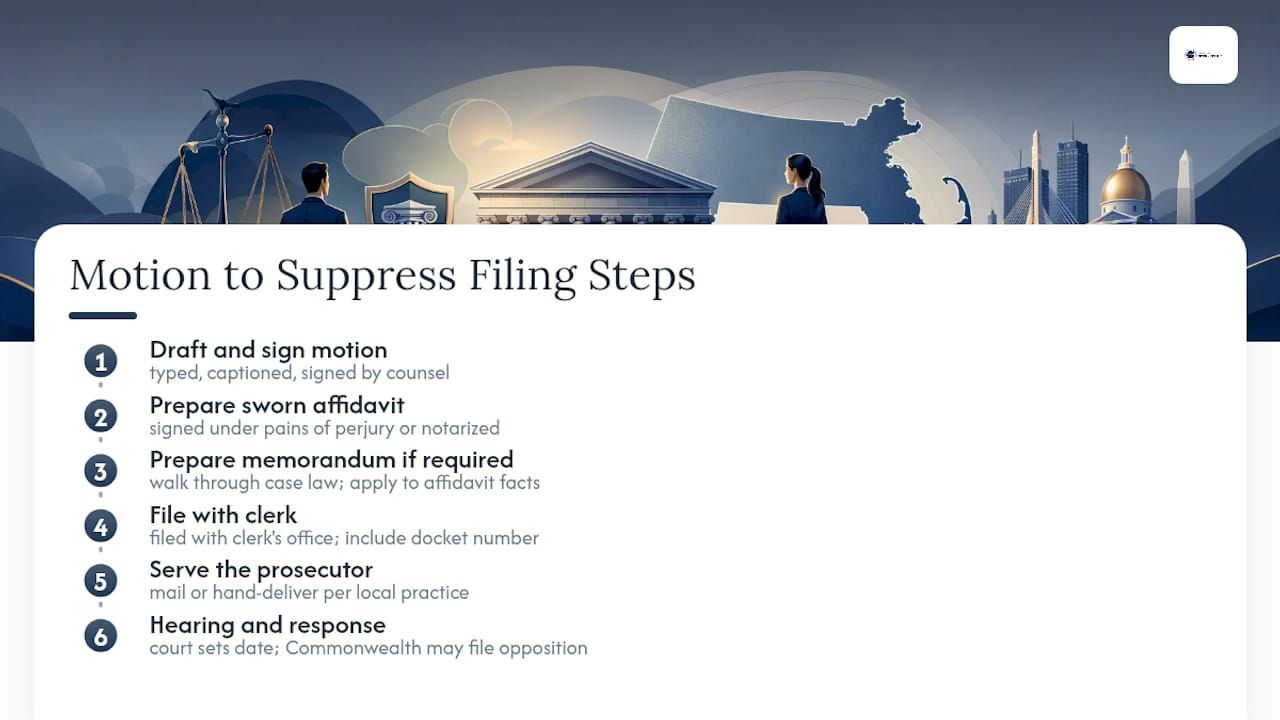
The affidavit attaches separately and must be signed under the pains and penalties of perjury, or notarized, depending on the court's local practice. If a memorandum of law is required, meaning the motion involves something other than a straightforward warrantless-search challenge, it should walk through the applicable case law and apply it to the specific facts in the affidavit, not just recite general Fourth Amendment principles.
Once drafted, the motion gets filed with the clerk's office and served on the prosecutor's office, typically by mail or hand delivery depending on local court practice. District Court and Superior Court sometimes handle scheduling differently, so confirming the specific session's procedure before filing avoids unnecessary delay. After filing, the court will set a hearing date, and the Commonwealth generally has an opportunity to file a written opposition before that hearing takes place. Anyone unclear on how a warrant record factors into that filing can review general guidance on checking outstanding warrant records. Keep in mind that procedures vary by state and jurisdiction.
Massachusetts Timelines: When to File and What to Expect
Timing drives nearly every suppression outcome in Massachusetts, and the deadlines differ by court. In Superior Court, Rule 61 sets the benchmark: file within seven days after the date set for the pretrial conference report, unless the judge permits a different schedule. District Court does not operate under an identical numbered rule, but judges there routinely set comparable pretrial filing deadlines during scheduling conferences, and missing them carries the same waiver risk under Rule 13's general framework.
Once filed, hearings do not happen overnight. Courts typically need time to allow the Commonwealth to respond, and busy criminal sessions may push a hearing date out several weeks depending on the court's calendar and the complexity of the issues raised. Cases involving expert testimony, such as a Franks challenge to a warrant affidavit, tend to take longer to schedule because both sides need time to prepare.
The practical lesson is simple: earlier is almost always better. Filing as soon as the factual basis is clear gives the defense time to investigate, gather witness statements, and secure video evidence before it disappears, and it avoids the scramble of trying to meet a seven-day deadline after key facts surface late.
A Local Attorney's View on Filing Suppression Motions Early
Massachusetts suppression practice rewards attorneys who know the local courts, not just the rule book. Different District Court sessions and Superior Court judges handle scheduling and evidentiary hearings with real variation, and knowing that in advance shapes when and how a motion gets filed. The attorney handles every suppression motion from the first client conversation through the hearing itself, without handing it off to rotating associates. If you are facing charges where a stop, search, or statement seems questionable, bring your paperwork, arrest reports, tickets, any documents police gave you, to a consultation as early as possible.
— Michael Carroll
Get Direct Help With a Massachusetts Suppression Motion
Certain law offices may give Massachusetts defendants direct access to the attorney handling a case, from the first filing to the final ruling on a motion. If you are facing an OUI, misdemeanor, or felony charge in Massachusetts, continuity matters when a suppression argument depends on precise timing and a consistent factual record.

An initial consultation typically covers the facts of the stop or search, the police reports and any body camera footage available, and a candid assessment of whether a suppression motion is realistic given the seven-day filing clock. Bring your arrest paperwork, any tickets or citations, and contact information for witnesses if you have them. For OUI and DUI cases specifically, where suppression fights over the initial stop are especially common, visit the firm's DUI defense page to see how that representation works, or review the criminal law services page for the full range of defense work handled across Bristol, Norfolk, and Plymouth counties. Reach out today to schedule a consultation before your filing deadline passes.
Primary Sources Worth Reading Directly
For readers who want to verify the rules firsthand, start with Mass. R. Crim. P. 13, which governs every pretrial motion's form and content statewide, and Superior Court Rule 61, which sets the Superior Court's specific verification and timing requirements. Practitioner training materials on motions to suppress and dismiss offer a useful, prosecution-side view of how affidavits, burdens, and common defense mistakes actually play out in Massachusetts courtrooms.
Sources
FAQ
What Are the Grounds for a Motion to Suppress in Massachusetts?
Common grounds include unlawful traffic stops or vehicle searches, defective search warrants, involuntary statements taken without proper Miranda warnings, and unreliable identification procedures.
How Do You Win a Motion to Suppress?
Winning typically requires a specific, well-documented affidavit tied to a single strong legal theory, filed on time under Rule 13 and, in Superior Court, within the seven-day window set by Rule 61.
Can You Give an Example of a Motion to Suppress?
A common example is an OUI defendant challenging a traffic stop where the officer lacked reasonable suspicion, arguing that the stop, and everything discovered afterward including field sobriety and breath test results, should be excluded.
Why Would an Attorney File a Motion to Suppress?
An attorney files one to remove evidence obtained through an unconstitutional search, seizure, or interrogation, which can weaken the prosecution's case enough to force a dismissal or a more favorable plea offer.
What Happens if a Motion to Suppress Is Denied?
The excluded evidence remains admissible at trial, and defense counsel generally must renew the objection when that evidence is actually offered to preserve the issue for a possible appeal.