
Massachusetts Lawyer: $150 Fine, 6 Months Jail for Disorderly Conduct
Massachusetts Lawyer: $150 Fine, 6 Months Jail for Disorderly Conduct

Disorderly conduct in Massachusetts is charged under G.L. c. 272, § 53, which punishes fighting, threatening, or violent behavior, or creating a hazardous condition in public with no legitimate purpose. A first offense carries a fine up to $150; a second or later offense can mean up to six months in jail. If you have been charged, do not discuss the incident with police, and talk to a Massachusetts criminal defense attorney before your arraignment.
TL;DR:
- Prosecutors must prove the behavior involved fighting, threatening, or creating a hazardous condition with no legitimate purpose, and it was reasonably likely to affect the public.
- The conduct must involve either violence or threats, tumultuous behavior, or unsafe conditions, but loud noise alone usually does not qualify unless combined with other elements.
- Penalties are modest on paper, with fines up to $150 for first offenses and jail for repeat charges, but convictions impact employment, housing, and immigration records for years.
- Defense strategies include demonstrating legitimate purpose, challenging evidence, and raising free speech protections, especially for expressive conduct or language.
- Cases tend to vary significantly based on local police priorities and court practices, making knowledge of specific jurisdictional tendencies crucial for a favorable outcome.
Table of Contents
- What Counts as Disorderly Conduct Under Massachusetts Law?
- Disorderly Conduct vs. Disturbing the Peace: What's the Difference?
- Penalties and Collateral Consequences You Should Know Now
- How Prosecutors Try to Prove Their Case
- Common Defenses and How Massachusetts Courts Limit the Statute
- If You're Charged: What to Do Right Now
- Constitutional Limits and Edge Cases Worth Knowing
- Does Enforcement Vary Across Massachusetts Cities and Counties?
- Can a Disorderly Conduct Record Be Sealed or Expunged in Massachusetts?
- Author Perspective: How This Firm Approaches These Cases
- Talk to a Massachusetts Criminal Defense Attorney Before Your Court Date
- Where These Answers Come From
- Sources
- FAQ
What Counts as Disorderly Conduct Under Massachusetts Law?
Section 53 does not criminalize being loud or obnoxious on its own. Prosecutors must show the defendant engaged in one of a few specific conduct categories, and courts read the statute narrowly because of its potential to sweep in ordinary behavior.
The official jury instruction breaks the prohibited conduct into three buckets:
- Fighting or threatening another person
- Violent or tumultuous behavior
- Creating a hazardous or physically offensive condition with no legitimate purpose for doing so
"Public" does not mean a crowd had to actually gather. It means the conduct was reasonably likely to affect people in a place accessible to the public, or a substantial group even in a semi-private setting. The statute also distinguishes between acting with the intent to cause public inconvenience, annoyance, or alarm, and acting recklessly enough to create that risk without meaning to. That distinction often decides whether a case gets charged as disorderly conduct at all, or reduced to something less serious.
Disorderly Conduct vs. Disturbing the Peace: What's the Difference?
Disturbing the peace lives in the same statute but requires different proof. Under the mass.gov instruction on disturbing the peace, the Commonwealth must show the conduct was unreasonably disruptive, that it was intentional rather than accidental, and that it actually annoyed or disturbed at least one real person.
That last element is the key difference. Disorderly conduct focuses on the likelihood of public impact and the defendant's intent or recklessness. Disturbing the peace needs an actual annoyed person on the record.
- A backyard party that runs loud past midnight in a quiet neighborhood likely fits disturbing the peace if a neighbor complains.
- Swinging fists in a parking lot outside a bar tends toward disorderly conduct, since it involves fighting or threatening behavior.
- Context drives everything: the same noise level at a daytime street festival probably clears neither charge.
Prosecutors sometimes charge both when the facts support overlapping theories, then let the evidence sort out which one survives to trial.
Penalties and Collateral Consequences You Should Know Now
Massachusetts treats disorderly conduct and disturbing the peace as misdemeanors, but the practical fallout goes beyond the fine on paper.
Statutory penalties: a first offense carries a fine of no more than $150. A second or subsequent offense is punishable by up to six months in jail, a fine up to $200, or both. Several other offenses enumerated in the same section of the statute, including indecent exposure and prostitution-related conduct, carry those same upper penalty limits.
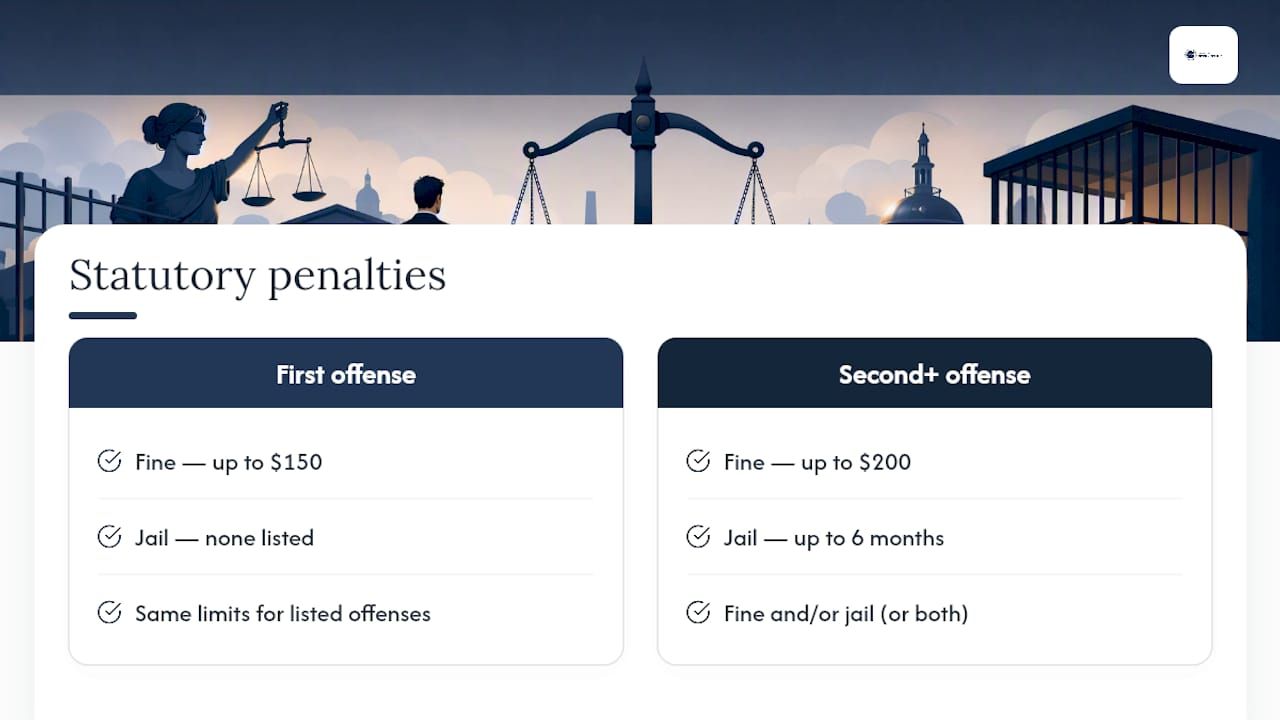
The dollar figures are modest. The record is not. A conviction shows up on background checks that employers, landlords, and licensing boards routinely run, and it can complicate immigration proceedings for noncitizens regardless of how small the fine was. Even an arrest without a conviction can surface in some screening searches. That gap between "it's just a $150 fine" and "this follows me for years" is exactly why early legal advice matters more than the penalty range suggests.
How Prosecutors Try to Prove Their Case
The Commonwealth carries the full burden here, and it has to clear three separate hurdles before a conviction sticks.
- Prohibited conduct. The defendant fought, threatened someone, acted violently or tumultuously, or created a hazardous or offensive condition without a legitimate reason.
- Public-likelihood. The behavior was reasonably likely to affect the public or a substantial group in an accessible place.
- Intent or recklessness. The defendant meant to cause public inconvenience, annoyance, or alarm, or recklessly created that risk.
To back those elements, police and prosecutors typically lean on witness statements, officer narratives, and on-scene observations, sometimes supplemented by video or documented noise complaints. If any single element is thin, say there is no evidence the conduct was likely to reach anyone beyond the two people arguing in a private driveway, the case can collapse into a dismissal or get knocked down to a lesser charge before trial.
Common Defenses and How Massachusetts Courts Limit the Statute
A few defenses come up again and again in these cases. Legitimate purpose is one: someone protesting on a public sidewalk, defending themselves, or acting out of necessity has a real answer to the "no legitimate purpose" element.
Speech protections matter just as much. The Supreme Judicial Court's A Juvenile decision makes clear that offensive or abusive language alone generally cannot sustain a disorderly conduct conviction. The state has to show the words crossed into fighting words or a genuine threat, or that the underlying conduct was nonexpressive. Beyond speech, defense attorneys also look hard at identification errors, gaps in the evidence, and procedural defects like an illegal stop or arrest that could suppress everything that followed. Diversion or a negotiated dismissal is often on the table for a first offense with no aggravating facts.
Pro Tip: Save everything before you talk to anyone. Screenshot the noise complaint thread, grab witness contact information while memories are fresh, and never post your version of events on social media. That kind of preserved record shapes motion practice and plea negotiations far more than what you remember telling the officer.
If You're Charged: What to Do Right Now
- Say your name and address to police, then stop talking. Ask for an attorney before answering any other questions.
- Write down what happened while it's fresh, including names of anyone who saw it, and hold onto any video or photos.
- Expect an arraignment shortly after arrest, where bail conditions and a not-guilty plea are typically entered.
- Contact a Massachusetts criminal defense attorney before that court date, not after. Learn more about what happens after an arrest so you know what's coming.
- Ask your attorney about dismissal, a reduced charge, or a diversion program that can keep the case off your permanent record.
The earlier a lawyer gets involved, the more options stay open. Waiting until the week before trial usually means fewer of them.
Constitutional Limits and Edge Cases Worth Knowing
Massachusetts courts have narrowed §53 over the years, largely to keep it from swallowing protected speech. The SJC's rulings in Alegata and A Juvenile both push back against convictions built on words alone, requiring prosecutors to show something closer to a threat or fighting words.
Private conduct is not automatically off limits. Loud behavior inside a home can still trigger charges if it's reasonably likely to disturb neighbors or others nearby. The statute also carves out an exception for elementary and secondary school students, who cannot be adjudged delinquent under this provision for conduct that happens in school buildings, on school grounds, or at school events. Across all of it, courts weigh time, location, and the surrounding circumstances before deciding what counts as unreasonable.
Does Enforcement Vary Across Massachusetts Cities and Counties?
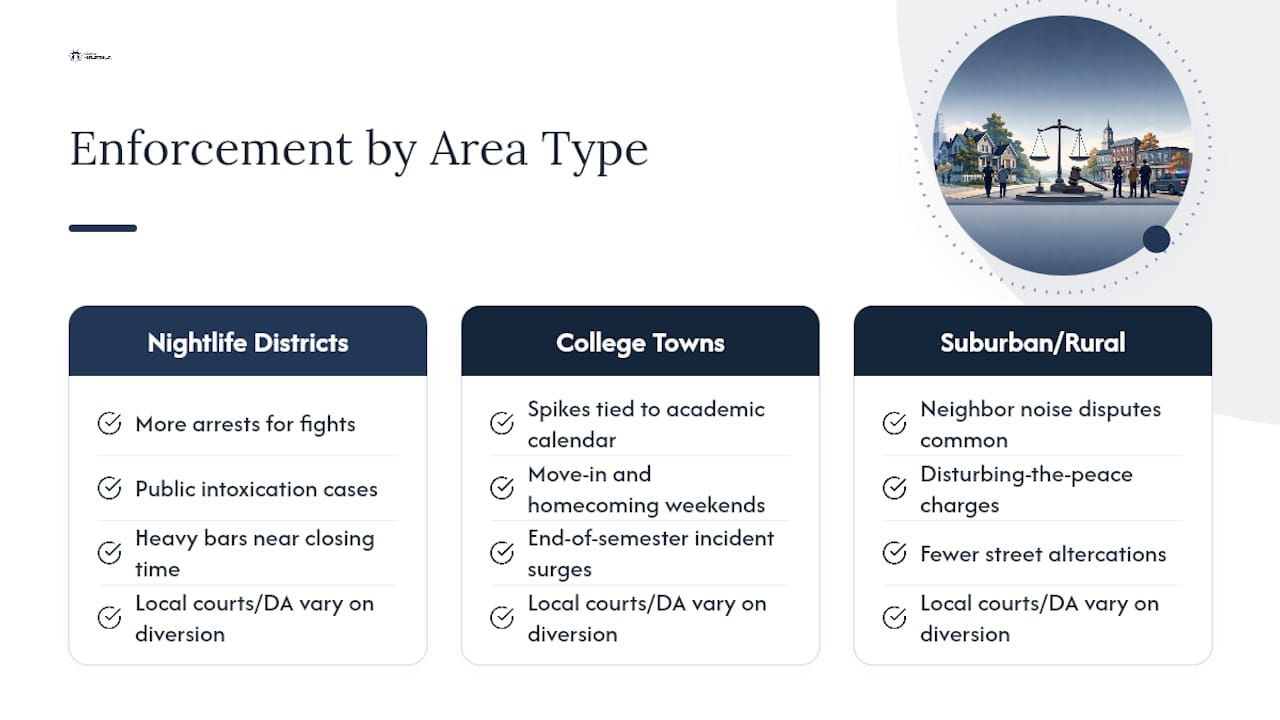
The statute is the same everywhere in the state, but how it plays out on the ground is not. Police departments set their own priorities, and a busy college town handles late-night noise very differently than a small suburban department with fewer calls to juggle.
Cities with dense nightlife districts, think areas with a heavy concentration of bars near closing time, tend to see more disorderly conduct arrests tied to fights and public intoxication. College towns often see spikes tied to the academic calendar: move-in weekends, homecoming, and the last weeks of the semester generate more noise complaints and street incidents than a quiet February Tuesday. Quieter suburban and rural communities more often see disturbing the peace charges tied to neighbor disputes over noise rather than street altercations.
Local courts and district attorney's offices also differ in how willing they are to offer diversion or pretrial probation for a first offense. A clerk magistrate hearing in one county might resolve a borderline case without a formal complaint ever issuing, while a similar set of facts elsewhere proceeds straight to arraignment. None of this changes what the Commonwealth has to prove under §53, but it does affect how a case gets handled in practice, and it's one more reason to work with an attorney who knows the local court and the local prosecutor's tendencies in Bristol, Norfolk, or Plymouth County specifically.
Can a Disorderly Conduct Record Be Sealed or Expunged in Massachusetts?
Yes, in most cases. Massachusetts allows sealing of a misdemeanor conviction, including disorderly conduct and disturbing the peace, after a waiting period once probation or the sentence ends, whether through a petition to the court or an administrative process through the Commissioner of Probation. A case that ends in a dismissal, a not-guilty finding, or certain diversion outcomes may qualify for sealing sooner, and some records can be sealed immediately after a dismissal or a finding of not guilty.
Expungement, which erases a record entirely rather than just hiding it from most background checks, is narrower and generally reserved for specific circumstances such as false accusations, mistaken identity, or offenses committed before age 21 under the state's more recent expungement provisions. It's not automatic, and not every disorderly conduct case will qualify.
This is exactly the kind of decision where the fine you paid matters less than the record that lingers behind it. A sealed or expunged record can make the difference between a clean background check and one that raises questions from an employer or landlord years later. If you already have a disorderly conduct conviction on your record, it's worth having an attorney review whether you're eligible to seal it now, rather than assuming the record is permanent.
Author Perspective: How This Firm Approaches These Cases
Running an owner-operated practice for over a decade has taught me that disorderly conduct cases are won or lost in the first two weeks, not at trial. My priority on every file is the same: lock down exculpatory evidence before it disappears, push for diversion or dismissal when the facts support it, and protect the client's record as the primary goal, not just the outcome of a single hearing. If you're facing a charge anywhere in Massachusetts, talk to a local attorney before your arraignment, not after.
— Michael Carroll
Talk to a Massachusetts Criminal Defense Attorney Before Your Court Date
Some law offices provide direct access to the attorney handling your case rather than a rotating cast of associates. For a disorderly conduct or disturbing the peace charge, this includes review of the police report, evaluation of whether the Commonwealth can prove all three elements, and efforts toward dismissal, a reduced charge, or diversion where the facts support it.

The firm handles misdemeanor and felony criminal defense, arraignment representation, and plea negotiation for clients throughout Bristol, Norfolk, and Plymouth Counties. If you were arrested and need to understand your bail conditions, resources like this guide on posting bail for a defendant can help you sort out the logistics while you line up representation. Call the Law Office of Michael P Carroll for a consultation before your arraignment date, so your defense starts on day one instead of the week of trial.
Where These Answers Come From
This article draws on the controlling statute and official state guidance: G.L. c. 272, § 53, the mass.gov jury instructions on disorderly conduct and disturbing the peace, and the Supreme Judicial Court's ruling in A Juvenile narrowing the statute's reach over protected speech.
This article is general information, not a substitute for advice from a qualified lawyer. Consult a qualified legal professional about your own circumstances before acting on anything here.
Sources
FAQ
What Are the Elements of Disorderly Conduct in Massachusetts?
The Commonwealth must prove the defendant engaged in fighting, threatening, or violent conduct (or created a hazardous condition with no legitimate purpose), that the conduct was reasonably likely to affect the public, and that the defendant intended or recklessly risked causing public inconvenience, annoyance, or alarm.
What Is the Most Common Punishment for Disorderly Conduct?
A first offense typically results in a fine of no more than $150; a second or later offense can bring up to six months in jail, a fine up to $200, or both.
What Exactly Qualifies as Disorderly Conduct?
Conduct qualifies when it involves fighting or threats, violent or tumultuous behavior, or creating a hazardous or offensive condition in public with no legitimate purpose, and it's reasonably likely to affect other people.
How Do You Get a Disorderly Conduct Charge Dropped?
Common paths include showing a legitimate purpose for the conduct, challenging weak identification or evidence, raising First Amendment protections for speech-based charges, or negotiating diversion or dismissal, which is where an experienced Massachusetts defense attorney like those at Law Office of Michael P Carroll can make the biggest difference.