
Avoid a 180 Day RMV Suspension: MA Drunk Driving Laws, Attorney Advice
Avoid a 180 Day RMV Suspension: MA Drunk Driving Laws, Attorney Advice
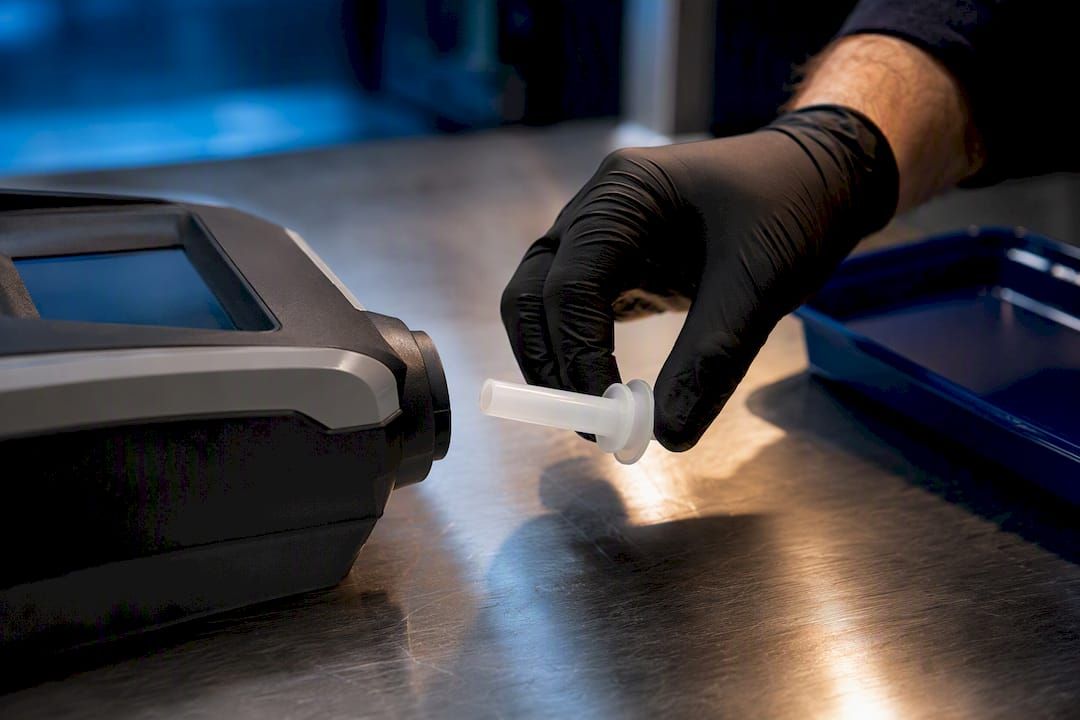
Arrest brings two separate consequences on the same day: criminal charges and an immediate RMV administrative license suspension. Penalties climb steeply with each prior conviction, and repeat or high-BAC cases often require an ignition interlock device.
TL;DR:
- Penalties increase sharply with each prior offense, with the third offense classified as a felony and license revocation reaching up to eight years or more.
- Refusing a lawfully requested breath test results in an administrative license suspension ranging from 180 days to a lifetime ban, often more severe than actual criminal penalties.
- Ignition interlock devices are mandatory for repeat offenders and some first-time high-BAC cases, requiring full compliance for the restriction period.
- Early legal consultation is crucial, as administrative suspensions and criminal proceedings operate on separate timelines, with deadlines often only days apart.
Table of Contents
- What Are Massachusetts's Drunk Driving Laws?
- What Are the Penalties for Drunk Driving in Massachusetts?
- What Happens if You Refuse a Breathalyzer in Massachusetts?
- When Is an Ignition Interlock Device Required?
- What Happens After You're Charged With OUI in Massachusetts?
- What Should You Do Right After an OUI Arrest?
- Why Trust This Massachusetts OUI Guidance?
- An Attorney's Perspective on Massachusetts OUI Law
- Talk to a Massachusetts OUI Defense Attorney Today
- Official Massachusetts OUI Resources
- Sources
- FAQ
What Are Massachusetts's Drunk Driving Laws?
Massachusetts law doesn't use the term "DUI." The statute, Mass. Gen. Laws c.90 §24, calls the offense "operating under the influence," or OUI, and it's the legal backbone for nearly every drunk driving law massachusetts prosecutors rely on. Related sections fill in the details: §24D governs first-offense alternative dispositions, §24½ addresses vehicle forfeiture and repeat-offender provisions, and §24E covers specific evidentiary and procedural rules tied to chemical testing.
The law recognizes two ways to prove impairment. The first is "per se" intoxication, meaning your blood alcohol content alone establishes guilt regardless of how you were driving. The second is impairment by evidence, where prosecutors use your driving pattern, field sobriety performance, and officer observations to argue you were unfit to drive, even without a BAC reading or with one below the legal threshold.
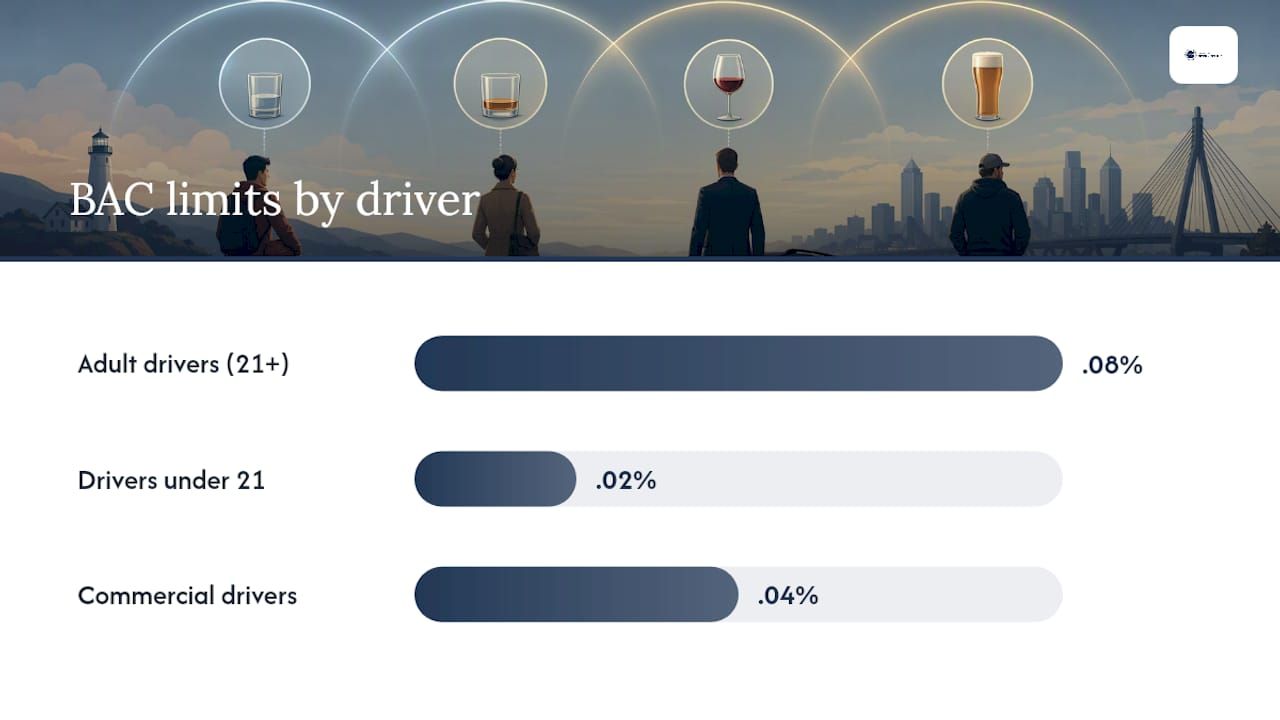
The BAC limit in Massachusetts breaks down by driver category:
- Adult drivers (21 and older): .08% or higher is per se OUI.
- Drivers under 21: .02% or higher triggers a violation under the state's zero tolerance approach for underage drivers.
- Commercial drivers: .04% or higher while operating a commercial vehicle.
Drug impairment is prosecuted under the same statute even when no alcohol is involved. Officers and prosecutors rely on observed behavior, drug recognition evaluations, and sometimes blood or urine testing to build a drugged-driving case, since there's no equivalent numeric "per se" threshold for most controlled substances.
What Are the Penalties for Drunk Driving in Massachusetts?
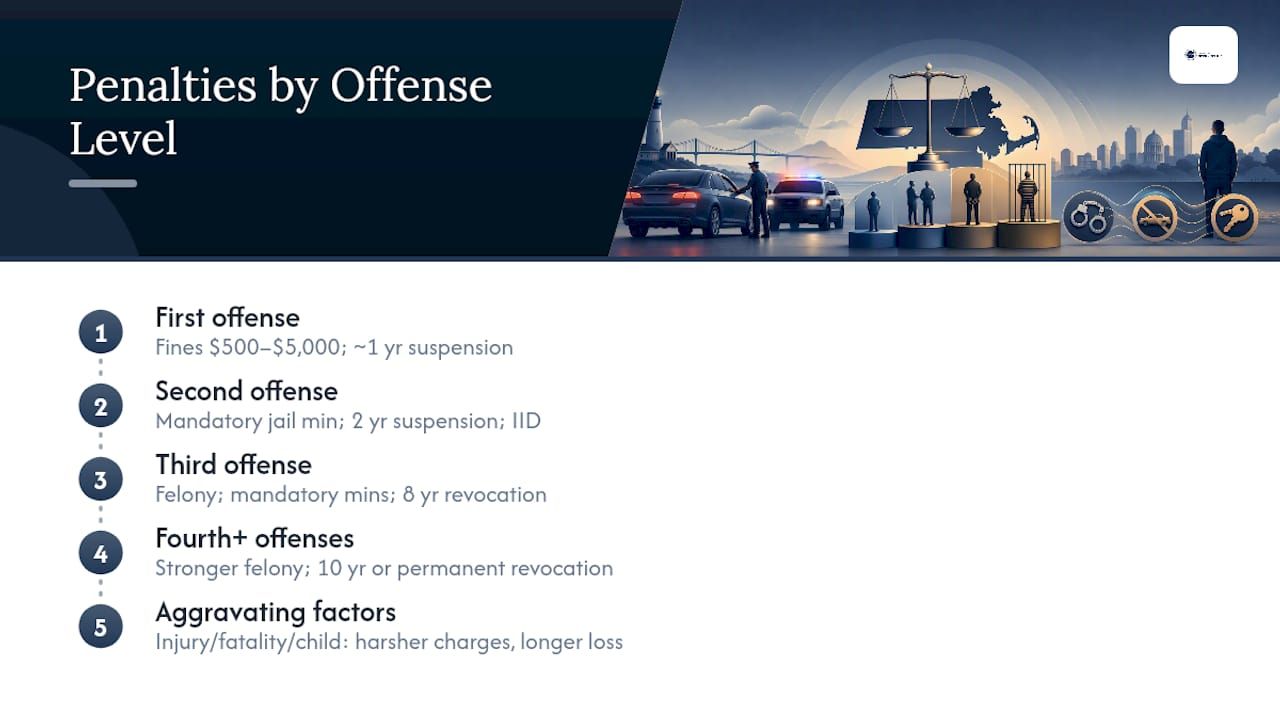
Massachusetts DUI penalties scale hard with each prior conviction, and the jump from a first to a second offense is one of the steepest in the state's criminal code. Under Chapter 90 §24, fines and jail exposure grow with the offense count, and license consequences stretch far beyond the criminal sentence itself.
First offense: Fines generally run $500 to $5,000, with jail exposure up to 2.5 years, though many first-time defendants resolve the case through a continuance without a finding under §24D, avoiding a permanent conviction if they complete probation and an alcohol education program. License suspension typically runs one year, though a hardship license may be available sooner.
Second offense: Mandatory minimum jail time applies, fines increase substantially, and license suspension jumps to two years. An ignition interlock device becomes mandatory once you're eligible to drive again, and hardship license eligibility narrows.
Third offense: This is charged as a felony. Prison exposure lengthens, mandatory minimum sentencing applies, and license revocation extends to eight years. IID requirements continue well beyond reinstatement.
Fourth offense and beyond: Felony penalties intensify further, with mandatory minimum prison time and license revocation extending to ten years or, in some circumstances, permanently.
Aggravating factors change everything. OUI causing serious bodily injury, a fatality, or involving a child passenger under 14 carries separate, harsher charges (including OUI with child endangerment and motor vehicle homicide), often with mandatory prison time and license loss extending well beyond a standard repeat offense.
Every one of these ranges assumes no enhancement. Combine a third offense with an injury, and you're looking at penalties near the top of what Massachusetts law allows.
What Happens if You Refuse a Breathalyzer in Massachusetts?
Massachusetts operates under implied consent: driving on a public road means you've already agreed to submit to a breath, blood, or urine test if lawfully arrested for OUI. Refuse, and the RMV suspends your license administratively, on top of and separate from whatever happens in the criminal case.
This administrative suspension isn't a punishment for OUI itself. It's a punishment for refusing the test, and it moves forward on its own timeline regardless of whether you're ever convicted. The suspension lengths for refusal by prior record, per Mass.gov, are:
- First refusal: 180-day suspension.
- One prior OUI conviction: three-year suspension.
- Two prior OUI convictions: five-year suspension.
- Three or more priors, or certain aggravated cases: lifetime suspension.
Refusing can actually cost you more license time than a conviction would, especially on a first offense. A driver who fails a breath test faces a shorter administrative suspension than one who refuses outright, which surprises a lot of people who assume refusal is the safer move.
You can request an RMV hearing to challenge the suspension, but the window to act is short and the paperwork is specific. Miss the deadline, and you may lose your right to appeal altogether, leaving the suspension in place for its full duration no matter what happens in criminal court.
When Is an Ignition Interlock Device Required?
Melanie's Law, enacted in 2005, established ignition interlock device (IID) requirements for multiple OUI offenders and some first-time offenders with elevated BAC levels. The RMV's IID program requires the device in every vehicle you own, lease, or regularly operate, including a company vehicle, for the entire restriction period.
Here's how the requirement and process typically unfold:
- Determine eligibility. IID is mandatory for second and subsequent OUI offenses, and for some high-BAC first offenders as a condition of hardship licensing.
- Apply for a hardship license (24D) if eligible. You'll need an employer letter dated within 30 days and proof that public transit can't meet your needs, along with attendance at an RMV hearing. Approval is discretionary. Full documentation doesn't guarantee a yes.
- Install the device through an approved vendor. The IID requires a clean breath sample to start the car, then random rolling retests while driving.
- Comply for the full restriction period. Failing a start test or rolling retest, or missing a retest window, counts as a violation and can extend your restriction or trigger license revocation.
- Apply for removal once eligible. The device doesn't come off automatically. You have to petition an RMV Hearings Officer and typically show six months free of IID violations before removal is approved.
Pro Tip: Gather your employer letter and transit documentation before your hardship hearing date, not the week of it. RMV hearing officers deny applications for stale or incomplete paperwork more often than people expect, and a denial can cost you weeks of driving time you can't get back.
If you want the fuller walkthrough on paperwork and timing, our guide to hardship licenses after an OUI covers it step by step.
What Happens After You're Charged With OUI in Massachusetts?
An OUI case moves through a fairly predictable sequence, and knowing the shape of it takes some of the fear out of the process. Arrest leads to arraignment, usually within a day or two, where charges are formally read and bail conditions are set. From there, the case moves into discovery, where your attorney requests police reports, breath or blood test records, dashcam and bodycam footage, and maintenance logs for the testing device.
Most first offenses resolve through a continuance without a finding (CWOF) under §24D rather than going to trial. A CWOF means you admit there's enough evidence to convict, but the judge doesn't enter a guilty finding. Instead, you serve probation and complete an alcohol education program, and if you finish clean, the case gets dismissed without a permanent OUI conviction on your record. Prosecutors offer this most often on clean first offenses; second and subsequent charges usually mean a harder negotiating table.
When cases don't resolve through a plea, defense attorneys typically dig into a handful of recurring issues:
- Whether the breath testing device was properly calibrated and maintained.
- Whether the officer administering the test followed the required protocol.
- Whether standardized field sobriety tests were administered and scored correctly, given how often footwear, terrain, and medical conditions skew results.
- Whether a medical condition (diabetes, acid reflux, certain neurological conditions) could explain the behavior officers interpreted as impairment.
- Whether the chain of custody for blood or urine samples was properly documented.
None of these defenses are automatic wins, but each one is worth an attorney's early attention. Waiting weeks to get counsel involved means losing access to evidence, like dashcam footage on a retention cycle, that can disappear before anyone thinks to request it. For a closer look at how these cases typically play out, see our breakdown of the MA OUI case timeline.
What Should You Do Right After an OUI Arrest?
The first 30 days after an arrest matter more than most people realize, largely because Massachusetts runs strict deadlines for administrative appeals that don't wait for your criminal case to catch up.
- Preserve everything from the arrest. Get copies of the police report, breath or blood test results, and booking paperwork as soon as they're available, and write down the arresting officers' names and a rough timeline while it's fresh.
- Watch your RMV suspension deadline. If you're appealing an administrative suspension, the window to request a hearing is short, and missing it can forfeit your right to challenge it.
- Call a Massachusetts OUI attorney quickly. Early involvement means evidence gets preserved and deadlines get met, especially anything on a short retention cycle like dashcam video.
- Stay off social media and stay quiet. Don't post about the arrest and don't discuss details with anyone besides your attorney; prosecutors do look.
- Start assembling hardship or IID paperwork immediately if you'll need one. Employer letters and program enrollment take time, and a delay here often costs you weeks of driving.
Pro Tip: Write down everything you remember about the stop within 24 hours, the exact words the officer used, what field sobriety tests you were asked to perform, and how you performed them. Memory fades fast, and these details often become the foundation of a defense.
Why Trust This Massachusetts OUI Guidance?
Michael P. Carroll has spent more than a decade focused on OUI and DUI defense throughout Massachusetts, and the Law Office of Michael P Carroll runs on an owner-operated model. That means the attorney you consult with is the attorney who works your case, not a paralegal or junior associate handling the file.
The firm's day-to-day OUI work covers RMV hearing representation, hardship license and IID compliance support, plea negotiation on first and repeat offenses, and trial preparation when a case doesn't resolve favorably through negotiation. For more on how specific charges typically play out, see our guides on OUI penalties in Massachusetts and OUI involving drug impairment.
An Attorney's Perspective on Massachusetts OUI Law
Most people research Massachusetts OUI law after they've already been arrested, which means they're reading statute language for the first time under real stress. That's backwards, and it's worth saying plainly: the biggest mistake I see isn't a bad defense strategy. It's the two or three weeks someone loses between arrest and calling an attorney, time when dashcam footage gets overwritten and hardship paperwork sits unstarted.
Conventional advice tends to focus almost entirely on the criminal charge, the fine, the possible jail time. That's real, but the RMV's administrative suspension often does more damage to someone's daily life than the criminal sentence does. A refusal suspension can run three to five years regardless of what happens in court. I'd rather a client understand that distinction on day one than discover it after the deadline to appeal has passed.
If you take one thing from this guide, take this: treat the administrative clock and the criminal clock as two separate emergencies, because Massachusetts treats them that way, and only one of them waits for you to hire a lawyer.
— Michael Carroll
Talk to a Massachusetts OUI Defense Attorney Today
Law Office of Michael P Carroll gives you something a larger firm structure often can't: direct access to the attorney handling your case, from the first phone call through resolution. If you're facing an OUI charge, an RMV suspension, or need help navigating hardship license and IID requirements, that direct line matters when deadlines are measured in days, not weeks.

The firm represents clients in the Massachusetts area, handling criminal defense cases including first offenses and repeat offenses, as well as RMV hearing representation. A consultation gets you a straight answer on where your case stands, what the realistic outcomes look like, and what needs to happen this week, not eventually. Reach out through the DUI attorney page to schedule a consultation, or call directly to talk through your situation with Michael Carroll himself.
Official Massachusetts OUI Resources
For primary-source detail beyond this guide, consult these official pages:
- Alcohol and drug suspensions for drivers 21 and over(Mass.gov)
- Ignition interlock device program(Mass.gov)
- Hardship driver's license application(Mass.gov)
- Mass. Gen. Laws c.90 §24(Massachusetts General Court)
This article is general information, not a substitute for advice from a qualified lawyer. Consult a qualified legal professional about your own circumstances before acting on anything here.
Sources
FAQ
What is the punishment for drunk driving in Massachusetts?
Punishment scales with prior offenses: a first offense can bring fines of $500 to $5,000 and up to 2.5 years in jail, though many first-timers resolve the case through a CWOF instead of a conviction. Second and subsequent offenses carry mandatory minimum jail time, felony exposure by the third offense, and license revocation running from two years up to a decade or longer.
What is the 3-hour rule in Massachusetts?
Massachusetts law generally allows chemical test results to be used as evidence when the test is administered within a reasonable time after driving, and courts have treated roughly three hours as a practical benchmark for reliability. Results taken well beyond that window can face stronger challenges over whether they accurately reflect BAC at the time of driving.
Do you lose your license immediately after a DUI in Massachusetts?
Yes, in most cases. Refusing a breath or blood test triggers an immediate RMV suspension starting at 180 days for a first refusal, and this administrative suspension runs separately from and often before the criminal case concludes.
What are the penalties for a first-time DUI in Massachusetts?
A first OUI conviction can bring fines between $500 and $5,000, up to 2.5 years in jail, and a license suspension of about one year, though many first offenders qualify for a CWOF under §24D that avoids a permanent conviction if probation and alcohol education requirements are completed.