
OUI Penalties in Massachusetts: What Drivers Need to Know
OUI Penalties in Massachusetts: What Drivers Need to Know

A first-offense OUI conviction in Massachusetts carries a fine of $500 to $5,000 and up to 2.5 years in a house of correction , plus a one-year license suspension from the Registry of Motor Vehicles. Most first-time defendants who qualify avoid a conviction entirely by using the Section 24D alternative, which trades a guilty finding for probation, an alcohol education program, and a much shorter administrative suspension. Penalties escalate fast after that: a second offense doubles the suspension, and a third conviction is a felony with mandatory jail time.
The two statutes that matter most for anyone facing charges are MGL c.90 §24 , which sets the criminal penalties, and MGL c.90 §24D , the first-offender alternative. The Mass governs the administrative side, which runs separately from whatever happens in court.
- First offense: a fine and jail time up to the legal limits, and a 1-year RMV suspension
- Second offense: mandatory jail time, 2-year suspension, ignition interlock required
- Third offense and beyond: felony charges, extended suspension periods, or lifetime revocation
If you've been charged, talking to a lawyer before your arraignment isn't optional in any meaningful sense. RMV suspension clocks and plea deadlines start running immediately, and decisions made in the first 30 days often determine whether you keep your license at all.
Key Takeaways
Massachusetts OUI penalties escalate sharply with each prior conviction, but first offenders who qualify for Section 24D can often avoid a conviction and a full-year suspension.
| Point | Details |
|---|---|
| Criminal penalties climb fast | First offense allows up to $5,000 in fines and 2.5 years in jail; a third offense is a felony. |
| RMV and court penalties run separately | A plea deal in court doesn't automatically undo an RMV suspension, which follows its own timeline. |
| 24D shortens the suspension | First offenders in the 24D program face a 45 to 90 day suspension instead of a full year. |
| Deadlines drive outcomes | Missing an RMV hearing window or hardship documentation deadline can lock in a longer suspension. |
| Early representation matters | Law Office of Michael P Carroll works to preserve RMV hearing rights and pursue 24D eligibility before deadlines close. |
Table of Contents
- Which Laws Govern OUI Penalties in Massachusetts?
- What Are the Penalties for Each OUI Offense?
- How Does the RMV Handle Suspensions and Hardship Licenses?
- What Alternatives Exist Besides a Straight OUI Conviction?
- How Do Judges Decide OUI Sentences?
- When Should You Hire an OUI Attorney in Massachusetts?
- Facing an OUI Charge? Here's How We Can Help
- Key Statutes and Official Resources
- Sources
- FAQ
Which Laws Govern OUI Penalties in Massachusetts?
Massachusetts OUI law runs on four statutes: MGL c.90 §24 (the core criminal penalty statute), §24D (first-offender probation alternative), §24P (ignition interlock program rules), and §24Q (assessment and evaluation requirements). Layered on top of these is Melanie's Law , the 2005 reform that added mandatory minimum jail sentences for repeat offenders and created the ignition interlock mandate.
Here's the distinction that trips people up: criminal penalties and RMV penalties are two separate tracks. A judge decides your fine, jail exposure, and probation terms. The RMV decides your license suspension independently, based on its own rules, and it doesn't automatically follow the court's outcome.
The RMV's suspension authority operates on its own timeline and its own criteria. A favorable plea deal in court does not automatically restore your license — you may need a separate motion or hearing to address the RMV suspension even after the criminal case resolves.
- Criminal court: fines, jail, probation, program assignment
- RMV: suspension length, hardship eligibility, ignition interlock requirements
- Out-of-state OUI convictions and program assignments count toward your Massachusetts lifetime total
What Are the Penalties for Each OUI Offense?
Massachusetts uses a lifetime look-back, meaning a conviction from 20 years ago in another state can still count as a prior offense. Penalties climb steeply with each subsequent charge, and by the third offense you're facing a felony.
Every conviction also carries mandatory, non-waivable assessments: a $250 head injury fund fee and a $50 victims fund fee , regardless of the fine amount the judge sets. These get added on top, not folded in.
A few things worth knowing about how this plays out:
- First offenders who qualify for Section 24D often avoid a formal conviction, trading it for probation and a much shorter RMV suspension window.
- The suspension periods shown above assume a straight conviction, not a 24D disposition, which follows different, shorter timelines.
- Melanie's Law mandates ignition interlock installation for any driver with two or more lifetime convictions before reinstatement, and for many first offenders with a high BAC reading.
- A second-offense OUI almost never qualifies for probation without a jail component, since the mandatory minimum kicks in automatically.
- Felony-level charges starting at the third offense can affect employment, firearm rights, and immigration status well beyond the sentence itself.
How Does the RMV Handle Suspensions and Hardship Licenses?
The RMV moves independently of the courthouse, and it moves fast. If you refuse a breathalyzer or blood test, the suspension hits immediately, often before you've even seen a judge, and it's governed by different rules than a suspension that follows a conviction.
Refusal penalties stack on top of, not instead of, whatever suspension follows the criminal case. A driver who refuses a chemical test and is later convicted can face two consecutive suspension periods rather than one. The RMV's suspension hearing process gives you a narrow window to contest the administrative action, separate from your criminal defense.
- Refusal suspensions run longer with each prior refusal or OUI on your record
- Suspensions for refusal and suspensions for conviction can run consecutively, not concurrently
- Hardship licenses require an employer letter dated within 30 days, proof of any required treatment completion, and IID installation for most repeat-offender petitions
- The RMV, not the court, decides hardship eligibility and documentation sufficiency
Pro Tip: Request your RMV hearing the moment you're eligible, and start collecting a dated employer letter right away. Hardship petitions get denied constantly over paperwork that's a few days too old, not because the underlying case is weak.
What Alternatives Exist Besides a Straight OUI Conviction?
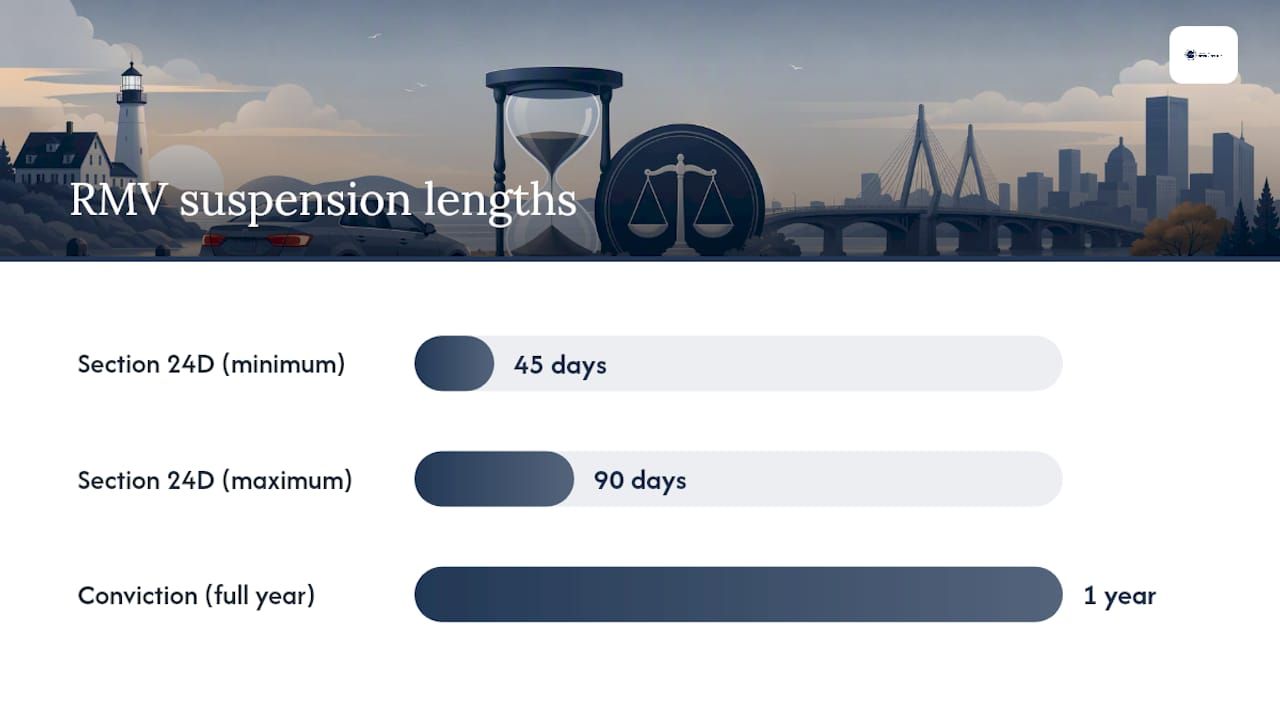
Section 24D is the main path most first offenders take instead of a conviction. It typically means probation, assignment to a state-approved Driver Alcohol Education Program, and a 45 to 90 day RMV suspension while enrolled, a fraction of the full year a conviction carries.
Beyond 24D, several other program tracks exist depending on age, prior record, and case specifics:
- Section 24D (first offense): probation plus alcohol education, shortest suspension window.
- Youth Alcohol Program (YAP): available to drivers under 21 facing their first alcohol-related offense.
- Second-Offender programs: typically require inpatient treatment followed by extended aftercare, licensed by the Department of Public Health.
- Section 24Q assessments: court-ordered evaluations that can determine whether inpatient treatment is required before sentencing.
Program fees aren't automatically waived just because you're struggling financially, but Massachusetts allows an affidavit of indigency to restructure or waive costs when paying would create real hardship. Skipping an assigned program isn't a minor paperwork lapse either. It can trigger a probation violation, revive the original charges, and knock you out of hardship license eligibility entirely.
How Do Judges Decide OUI Sentences?
Judges weigh a mix of factors before settling on a sentence: your BAC level, whether there was an accident or injury, any admissions you made during the stop, your criminal history, and whether you've completed any assigned programs. A clean record with a borderline BAC reading gets treated very differently than a third offense with an accident attached.
The procedural timeline typically runs: arraignment, pretrial conference, plea negotiations or motion hearings, then trial or sentencing. Each stage is an opportunity to negotiate toward 24D eligibility, probation instead of jail, or a reduced charge. Meanwhile, the RMV suspension clock keeps running on its own schedule, independent of how slowly the criminal case moves.
- Prior OUI record (in-state or out-of-state) drives mandatory minimums
- High BAC readings (.15+) often trigger stricter IID and hardship conditions
- Cooperation, program completion, and lack of accident/injury tend to favor lighter dispositions
When Should You Hire an OUI Attorney in Massachusetts?
Certain situations make hiring counsel far more consequential than others: a BAC reading at or above .15, any accident involving injury, a prior OUI already on your record, a chemical test refusal, or questions about whether the traffic stop itself was legal.
An experienced Massachusetts OUI attorney can preserve your RMV hearing rights, negotiate for 24D eligibility, challenge the stop or the test's reliability, and work to limit how much your license suspension stretches beyond the statutory minimum.
- High BAC, injury, or refusal cases carry real trial risk without representation
- Prior convictions eliminate 24D eligibility unless negotiated carefully
- Evidentiary issues (dashcam footage, stop legality, testing calibration) require legal expertise to challenge effectively
Pro Tip: Calendar your RMV hearing deadline the same day you're arrested. Missing that window can lock in a suspension that a timely hearing might have shortened or avoided.
A Defense Attorney's Take
In every OUI case I take on, the priorities are the same: protect the license first, explore 24D eligibility, and meet every RMV deadline before it closes.
Facing an OUI Charge? Here's How We Can Help
Law Office of Michael P Carroll gives you something a lot of drivers don't expect from a criminal defense firm: direct access to the attorney handling your case, not a rotating cast of associates. When your license, your job, and your driving record are all on the line at once, that continuity matters, because RMV deadlines and court dates don't wait for a file to get passed around.

The firm handles OUI defense, RMV suspension hearings, hardship license petitions, and ignition interlock guidance for clients across Bristol, Norfolk, and Plymouth counties, including Attleboro and Quincy. If you're facing a first offense or a repeat charge, the earlier you get counsel involved, the more options stay open for 24D eligibility or a reduced suspension. Call the Law Office of Michael P Carroll's OUI defense team to schedule a consultation and find out where your case actually stands.
Key Statutes and Official Resources
These are the primary sources behind Massachusetts OUI penalties:
- MGL c.90 §24: criminal fines and jail exposure
- MGL c.90 §24D: first-offender alternative
- RMV alcohol and drug suspensions: suspension periods and IID rules
- Licensed impaired-driving programs: program types and requirements
- Hardship license criteria: documentation for reinstatement
This article is general information, not a substitute for advice from a qualified lawyer. Consult a qualified legal professional about your own circumstances before acting on anything here.
Sources
FAQ
What Is the Punishment for an OUI in Massachusetts?
A first offense carries a fine of $500 to $5,000, up to 2.5 years in jail, and a one-year RMV suspension, though many first offenders qualify for the Section 24D alternative instead.
Is a First-Time OUI a Felony in Massachusetts?
No. A first OUI offense is a misdemeanor; charges become a felony starting with a third conviction, which carries mandatory jail time and an 8-year suspension.
How Can You Fight an OUI Charge in Massachusetts?
Common defense strategies include challenging the legality of the traffic stop, questioning breathalyzer or field sobriety test accuracy, and negotiating for a 24D disposition instead of a conviction. A Massachusetts OUI attorney can evaluate which approach fits your specific evidence.

What Happens if You Get a Second OUI in Massachusetts?
A second offense carries a mandatory minimum jail term, fines up to $10,000, a 2-year RMV suspension, and a required ignition interlock device before reinstatement.
Does an OUI Conviction Affect Insurance Rates?
Yes. Insurers in Massachusetts typically classify OUI convictions as high-risk events, often leading to significant premium increases or policy non-renewal for several years following the conviction.