
What Happens at a Dangerousness Hearing in Massachusetts
What Happens at a Dangerousness Hearing in Massachusetts
A dangerousness hearing, held under Massachusetts General Laws c.276 §58A, lets a prosecutor ask a judge to hold a defendant in jail before trial, without bail, if the Commonwealth proves by clear and convincing evidence that no set of release conditions will reasonably protect the public or a specific alleged victim. This is not a bail hearing in the ordinary sense; to understand more about bail and why proposed release conditions matter, see The Role of Bail in Felony Cases: What You Need to Know. There's no bail amount to post. Either the judge finds the Commonwealth met its heavy burden and orders detention, or the judge sets conditions and the person goes home.
If you or a family member has just been told a "58A hearing" is scheduled, the clock is already running. The hearing typically happens at your first court appearance, and you can be held in custody until then. Getting a defense attorney involved immediately, before the hearing rather than after, changes what the judge sees and hears.
Here's what matters most right away:
- You can be detained without bail if the judge rules against you.
- Detention has hard statutory caps: 120 days in District Court, 180 days in Superior Court.
- Judges may consider hearsay, including police reports and unsworn victim statements, evidence that would never come in at trial.
- You have the right to counsel at this hearing, and if you can't afford one, the court must appoint one.
If a hearing is on your calendar, talk to a criminal defense attorney before you set foot in that courtroom.
Key Takeaways
Winning a dangerousness hearing in Massachusetts almost always comes down to whether the defense presents a specific, documented release plan rather than simply arguing against detention.
| Point | Details |
|---|---|
| Detention is time-limited | Courts can hold a defendant up to 120 days in District Court or 180 days in Superior Court under §58A. |
| Hearsay is fair game | Judges may weigh police reports and secondhand statements, so challenging reliability matters more than objecting to admissibility. |
| Specific conditions beat general arguments | GPS monitoring, treatment intake, and a named supervising contact carry more weight than a general promise of good behavior. |
| Written findings protect your rights | A detention order must include written reasoning, which becomes the basis for any later motion to reconsider. |
| Early representation changes outcomes | Law Office of Michael P Carroll works directly with clients from arraignment forward to build the documented release plan judges look for. |
Table of Contents
- Dangerousness Hearing Massachusetts: Quick Facts to Know
- What M.G.L. c.276 §58A Actually Says
- Which Charges Can Trigger a 58A Motion?
- What to Expect: From Arrest to Hearing
- The Clear and Convincing Standard, and What Judges Actually Consider
- Building a Release Plan That Actually Works
- Possible Outcomes and Detention Time Limits
- How 58A Interacts With Restraining Orders and Other Proceedings
- What to Prepare Before Your Hearing
- Primary Sources for Further Reading
- What Defendants Actually Need to Know
- Talk to a Massachusetts Defense Attorney Before Your Hearing
- Sources
- FAQ
Dangerousness Hearing Massachusetts: Quick Facts to Know
The governing law is M.G.L. c.276 §58A. A handful of numbers and rules drive nearly every outcome in these cases:
- Who can request it: Only the prosecutor (the Commonwealth) can move for a dangerousness hearing, not the defense.
- Timing: The hearing must happen at the defendant's first court appearance unless a continuance is granted.
- Continuances: The Commonwealth can request a short continuance of a few business days; the defense may also request a longer continuance without showing good cause.
- Detention caps: Detention periods are capped at certain statutory maximums depending on the court level.
Statistic Callout: A defendant held pending a continuance can lose up to 10 days in custody before the actual dangerousness hearing even happens, and that time typically doesn't count against the later detention cap.
The formal rules of evidence don't apply here. Judges can and do weigh hearsay, arrest reports, and secondhand statements that a trial jury would never see.
What M.G.L. c.276 §58A Actually Says
The statute gives prosecutors a narrow but powerful tool: the ability to ask a judge to detain someone pretrial based on future danger, not just flight risk. It applies only to specific charges, and the Commonwealth has to file the motion and get a hearing on the books fast.
That's the mechanism in plain terms: the prosecutor flags the case, and the court has to act on it immediately, not weeks later. The judge doesn't have unlimited discretion in how to weigh the case, either. The law lists specific factors:
- The nature and seriousness of the danger the person poses
- The nature and circumstances of the offense charged
- The person's family ties, employment, and history of flight
- Any history of orders of protection, prior convictions, and record of appearance at court proceedings
- Whether the person has access to weapons
If the judge orders detention, the statute requires written findings explaining exactly why no conditions would work. That paper trail matters. It's what an appeal or a later motion to reconsider will be built on.
And if the judge decides to release the person, the law is specific: conditions have to be the least restrictive ones that will reasonably assure safety. A judge can't jump straight to the harshest conditions available just because the charge sounds serious.
Which Charges Can Trigger a 58A Motion?
Not every criminal charge opens the door to a dangerousness hearing. The statute lists specific categories of predicate offenses, and if your charge isn't on that list, the Commonwealth generally can't use this process against you.
Broadly, the law covers:
- Offenses that involve the use, attempted use, or threatened use of physical force against another person
- Certain felonies that by their nature present a substantial risk of physical force
- Violations of a 209A abuse prevention order that occurred while the order was in effect
- Certain firearm offenses, including unlawful possession of a firearm and large-capacity weapon violations
- A number of other felony categories tied to violence, including burglary and arson in specific circumstances
Common real-world triggers include domestic assault and battery charges, violations of restraining orders, and unlicensed firearm possession. If you're facing one of the domestic assault charges that commonly overlaps with 58A motions, expect the prosecutor to raise dangerousness at arraignment, not later.
The Supreme Judicial Court's decision in Commonwealth v. Diggs and Commonwealth v. Soto clarified an important procedural point: "held under arrest" includes people arrested or subject to an active arrest warrant for a listed offense, and the hearing must happen right at that person's first appearance in court. The court also reaffirmed something worth repeating: the Commonwealth carries a heavy burden here. Clear and convincing evidence is a real bar, not a formality.
A related decision, Vega v. Commonwealth, upheld the inclusion of certain firearm offenses among the predicate charges and addressed how courts should balance the dangerousness inquiry against due process concerns, particularly when the underlying facts are contested.
What to Expect: From Arrest to Hearing
The path from arrest to a dangerousness ruling moves fast, and knowing the sequence ahead of time takes some of the panic out of it.
- Arrest or summons. You're taken into custody or issued a summons to appear in court on a qualifying charge.
- First appearance/arraignment. This is typically your first time in front of a judge. If the Commonwealth intends to seek detention, this is when the motion gets filed.
- The 58A motion. The prosecutor formally moves for a dangerousness hearing. Under Guideline 8:06 of the Trial Court's 209A guidance, the hearing generally must happen immediately unless someone requests, and the judge grants, a continuance.
- Continuance (if requested). The Commonwealth can get up to 3 business days; the defense can get up to 7 days without showing good cause. During this stretch, you're typically held on a probable cause standard, a lower bar than the clear and convincing standard used at the actual hearing.
- The hearing itself. Both sides present information. The prosecutor argues why no conditions would work; the defense presents counterevidence and a proposed release plan.
- Ruling. The judge either releases the defendant (with or without conditions) or orders detention with written findings.
Inside the courtroom, the process looks different from a criminal trial. There's no jury, and the rules of evidence don't apply, so lawyers can introduce police reports, witness statements, and hearsay directly. You have the right to be represented by counsel, and if you already had a lawyer at arraignment, that same attorney typically argues the dangerousness hearing. Juvenile cases follow a similar structure but include additional protections tied to record confidentiality and the youth's developmental circumstances.
Before you walk in, have this ready:
- Contact information for anyone willing to supervise or house you if released
- Proof of employment or school enrollment
- Any documentation of treatment programs you've started or completed
- A family member or friend present who can speak to stability, if the judge allows it
The Clear and Convincing Standard, and What Judges Actually Consider
"Clear and convincing evidence" sits above a "preponderance of the evidence" (more likely than not, the standard in most civil cases) and below "beyond a reasonable doubt" (the standard for a criminal conviction). It requires the judge to be firmly convinced, though not certain, that no combination of release conditions would keep the public or the alleged victim reasonably safe.
Judges at these hearings routinely rely on:
- Police reports describing the alleged incident
- Statements from the alleged victim or witnesses, often relayed secondhand
- The defendant's criminal history and CORI record
- Probation or parole status at the time of the alleged offense
- Documented mental health or substance use history, when relevant to risk
Because hearsay is explicitly admissible at these hearings, a police report alone can carry real weight, something that would never fly in a jury trial. That said, courtroom practice guidance makes clear that hearsay used as the Commonwealth's sole proof still needs to show real indicia of reliability; judges look for corroboration, not just an unsworn allegation.
Statistic Callout: Detention orders can run up to 120 days in District Court and up to 180 days in Superior Court, meaning the stakes of this one hearing often outweigh what many other pretrial motions in the case will ever carry.
Defense counsel isn't powerless against a hearsay-heavy record. Before subpoenaing an alleged victim to testify, the defense has to show a good-faith basis that the testimony is material to the release-conditions question, a safeguard against using the hearing to intimidate witnesses. Short of that, attorneys can challenge the reliability of the reports directly and offer independent evidence, such as employment records or treatment documentation, that undercuts the Commonwealth's dangerousness narrative.
Building a Release Plan That Actually Works
Too many defendants, and honestly, too many defense attorneys under time pressure, walk into a 58A hearing planning only to argue against detention. That's backwards. The statute requires the judge to impose the least restrictive conditions that reasonably assure safety, which means the defense's real job is to hand the judge a specific, workable plan to say yes to.
A strong release proposal typically includes some combination of the following:
- GPS monitoring , useful when the alleged risk involves proximity to a specific person or location
- Stay-away and no-contact orders , often paired with GPS to make compliance verifiable
- Curfews , which reduce opportunity for the kind of conduct the Commonwealth is worried about
- Inpatient or outpatient treatment , when substance use or mental health is part of the Commonwealth's argument
- Supervised third-party custody , where a responsible family member or friend agrees to house and monitor the defendant
- Community supervision through probation , layered on top of other conditions for added accountability
None of this works if it's vague. A judge weighing detention against release wants specifics: who is supervising, where the person will live, whether treatment intake has already started. A release plan that names an actual contact person, includes a signed letter confirming housing, and attaches proof of a scheduled treatment intake appointment reads as real. A plan that says "family support available" reads as a hope, not a plan.
Pro Tip: Package every proposed condition with documentary proof. A treatment center's written intake confirmation, a signed statement from the person agreeing to supervise you, and proof of steady employment turn abstract promises into something a judge can act on immediately. Judges detain people when they don't see a credible alternative, not because they're determined to detain everyone in front of them.

Attorneys experienced with these hearings also assemble a written release-plan packet ahead of time, rather than describing the plan verbally in court. That packet typically includes the proposed supervising contact's information, employment verification, any treatment paperwork, and a clear description of the electronic monitoring arrangement if GPS is part of the ask. Judges move fast in these hearings. A packet they can read and hand to the clerk carries more weight than an oral argument they have to remember an hour later.
Possible Outcomes and Detention Time Limits
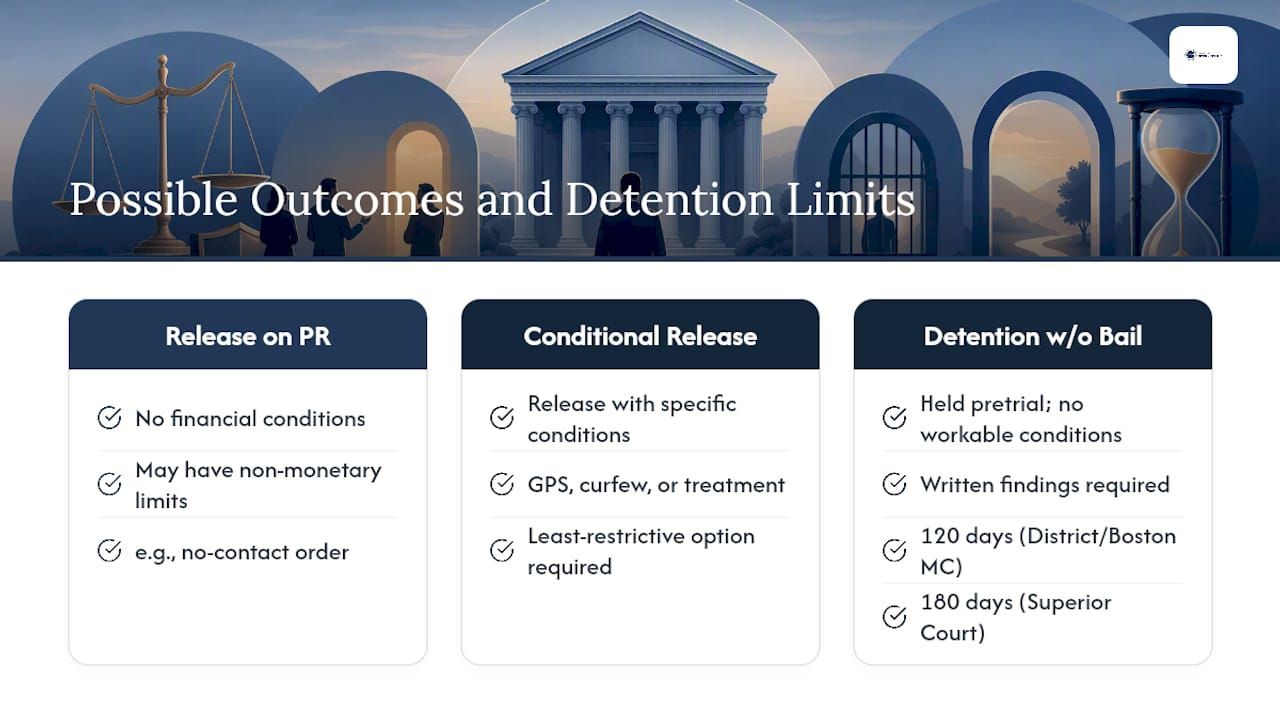
A judge presiding over a dangerousness hearing has three real options, and each carries different next steps.
Release on personal recognizance. The judge finds detention isn't warranted and releases the defendant without financial conditions, sometimes with minimal non-monetary conditions like no-contact orders.
Conditional release. The judge orders release but attaches specific conditions, such as GPS monitoring, curfew, or mandated treatment, chosen because the statute requires the least restrictive option that still reasonably assures safety.
Detention without bail. The judge finds clear and convincing evidence that no set of conditions would work. The person is held, subject to firm statutory caps: 120 days in District or Boston Municipal Court, and 180 days in Superior Court , excluding certain delays attributable to the defendant under Mass. R. Crim. P. 36(b)(2).
Statistic Callout: Those detention caps exist precisely because pretrial detention without bail is meant to be an emergency measure, not an indefinite one. Once the cap is reached, the Commonwealth has to either bring the case to trial or the detention order lapses.
If detention is ordered, the judge must issue written findings explaining the reasoning. That written record isn't a formality. It's the foundation for any later motion to reconsider or reopen the hearing if new information, such as a completed treatment intake or a change in the alleged victim's circumstances, becomes available before trial. If you or a family member is currently detained under a 58A order, the immediate next step is asking counsel to file for reconsideration based on new conditions, not waiting out the full statutory period.
How 58A Interacts With Restraining Orders and Other Proceedings
Dangerousness hearings rarely happen in isolation. If your case involves an active 209A restraining order, a violation of that order is itself one of the predicate offenses that can trigger a 58A motion, and the judge's written findings in a detention order have to be entered into the statewide domestic-violence record system.
Being on probation or parole at the time of arrest weighs heavily in the judge's factor analysis, often making detention more likely even for charges that might otherwise result in release. The same is true if you're already the subject of a prior abuse prevention order, even one unrelated to the current charge.
Allegations of witness intimidation get particular scrutiny. If the Commonwealth argues the defendant has attempted to contact or pressure a witness, expect the judge to weigh strict no-contact conditions heavily, or cite the allegation directly as grounds for detention.
Juvenile cases follow the same basic structure but include added statutory protections around confidentiality and are handled with attention to the minor's developmental circumstances, per guidance in the courtroom practice guide for dangerousness hearings.
What to Prepare Before Your Hearing
Attorneys who handle these cases regularly build a standard preparation checklist, and it's worth working through before you ever step into the courtroom.
- Confirm counsel is retained or request court-appointed counsel immediately after arrest
- Gather documentation for every proposed condition: treatment intake forms, proof of residence, employment verification, a signed statement from a supervising contact
- Request a full CORI and criminal history review so there are no surprises during the hearing
- Identify any witnesses you may need and be ready to show a good-faith basis for calling them
- Put together an emergency contact plan in case you're released with a short timeline to arrange housing or supervision
Before the hearing, ask your attorney directly: What specific conditions will you propose? What evidence is the Commonwealth likely to rely on? Is there anything in my record that increases risk in the judge's eyes?
Pro Tip: The defendants who do best at these hearings are the ones whose attorneys got involved early enough to build a documented, enforceable supervision plan, not the ones who show up and hope for the best. If you've just been arrested on a qualifying charge, don't wait for the arraignment to call a lawyer.
Primary Sources for Further Reading
For readers who want to verify these rules directly, the statute itself and official Trial Court guidance are the most reliable starting points.
- M.G.L. c.276 §58A: the full statutory text
- Mass: plain-language summary of the law
- Commonwealth v. Diggs / Soto: SJC precedent on hearing timing and burden of proof
What Defendants Actually Need to Know
Most explanations of dangerousness hearings focus on the statute's mechanics and stop there. That's a mistake. The mechanics matter, but the outcome of most 58A hearings turns on something more practical: whether the defense shows up with a plan or shows up with an argument.
An argument tells the judge why detention is wrong. A plan tells the judge what to do instead. Judges facing a clear and convincing standard on public safety are not inclined to take chances on vague reassurances, and I think defendants and families underestimate how much a documented, specific release proposal shifts that calculation.
The other thing conventional advice gets wrong: waiting until the hearing to think about conditions. By the time you're in front of a judge, there's no time to arrange a treatment intake or track down a supervising contact. That work has to start the moment you know a hearing is coming, often within hours of an arrest.
If you take one thing from this, let it be this: call a defense attorney before the hearing, not after the Commonwealth files its motion. The gap between those two timelines is often the gap between going home and sitting in custody for months.
Talk to a Massachusetts Defense Attorney Before Your Hearing
If you're facing a dangerousness hearing anywhere in Bristol, Norfolk, or Plymouth County, the difference between detention and release often comes down to how early your attorney gets involved. Law Office of Michael P Carroll works directly with clients from the moment charges are filed, not through a rotating team of associates, so the person building your release plan is the same person arguing it in front of the judge.

That direct relationship matters most in exactly this kind of hearing, where a documented, specific release proposal, backed by real supervision contacts and treatment paperwork, can be the difference between going home and being held for months. Michael Carroll has spent over a decade handling exactly these cases across Massachusetts criminal courts, including domestic assault and firearm-related charges that commonly trigger §58A motions.
If a hearing is already on your calendar or you expect one soon, visit the criminal defense practice page or call for a consultation today. Time matters more in these cases than almost any other criminal matter in Massachusetts courts.
This article is general information, not a substitute for advice from a qualified lawyer. Consult a qualified legal professional about your own circumstances before acting on anything here.
Sources
FAQ
What is a dangerousness hearing in Massachusetts?
It's a court proceeding under M.G.L. c.276 §58A where a judge decides whether to detain a defendant without bail before trial, based on clear and convincing evidence that no release conditions would reasonably assure public safety.
Is disturbing the peace an arrestable offense in Massachusetts?
Yes, disturbing the peace is a criminal offense in Massachusetts and can result in arrest, though it is not among the enumerated predicate offenses that trigger a §58A dangerousness hearing on its own.
What is the "three strikes" rule in Massachusetts?
Massachusetts habitual offender law can impose enhanced sentences on defendants with multiple prior felony convictions, but this is a sentencing enhancement separate from the pretrial detention analysis used in a dangerousness hearing; a prior record can still factor into the judge's risk assessment at a §58A hearing.
Can charges be dropped at a bond hearing?
A dangerousness hearing addresses only pretrial release or detention, not whether charges are dismissed; a prosecutor can still choose to reduce or drop charges separately, which would remove the basis for the §58A motion but happens through different legal channels.
How quickly do I need a lawyer if I'm facing a 58A hearing?
Immediately. Because the hearing typically occurs at your first court appearance, the Law Office of Michael P Carroll recommends contacting defense counsel as soon as you learn a dangerousness motion has been filed or is likely.