
Immediate Threat Suspension in Massachusetts: A Driver's Guide
Immediate Threat Suspension in Massachusetts: A Driver's Guide

An immediate threat suspension is an indefinite revocation the Massachusetts RMV imposes without a prior hearing when it believes your continued driving poses a serious, immediate danger to public safety, under Massachusetts General Laws Chapter 90, Section 22. The RMV does not have to wait for a court date or hold a hearing before pulling your license. You get a written notice, and you get the right to request a hearing within 30 days, but the suspension is already in effect the moment that notice goes out.
Here's what changes immediately: your license or permit is revoked, no prior hearing was required to make that happen, and the clock starts on your 30-day window to request a review.
Your first moves should happen fast. Request a telephone hearing through the RMV Online Service Center, keep the RMV notice and any underlying complaint in a safe place, pull copies of the police or medical reports referenced in your suspension, and call an attorney before you say anything to the RMV in writing.
The RMV's Request for Immediate Threat License Suspension/Revocation form and the RMV Online Service Center are your official starting points. Everything downstream, from scheduling a hearing to filing an appeal, runs through these two channels.
- Save every document the RMV sends you, including the envelope.
- Request your hearing online rather than waiting for a phone call that may never come.
- Do not assume the suspension will simply expire. It's indefinite until you win a hearing or appeal.
Pro Tip: Call an attorney before your hearing date, not after. Once you've testified on the record, it's much harder to walk back a bad answer.
Key Takeaways
An immediate threat suspension is an indefinite RMV revocation under M.G.L. c. 90 § 22 that takes effect before any hearing, and beating it depends on documentation that directly rebuts the original complaint.
| Point | Details |
|---|---|
| Suspension takes effect immediately | No prior hearing is required; the RMV notice arrives after your license is already revoked. |
| 30-day window to request a hearing | File through the RMV Online Service Center as soon as you receive written notice. |
| Documentation decides most hearings | Police and medical reports, treating-provider letters, and course certificates carry more weight than general arguments. |
| Board of Appeal is the next step | File within 10 days of an unfavorable RMV decision, with a separate 30-day court deadline for chemical test refusals. |
| Legal help matters for overlapping cases | Law Office of Michael P Carroll assists with hearing prep, appeals, and documentation when a suspension ties to an OUI or related charge. |
Table of Contents
- What Is an Immediate Threat Suspension Under Massachusetts Law?
- Who Reports Someone as an Immediate Threat, and Why?
- What Happens to Your License, Insurance, and Record Right Away?
- How Do You Request and Prepare for the RMV Hearing?
- Can You Appeal a Losing RMV Hearing Decision?
- What's the Path Back to Full Driving Privileges?
- Your 7 to 14 Day Action Checklist
- Sources
- FAQ
What Is an Immediate Threat Suspension Under Massachusetts Law?
The Massachusetts Registrar of Motor Vehicles gets its authority from Chapter 90, Section 22 of the Massachusetts General Laws, which allows the Registrar to suspend or revoke a license "forthwith" and without a prior hearing whenever continued operation appears to be an immediate threat to public safety. That's the entire legal basis for the action. No judge signs off first. No court date needs to happen before your license is gone.
"Indefinite revocation" means exactly what it sounds like: there's no built-in expiration date. The suspension stays active until the RMV decides otherwise, which usually happens through a hearing. The statute does require the Registrar to notify you and give you the chance to request a hearing within 30 days of the suspension taking effect.
The immediate threat category sits alongside a related but distinct one: Immediate Threat Medical, used when a medical condition, rather than a behavioral or driving complaint, is the stated basis for the suspension.
- Suspension takes effect before any hearing occurs.
- You have 30 days to request a hearing once notice is delivered.
- The RMV's suspension hearing guidance explains how those hearings are scheduled and conducted.
Who Reports Someone as an Immediate Threat, and Why?
Immediate threat suspensions don't require a criminal conviction. A wide range of complaints and reports can trigger one, and the RMV treats them as sufficient grounds on their own.
Common triggers include police complaints describing erratic or dangerous driving, medical professional reports flagging a condition that affects driving ability (the basis for an Immediate Threat Medical suspension), licensing or registration irregularities, and formal complaints filed by third parties, including family members, neighbors, or witnesses to an incident.

Because a conviction isn't necessary, a single complaint or a single doctor's note can start the whole process.
Pro Tip: Get the exact wording of the complaint or police report that triggered your suspension. Your defense at the hearing should directly answer the specific claims in that document, not a general story about your driving history.
What Happens to Your License, Insurance, and Record Right Away?
The effects land immediately and on multiple fronts at once. Your license, permit, or right to operate gets revoked or held, and the RMV mails written notice specifying the incident or report that triggered the action.
- Your driving privileges stop the day the suspension takes effect, not after a hearing.
- Auto insurance premiums often rise, and some policies flag suspensions during renewal underwriting.
- Vehicle registration can be affected depending on the circumstances of the suspension.
- The suspension appears on your Massachusetts driving record, which employers, courts, and insurers can access, as seen in a typical Registry Recognizer record example.
The RMV handles roughly 1,000 suspension hearings each week, which tells you this is a high-volume administrative system, not a rare or unusual event reserved for extreme cases. That volume also means delay works against you: the longer your notice sits unanswered, the longer the suspension, and its ripple effects on insurance and your record, continues.
How Do You Request and Prepare for the RMV Hearing?
Requesting a hearing is the single most important procedural step after receiving notice, and Massachusetts makes it a fully online process.
- Log into the RMV Online Service Center.
- Navigate to Appointments, then Make or Cancel a Hearing Appointment.
- Select the immediate threat hearing type and schedule a slot.
- Upload supporting documentation before the scheduled time.
- Wait for the call during your scheduled hour window.
The RMV conducts these hearings by telephone, not in person, and there is no walk-in option. A hearings officer will attempt to reach you up to three times within your scheduled hour, so a missed call from a blocked or unknown number can cost you the hearing.
What to gather before that call:
- The written notice the RMV sent you.
- Copies of the police or medical report referenced in the complaint.
- Letters from treating physicians or specialists, especially for medical-basis suspensions.
- Your official Massachusetts driving record.
- Certificates from any completed driver improvement or defensive driving courses.
- Documentation of any corrective steps already taken, such as new medical treatment or a revised prescription.
Draft a short, factual statement that responds directly to the complaint's specific claims rather than a general defense of your character. If a medical condition is at issue, a written clearance or evaluation from your treating provider often carries more weight at the hearing than anything else you can submit.
Pro Tip: Upload every document to the Online Service Center before your hearing date, and test that your phone accepts calls from unknown numbers. A hearing you miss because a call went to voicemail counts against you the same as a hearing you lose on the merits.
Can You Appeal a Losing RMV Hearing Decision?
If the hearings officer rules against you, the next stop is the Board of Appeal on Motor Vehicle Liability Policies and Bonds, a separate administrative body from the RMV itself.
- You generally have 10 days from the RMV's decision to file a formal appeal application with the Board.
- Filing requires a fee, and wait times for a Board hearing date vary depending on the current caseload.
- Chemical test refusal suspensions follow a different track: those must be appealed to the court within 30 days rather than to the Board.
Starting your appeal immediately matters because the Board's backlog moves in filing order. A delay of even a few days can push your hearing date out by weeks.
What's the Path Back to Full Driving Privileges?
Reinstatement depends entirely on the outcome of your hearing or appeal. If the Registrar determines the immediate threat no longer exists, based on the hearing record, medical clearance, or corrective steps you've documented, the RMV will issue reinstatement instructions covering any required forms and fees.
- A favorable hearing or Board decision typically triggers reinstatement paperwork rather than automatic restoration.
- Medical clearance from a treating provider is often required before the RMV will lift an Immediate Threat Medical suspension.
- A limited or hardship license may be available in some circumstances even before full reinstatement, particularly where documented need (work, medical appointments) exists alongside progress toward resolving the underlying issue. The RMV's suspension hearings guide outlines hardship license requirements in more detail.
- After a successful outcome, confirm exactly which forms and fees the RMV requires before you assume you're cleared to drive again.
Your 7 to 14 Day Action Checklist
Treat the first two weeks after your notice like a deadline-driven case file, because that's what it is.
- Within 24 hours: Save the RMV notice and any attached complaint or report; do not discard the envelope.
- Within 48 hours: Request your telephone hearing through the RMV Online Service Center.
- Within 3 days: Contact an attorney who handles Massachusetts RMV suspensions, particularly if the notice references a police report, OUI allegation, or medical condition.
- Within 5 days: Request copies of the police or medical report cited in your suspension notice.
- Within 7 days: Reach out to any treating physician or specialist for a written letter addressing the specific concern raised.
- Within 10 days: Complete any relevant driver improvement course if applicable to your situation.
- Within 14 days: Upload all documentation to the RMV Online Service Center and confirm your hearing date and time.
Keep everything in a single folder, labeled and in chronological order, with a one-page summary on top. A hearings officer who can follow your timeline in thirty seconds is more likely to rule in your favor than one sorting through a stack of loose paperwork.
Pro Tip: If your suspension overlaps with a pending criminal charge, such as an OUI arrest or a breathalyzer refusal, tell your attorney immediately. The RMV hearing and the criminal case run on separate tracks, and what you say in one can affect the other.
An Attorney's View on What Actually Wins These Hearings
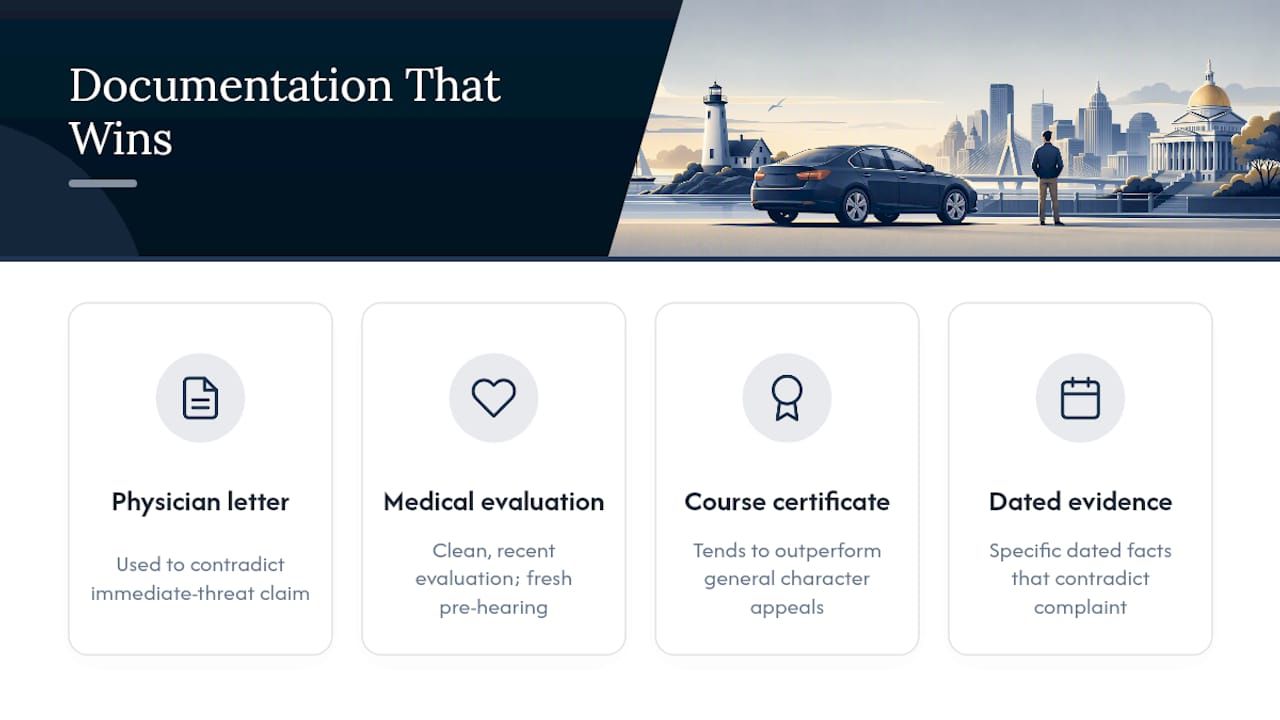
Most immediate threat cases turn on documentation, not oratory. Hearings officers weigh the factual narrative in the original complaint heavily, so a defense built around specific, dated evidence, a physician's letter, a clean recent evaluation, a course certificate, tends to outperform a general appeal to character. These are administrative proceedings with a different proof standard than criminal court. Winning usually means directly contradicting the "immediate threat" claim with paper, not arguing that the RMV overreacted. Sometimes that requires a fresh medical evaluation before the hearing even happens.
How Law Office of Michael P Carroll Can Help With Your Suspension
If your immediate threat suspension traces back to an OUI stop, a chemical test refusal, or a domestic complaint, the stakes go beyond the RMV hearing itself. Law Office of Michael P Carroll handles the parts of this process that trip up drivers who go it alone: assembling the right medical and police documentation, preparing testimony that answers the specific complaint rather than a general defense, and filing appeals to the Board of Appeal when the first hearing doesn't go your way.
The firm serves Attleboro and the surrounding Massachusetts counties, including Bristol, Norfolk, and Plymouth. If your suspension notice mentions an OUI allegation, start with a review of your DUI defense options or reach out through the firm's main contact page to set up a consultation before your hearing date locks in.
Sources
This article is general information, not a substitute for advice from a qualified lawyer. Consult a qualified legal professional about your own circumstances before acting on anything here.
FAQ
How Long Does an Immediate Threat Suspension Last in Massachusetts?
It's indefinite by design. There's no automatic expiration date; it lasts until you win a hearing, succeed on appeal, or otherwise satisfy the RMV that the threat no longer exists.
How Long Does a Suspension Stay on Your Driving Record?
Suspensions remain on your Massachusetts driving record for years and can affect insurance rates and background checks well after the suspension itself ends; the exact retention period depends on the type of suspension and your overall record.
How Do I Get My License Back After a Suspension in Massachusetts?
You typically need a favorable RMV hearing or Board of Appeal decision, followed by any required medical clearance or documentation, then reinstatement paperwork and fees processed through the RMV.
What Is a Cinderella License in Massachusetts?
A Cinderella license is a limited hardship license, often tied to OUI suspensions, that allows driving during restricted hours, such as to and from work. Availability and eligibility depend on the type of suspension involved, and an attorney like those at Law Office of Michael P Carroll can review whether your situation qualifies.