
What to Expect: The OUI Case Timeline in Massachusetts
What to Expect: The OUI Case Timeline in Massachusetts

If you were just arrested for OUI in Massachusetts, here's the short version: arraignment happens within 24 hours or the next court day, you have only 15 days from arrest to request an RMV hearing if you refused a breath test, and a contested case typically takes several months to reach trial. Cases resolved by early plea can wrap up in weeks. Neither timeline gives you much room to think, which is exactly why the first 48 hours matter more than almost anything else in the case.
Here's what needs your attention right now:
- Arraignment : Usually within 24 hours of arrest, or on the next business day the court is open. Clear your schedule. Mass.gov advises planning for at least 3 hours at the courthouse, sometimes until 4:30 p.m. if the docket is heavy.
- RMV hearing request : If you refused a chemical test, you have 15 days from the arrest date to request an administrative hearing challenging your license suspension. Miss it, and that hearing right is gone.
- Trial timeline (if contested) : Often 4 to 6 months from arrest to trial date, though local court backlogs shift this in either direction.
- Do not plead guilty at arraignment. Say as little as possible, request counsel, and let an attorney evaluate the evidence first.
Pro Tip: Write down everything you remember about the stop, the field sobriety tests, and the breath test within 24 hours of your release. Memory fades fast, and small details, like whether the officer's dashcam was running, often matter later.
Key Takeaways
A Massachusetts OUI case moves fast on two fronts at once: the 15-day RMV deadline and the 4 to 6 month path to trial if you contest the charge, and missing either one narrows your options permanently.
| Point | Details |
|---|---|
| Arraignment comes fast | Expect it within 24 hours of arrest or the next court day; budget at least 3 hours at the courthouse. |
| RMV deadline is unforgiving | Request an administrative hearing within 15 days of arrest if you refused a chemical test, or lose that right entirely. |
| Trial takes months, not weeks | Contested cases commonly reach trial in 4 to 6 months; bench trials often resolve in a single day. |
| Dispositions favor the prosecution on average | About 77% of cases resolve against the defendant, which makes early evidence preservation and motion practice essential. |
| Local counsel can manage the calendar | The Law Office of Michael P Carroll handles RMV filings, discovery requests, and motions directly to protect your timeline from day one. |
Table of Contents
- OUI Arrest Process in Massachusetts: How the Timeline Begins
- Arraignment: Your First Court Appearance and What It Decides
- Pre-Trial Conference: Scheduling and Early Negotiation
- Motion Hearings: Suppression Fights and Discovery Disputes
- Trial: Timing, Length, and What the Numbers Actually Show
- RMV License Suspensions: The Deadline That Runs on Its Own Clock
- Three Timeline Scenarios: Which One Matches Your Case
- What to Do Right Now: A Practical Checklist
- How Experienced Counsel Actually Manages Your Case Timeline
- The Deadline Most Defendants Get Wrong
- Local, Direct OUI Defense When the Clock Is Already Running
- Sources
- FAQ
OUI Arrest Process in Massachusetts: How the Timeline Begins
Every Massachusetts OUI case timeline starts at the traffic stop, and what happens in those first twenty minutes shapes everything that follows. An officer needs reasonable suspicion to pull you over and probable cause to arrest you for OUI. That probable cause usually comes from a combination of driving pattern, physical observations (odor of alcohol, slurred speech, bloodshot eyes), and performance on field sobriety tests.
Field sobriety tests, the walk-and-turn, one-leg stand, and horizontal gaze nystagmus, are voluntary in Massachusetts. Chemical tests are a different matter entirely. Under the state's implied consent law, once you're arrested, you're deemed to have already agreed to a breath or blood test. Refuse it, and you face an automatic administrative license suspension separate from whatever happens in criminal court.
What happens after the arrest depends heavily on how the police process you:
- Custody arrest : You're booked at the station, which may include fingerprinting, photographs, and a breath test on a machine like the Draeger Alcotest. You'll typically be held until arraignment or released on bail by a bail commissioner.
- Citation or summons : For some circumstances, you may be released with a notice to appear rather than held, pushing your first court date out to a scheduled arraignment date rather than the next business day.
- Evidence generation : The stop itself generates a paper and digital trail, cruiser dashcam footage, bodycam video if the department uses it, the breath machine's printed results and internal diagnostics, and the officer's written report.
That evidence trail is the foundation of your defense, and it starts decaying the moment it's created. Police departments don't retain bodycam footage indefinitely, and breath machine calibration and maintenance records can be difficult to obtain once too much time passes. An attorney who sends a preservation letter or discovery request in the first days after arrest, rather than the first weeks, has a meaningfully better shot at getting complete records before anything goes missing.
Arraignment: Your First Court Appearance and What It Decides
Arraignment is where the Massachusetts OUI legal process officially begins in the courtroom, and it happens fast. Mass.gov's guidance confirms that if you were arrested, you'll typically be arraigned within 24 hours or on the next day the court sits. If you received a summons instead, your arraignment date is printed right on that paperwork, usually a matter of days to a few weeks out.
Block out real time for this. Mass.gov advises budgeting at least three hours for the arraignment appearance, and on a busy docket day, especially in a high-volume court like Boston Municipal Court, you could be there until 4:30 p.m. Bring any paperwork you received from the arresting officer, including the citation and any RMV suspension notice.
At arraignment, the judge reads the charges, addresses bail conditions, and asks for a plea. If you don't already have an attorney, a duty lawyer will typically be available to represent you for this appearance. This is not the moment to hire your long-term counsel casually; it's the moment to make sure you don't accidentally waive rights you'll want later.
A few things happen in rapid succession:
- The judge sets or continues bail conditions, sometimes including a requirement that you not drive without a valid license.
- You enter a plea, almost always "not guilty" at this stage, regardless of what actually happened.
- If the case isn't disposed of immediately, the court schedules a pre-trial conference.
- For very minor add-on charges, some matters get resolved right there. OUI itself almost never should be one of them.
Pro Tip: Never plead guilty at arraignment just to "get it over with." Attorneys routinely see defendants accept a fast disposition before the state has even turned over its evidence, including breath machine calibration records that could undermine the whole case.
You can request a continuance at arraignment if you need more time to retain counsel, though judges vary in how readily they grant this. Waiving counsel is also an option, but doing so at this early stage, before you've seen a shred of the prosecution's evidence, is one of the more common regrets defendants report later in the process.
Pre-Trial Conference: Scheduling and Early Negotiation
The pre-trial conference is the working meeting of the Massachusetts OUI case timeline, typically scheduled a few weeks to a couple of months after arraignment depending on the court's calendar. This is where the case actually starts moving instead of just existing on a docket.
- Discovery exchange begins in earnest. The prosecution should turn over police reports, breath test records, and any video evidence; the defense reviews what's been provided and flags what's missing.
- Plea discussions open. Prosecutors may extend an offer at this stage, often involving a continuance without a finding (CWOF) or a reduced charge, depending on the strength of the evidence and your record.
- Probation checks in. For most OUI defendants, probation runs a records check to confirm prior offense history, which directly affects sentencing exposure and plea leverage.
- Scheduling gets set. If the case isn't resolved here, the court sets dates for any anticipated motions and, eventually, trial.
Continuances requested at this stage, whether because discovery is incomplete or because the defense needs more time to evaluate breath test science, are common and usually granted for good cause. They also push the overall timeline out, which is not automatically a bad thing. A rushed case rarely favors the defendant.
Motion Hearings: Suppression Fights and Discovery Disputes
Pretrial motions are where a Massachusetts OUI case timeline can either stay on schedule or stretch out considerably, and they're often the single biggest lever an attorney has over the outcome. The most consequential is the motion to suppress.
A motion to suppress asks the court to exclude evidence, most often the traffic stop itself, the field sobriety tests, or the breath test results, because it was obtained improperly. Common grounds include:
- The officer lacked reasonable suspicion for the initial stop.
- The arrest lacked probable cause based on the officer's own report.
- The breath test machine wasn't properly calibrated or maintained under state protocols.
- Miranda warnings were required and not given before a custodial statement.
Filing and litigating a suppression motion typically adds weeks, sometimes a few months, to the case, since it requires its own hearing date, briefing, and sometimes live testimony from the arresting officer. Court availability in busier districts stretches this further. It's worth the delay when the motion has merit: a successful suppression ruling can gut the prosecution's case and shift plea negotiations dramatically in the defendant's favor, sometimes turning a likely conviction into a dismissal offer.
Discovery disputes cause similar delays. If the defense requests independent testing of a blood sample, or pushes for the breath machine's full maintenance and calibration history rather than just the printout, the prosecution needs time to gather and produce it. Breath test evidence in particular is frequently the weakest link in an OUI case, and thorough discovery requests around it are rarely wasted time.
Pro Tip: Ask your attorney directly whether a motion to suppress applies to your stop. Many defendants assume the stop was automatically legal simply because an arrest followed it, and that assumption is often wrong.
Trial: Timing, Length, and What the Numbers Actually Show
If your OUI case is headed to trial, plan on roughly four to six months from arrest to trial date as a general rule, though this varies with the court's backlog and how much motion practice preceded it. Some districts move faster; others, particularly high-volume urban courts, run slower.
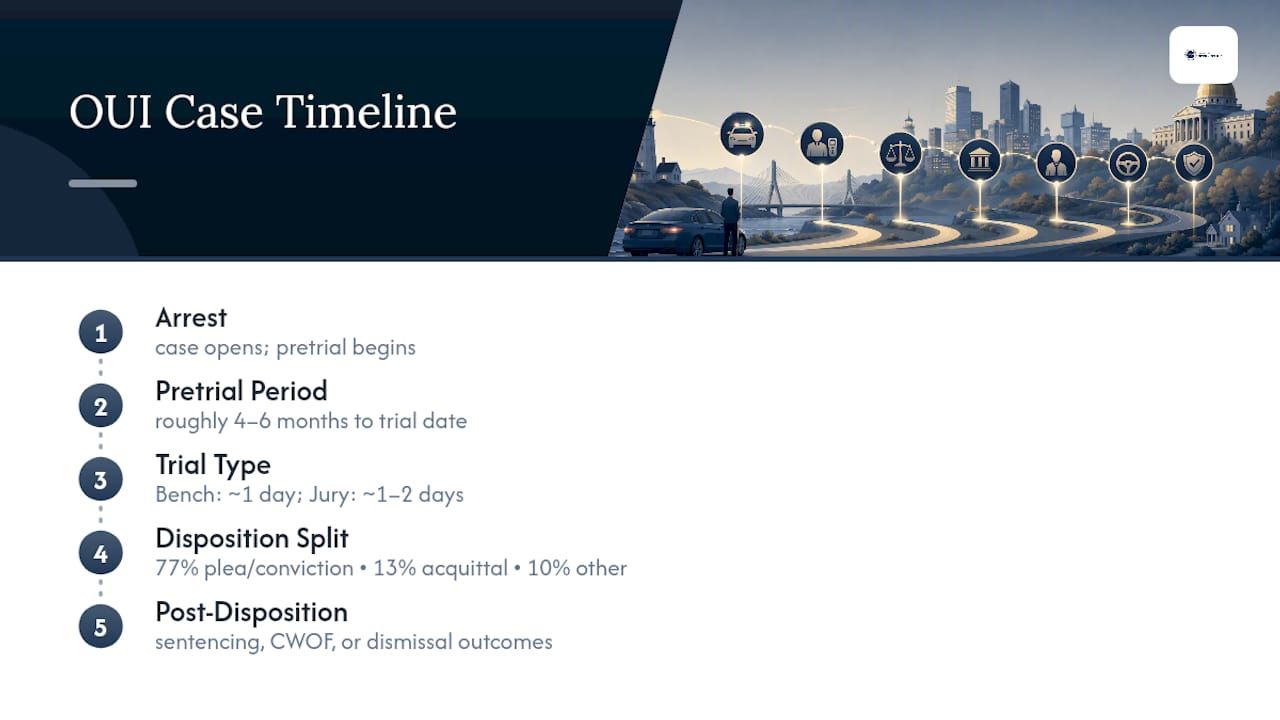
Once you're actually in the courtroom, the trial itself is usually brief. A bench trial, decided by a judge rather than a jury, commonly wraps up in a single day. A jury trial takes longer to seat and try, but even jury OUI trials in Massachusetts typically run only a day or two, not the multi-week affair many people picture from television.
The numbers on how these cases actually turn out are worth sitting with before you decide how to proceed. A large review of Massachusetts OUI dispositions, conducted for the Supreme Judicial Court by Special Counsel R. J. Cinquegrana, examined nearly 57,000 case dispositions and found that about 77% resolved against the defendant through a plea or a trial conviction, roughly 13% ended in acquittal , and about 10% resulted in other outcomes , including dismissals.
It means the aggregate outcome across tens of thousands of cases skews toward the prosecution, which is exactly why the earlier stages, evidence preservation, suppression motions, discovery scrutiny, matter so much. The report also found meaningful differences in acquittal rates between bench and jury trials, a distinction worth discussing directly with your attorney when deciding which trial format to choose.
Whatever the outcome, it maps to a specific next step. A guilty finding or plea leads to sentencing, which can include fines, license loss, probation, or in repeat-offense cases, jail exposure. A continuance without a finding (CWOF) means no conviction enters if you complete probation conditions. A dismissal or acquittal ends the criminal case outright, though RMV administrative suspensions can still exist independently and may require their own resolution.
RMV License Suspensions: The Deadline That Runs on Its Own Clock
The Registry of Motor Vehicles doesn't wait for your criminal case to conclude, and this is the part of the Massachusetts OUI legal process that trips up the most people. Under the state's implied consent law, the RMV suspends your license administratively the moment you fail or refuse a chemical test, regardless of what eventually happens in court.

If you refused the test, you have 15 days from the date of arrest to request an administrative hearing challenging that suspension. This deadline is unforgiving. Miss it, and you forfeit the right to that hearing entirely, leaving the suspension in place for its full duration no matter how your criminal case turns out. If you're weighing whether to challenge a breathalyzer refusal, the 15 day window is the deadline that should drive your first phone call, not your arraignment date.
Suspension lengths escalate sharply with prior offenses:
These administrative suspensions run independently of, and often longer than, any license consequence tied to a criminal conviction. A dismissal in criminal court does not automatically lift an RMV suspension; you typically need a separate reinstatement process once your suspension period ends or your hearing produces a favorable result.
A few practical points worth remembering:
- Refusing the test doesn't avoid the OUI charge itself; it only triggers a separate license consequence, and often a longer one than failing the test would have.
- A hardship license may be available during a suspension period for essential driving, though eligibility depends on the type of suspension and prior record.
- Reinstatement after a suspension period ends usually requires paying a fee and, in some cases, completing an alcohol education program before driving privileges are restored.
If a hardship license could get you through this period, it's worth exploring hardship license eligibility early rather than waiting until the suspension is already in effect.
Three Timeline Scenarios: Which One Matches Your Case
Most Massachusetts OUI cases fall into one of three general patterns, and knowing which one you're likely facing helps you plan the months ahead.
- Quick resolution. Some cases resolve at or shortly after arraignment, typically weeks rather than months, when the charge is minor, the evidence is straightforward, and a plea deal (often a CWOF) is offered early. This path is fastest, but it should never be chosen reflexively before an attorney has reviewed the breath test and stop documentation.
- Negotiated pre-trial resolution. Many cases settle somewhere between the pre-trial conference and the eve of trial, generally a span of several weeks to a few months. Discovery review, plea negotiation, and sometimes a partial motion process all play out during this window before the case resolves without a trial.
- Contested case to trial. Cases that proceed all the way to trial commonly take 4 to 6 months from arrest to trial date, sometimes longer when suppression motions, expert testimony on breath test reliability, or scheduling conflicts stack up.
What actually determines which scenario you land in comes down to a handful of factors: how backed up the local court's docket is, whether pretrial motions get filed, how long lab testing or expert review takes, how many charges are on the docket beyond the OUI itself, and whether witnesses, including the arresting officer, are consistently available for scheduled hearings. A single continuance for officer unavailability can push a trial date out by a month or more in a busy district.
What to Do Right Now: A Practical Checklist
The steps you take in the first week after arrest do more to shape your case's outcome and timeline than almost anything that happens later. Start with the basics: contact an attorney before your arraignment if at all possible, and do not plead guilty at that first appearance no matter how minor the charge feels in the moment. If you refused the chemical test, get the RMV hearing request submitted well inside that 15 day window; don't leave it until day 14.
Discovery preparation matters just as much as the initial response. Ask your attorney to formally request the police report, the breath machine's calibration and maintenance logs, and any bodycam or dashcam footage from the stop. These records have a shelf life, and departments aren't always proactive about preserving them past a standard retention period.
Pro Tip: Keep a simple folder, physical or digital, with every piece of paperwork from the arrest: the citation, any RMV notice, bail paperwork, and business cards from anyone involved. Courts and attorneys will ask for these repeatedly, and having them organized saves real time.
When you head to court for any hearing, bring photo identification, all paperwork related to the case, and a list of questions for your attorney beforehand. If a scheduling conflict comes up, raise it with counsel immediately rather than waiting; continuances are far easier to arrange proactively than after a missed date. On cost, legal fees for OUI defense vary by case complexity, but many attorneys offer a free initial consultation to review the specifics and discuss a flat or phased fee arrangement before you commit to anything.
How Experienced Counsel Actually Manages Your Case Timeline
An OUI case timeline isn't something that just happens to you. It's something an attorney actively manages, and the difference between a passively defended case and an actively managed one often shows up in weeks saved and leverage gained.
At the Law Office of Michael P Carroll, that management starts with triage. Michael P. Carroll has spent more than a decade defending OUI and DUI charges throughout Massachusetts, running an owner-operated practice where clients work directly with him rather than being routed through associates. That direct relationship matters most in the first 72 hours, when the RMV clock is already running and evidence is already at risk.
The two things that get missed most often in the first days after an OUI arrest are the RMV hearing deadline and the breath machine's maintenance records. Both are time-limited, and both can shape the entire rest of the case if handled, or missed, early.
Clients working with the firm should expect direct, plain-language updates at each stage, arraignment, pre-trial conference, any motion hearings, rather than long silences between court dates. If you're not hearing from your attorney between hearings, ask why. A managed timeline includes proactive check-ins, not just appearances when the calendar demands it.
If you're facing an OUI charge, the most useful first move is a direct consultation, one where you bring your citation, any RMV paperwork, and a written timeline of what you remember from the stop itself.
The Deadline Most Defendants Get Wrong
Conventional advice on OUI cases in Massachusetts tends to focus almost entirely on the criminal case, sentencing exposure, plea options, trial odds, while treating the RMV suspension as an afterthought. That gets the priority backward. The RMV process runs on its own 15-day clock, and it doesn't pause for anything happening in criminal court. I've seen the criminal case handled competently while the administrative deadline slipped by entirely unaddressed, which is the more preventable mistake of the two.
The SJC's disposition data, roughly three out of four cases resolving against the defendant, gets misread as fatalism when it should be read as motivation. That statistic reflects the average case, not a mandatory outcome, and it exists precisely because too many defendants treat the early stages as procedural formalities rather than as the moments where evidence gets locked in or lost. Suppression motions and discovery requests filed in week two do more work than the same requests filed in month four.
If there's one thing to prioritize above all else, it's this: treat the first 15 days as the most consequential stretch of the entire case, not the trial date months down the road.
*— Michael Carroll
Local, Direct OUI Defense When the Clock Is Already Running
Law Office of Michael P Carroll is a direct alternative to larger firms that hand your case to whichever associate has bandwidth that week. In Bristol, Norfolk, and Plymouth counties, clients work with Michael P. Carroll himself, from the first phone call through arraignment, pre-trial conference, and any hearings that follow, with no handoffs in between.
A typical engagement starts with an initial consultation to review your arrest paperwork and any RMV suspension notice, followed immediately by whatever time-sensitive filing your case needs, most urgently, an RMV hearing request if the 15-day window is still open. From there, the firm moves into discovery requests for police reports, breath test records, and video evidence, while preparing for pre-trial negotiations or, when the evidence supports it, a motion to suppress.
If you're facing OUI charges anywhere in these three counties, bring your citation, any bail paperwork, and your written recollection of the stop to a consultation with an OUI attorney sooner rather than later. The earlier counsel gets involved, the more of the timeline stays within your control.
Sources
Every deadline and figure in this article traces back to official Massachusetts sources, and it's worth reviewing them directly if you want the full procedural language behind any step in your case.
- Mass
This article is general information, not a substitute for advice from a qualified lawyer. Consult a qualified legal professional about your own circumstances before acting on anything here.
FAQ
How much jail time is possible for an OUI in Massachusetts?
Jail exposure depends heavily on prior offenses; a first offense typically carries no mandatory jail time and often resolves with probation or a CWOF, while second and subsequent offenses carry escalating mandatory minimum sentences under Massachusetts law.
What does it mean to be found guilty of OUI?
A guilty finding means the court determined you operated a vehicle while your ability to drive safely was impaired by alcohol or drugs, or that your blood alcohol content measured 0.08% or higher, resulting in a conviction on your record rather than a continuance without a finding.
How can you fight an OUI charge in Massachusetts?
Common defense strategies include challenging the legality of the traffic stop, questioning whether probable cause existed for the arrest, disputing the reliability or calibration of the breath test, and pursuing a motion to suppress evidence obtained improperly; an attorney like those at the Law Office of Michael P Carroll evaluates which of these applies to your specific stop and evidence.
How long does an OUI stay on your record in Massachusetts?
An OUI conviction generally remains on your Massachusetts criminal record permanently unless sealed, and it counts as a prior offense for sentencing purposes indefinitely, though a continuance without a finding that's successfully completed avoids a conviction while the case itself remains part of your court record.