
OUI Drugs Massachusetts: Laws, Penalties, and Defenses
OUI Drugs Massachusetts: Laws, Penalties, and Defenses

Yes, you can be charged with OUI for drugs in Massachusetts, and prescription medication does not give you a pass. Under G.L. c.90 §24, operating a vehicle while impaired by marijuana, narcotics, depressants, stimulants, or even intoxicating fumes is a crime, whether the drug came from a dealer or a pharmacist. A conviction carries fines and possible jail time, and it triggers mandatory court assessments on top of whatever sentence a judge imposes.
The Massachusetts Registry of Motor Vehicles runs its own parallel system. An arrest, a refused chemical test, or a conviction can suspend your license through the RMV's administrative process even before your criminal case is resolved.
- First-offense penalties: fines between $500 and $5,000, up to 2.5 years in jail, and mandatory assessments the court cannot waive.
- RMV exposure: license suspension separate from any criminal outcome, with longer suspensions for refusing a chemical test.
- Immediate next step: ask for an attorney, say nothing further to police, and preserve every prescription record, pharmacy printout, and doctor's note tied to the medication involved.
If you were arrested, the clock on RMV hearing deadlines starts immediately. Waiting even a few days to talk to a lawyer can cost you leverage you never get back.
Key Takeaways
Massachusetts prosecutes drug-related OUI under G.L. c.90 §24 with criminal penalties and separate RMV suspensions, and prescription-medication defenses succeed only when supported by documented medical proof.
| Point | Details |
|---|---|
| Statute covers more than illegal drugs | G.L. c.90 §24 applies to marijuana, narcotics, depressants, stimulants, and intoxicating fumes, prescribed or not. |
| Two systems, two clocks | Criminal penalties (fines up to $5,000, up to 2.5 years jail) run separately from RMV suspensions. |
| Refusal has its own penalty | A first chemical test refusal triggers a 180-day suspension regardless of the criminal outcome. |
| Roadside tests aren't proof | Model Jury Instruction 5.400 confirms field assessments are not scientific evidence of drug impairment. |
| Prescription defense needs documentation | Involuntary intoxication defenses succeed with prescription records, physician statements, and contemporaneous notes. |
Table of Contents
- What Massachusetts Law Says About OUI Drugs
- RMV Suspensions, Refusal Penalties, and Getting Your License Back
- How Prosecutors Try to Prove You Were Impaired by Drugs
- Defenses: Prescription Medication and Involuntary Intoxication
- What an OUI Drugs Conviction Costs You Beyond Court
- What to Do in the Hours After an OUI Drugs Arrest
- Why Local Experience Matters in Drug OUI Cases
- Ready to Talk to an OUI Attorney?
- A Massachusetts Lawyer's Take on OUI Drug Defense
- Sources
- FAQ
What Massachusetts Law Says About OUI Drugs
Massachusetts prosecutors don't need to prove you were drunk to convict you of an OUI. Under G.L. c.90 §24, the statute covers operation of a motor vehicle on a public way while under the influence of marijuana, narcotic drugs, depressant or stimulant substances, or vapors of glue. That list is broader than most drivers assume. A driver on a properly prescribed opioid, a benzodiazepine, or even certain cold medications can face the same charge as someone who used an illegal narcotic.
To convict, the Commonwealth has to prove three things beyond a reasonable doubt: you operated the vehicle, you did so on a public way (or a place the public has access to), and one of the listed substances impaired your ability to drive safely. That third element is where most drug OUI cases actually get fought. Massachusetts defines the covered substances by cross-referencing Chapter 94C, the state's controlled substances act, so the classification of a given pill or substance often becomes its own legal question.
The penalties are steep even on a first offense:
- Fines ranging from several hundred to several thousand dollars.
- Possible imprisonment for up to a few years.
- A mandatory court assessment tied to the Head Injury Treatment Services Trust Fund, plus other statutory fees a judge has no discretion to waive.
- Probation conditions that frequently include substance evaluation and completion of an education program.
Prior OUI or DUI convictions, whether from drugs or alcohol, escalate everything. Massachusetts treats them as the same offense category for sentencing purposes, so a second offense (drug or alcohol) brings mandatory minimum jail time, a longer license loss, and, after two or more incidents, an ignition interlock device requirement once you're back on the road.
RMV Suspensions, Refusal Penalties, and Getting Your License Back
Massachusetts operates under implied consent: by driving on a public way, you've already agreed to submit to a chemical test if police have probable cause to believe you're impaired. Refuse that test, and the RMV suspends your license administratively, separate from and often faster than your criminal case moves.
Refusing isn't a crime itself, but the consequences are immediate and can be more severe than a first conviction. A first refusal costs you a 180-day suspension. Refuse again with prior offenses on your record, and the suspension periods stretch to years.
Reinstatement typically requires:
- Completing the RMV's Driver Alcohol Education Program, which can shorten a suspension tied to a first offense.
- Paying reinstatement fees and any outstanding assessments.
- Installing an ignition interlock device if you have two or more OUI-related events on your record, a requirement under Melanie's Law.
- Passing any required RMV hearing before your license is restored.
| Circumstance | Suspension Length |
|---|---|
| First chemical test refusal | 180 days |
| First OUI conviction (drugs) | Determined by court; RMV education program may reduce it |
| Second or subsequent offense | Multi-year suspension, IID required upon reinstatement |
| Refusal with prior OUI history | Extended suspension, often measured in years |
Out-of-state OUI convictions count against you in Massachusetts. The RMV treats them the same as an in-state conviction when calculating suspension length and program eligibility, which surprises a lot of people who assumed a prior case in another state wouldn't follow them here. If you're facing a suspension, understanding your rights during a breathalyzer or chemical test refusal matters just as much as your criminal defense strategy, and a hardship license may keep you driving to work while everything else plays out.
How Prosecutors Try to Prove You Were Impaired by Drugs
Proving alcohol impairment is comparatively simple: a breathalyzer gives police a number. Proving drug impairment is messier, and that gap is where a lot of drug OUI cases fall apart for the prosecution.
Officers typically build their case on field sobriety assessments, officer observations (slurred speech, dilated pupils, erratic driving), and later, a blood or urine test. The District Court's Model Jury Instruction 5.400 is blunt about the limits of that first category: roadside assessments were designed and validated for alcohol, not drugs, and they are not scientific proof of drug impairment on their own.
Timing is the other problem for prosecutors. Blood and urine tests can detect metabolites of a drug days or even weeks after use, long after any actual impairment has worn off. A positive test result doesn't automatically mean you were impaired at the moment you were driving, and defense attorneys lean hard on that distinction.
- Field assessments carry limited weight without corroborating evidence.
- Test timing matters more than the test result itself.
- Chain-of-custody gaps and lab reliability issues are common points of attack.
- Expert toxicology testimony is often the deciding factor in close cases.
The jury decides whether "under the influence" means the driver's ability to operate safely was diminished by reduced alertness, judgment, or response, based on all the evidence, not a single test score.
Pro Tip: If you're arrested and taken for a blood draw, note the exact time it happened. The gap between your last dose, your arrest, and the actual test can become the single most important fact in your defense. An early challenge to a failed test result often starts with exactly this kind of timeline reconstruction.
Defenses: Prescription Medication and Involuntary Intoxication
Massachusetts courts recognize a real defense for drivers impaired by medication they had no reason to know would affect them this way. It's called involuntary intoxication, and appellate cases including Commonwealth v. Bishop shape how juries are instructed on it.

The defense applies when a defendant took medication as prescribed and had no reason to expect it would cause intoxicating side effects. It does not apply the same way if you knowingly mixed alcohol with a prescription drug that warned against that combination. Courts draw a sharp line between a genuine surprise reaction and a driver who ignored a label.
If you're building this defense, prioritize:
- Prescription records showing the dosage and instructions your doctor actually gave you.
- Statements from your prescribing physician confirming you followed the prescribed regimen.
- Medication labels and warnings , especially anything that did or did not mention driving risk.
- Contemporaneous notes about how you felt before driving, written down as soon as possible after the incident while memory is still fresh.
Pro Tip: Call your pharmacy the same week as your arrest and request a printout of your prescription history. Pharmacies don't always keep detailed records indefinitely, and this document can anchor your entire defense.
What an OUI Drugs Conviction Costs You Beyond Court
A conviction doesn't stay contained to the courtroom. It shows up on your driving record and, for many charges, your criminal record, and both can stay visible for years depending on the offense and any subsequent sealing petition.
- Mandatory court assessments add hundreds of dollars in fees on top of any fine.
- Insurance premiums typically rise sharply after an OUI, sometimes for several years.
- Many employers run background checks that will surface a conviction, particularly for jobs involving driving.
- Record-sealing options exist in Massachusetts but come with waiting periods and eligibility rules that vary by offense type.
Talking through mitigation options with an attorney early, before sentencing, gives you more room to negotiate outcomes that reduce these downstream effects.
What to Do in the Hours After an OUI Drugs Arrest
- Invoke your right to counsel immediately and limit what you say to police beyond basic identifying information.
- Request copies of the police report and any field assessment or testing documentation as soon as they become available.
- Preserve medical and medication records , including hospital paperwork if you were treated, and write down names of any witnesses.
- Note the exact timeline , when you last took medication, when you were stopped, and when any test was administered.
- Check your RMV hearing deadline and schedule a consultation with an OUI attorney before that window closes.
Pro Tip: Massachusetts RMV hearing deadlines move fast. Missing one can mean losing your chance to challenge a suspension administratively, even if your criminal case eventually goes your way. A first-offense guide can help you understand what the criminal side of the process looks like while you're sorting out the RMV side.
Why Local Experience Matters in Drug OUI Cases
Drug OUI cases hinge on details that generic legal advice can't address: how a specific court treats toxicology timing, which judges scrutinize field assessments closely, and how local prosecutors typically approach prescription-medication defenses. Michael P. Carroll has spent over a decade focused specifically on OUI and DUI defense across Bristol, Norfolk, and Plymouth counties, working directly with clients rather than handing cases off to junior associates.
That practice covers RMV hearings, toxicology review, plea negotiation, trial defense, and advocacy for treatment or diversion program placement when that route serves a client better than fighting every charge outright.
Cases involving prescription medication require someone who reads the toxicology report line by line, not someone who skims the police narrative and calls it a defense.
Ready to Talk to an OUI Attorney?
Facing an OUI drugs charge in Massachusetts means dealing with two separate systems at once, the criminal court and the RMV, on two different timelines, with two different sets of rules. That is not something to sort out alone, especially when a prescription medication is involved and the science around impairment timing gets complicated fast.
Law Office of Michael P Carroll represents clients throughout Bristol, Norfolk, and Plymouth counties in OUI drug cases, RMV suspension hearings, and related criminal matters. If you were arrested for OUI drugs in Massachusetts, reach out to discuss your OUI defense options before your RMV hearing deadline passes.
A Massachusetts Lawyer's Take on OUI Drug Defense
Most advice about OUI drugs treats it like a smaller cousin of drunk driving, and that framing does readers a disservice. Drug impairment cases are actually harder for prosecutors to prove cleanly, because the science doesn't give them a clean number the way a breathalyzer does. That gap is where a defense actually gets built, not in generic arguments about the officer's demeanor at the stop.
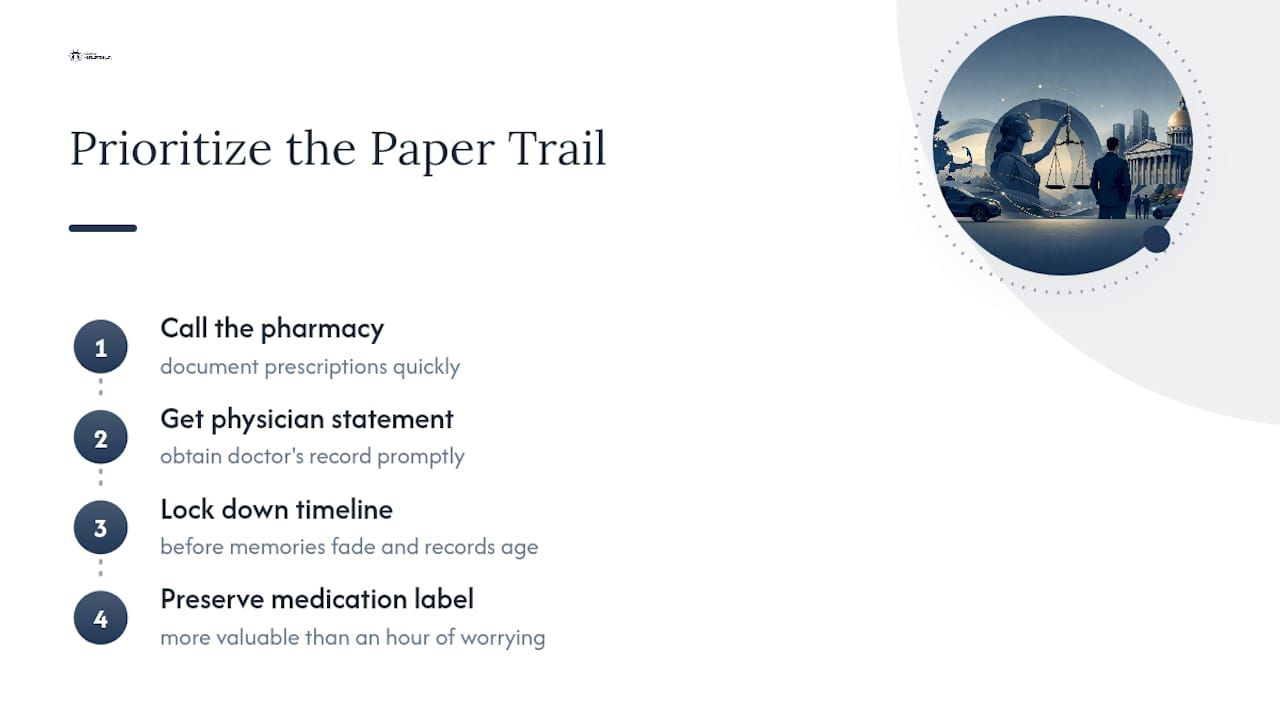
The conventional advice, "get a lawyer, stay quiet", is fine but incomplete. What actually moves a prescription-medication case is documentation speed: calling the pharmacy, getting the physician's statement, and locking down the timeline before memories fade and records age out. Wait two weeks and you've lost leverage you can't buy back.
If you take one thing from this article, prioritize the paper trail over the panic. The medication label sitting in your car is worth more to your defense than an hour of worrying about how the case looks.
— Michael Carroll
This article is general information, not a substitute for advice from a qualified lawyer. Consult a qualified legal professional about your own circumstances before acting on anything here.
Sources
FAQ
How do you beat an OUI drugs charge in Massachusetts?
The strongest defenses attack the prosecution's proof of impairment, challenging roadside assessment reliability, blood/urine test timing, and chain-of-custody issues, or establishing an involuntary intoxication defense when prescription medication caused unexpected effects.
Can you go to jail for an OUI in Massachusetts?
Yes. A first-offense conviction under G.L. c.90 §24 carries up to 2.5 years of imprisonment along with fines between $500 and $5,000, and repeat offenses carry mandatory minimum jail time.
What makes an OUI a felony in Massachusetts?
An OUI typically becomes a felony-level charge when it involves serious bodily injury, death, or falls under specific repeat-offense provisions that carry state prison exposure rather than the standard jail terms attached to a first or second offense.
How long does an OUI stay on your record in Massachusetts?
An OUI conviction generally stays on your criminal and driving record indefinitely unless you qualify for and successfully petition to seal it, and eligibility timelines vary depending on the offense and any prior record.