
Ignition Interlock Massachusetts: Rules, Costs, and Removal
Ignition Interlock Massachusetts: Rules, Costs, and Removal

If you have two or more OUI convictions in Massachusetts, or you are a first-time offender with a breathalyzer result of .15 or higher seeking a hardship license, you must install an ignition interlock device before you drive again. Courts can also order one independently. The Massachusetts Registry of Motor Vehicles (RMV) oversees the entire process, and the Ignition Interlock Device Program sets the framework under Melanie's Law.
Three facts matter more than anything else on this page:
- You need to participate in the program for a minimum duration set by the state before removal becomes possible.
- You must go six consecutive months with zero violations right before you apply to remove the device.
- Never install the device before an RMV Hearings Officer approves you. Installing early can jeopardize your hardship license or delay reinstatement.
The rules come from state regulation 540 CMR 25.00, which governs everything from device certification to what counts as a violation.
Key Takeaways
Massachusetts requires an ignition interlock for repeat OUI offenders and certain hardship cases, with a mandatory 730 day minimum and a six month violation-free period before removal.
| Point | Details |
|---|---|
| Know your trigger | Two or more OUIs, a high BAC hardship case, or a court order all mandate an IID. |
| Never install early | Wait for written RMV Hearings Officer approval before scheduling installation. |
| Track your clock | You need 730 days minimum in the program and six consecutive violation-free months before removal. |
| Service visits are strict | Missing a 25 to 30 day service visit triggers an immediate lockout with no warning. |
| Costs can be waived | Document a grave and serious hardship to request a no-cost device through the Registrar. |
Table of Contents
- Massachusetts Ignition Interlock Law: Who It Applies To
- How to Get an Ignition Interlock Installed in Massachusetts
- How Does an Ignition Interlock Work Day to Day?
- What Counts as a Violation, and What Happens Next
- Removing an Ignition Interlock and Getting Your License Back
- Cost of Ignition Interlock in Massachusetts
- Finding Ignition Interlock Providers in Massachusetts
- When an OUI/DUI Attorney Actually Changes the Outcome
- What the Interlock Rules Get Right, and Where They Trip People Up
- Sources
- FAQ
Massachusetts Ignition Interlock Law: Who It Applies To
The IID requirement in Massachusetts is not discretionary once you fall into one of three categories, and understanding which one applies to you determines how long you will be in the program and what your license will look like in the meantime.
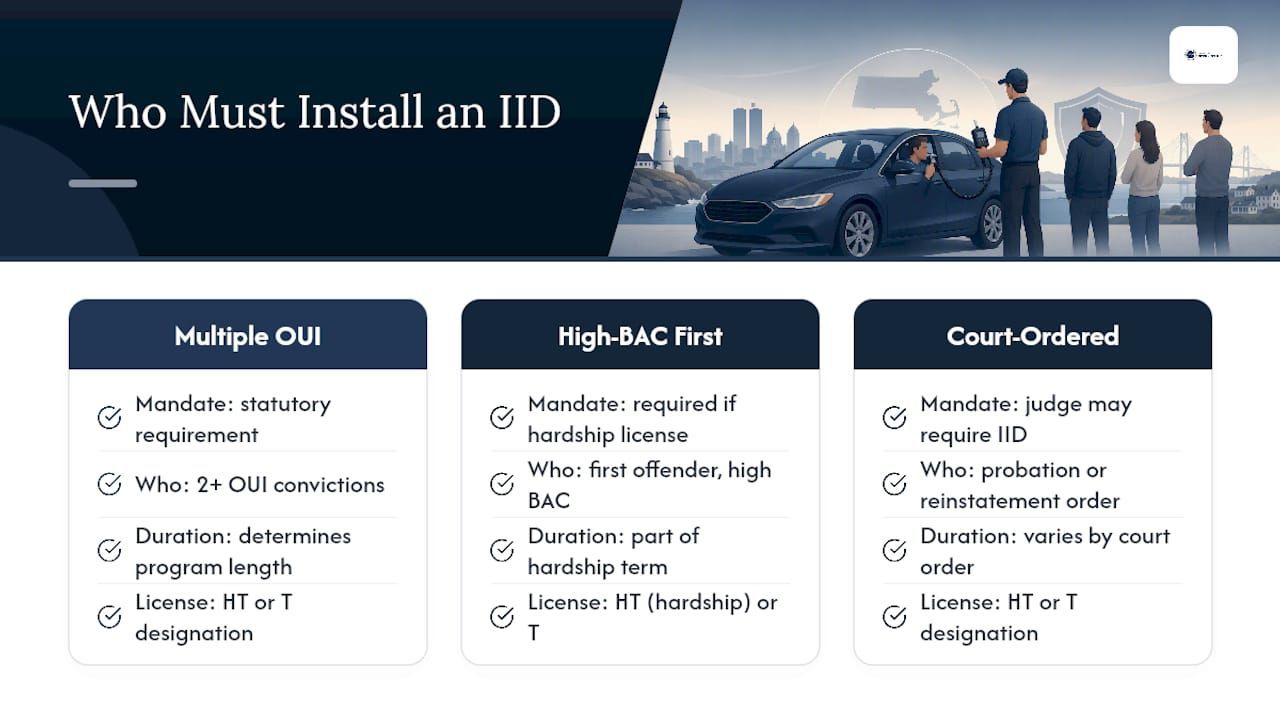
Multiple OUI offenders. If you have two or more OUI convictions, Massachusetts law requires an interlock device as a condition of getting your license back, regardless of whether you are pursuing a hardship license or a full reinstatement. This is a statutory mandate, not something a judge can waive.
First offenders with a hardship license and a high BAC. If your breathalyzer result was at or above the high threshold and you are seeking a hardship license, you fall under the same requirement. A lower BAC first offense generally does not trigger mandatory installation, though a judge retains discretion to order one.
Court-ordered installation. Judges can require an IID as a condition of probation or license reinstatement even outside the two categories above, and the duration in these cases varies by the terms of the order.
Once approved, your license carries an HT (hardship, interlock-restricted) or T (interlock-restricted, non-hardship) designation. Both restrictions mean the same practical thing: you can only legally operate a vehicle equipped with a certified IID, and driving any other vehicle, even briefly, violates your restriction.
If you moved out of state or split time between Massachusetts and another state, the RMV still requires the device to be calibrated to Massachusetts settings to receive program credit. According to Melanie's Law guidance on the Ignition Interlock Device (IID) Program, you need a vendor licensed to operate in both jurisdictions, and time spent driving out of state with a properly configured device still counts toward your 730 days. Deferment without an approved device does not count.
How to Get an Ignition Interlock Installed in Massachusetts
Getting approved is a sequence, and skipping a step or acting out of order is the single most common mistake we see.
- Request a hearing with the RMV. You need a hardship or reinstatement hearing before the RMV Hearings Officer, and you must bring the correct affidavits and supporting documents for your case type.
- Wait for written approval. The Hearings Officer issues approval along with the official list of certified vendors. Do not schedule an installation before this happens.
- Choose a certified vendor from the RMV list. Not every interlock company on the market is certified for Massachusetts; the RMV list is the only one that counts.
- Schedule installation within the vendor's window. Most vendors can install within days of your approval, but you generally have around 30 days to complete this step and confirm your restricted license status.
- Confirm the vendor reports your installation to the RMV. This step is what actually starts your restricted license and your compliance clock, and a vendor who fails to report properly can delay your reinstatement fees and paperwork.
Pro Tip: Bring two copies of every document to your hearing, including your court disposition and any hardship paperwork. A missing document is the most common reason hearings get continued, which adds weeks to a process that should take days.
If you are still working out your eligibility for a hardship license in the first place, our guide on getting a hardship license after an OUI in Massachusetts walks through the qualifying criteria before you ever get to the interlock stage.
How Does an Ignition Interlock Work Day to Day?
The device requires a breath sample before your engine will start, and it requires additional random breath tests while you drive. Understanding the mechanics prevents the kind of accidental violation that resets your compliance clock.
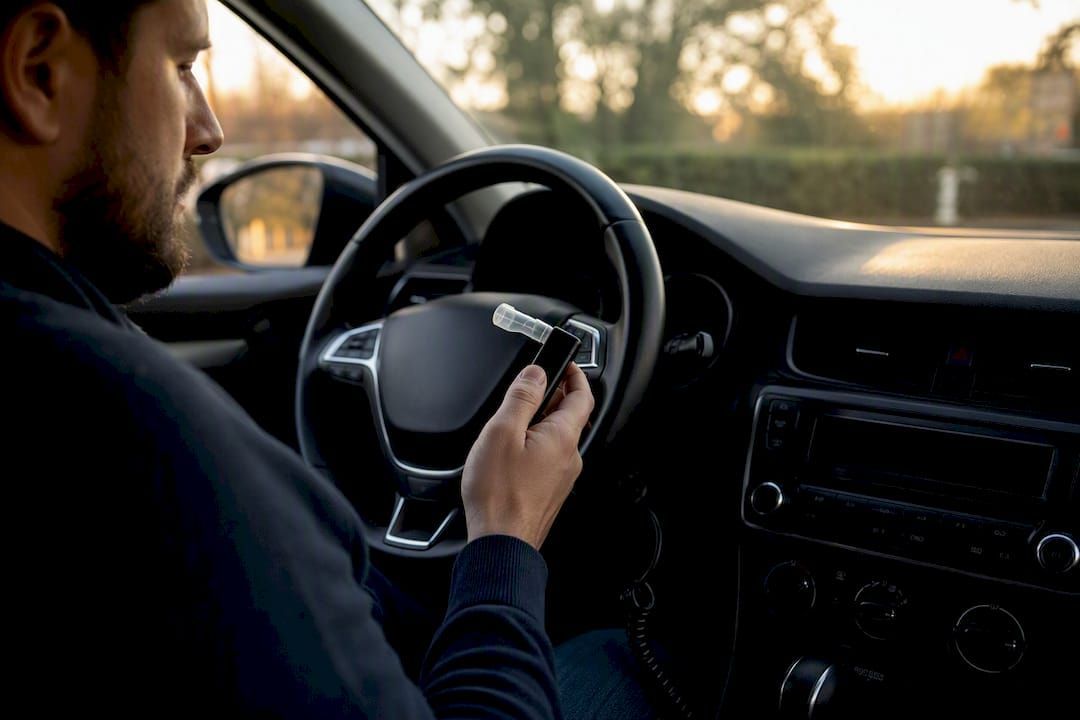
A blood alcohol concentration reading above .02 on the initial start test causes an automatic fail, and the vehicle will not start. Once you are driving, the device demands "rolling retests" at random intervals. You get a warning window to pull over safely and provide a sample. Missing a rolling retest, or failing one, gets logged and reported.
Every 25 to 30 days, per 540 CMR 25.00, you must return to your certified vendor for a service visit. The vendor downloads your device data, checks calibration, and uploads your compliance record to the RMV. Missing this window is not a minor inconvenience: the device locks out the vehicle entirely with no advance warning once you cross the deadline.
A few technical realities catch people off guard:
- IIDs work only on vehicles with standard electrical systems; some older or specialty vehicles may not be compatible.
- Motorcycles cannot be fitted with certified interlock devices at all under current state program rules.
- The device must go on every vehicle you own, lease, or regularly operate, including a work vehicle registered in your name.
- If your only vehicle is a motorcycle, you will need to downgrade your license endorsement to a Class D restriction to comply.
What Counts as a Violation, and What Happens Next
Massachusetts treats interlock violations seriously, and the consequences scale from an inconvenient lockout to a full return to suspended status.
The most common violations are a failed start-up test above the .02 threshold, a missed or failed rolling retest, and any attempt at circumvention, meaning tampering with the device or having someone else blow into it for you. Circumvention is not treated as a paperwork problem. It can trigger separate criminal charges under Massachusetts law in addition to interlock program penalties.
- Immediate device response. A failed test or missed service visit typically locks the vehicle, requiring a trip to the vendor to reset it.
- RMV reporting. Vendors are required to report violations to the RMV as part of their certification obligations, and repeated violations trigger an RMV review.
- Suspension or extended program time. Depending on severity and frequency, the RMV can extend your interlock period, deny an upcoming removal request, or in serious cases suspend your license again.
- Dispute window. You generally have 30 days to contest a reported violation. Bring your own trip logs, timestamps, or witness statements if you believe the event was a false positive from mouthwash, a breath mint, or a device malfunction.
Pro Tip: Keep a simple log of anything you eat or drink right before getting in the car during your interlock period. If you ever need to dispute a failed test, contemporaneous notes carry far more weight than a memory reconstructed weeks later.
If you believe a reported violation was inaccurate and it is affecting your case, our post on challenging a failed breathalyzer result in Massachusetts covers the kind of evidence that holds up in these disputes.
Removing an Ignition Interlock and Getting Your License Back
Removal is not automatic once your minimum time is up. You still have to apply and prove a clean record.
- Confirm you have served the minimum 730 days in the program required for your offender category, per the RMV's Road to Reinstatement guidance.
- Verify six consecutive months with zero violations immediately before applying. A violation in month five resets this clock.
- Submit your removal request through the IID Service Request Portal or by scheduling a removal hearing, following the official steps for IID removal.
- Attend a telephone review if requested, where the RMV confirms your six-month clean record.
- Obtain your unrestricted replacement license through myRMV once approved. The RMV typically processes removal approvals within three to five business days.
- Schedule vendor removal only after your new unrestricted license is issued, not before.
Removing the device before RMV approval, or before your replacement license is issued, can put you back at square one. If a removal request is denied, you generally re-enroll under your existing restriction and wait out the required clean period again before reapplying.
Cost of Ignition Interlock in Massachusetts
You pay for your own device in almost every case. Installation, monthly monitoring, maintenance, and eventual removal are the operator's financial responsibility under standard RMV rules described in the Ignition Interlock Device Program guidance.
Vendors set their own pricing, and costs vary by company, but expect an upfront installation fee plus a recurring charge tied to your monthly service visit. If covering these costs would create what the RMV calls a "grave and serious hardship," you can request an indigency determination from the Registrar.
- A documented indigency waiver gets you a certified IID at no cost, along with covered monitoring and maintenance during your program.
- The waiver does not cover RMV administrative fees, device upgrades you request, or damage fees if you or someone else damages the unit.
- You need documentation, typically income and hardship evidence, to support the request; the Registrar makes the determination in writing.
Finding Ignition Interlock Providers in Massachusetts
The RMV publishes the current list of certified vendors, and it only releases that list to you after your hearing approval, not before. Working outside that list risks installing a device that does not satisfy your program requirements at all.
A few logistics catch people off guard on installation day. Arrange a ride to the vendor, since you should not drive yourself in an unequipped vehicle to get the device installed. Bring your license, your RMV approval paperwork, and be prepared for the visit to take an hour or more depending on your vehicle's electrical system.
- Confirm your vehicle's electrical setup is compatible before you arrive to avoid a wasted trip.
- If you buy, sell, or change vehicles during your program, you must notify your vendor to transfer or reinstall the device.
- Keep a plan for towing or alternate transportation in case a lockout happens somewhere inconvenient.
Pro Tip: Call your certified vendor before your appointment and ask directly whether your specific make and model has had any reported compatibility issues. Some older vehicles need supplemental wiring work that adds time and cost you can plan around in advance.
When an OUI/DUI Attorney Actually Changes the Outcome
Most of the interlock process is administrative, and plenty of people handle straightforward cases on their own. Where it stops being simple is at contested hearings, disputed violations, and indigency petitions, where the paperwork and the standard of proof genuinely matter.
A Hearings Officer denial over an incomplete affidavit, a disputed rolling retest you believe was a false positive, or a multi-jurisdictional case involving both Massachusetts and Rhode Island driving records are all situations where representation changes what happens in the room. Michael P. Carroll has spent more than a decade handling OUI and DUI defense across Bristol, Norfolk, and Plymouth Counties as an owner-operated practice, meaning the attorney reviewing your paperwork is the same one standing next to you at the hearing.
- Bring your court disposition, any prior RMV correspondence, and your own compliance log to a consultation.
- Ask specifically whether your case involves a contested violation or a straightforward timeline issue, since the strategy differs.
- If you are already facing a hearing, review our breakdown of breathalyzer refusal penalties in Massachusetts if refusal is part of your history.
| Situation | Why Counsel Helps |
|---|---|
| Denied hardship hearing | An attorney can identify missing affidavits or procedural errors before resubmission. |
| Disputed violation | Counsel can organize trip logs and vendor records into a formal challenge within the 30-day window. |
| Indigency petition | A properly documented request avoids delays that leave you without a legal vehicle option. |
If you are facing any of these situations, the DUI Attorney page at Law Office of Michael P Carroll has more on how the firm approaches hearings and disputes, or you can reach out directly to discuss your case.
What the Interlock Rules Get Right, and Where They Trip People Up
The interlock program is not designed to punish you twice. It is designed to get you back on the road legally while proving, day by day, that you can be trusted behind the wheel. Where conventional advice falls short is in treating the 730-day mark like a finish line. It is not. The six-month clean record right before your removal application matters more than the two years that preceded it, and I have seen people undo a nearly complete program with an avoidable missed service visit in month twenty-three.
The paperwork feels bureaucratic, and it is, but the RMV Hearings Officer process exists precisely because the state wants documented proof before it hands back an unrestricted license. Treat every affidavit, every hearing date, and every service visit as part of a record you are building, not a hoop you are jumping through. If a violation gets logged that you believe is wrong, dispute it within the 30-day window and bring real documentation. Waiting it out rarely works in your favor.
— Michael Carroll
This article is general information, not a substitute for advice from a qualified lawyer. Consult a qualified legal professional about your own circumstances before acting on anything here.
Sources
FAQ
How Can I Remove My IID in Massachusetts?
You apply through the RMV once you have served the 730-day minimum and completed six consecutive violation-free months, following the steps for IID removal, then obtain your unrestricted replacement license before scheduling vendor removal.
Can I Drink One Beer With an Interlock Installed?
No. Any alcohol consumption risks tripping the BAC threshold on your start test or a rolling retest, which counts as a failed test and gets reported to the RMV as a compliance issue.
Is Driving Without an Interlock a Felony in Massachusetts?
Driving a vehicle without a required interlock while under an HT or T restriction is a serious violation that can lead to additional license suspension, and circumventing or tampering with a device can carry separate criminal exposure under Massachusetts law.
How Do I Get My License Back After a DUI in Massachusetts?
You complete your required suspension or hardship period, satisfy any mandatory interlock program time with a clean six-month record, then apply for reinstatement through the RMV to receive an unrestricted license.