
Massachusetts Record Sealing: Eligibility, Steps, and Costs
Massachusetts Record Sealing: Eligibility, Steps, and Costs

Most Massachusetts residents with a criminal record qualify for one of two sealing paths, and the right one depends entirely on how the case ended. If you were convicted, you likely need administrative sealing under G.L. c. 276, §100A once you clear a waiting period: multiple years for a misdemeanor, longer for a felony. If your case ended in a dismissal, a not-guilty finding, or a nolle prosequi, you may qualify for court-ordered sealing under §100C, sometimes with no waiting period at all. Expungement, which erases a record rather than restricting access to it, applies only in narrow circumstances.
Before you file anything:
- Request your own CORI (Criminal Offender Record Information) report from the Department of Criminal Justice Information Services.
- Get certified dockets from the clerk's office in every county where you were charged.
- Confirm your disposition type (guilty finding, dismissal, nolle prosequi) matches the path you're pursuing.
A waiting period applies before an administrative petition can be filed, typically several years for misdemeanors and a longer period for felonies , per the waiting-period rules under §100A. Get your paperwork in order first. Everything else follows from that.
Key Takeaways
Record sealing in Massachusetts depends on disposition type, not just time served: convictions wait out a statutory period under §100A, while dismissals can seek discretionary court sealing under §100C with no fixed wait.
| Point | Details |
|---|---|
| Confirm your path first | Convictions need administrative sealing (§100A); dismissals and nolle prosequi cases use court sealing (§100C). |
| Waiting periods are fixed but resettable | Three years for misdemeanors, seven for felonies, restarting with any new conviction. |
| Get documents before filing | Pull your CORI and certified dockets first to avoid eligibility disputes later. |
| Sealing limits access, doesn't erase | Law enforcement, courts, and some licensing agencies retain access even after sealing. |
| Complex cases benefit from counsel | Law Office of Michael P Carroll helps verify waiting-period math and represents clients at contested hearings. |
This article is general information, not a substitute for advice from a qualified lawyer. Consult a qualified legal professional about your own circumstances before acting on anything here.
Table of Contents
- What Qualifies for Record Sealing in Massachusetts?
- How Do You File a Petition to Seal Your Record?
- How Long Does Massachusetts Record Sealing Take?
- Who Can Still See a Sealed Record?
- Should You Seal or Expunge Your Record?
- When Should You Hire a Lawyer for Sealing?
- What Actually Moves the Needle on a Sealing Petition
- Get Help Filing Your Sealing Petition
- Sources
- FAQ
What Qualifies for Record Sealing in Massachusetts?
Eligibility splits along two tracks, and mixing them up is the single most common reason petitions stall.
Administrative sealing (§100A) covers convictions. You need three years past the guilty finding or release from incarceration for a misdemeanor, seven years for a felony. The clock resets to zero with any new criminal conviction during the waiting period, so a fresh charge at year six on a felony wait means that you start over. You file a sworn declaration confirming no new convictions and that you meet the time requirement. No judge reviews it unless something is flagged.
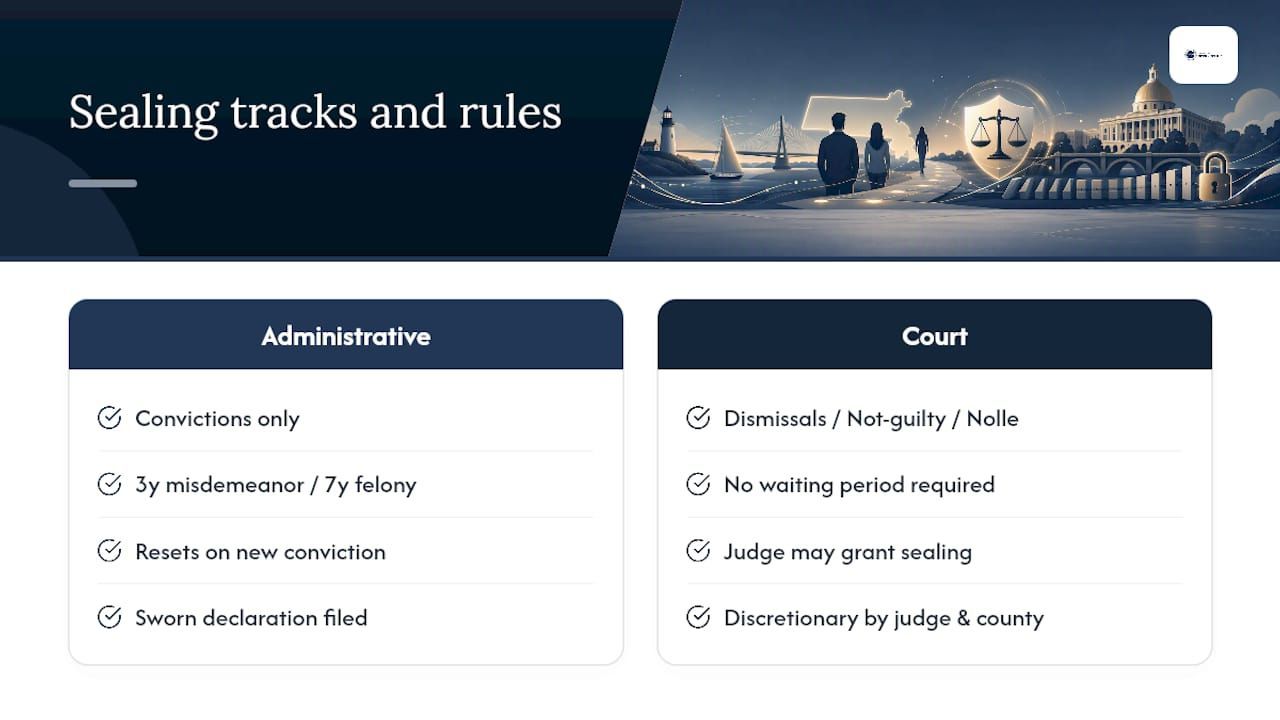
Court sealing (§100C) applies to cases that never resulted in a conviction: dismissals, not-guilty verdicts, and nolle prosequi (charges the prosecutor formally dropped). The statute lets a judge grant sealing without any waiting period if sealing "would serve the interests of substantial justice." That's a discretionary standard, and outcomes vary by judge and by county.
Some offenses are excluded outright or carry extended timing rules, particularly certain sex offenses, which can require decades of waiting or aren't eligible at all. Larceny cases deserve a second look if the original charge dates back further than 2018: the felony threshold moved to $1,200, and cases charged under the old, lower threshold sometimes get misclassified as felonies when they should now be treated as misdemeanors with a shorter wait.
Pro Tip: If your larceny conviction is older than 2018 and coded as a felony, check the dollar amount on the original complaint against the current $1,200 threshold before assuming you owe seven years instead of three.
How Do You File a Petition to Seal Your Record?
Filing itself is mechanically simple. Getting the paperwork right before you file is where most people trip up.
- Pull your CORI. Request it directly through DCJIS, since you'll need it to confirm exactly what's on file and how each case is coded.
- Get certified dockets. Visit or mail a request to the clerk's office in the county where each case was heard. Administrative petitions and court petitions both require these.
- Choose the correct form. Mass.gov's sealing request page hosts the OCP petition forms for §100A convictions and the separate petition used for §100C dismissals and nolle prosequi outcomes.
- Send it to the right place. Administrative petitions go by mail to the Office of the Commissioner of Probation. Court petitions get filed directly with the clerk's office in the court that handled the original case.
- Watch for DA notice requirements. In Boston Municipal Court, the district attorney's office typically gets notice of certain petitions and a window to object before a decision is made.
After filing, three things can happen. The OCP can approve an administrative petition on the papers alone. A judge can deny a §100C petition without ever holding a hearing if the paperwork doesn't establish eligibility. Or a hearing gets scheduled, sometimes with public notice, particularly when the DA objects or the case involves an unusual disposition.
A practitioner's guide from the Boston Bar Journal notes that administrative and court sealing are genuinely separate legal tracks, not two versions of the same process, and treating them interchangeably is a common drafting mistake.
How Long Does Massachusetts Record Sealing Take?
The waiting period is the fixed part. Processing time afterward is more variable.
Waiting periods run from the guilty finding or the date you finished incarceration or probation, whichever is later, and a new conviction anywhere in Massachusetts during that window resets it to zero. Administrative petitions that are complete and undisputed often clear in a matter of weeks once filed. Court petitions requiring a hearing can take longer, especially in Boston Municipal Court, where multiple cases or a DA objection can push scheduling out several months.

Filing an administrative or court sealing petition itself carries no fee in most cases. Costs show up elsewhere: certified copies of dockets, postage for mailing petitions to OCP, and any copying fees the clerk's office charges. Hiring an attorney to handle the filing and represent you at a hearing is a separate cost, but for contested cases it's often the difference between a denial and an approval.
Who Can Still See a Sealed Record?
Sealing doesn't erase anything. It restricts who can pull it up, and the exceptions matter more than most people expect.
Most employers, landlords, and background check services running a standard inquiry will get a "no record" result once a case is sealed. Law enforcement, prosecutors, and courts retain access, and sealed records can resurface in sentencing for a later offense or in certain child-protection proceedings. Licensing boards for professions involving vulnerable populations, including the Department of Early Education and Care and the Department of Children and Families, can also see sealed records when statute requires it for a specific credential.
- Law enforcement and the courts keep full access regardless of sealing.
- Sentencing judges can consider sealed prior records in some circumstances.
- Certain childcare and healthcare licensing bodies retain access by law.
- Federal background checks may not recognize a Massachusetts state seal the same way.
Pro Tip: If you're not a U.S. citizen, talk to an immigration attorney before you seal anything. Immigration filings often require certified copies of the underlying record, and once a case is sealed, those copies get harder to obtain, which can complicate a pending application rather than help it.
Should You Seal or Expunge Your Record?
Sealing and expungement solve different problems, and picking the wrong one wastes the waiting period you already served.
Sealing restricts access to your record; the case still exists, but most inquiries return "no record." Expungement destroys the record entirely, and once that happens, you can truthfully say you were never charged. Under G.L. c. 276, §§100E through 100U, expungement is available on a handful of grounds: certain juvenile and young adult cases decided within specific age windows, cases involving decriminalized conduct (an offense that's no longer a crime at all), identity theft where you were wrongly charged, and a few similarly narrow categories.
Because the standard is so much tighter than sealing's, expungement is genuinely rare in practice. Most adults with an old conviction or dismissal are looking at sealing, not expungement, and that's fine. If your case involves a clerical error, a charge tied to conduct that's since been decriminalized, or an offense from your teenage years, it's worth asking specifically whether expungement applies before you default to sealing.
When Should You Hire a Lawyer for Sealing?
Straightforward administrative petitions with clean waiting-period math often don't need an attorney. Several situations change that calculus fast.
- You have multiple cases across different counties, and the waiting-period math isn't obvious.
- Immigration status is involved, and sealing could complicate a pending filing.
- A juvenile record is mixed in with adult cases.
- The district attorney has objected to a §100C petition.
- Your larceny conviction may be misclassified under the outdated dollar threshold.
A lawyer's job in these cases is specific: verifying the waiting-period calculation against your actual dockets, pulling certified copies before anything gets sealed, drafting the supporting statement a judge will actually read, and showing up to argue at a hearing if the DA objects or a judge wants more than a paper record. Legal experts note that eligibility analysis gets complicated fast when multiple cases or shifting statutory thresholds intersect, and a procedural mistake at filing is one of the more preventable reasons petitions get denied.
Judges now take judicial notice that a criminal record can damage employment and housing prospects, which lowers the practical burden of showing "good cause" for sealing when a hearing does happen. That shift favors petitioners who show up prepared.
Michael P. Carroll runs an owner-operated criminal defense practice, and clients who reach out about sealing work directly with him rather than being routed through associates.
What Actually Moves the Needle on a Sealing Petition
The waiting periods and forms get most of the attention, but they're not where petitions actually fail. Most denials I've seen described in practitioner guidance trace back to sloppy math on the waiting period or a misread disposition code on an old docket, not some hidden legal defect. That's fixable, and it's fixable before you file, not after a judge says no.
The conventional advice treats sealing as a form-filling exercise: get the petition, mail it in, wait. That's true for the cleanest cases. It falls apart the moment a case involves a DA objection, a mixed juvenile and adult record, or a larceny charge from before the threshold moved to $1,200. Those cases need someone reading the actual docket language, not just the CORI summary, because the summary doesn't always reflect what a judge will see.
If you take one thing from this, prioritize getting your certified dockets and CORI report before you touch a petition form. Half the eligibility disputes I'd expect to see never happen if the underlying paperwork is verified first. The rest come down to whether someone with courtroom experience is standing next to you when a judge asks a question you didn't expect.
— Michael Carroll
Get Help Filing Your Sealing Petition
A do-it-yourself administrative petition works fine for a clean, single misdemeanor case with no objections coming. It gets riskier fast once a DA objects, a larceny charge is old enough to fall under the outdated threshold, or your record spans more than one county. Law Office of Michael P Carroll works directly with clients on sealing petitions, from verifying waiting-period math against certified dockets to representing you if a hearing gets scheduled or the district attorney pushes back.

The firm handles criminal defense matters across Bristol, Norfolk, and Plymouth counties, including Quincy, Brockton, and Braintree, and clients work with Michael Carroll directly rather than being handed off through a larger office. If your record includes an OUI or DUI conviction that's part of what you're trying to seal, the firm's DUI attorney services cover both the underlying defense and how that conviction affects your sealing timeline. Call the office or submit a contact form to talk through your specific waiting period and whether your case is a strong candidate for sealing now.
Sources
FAQ
Is It Better to Seal or Expunge Your Record?
Sealing is available far more often and restricts access without erasing the record; expungement destroys it entirely but only applies to narrow categories like decriminalized conduct or specific juvenile cases. Most people pursue sealing because they simply don't qualify for expungement.
How Long Does It Take to Seal a Record in Massachusetts?
The waiting period itself is three years for misdemeanors and seven for felonies, counted from the disposition or release date. Processing an uncontested administrative petition after that wait often takes weeks; a contested court hearing can take longer.
How Much Does It Cost to Seal or Expunge a Record in Massachusetts?
Filing most sealing petitions carries no fee, though you'll pay for certified copies of dockets and postage. Attorney fees for contested cases or hearings are a separate cost worth weighing against the risk of a denied petition.
What Crimes Cannot Be Sealed in Massachusetts?
Certain sex offenses carry extended waiting periods or exclusions, and some serious offenses are never eligible regardless of time passed. If you're unsure whether your specific charge qualifies, checking your certified docket against current statute is the safest first step.