
Attorney Advice: Implied Consent Refusals in Massachusetts
Attorney Advice: Implied Consent Refusals in Massachusetts
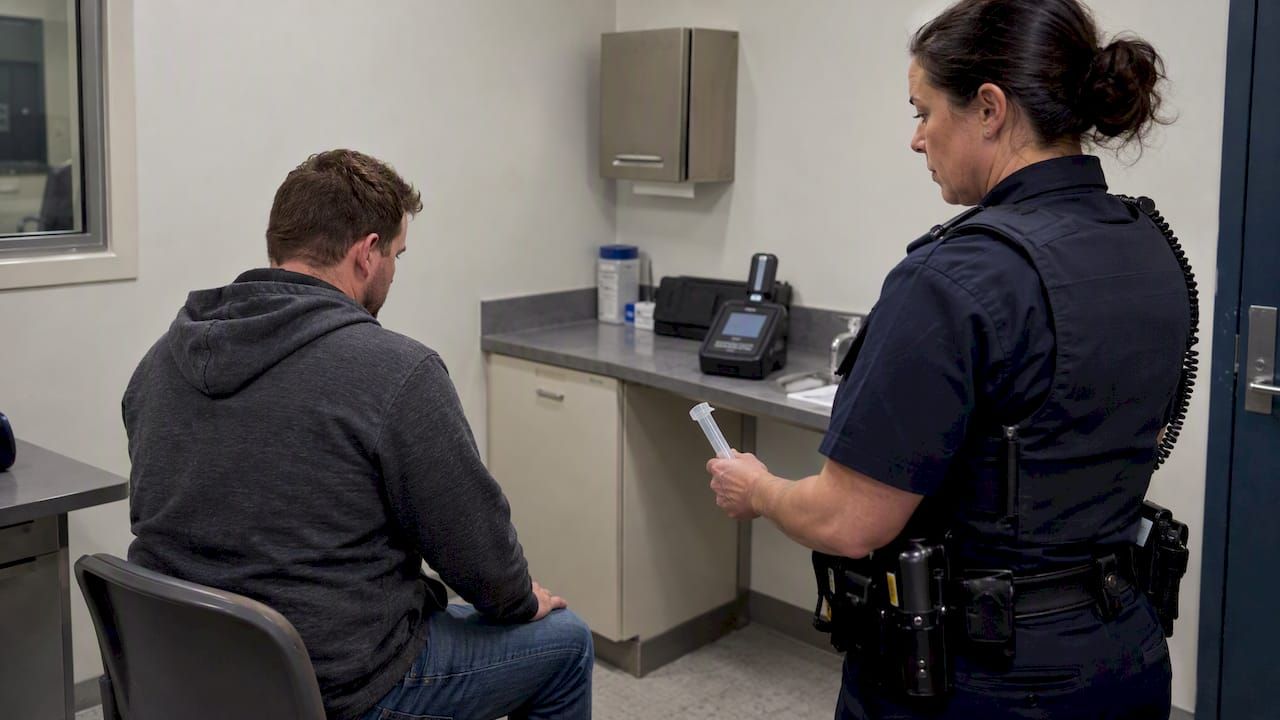
Massachusetts is an implied consent state: if you are lawfully arrested for OUI and refuse the requested chemical test, you face an automatic RMV suspension, a fixed period for a first refusal and longer for repeat refusals. That suspension is administrative, not criminal, but the clock starts immediately. Request an RMV hearing within a limited number of days and talk to Massachusetts OUI counsel promptly.
TL;DR:
- Refusing a chemical test in Massachusetts results in an automatic license suspension based on your OUI history, ranging from months to a lifetime ban.
- You must request an RMV hearing within 15 days to challenge the suspension, and failing to do so generally means the suspension continues unchallenged.
- Blood draws require a warrant or consent; implied consent only broadly covers breath testing, and refusal does not prevent police from obtaining evidence through other legal means.
- A refusal removes the possibility of a per se BAC conviction but does not prevent an impairment case from proceeding with other evidence like witness testimony or dashcam footage.
- Handling both the RMV hearing and criminal defense with an experienced attorney especially during the first 15 days can significantly impact the outcome of your case.
Table of Contents
- What implied consent means under Massachusetts law
- Suspension lengths for refusing a chemical test
- Requesting an RMV hearing within the 15-day window
- Blood draws, warrants, and where implied consent stops
- How a refusal plays out in the criminal case
- Ignition interlock requirements and getting your license back
- Your first 15 days after an arrest and refusal
- An attorney's view on the refusal decision
- How we help with RMV hearings and OUI defense
- FAQ
What implied consent means under Massachusetts law
Under M.G.L. c. 90 §24, anyone who drives on a Massachusetts public way is deemed to have consented to a breath or blood test if a police officer has reasonable grounds to believe they were operating under the influence. That deemed consent is not absolute: the same statutory scheme states that if a driver refuses, no test shall be administered. The officer cannot force the breath tube or force a blood draw simply because the law "presumes" consent.
In practice, breath testing happens at the station shortly after arrest. Blood testing usually requires a medical setting and carries its own legal rules, which we cover below. The most important thing to understand is that implied consent is a condition attached to your driving privilege, enforced by the Registry of Motor Vehicles, not a separate crime. Refusing the test does not add a new charge to your docket. It triggers a license suspension that runs on its own track, independent of whatever happens in criminal court.
Suspension lengths for refusing a chemical test
The RMV suspension for refusal is fixed by statute and scales with your OUI history. These penalties attach automatically once the RMV receives the police report of refusal, regardless of whether you are later convicted or acquitted of OUI.
| Prior OUI offenses | License suspension for refusal |
|---|---|
| None (first refusal) | Several months |
| One prior | Several years |
| Two priors | Several more years |
| Three or more priors | Lifetime |
These figures come directly from the RMV's alcohol and drug suspension guidance, which also makes clear that refusal itself is not a criminal offense. Separate penalties, including fines, probation, and license loss on conviction, can still follow from the underlying OUI case in court. Drivers under 21 face their own suspension rules under a lower legal limit, and those thresholds are detailed in the same RMV guidance rather than in the general adult schedule above.
Requesting an RMV hearing within the 15-day window
You have a limited window from your arrest to request a hearing challenging the refusal suspension, a deadline set out in 540 CMR 11.00. Missing it generally means the suspension simply runs.
- Request the hearing promptly through myRMV or by contacting the Boston/Haymarket hearing office; virtual hearing options are also available.
- Gather your documents before the date, including the police report, booking paperwork, and the names of any witnesses who were present.
- Know the scope : the hearing officer only decides three questions, whether police had reasonable grounds to believe you were operating under the influence, whether you were actually arrested, and whether you refused the test.
- Understand the outcome : if the RMV upholds the suspension, judicial review is available but narrow, limited largely to whether the hearing officer's decision was supported by the record.
This is not a trial on guilt. It is a factual gatekeeping hearing, and preparing for it with an attorney familiar with breathalyzer refusal cases often makes the difference between a short suspension and a successful challenge.
Blood draws, warrants, and where implied consent stops
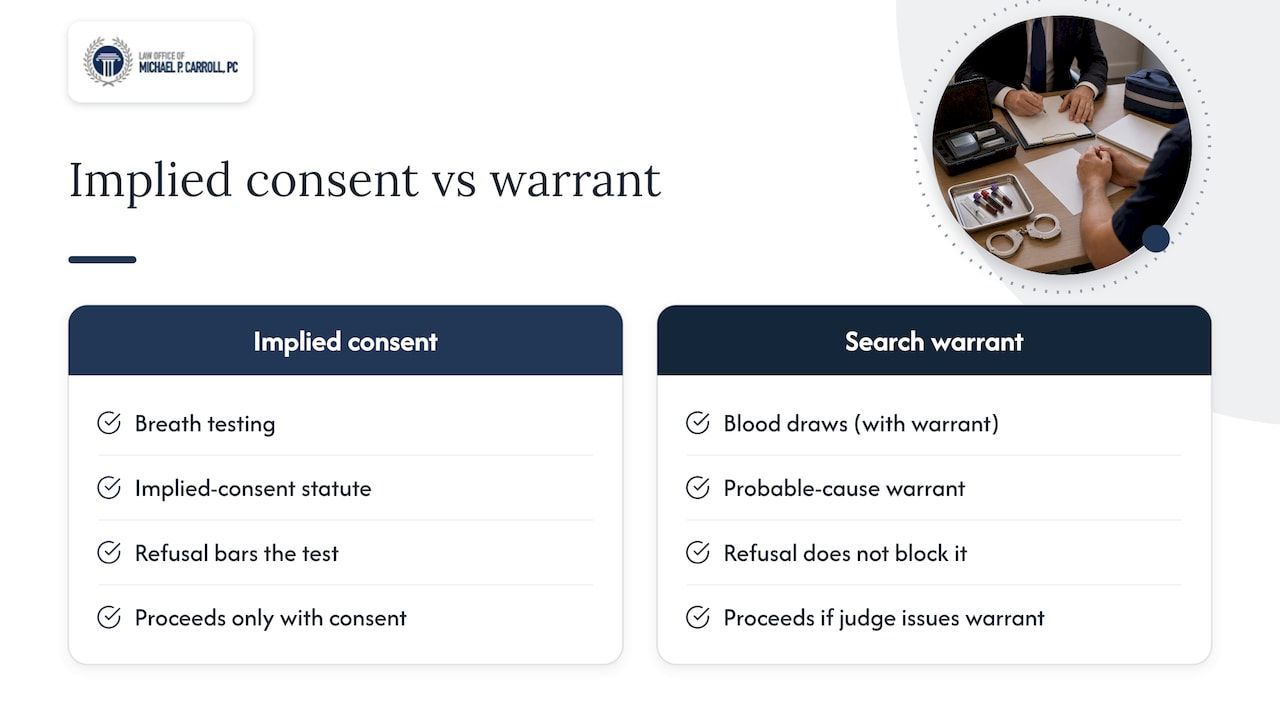
Implied consent covers breath testing fairly broadly, but blood draws sit on different legal footing. Massachusetts courts, including Supreme Judicial Court analysis addressing blood-draw consent, have made clear that the implied-consent statute itself does not authorize police to draw blood without consent. The statute's refusal language works one way: it bars testing when a driver refuses.
A search warrant is a separate legal track entirely. If police obtain a valid warrant, grounded in the usual constitutional showing of probable cause, a blood draw can proceed even though the driver never consented and even though implied consent alone would not have authorized it. The practical result is that refusing a breath test at the scene blocks that specific test, but it does not guarantee that no chemical evidence will ever be collected. Our earlier discussion of blood-draw exceptions in Massachusetts OUI cases walks through how these warrant applications typically unfold.
How a refusal plays out in the criminal case
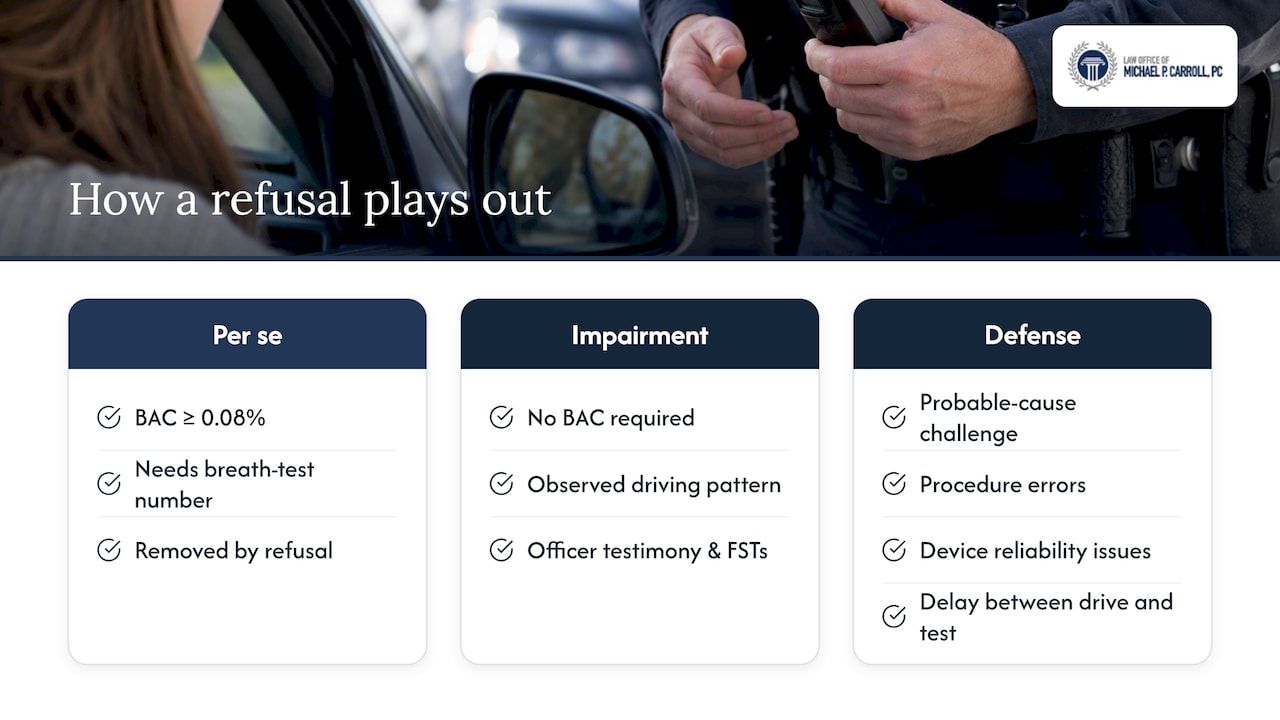
Prosecutors can pursue an OUI conviction under two theories, documented in a report to the Supreme Judicial Court on breath-test evidence: a per se theory built on a blood alcohol content of 0.08% or higher, or an impairment theory built on observed behavior, driving pattern, and officer testimony. A refusal removes the numeric numbers a per se case depends on, but it does not stop an impairment case built on dashcam footage, field sobriety performance, or an officer's account of slurred speech and odor of alcohol.
Defense counsel typically examines several angles after a refusal case comes in: whether the initial stop and arrest had adequate probable cause, whether any test administration procedures were followed correctly, whether a breath device's reliability is in question, and whether delays between driving and testing undermine the Commonwealth's timeline. Some historical breath test results were excluded entirely due to documented issues with certain Alcotest 9510 devices between June 2011 and April 2019, a reminder that device reliability has mattered in real Massachusetts cases before.
Pro Tip: Loop in an attorney before your RMV hearing date, not after, so your hearing testimony and your criminal defense strategy do not undercut each other.
Ignition interlock requirements and getting your license back
Massachusetts requires an ignition interlock device, or IID, for many repeat OUI offenders and for some first-time offenders who obtain a hardship license during a suspension. According to the RMV's ignition interlock program guidance, multiple offenders generally face a multi-year IID participation period, and many drivers must keep the device installed throughout a hardship license period plus additional time after full reinstatement.
Reinstatement generally follows a set sequence: the RMV hearing resolves or the suspension period runs out, you select an RMV-approved interlock vendor, the vendor installs the device and notifies the RMV, you pay the associated fees, and you file the required affidavits. Once you reach the eligible date, you apply for removal. Program violations, such as failed breath samples on the device, can extend your restriction period rather than shorten it. Drivers relocating between states should confirm their vendor operates in both jurisdictions, since credit for out-of-state installation is not automatic. Our separate guide to ignition interlock rules and removal steps covers the vendor and cost details in more depth.
Your first 15 days after an arrest and refusal
- Request your RMV hearing immediately and keep the clock in mind: you have 15 days, not 15 business days.
- Collect your arrest paperwork, booking number, and the names of anyone who witnessed the stop or the station interaction.
- Call Massachusetts OUI counsel before your hearing date so your RMV and criminal strategies stay aligned.
- Do not drive on a suspended license and do not attempt to bypass IID requirements once installed; both create new legal problems on top of the existing suspension.
An attorney's view on the refusal decision
Refusing a breath test is a clean statutory tradeoff: you avoid handing prosecutors a BAC number, but you accept a suspension schedule that is predictable and hard to argue around. Whether that tradeoff helps your criminal case depends entirely on what else exists, dashcam video, field sobriety results, witness statements. We look at that evidence before advising a client on whether refusal made sense, and we manage the RMV hearing and the criminal defense as one coordinated strategy rather than two separate problems.
— Michael Carroll
How we help with RMV hearings and OUI defense
We built our practice around direct attorney access: when you call about an implied consent suspension, you work directly with the attorney, not a rotating staff of case managers. That matters in refusal cases because the RMV hearing and the criminal case move on overlapping timelines, and decisions made in one affect the other.
We handle RMV hearing preparation and representation, petitions for judicial review when a suspension is upheld, full OUI criminal defense strategy, and guidance through ignition interlock and reinstatement requirements. If your license is on the line after a refusal, reach out through our DUI attorney page to schedule a consultation before your 15-day window closes.
- Direct attorney representation from first call to resolution.
- RMV hearing preparation built around the three narrow issues the hearing officer actually decides.
- Coordinated criminal defense and ignition interlock device (IID)/reinstatement guidance under one strategy.
This article is general information, not a substitute for advice from a qualified lawyer. Consult a qualified legal professional about your own circumstances before acting on anything here.
FAQ
What are some examples of implied consent?
Implied consent commonly applies to breath or blood alcohol testing after a lawful OUI arrest, where state law treats driving on public roads as consent to that testing. Outside Massachusetts, some states extend similar implied consent rules to field sobriety testing or drug recognition evaluations, though those categories vary by jurisdiction.
What is the 3-hour rule in MA?
Massachusetts law does not set a strict 3-hour testing deadline the way some states do; instead, timing affects how prosecutors argue BAC evidence back to the time of driving. Delays between the stop and any chemical test can become a point of challenge in a criminal OUI case rather than an automatic bar to the evidence.
What is the implied consent rule?
The implied consent rule holds that a licensed driver is considered to have agreed to chemical testing if lawfully arrested for OUI, but the same law lets the driver refuse at the moment of testing. Refusing avoids the test itself but triggers an automatic RMV suspension rather than a new criminal charge.
Do all 50 states have implied consent?
Every state has some version of an implied consent law tied to chemical testing after a DUI or OUI arrest, though the specific suspension lengths, hearing procedures, and refusal consequences differ significantly by state. A driver facing a refusal case outside Massachusetts, such as in California, should check that state's own statute rather than assume Massachusetts timelines apply.