
Massachusetts Miranda Rights: 4 Warnings, §5A OUI & Juvenile Rules
Massachusetts Miranda Rights: 4 Warnings, §5A OUI & Juvenile Rules
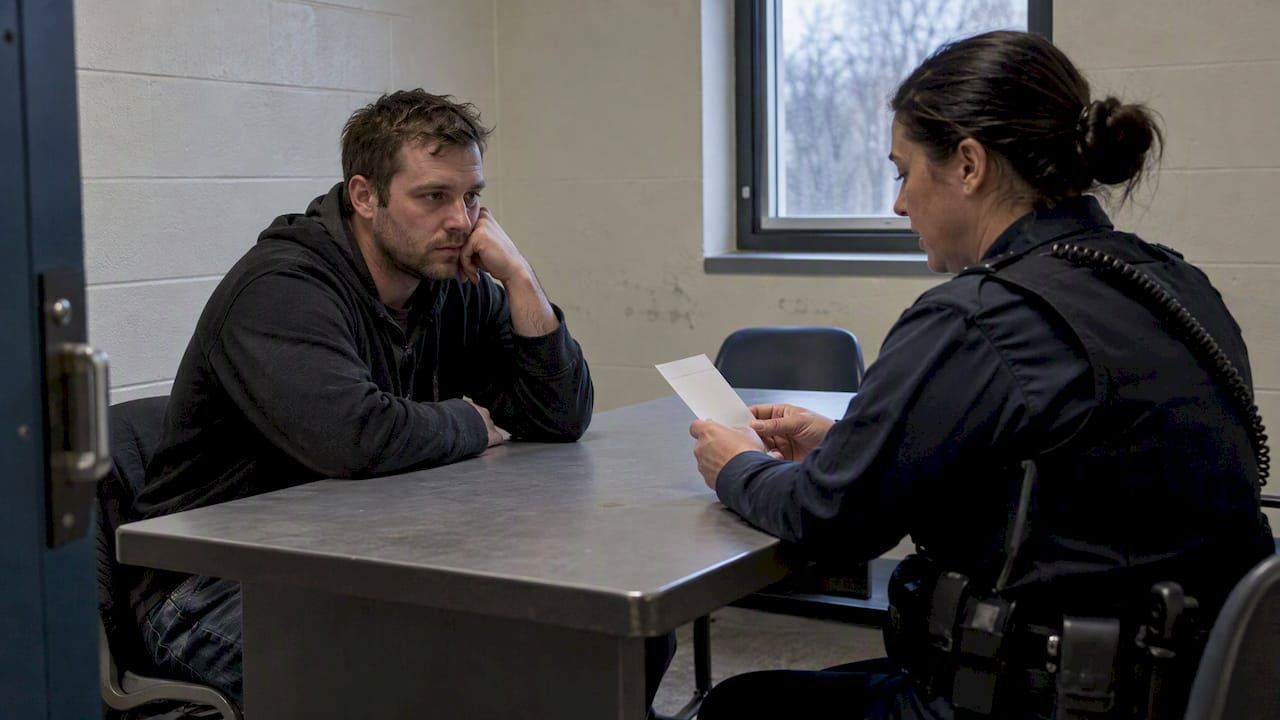
Miranda warnings are required in Massachusetts only when police hold you in custody and intend to question you, and skipping that step can get your statements thrown out of court. Massachusetts also layers in its own rules, including independent protections for OUI arrests at booking. Even when warnings are given correctly, a judge still has to decide separately whether your statement was voluntary.
TL;DR:
- Police only need to read Miranda rights when a person is both in custody and being interrogated; casual questioning or traffic stops are often not custodial.
- Massachusetts requires officers to inform suspects of their rights in a way that conveys the substance, not the exact wording, and failure to do so can lead to suppression of statements.
- During OUI arrests, officers must also inform arrestees of their right to an independent medical exam, separate from Miranda protections, or face potential evidence suppression.
- If police fail to record warnings and interrogations, courts may instruct juries to treat statements with additional caution, affecting their reliability.
- Suspects can protect their rights by clearly invoking silence or legal counsel, documenting the encounter, and immediately consulting an attorney to preserve evidence.
Table of Contents
- The Four Miranda Warnings and Where They Come From
- When Do Police Have to Read You Your Rights in Massachusetts?
- Exceptions: Juveniles, Traffic Stops, and OUI Booking Rights
- What Happens When Miranda Is Not Given or the Waiver Is Flawed
- How to Invoke and Protect Your Rights During a Police Encounter
- An Attorney's View on Miranda Disputes in Massachusetts Cases
- What Your Lawyer Does During and After Miranda Warnings
- How Officers Are Supposed to Document Warnings and Waivers
- Why Direct Access to Your Attorney Matters After an Arrest
- How We Help With Miranda and Arrest Issues in Massachusetts
- FAQ
- Sources
The Four Miranda Warnings and Where They Come From
The Miranda warning traces back to the 1966 Supreme Court case Miranda v. Arizona, and it exists to protect the privilege against self-incrimination found in the Fifth Amendment and echoed in Article 12 of the Massachusetts Declaration of Rights. Before any custodial interrogation can be used against you in court, officers must convey four things as outlined in the Miranda rights:
- You have the right to remain silent.
- Anything you say can and will be used against you in court.
- You have the right to an attorney.
- If you cannot afford an attorney, one will be appointed for you.
Police sometimes add a fifth line letting you know you can stop answering at any time, though that one is not constitutionally required. Officers do not need to recite the warning word for word. Massachusetts evidence guidance confirms that what matters is whether the substance of each right was reasonably conveyed, not whether a script was followed exactly.
When Do Police Have to Read You Your Rights in Massachusetts?
Miranda only applies when two conditions exist at the same time: custody and interrogation. Neither one alone triggers the requirement, which is why so much confusion surrounds traffic stops and casual questioning.
Custody is measured with an objective test: would a reasonable person in your position feel free to leave? You do not need handcuffs or a formal arrest for custody to exist. As Mass.gov's privilege against self-incrimination guidance explains, custody can arise the moment a reasonable person would believe their freedom of movement has been meaningfully restrained.
Interrogation is broader than direct questions. It includes any words or actions by police that they should know are reasonably likely to produce an incriminating response. Courts weigh several factors together:
- Whether you were physically restrained or isolated from others.
- The location: a police station carries more weight toward custody than a roadside stop.
- The officer's tone, language, and whether weapons were drawn.
- Your age, which can affect how a reasonable person in your situation would perceive the encounter.
A routine traffic stop where an officer asks for your license and registration usually is not custodial. The moment that stop turns into prolonged detention, accusatory questioning, or a trip to the station, the custody analysis shifts.
Pro Tip: If you are unsure whether you are free to leave, ask the officer directly. Their answer, and how they respond, becomes part of the custody record later.
Exceptions: Juveniles, Traffic Stops, and OUI Booking Rights
Several situations change how Miranda applies in Massachusetts, and missing these nuances is a common mistake.
- Consensual, noncustodial encounters, like an officer asking general questions in a public place, typically do not require Miranda, but context matters: if the encounter becomes a de facto detention, the analysis changes.
- Age is a recognized factor in the custody analysis. Courts recognize that children and teenagers may feel more pressure to comply with authority than adults would in the same setting, which can tip a borderline encounter into custody.
- For OUI arrests, Massachusetts General Laws chapter 263, section 5A creates a separate protection: arrestees must be informed of the right to an independent medical examination and given a copy of the statute, or it must be posted at the station. This is independent of Miranda, and failure to comply can support suppression or dismissal.
- Spontaneous statements you volunteer without being questioned are generally admissible even without warnings, since Miranda protects against compelled responses to interrogation, not statements you offer on your own.
What Happens When Miranda Is Not Given or the Waiver Is Flawed
The main consequence of a Miranda violation is suppression: a judge can exclude custodial statements obtained without proper warnings from the prosecution's case. This is decided as a preliminary legal question, and under Massachusetts guidance on confessions and admissions, the judge must be convinced beyond a reasonable doubt that warnings were given and properly waived before any custodial statement comes in.
- Suppression is the primary remedy, decided by the judge before trial, not by the jury.
- When interrogation happens at a police station or other detention site and is not recorded, Massachusetts courts may give a cautionary jury instruction known as a DiGiambattista instruction, telling jurors to weigh the statement's reliability with caution.
- In limited situations, a statement excluded from the prosecution's main case can still be used to challenge your credibility if you testify, though this impeachment use is narrow and fact dependent.
- A valid Miranda waiver and a voluntary statement are two separate questions. Even if you waived your rights, the court still examines whether police used coercive tactics, prolonged isolation, or pressure that made the statement involuntary regardless of the waiver.
How to Invoke and Protect Your Rights During a Police Encounter
What you say, and how clearly you say it, matters as much as whether you were warned.
- State your intent clearly: "I am invoking my right to remain silent" or "I want a lawyer" are unambiguous and effective.
- Stop talking after you invoke. Silence alone can be read as ambiguous by police, so pair it with a clear verbal statement first.
- Do not try to explain your way out of the situation once you have invoked. Continued answers after invoking can undercut the protection.
- After the encounter, write down officer names or badge numbers, the time and location, any witnesses, and whether you noticed recording equipment.
- Contact an attorney as soon as possible, and preserve anything that documents the encounter, including phone recordings, texts, or photos, since this evidence often supports a suppression motion.
Pro Tip: Say the words out loud, even if you feel it is obvious. "I'm not answering any more questions" leaves no room for police to argue your silence was just a pause.
An Attorney's View on Miranda Disputes in Massachusetts Cases
In practice, Miranda disputes rarely turn on whether the warning card was read. They turn on the custody and interrogation facts surrounding it: how long someone was held, what was said before any warning, and whether the interrogation was recorded. In OUI cases, we routinely check booking paperwork for §5A compliance, since a missing medical exam notice can support suppression independent of any Miranda issue. Early attorney involvement matters because recordings, witness statements, and timelines can disappear quickly after an arrest.
Pro Tip: If you believe your rights were violated during an arrest, preserve evidence immediately and avoid discussing the case with anyone besides your attorney.
— Michael Carroll
What Your Lawyer Does During and After Miranda Warnings
Once Miranda becomes relevant to a case, defense counsel's role shifts into fact gathering and legal argument. If you invoke your right to an attorney during questioning, police are required to stop the interrogation until counsel is present or you reinitiate contact yourself. After an arrest, an attorney reviews whether warnings were given at the right moment, whether the waiver was knowing and voluntary, and whether anything said before the formal warning should have triggered one earlier.
Counsel also examines the broader context judges consider under Massachusetts's humane practice standard for confessions: the interrogation setting, how long questioning lasted, whether promises or threats were used, and whether the suspect's responses suggest genuine understanding of the warnings. Building a suppression motion means reconstructing a timeline, from the initial stop through transfer to the station, and comparing it against any available recordings or body-camera footage. For readers who want more detail on filing these motions, our guide to Massachusetts suppression motions walks through the practical steps.
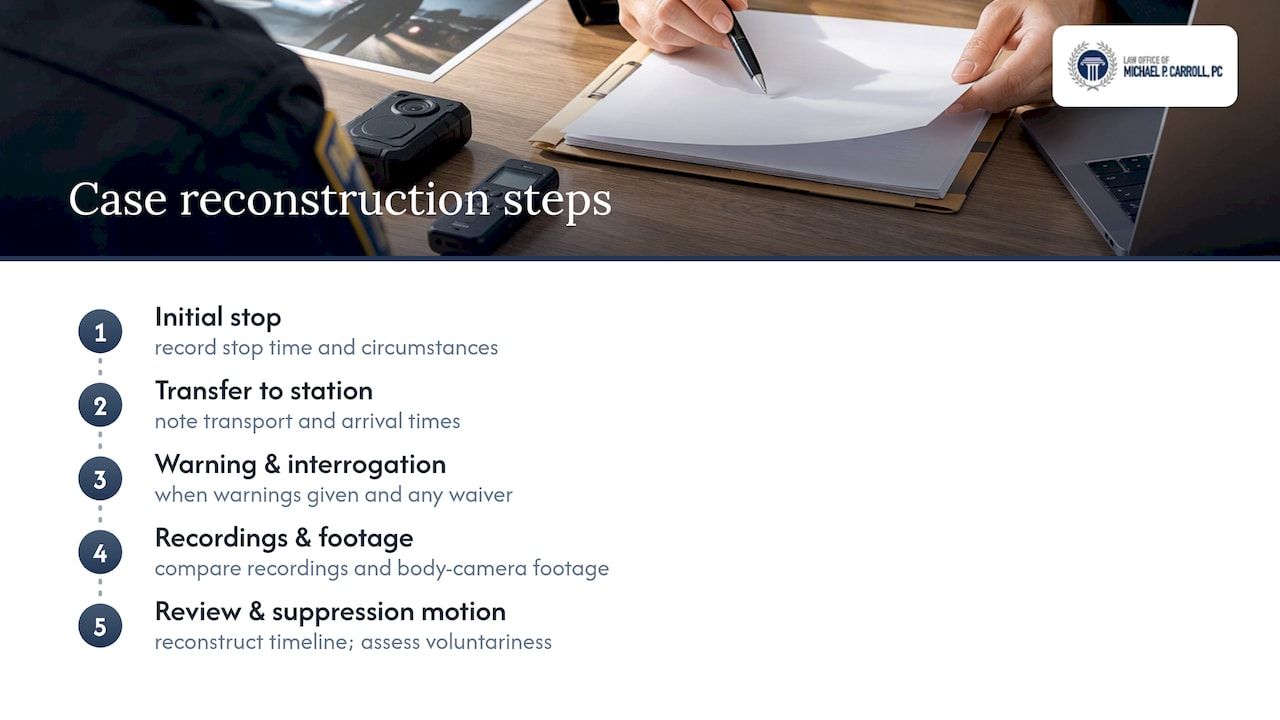
Beyond the warning itself, counsel also protects you at every stage that follows, including advising against further statements, managing contact with investigators, and preparing for what happens procedurally once charges are filed. Our overview of what happens after an arrest in Massachusetts and our explanation of what to expect at a Massachusetts arraignment cover the stages that typically follow a Miranda dispute.
How Officers Are Supposed to Document Warnings and Waivers
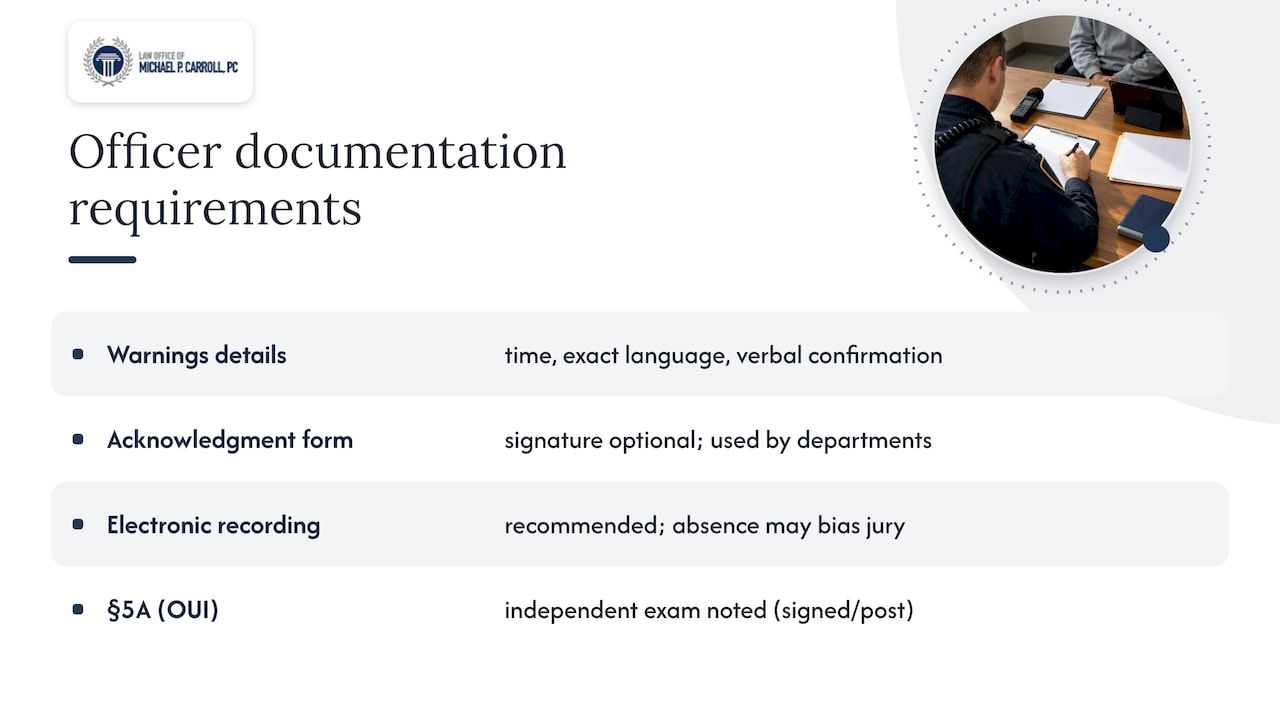
Proper documentation matters because it becomes the evidence a judge relies on when deciding whether a waiver was valid. Officers are generally expected to note the exact time warnings were given, the specific language used, and whether the suspect verbally confirmed understanding each right. Many departments use a printed Miranda card or form that the suspect can sign to acknowledge the warning and waiver, though a signature is not legally required for a valid waiver.
Recording the encounter has become increasingly significant. Under the DiGiambattista framework referenced in Massachusetts guidance on admissions, when police fail to electronically record an interrogation at a station or other place of detention, courts may instruct the jury to weigh the resulting statement with added caution. That creates a strong incentive for departments to record both the warning and the subsequent interrogation in full.
For OUI arrests specifically, documentation extends beyond Miranda. Section 5A requires that booking records show the arrestee was informed of the right to an independent medical exam, either through a signed acknowledgment or a posted notice at the station. Gaps in this documentation are something defense attorneys look for closely, since they can support suppression of breath test results even when Miranda itself was handled correctly.
Why Direct Access to Your Attorney Matters After an Arrest
When your rights are on the line, you deserve to talk directly with the attorney handling your case, not a rotating cast of staff. We built our practice around the principle of ensuring clients work directly with their attorney from the first conversation. Bring your arrest paperwork, booking documents, and any recollection of what was said before and after any warning to your first consultation. Reach out early, before details fade.
How We Help With Miranda and Arrest Issues in Massachusetts

If you were questioned after an arrest in Massachusetts and are not sure your rights were handled correctly, we can review the facts and tell you honestly where your case stands. Our practice handles criminal defense across misdemeanors and felonies, along with focused OUI defense where §5A booking violations and Miranda issues frequently overlap. For readers facing a breath test refusal alongside Miranda questions, our breathalyzer refusal guide covers the related penalties. An initial consultation covers the timeline of your arrest, whether warnings were given at the right moment, and whether grounds exist for a suppression motion. Call our office or request a consultation through our criminal law page to get a straight answer about your options.
This article is general information, not a substitute for advice from a qualified lawyer. Consult a qualified legal professional about your own circumstances before acting on anything here.
FAQ
Can a cop handcuff you without reading your rights?
Yes. Handcuffing relates to physical restraint during an arrest, while Miranda warnings are only required before custodial interrogation begins. Police can lawfully arrest and restrain you first and still be within the law if they do not question you until after warnings are given.
What are the 5 Miranda warnings?
The four constitutionally required components are the right to remain silent, the warning that anything said can be used in court, the right to an attorney, and the right to an appointed attorney if you cannot afford one. Some departments add a fifth, optional line noting that you can stop answering questions at any time.
Is Massachusetts a stop and identify state?
Massachusetts does not have a general stop and identify law requiring you to show identification during a routine stop, though specific circumstances like traffic stops carry their own license and registration requirements. Whether you must answer questions at all depends on the nature of the stop and whether you are in custody.
What is a violation of Miranda rights?
A Miranda violation occurs when police conduct a custodial interrogation without first giving the required warnings, or question you further after you clearly invoke your right to silence or an attorney. The usual remedy is suppression of the resulting statements, decided by a judge before trial, as described in Massachusetts guidance on confessions and admissions.