
Arrested in Massachusetts: What Happens Next
Arrested in Massachusetts: What Happens Next

TL;DR:
- After an arrest in Massachusetts, a strict sequence of legal steps begins, including booking, arraignment, and trial. Understanding each stage helps protect your rights, from preliminary procedures to bail conditions and court appearances. Violating bail or missing court dates can worsen your situation, so early legal guidance is crucial.
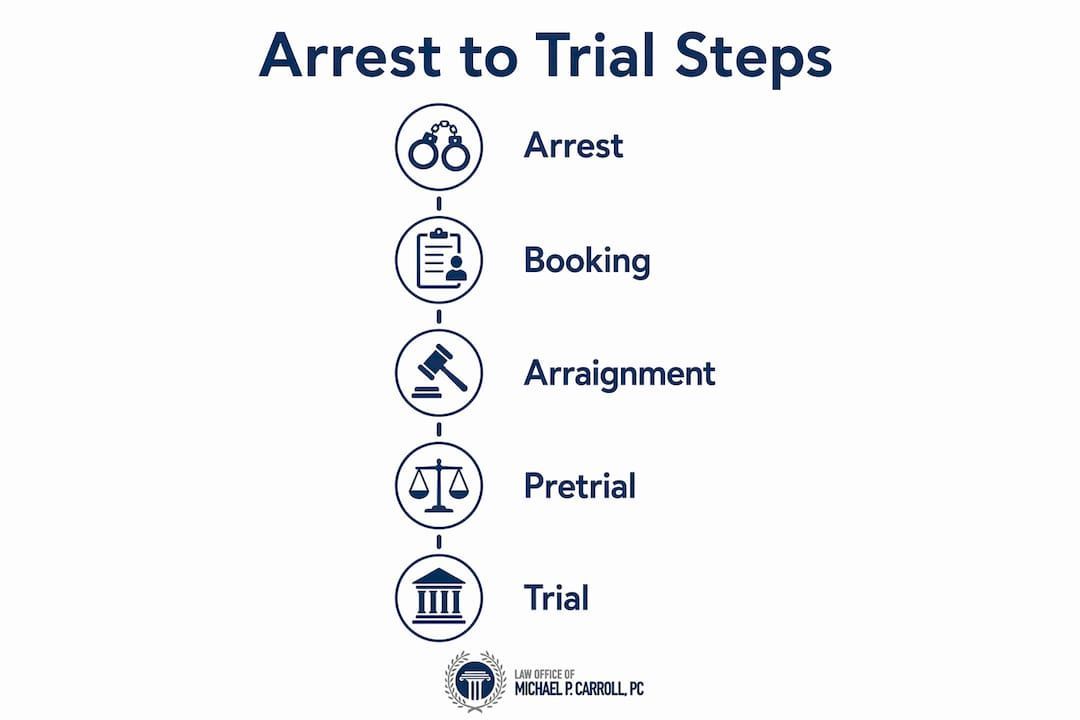
An arrest in Massachusetts triggers a legally mandated sequence of events, beginning with booking and ending with sentencing or case resolution. What happens after you are arrested in Massachusetts is governed by M.G.L. c. 276, which sets out arrest authority, booking procedures, and pretrial rights. The process moves through distinct stages: booking at the police station, arraignment before a judge, bail determination, pretrial conferences, and potentially trial. Knowing each stage protects your rights and helps you make informed decisions from the moment you are taken into custody.
What happens after you are arrested in Massachusetts?
The post-arrest process in Massachusetts begins the moment an officer takes you into custody. A lawful arrest requires either a warrant based on probable cause or a warrantless arrest supported by probable cause. From that point, the law sets a clear sequence of steps that every arrested person moves through, regardless of the charge.
The key stages are:
- Booking: Fingerprinting, photographing, and personal data collection at the police station
- Arraignment: First court appearance where charges are read and bail is addressed
- Pretrial process: Discovery, conferences, and possible plea negotiations
- Trial or disposition: Resolution by plea, dismissal, or jury/bench trial
- Sentencing: If convicted, a judge applies the Massachusetts Sentencing Commission guidelines
Each stage carries specific rights and deadlines. Missing a court date or violating a bail condition can make your situation significantly worse. Understanding the full sequence from the start is the most direct way to protect yourself.
What happens at booking and initial police processing?
Booking is the first formal step after arrest. After arrest, individuals are booked and may be released or held until arraignment. If you need medical attention, officers take you to a hospital first before completing the booking process.
At the police station, booking involves:
- Fingerprinting and photographing (your "mugshot")
- Collection of personal information including name, address, and date of birth
- Inventory and storage of your personal belongings
- Possible medical screening
- Entry of your information into the criminal records system
Officers are required to read you your Miranda rights before any custodial interrogation. Miranda warnings cover your right to remain silent and your right to an attorney. These rights exist to prevent self-incrimination, and exercising them is not an admission of guilt.
Pro Tip: Say nothing beyond basic identifying information until you have spoken with an attorney. Anything you say during booking can be used against you in court, even casual conversation.
After booking, you are either held in custody or released, depending on the charge and your criminal history. For minor offenses, police may issue a citation and release you. For more serious charges, you remain in custody until arraignment.
How does arraignment work in Massachusetts?
Arraignment is your first official court appearance. Arraignment sets the ground rules for the case: charges are formally read, you enter a plea, and the judge addresses bail. Arraignment typically occurs within 24 hours of arrest on business days.
At arraignment, you can expect the following:
- The judge reads the formal charges against you
- You enter a plea, almost always "not guilty" at this stage
- The prosecutor argues for bail or detention
- Your attorney argues for release or lower bail
- The judge sets bail conditions or releases you on personal recognizance
- The court schedules the next hearing date
| Arraignment element | What it means for you |
|---|---|
| Charges read | You learn the exact offenses the state is pursuing |
| Not guilty plea | Preserves all defense options; standard procedure |
| Bail determination | Sets the financial or conditional terms of your release |
| Next court date | Starts the pretrial clock; missing it triggers a warrant |
Entering a not guilty plea at arraignment is standard procedure, not a moral statement. Legal experts emphasize this step is necessary regardless of the evidence, because it preserves every defense option available to you. Pleading guilty at arraignment eliminates your ability to negotiate, challenge evidence, or pursue dismissal.
Pro Tip: Never enter a guilty plea at arraignment without first consulting a criminal defense attorney. The arraignment stage is too early to evaluate the full strength of the prosecution's case.
What are the pretrial steps between arraignment and trial?
The period between arraignment and trial is where most cases are actually resolved. Pretrial conferences allow defense and prosecution to discuss plea deals or case resolutions before trial. If no agreement is reached, the case proceeds to a full trial.
-
Discovery: Your attorney requests all evidence the prosecution holds, including police reports, witness statements, video footage, and lab results. Reviewing this material is how your defense team identifies weaknesses in the state's case.
-
Pretrial motions: Your attorney may file motions to suppress evidence obtained unlawfully, dismiss charges for procedural errors, or exclude certain testimony. A successful suppression motion can end a case before trial.
-
Pretrial conference: Defense and prosecution meet, often with the judge, to discuss the status of the case. This is where plea negotiations typically happen in a structured setting.
-
Diversion programs: For first-time offenders or certain charge types, Massachusetts courts offer diversion programs. Completing a program can result in charges being dismissed entirely.
-
Plea agreement or trial: If negotiations produce an acceptable offer, you can accept a plea deal. If not, the case moves to a bench trial or jury trial.
The timeline from arraignment to resolution varies widely. Simple cases may resolve in a few months. Complex felony cases can take a year or longer. Staying in close contact with your attorney during this period is the most effective way to stay informed and prepared.
How does bail work in Massachusetts?
Bail in Massachusetts is governed by M.G.L. c. 276 and is designed to secure your appearance at future court dates, not to punish you. The judge weighs factors including the severity of the charge, your criminal history, ties to the community, and flight risk.
Massachusetts recognizes three primary forms of release:
- Personal recognizance: You are released on your promise to appear. No money changes hands.
- Cash bail: You or a family member pays a set amount to the court. The money is held until the case ends.
- Conditional release: You are released subject to specific conditions such as no-contact orders, GPS monitoring, curfews, or travel restrictions.
Bail money is held by the court until case resolution. If you comply with all conditions and appear at every hearing, the money is returned at the end of the case. If you miss a court date, the court forfeits the bail and issues a warrant for your arrest.
Conditions of release can include no-contact orders, GPS monitoring, curfews, substance abuse treatment, or travel restrictions. Violating any condition is treated seriously and may result in immediate re-arrest and detention without bail.
Pro Tip: Read every bail condition carefully before leaving the courthouse. Violating a condition, even unintentionally, can result in detention for the remainder of your case.
What rights should you know immediately after arrest?
Your legal rights after arrest are specific and immediate. The Fifth Amendment right to remain silent and the Sixth Amendment right to counsel both apply from the moment of arrest. Exercising these rights is not obstruction. It is the law working as intended.
The rights that matter most in the hours after arrest:
- Right to remain silent: You are not required to answer questions beyond providing basic identifying information. Invoke this right clearly by saying, "I am invoking my right to remain silent."
- Right to an attorney: You have the right to speak with a criminal defense attorney before answering any questions. If you cannot afford one, the court appoints a public defender.
- Right to know the charges: You must be informed of the charges against you within a reasonable time.
- Right to a phone call: Massachusetts law gives arrested individuals the right to make a phone call to notify a family member or attorney.
The most common mistake people make after arrest is talking. Officers are trained to build rapport and encourage conversation. Statements made during that conversation become evidence. The second most common mistake is consenting to searches without legal advice. Neither silence nor refusing a search can be used as evidence of guilt.
Key Takeaways
The post-arrest process in Massachusetts follows a fixed legal sequence, and knowing each step is the most direct way to protect your rights and your case.
| Point | Details |
|---|---|
| Booking comes first | Fingerprinting, photographing, and data collection happen before any court appearance. |
| Arraignment sets the terms | Charges are read, a not guilty plea is entered, and bail is determined at this first hearing. |
| Pretrial is where cases resolve | Most cases end through plea deals or motions before trial, not in the courtroom. |
| Bail conditions are binding | Violating any release condition can result in immediate re-arrest and loss of bail money. |
| Silence protects you | Invoking your right to remain silent and requesting an attorney are the two most protective actions after arrest. |
What I tell every client at the start
The first thing I tell anyone who calls me after an arrest is this: the process feels designed to confuse you, and that confusion works against you. Most people assume that cooperating fully and explaining themselves will help. In my experience, it rarely does. Statements made in the hours after arrest, before anyone has reviewed the evidence, are almost always more damaging than helpful.
The not guilty plea at arraignment is the single most misunderstood step in the process. Clients sometimes hesitate because they think it signals something. It signals nothing except that you are protecting your legal options. Every experienced defense attorney enters that plea as a matter of course. The facts of the case get evaluated later, after discovery, after motions, after the full picture is clear.
Bail conditions are the other area where I see people get into serious trouble. A no-contact order sounds straightforward until a family member reaches out and you respond. That response can land you back in custody. Read every condition. Follow every condition. The cost of a single violation is almost always higher than the inconvenience of strict compliance.
The clients who do best are the ones who engage an attorney early, say nothing to police without counsel present, and treat every court date and bail condition as non-negotiable. That is not a theory. That is what the outcomes show.
— Michael Carroll
Facing charges? Law Office of Michael P Carroll can help
An arrest does not determine the outcome of your case. The decisions made in the hours and days that follow do.

Law Office of Michael P Carroll represents individuals in Bristol, Norfolk, and Plymouth Counties through every stage of the criminal process, from booking through sentencing. Michael Carroll works directly with each client, reviewing the evidence, challenging the prosecution's case, and building a defense tailored to the specific facts. Whether you are facing a first offense or a serious felony, early legal representation changes outcomes. Contact the Law Office of Michael P Carroll to discuss your case and understand your options before your next court date.
FAQ
What happens immediately after arrest in Massachusetts?
After arrest, you are transported to a police station for booking, which includes fingerprinting, photographing, and personal data collection. You may be held until arraignment or released, depending on the charge.
How long before arraignment after arrest in Massachusetts?
Arraignment typically occurs within 24 hours of arrest on a business day. If arrested on a weekend or holiday, you may wait until the next court day.
Can I be released before arraignment?
For minor offenses, police may release you with a citation before arraignment. For more serious charges, you remain in custody until a judge addresses bail at arraignment.
What does a not guilty plea at arraignment mean?
A not guilty plea at arraignment is a standard procedural step that preserves all defense options. It is not an admission about the facts of the case.
What happens if I violate bail conditions in Massachusetts?
Violating bail conditions can result in immediate re-arrest, detention for the remainder of the case, and forfeiture of any bail money paid to the court.