
Bail on Domestic Violence Charges: What to Expect
Bail on Domestic Violence Charges: What to Expect

TL;DR:
- Bail in domestic violence cases involves a court-ordered release with strict conditions designed to protect victims and ensure court appearances.
- These conditions, such as no-contact and stay-away orders, are legally binding and can significantly restrict daily life and employment.
- Defendants can seek modifications through legal motions, but early legal counsel is crucial to avoid unnecessary restrictions and future violations.
Bail on domestic violence charges is a court-ordered release process that sets a bond amount and strict conditions designed to protect the alleged victim while ensuring the defendant appears in court. After a domestic violence arrest, you will not simply walk free. A judge decides whether to release you, and under what terms, at a bond hearing typically scheduled within 24 to 48 hours of your arrest. Those first hours shape everything that follows, from where you can live to whether you can contact your children. Understanding this process before you walk into that courtroom is not optional. It is the foundation of your defense.
What happens at a domestic violence bail hearing?
A bond hearing is the first formal courtroom event after a domestic violence arrest. The judge reviews the charges, hears arguments from both the prosecutor and your defense attorney, and then decides whether to release you and on what terms.
Judges weigh several factors when setting bond amounts:
- Severity of the charge. Felony domestic violence charges carry higher bond amounts than misdemeanors. A first-time misdemeanor charge may result in a relatively modest bond, while a felony assault charge can push bond into the tens of thousands of dollars.
- Criminal history. Prior domestic violence arrests or convictions signal elevated risk to the court. Judges treat repeat defendants far more cautiously.
- Risk to the alleged victim. Prosecutors present evidence of threats, prior incidents, or restraining order violations. This evidence directly influences bond amounts and conditions.
- Flight risk. Ties to the community, employment status, and family connections all factor into whether the court believes you will appear for future hearings.
- Dangerousness assessment. In serious cases, prosecutors may request a formal dangerousness hearing, which can result in bail denial for up to 120 days. This is not a routine step, but it is a real risk when the charges involve serious bodily harm or a restraining order violation.
Prosecutors in domestic violence cases operate under no-drop policies in many jurisdictions. This means they pursue charges regardless of whether the alleged victim cooperates or requests dismissal. That posture affects bail hearings directly. Prosecutors argue for higher bonds and stricter conditions because they are committed to the case regardless of victim participation.
Pro Tip: Bring documentation of your employment, community ties, and any prior clean record to your bond hearing. Your attorney can present this evidence to argue for lower bond and less restrictive conditions.
Common bail conditions in domestic violence cases
Courts impose conditions on domestic violence defendants as a matter of course. These conditions are not suggestions. They are legally binding orders, and violating any one of them can result in immediate arrest and new criminal charges.
The most common conditions include:
- No-contact orders. These prohibit all direct and indirect contact with the alleged victim, including texts, emails, phone calls, social media messages, and contact through third parties such as friends or family members.
- Stay-away orders. You may be ordered to stay a specific distance from the alleged victim's home, workplace, school, or any location they regularly visit.
- Firearm surrender. Courts routinely require defendants to surrender all firearms and ammunition. Federal and state laws both support this requirement in family violence cases.
- Electronic monitoring. In higher-risk cases, GPS ankle monitors track your location around the clock.
- Travel restrictions. You may be prohibited from leaving the state or a specific geographic area without prior court approval.
- Alcohol and drug prohibitions. Courts frequently ban alcohol and drug use as a condition of release, particularly when substance use is alleged to have played a role in the incident.
Violating a no-contact order is a separate criminal offense, even if the alleged victim initiates the contact. Courts do not recognize informal agreements between the parties. If the order says no contact, any contact at all, regardless of who starts it, can result in new charges and immediate bond revocation.
The breadth of these conditions surprises most defendants. A no-contact order does not just mean you cannot call. It means you cannot like a social media post, send a message through a mutual friend, or ask a family member to relay information.
How bail conditions affect your daily life
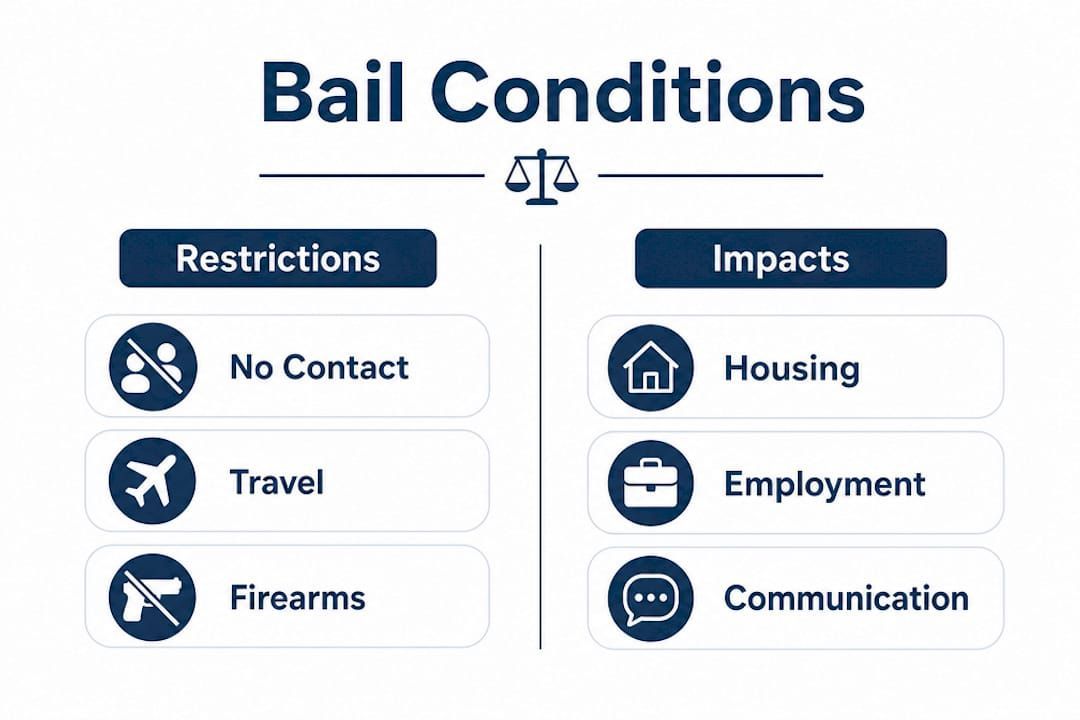
The practical impact of domestic violence bail conditions begins within hours of your arrest. Protective orders issued at bail hearings can force you out of your own home before any evidence has been tested or any trial has occurred. If the alleged victim lives in your residence, you may be required to leave immediately, regardless of whose name is on the lease.

The table below summarizes the most significant real-world consequences of common bail conditions:
| Bail Condition | Practical Impact |
|---|---|
| No-contact order | Cannot discuss children, shared property, or finances directly with the alleged victim |
| Stay-away order | May lose access to your home, children's school, or workplace if victim is present |
| Firearm surrender | Must relinquish all firearms, including those used for work or sport |
| Electronic monitoring | GPS ankle monitor restricts travel and signals your location to authorities |
| Alcohol prohibition | Any alcohol use, even at a private event, constitutes a violation |
The firearm issue deserves particular attention. Under the Lautenberg Amendment, a misdemeanor domestic violence conviction triggers a permanent federal ban on firearm possession. Many defendants accept plea deals without understanding this consequence. A misdemeanor plea that feels minor in the moment can end a career in law enforcement, the military, or security permanently.
Employment consequences extend beyond firearms. Electronic monitoring and travel restrictions can make it impossible to report to work, attend job sites in other states, or maintain professional licenses that require travel. Custody arrangements can collapse overnight when a no-contact order prevents any communication about your children.
Pro Tip: If a no-contact order prevents necessary communication about shared children, ask your attorney to file a motion to modify release conditions immediately. Courts can carve out limited exceptions for child-related communication through a third party or parenting app.
How can defendants seek modification of bail conditions?
Bail conditions are not permanent. Defendants have the right to challenge conditions that are unnecessarily restrictive, and courts do grant modifications when the argument is well-constructed.
The legal basis for modification rests on the Eighth Amendment's prohibition against excessive bail and the principle that conditions must be the least restrictive necessary to protect the community and ensure court appearance. A motion to modify release conditions must show the court that a less restrictive alternative achieves the same safety goals.
Grounds that courts have found persuasive include:
- The defendant has no prior criminal history and poses a low flight risk.
- The no-contact order prevents necessary co-parenting communication that could be handled through a supervised channel.
- Travel restrictions prevent the defendant from maintaining employment that supports dependents.
- Electronic monitoring is disproportionate to the severity of the charge.
- The alcohol prohibition applies to a case with no allegation of substance use.
Filing a motion to modify requires your attorney to present specific evidence, not just general arguments. Character references, employment records, evidence of stable housing, and documentation of community ties all strengthen the motion. Judges have wide discretion in domestic violence cases, and they are cautious about relaxing conditions. The motion must be precise and grounded in facts specific to your situation.
Defense counsel also plays a critical role at the original bond hearing. An attorney who argues effectively at that first appearance can prevent overly broad conditions from being imposed in the first place. That is far easier than seeking modification after the fact. Coordinating bail condition relief with your broader defense strategy, including whether a domestic violence case can be dismissed at pre-trial, is the most effective approach to protecting your rights.
Key Takeaways
Bail on domestic violence charges sets legally binding conditions that affect housing, communication, firearms, and employment from the moment of release, making early legal counsel the single most important step a defendant can take.
| Point | Details |
|---|---|
| Bond hearing timeline | Judges set bail within 24–48 hours of arrest; some jurisdictions impose mandatory holds before that hearing. |
| Conditions are binding | No-contact and stay-away orders apply immediately and cannot be modified by informal agreement with the alleged victim. |
| Firearm consequences | A misdemeanor conviction triggers a permanent federal firearm ban under the Lautenberg Amendment. |
| Modification is possible | Courts grant condition modifications when defendants show less restrictive alternatives that still protect community safety. |
| Legal counsel is critical | An attorney at the bond hearing can limit overly broad conditions before they disrupt housing, employment, and custody. |
What I've learned from domestic violence bail cases
After handling criminal defense cases for over a decade, the pattern I see most often is this: defendants underestimate how fast bail conditions reshape their lives. They walk out of the bond hearing relieved to be free, and then they violate a condition within 48 hours because they did not fully understand what "no contact" means in practice.
The most common mistake is responding when the alleged victim reaches out first. Defendants assume that if the other person initiates contact, they are in the clear. They are not. Courts do not care who sent the first message. The order applies to you, and only you, regardless of what the other party does. I have seen defendants face new criminal charges for responding to a text from the alleged victim, even when the message was friendly and the defendant had no intent to harass.
The second mistake is waiting to hire an attorney. The bond hearing happens fast, often within a day of arrest. Walking into that hearing without counsel means walking in without a voice. Prosecutors arrive prepared. Judges move quickly. The conditions set at that first hearing can follow you for months.
Compliance is not passive. It requires active attention every day. Know exactly what your order says. Know the geographic boundaries of any stay-away order. Know what counts as indirect contact. If anything is unclear, ask your attorney before you act, not after. The cost of a five-minute phone call to clarify a condition is nothing compared to the cost of a new criminal charge.
— Michael Carroll
Facing domestic violence charges? Get experienced legal help now
Domestic violence bail cases move quickly, and the decisions made in the first 48 hours carry consequences that last for months or years.

The Law Office of Michael P Carroll provides direct, experienced representation at bond hearings and throughout the criminal defense process. Michael Carroll works personally with every client, reviewing the specific facts of each case to argue for fair bail conditions and build a defense strategy from day one. Whether you need help at a bond hearing, want to file a motion to modify release conditions, or need guidance on the full scope of your criminal defense options, the Law Office of Michael P Carroll is ready to help. Contact the firm today to schedule a consultation and get clear answers about your situation.
FAQ
What does "released without bail" mean in a domestic violence case?
Released without bail, also called release on personal recognizance, means the court releases the defendant without requiring a cash bond. The defendant must still comply with all court-imposed conditions, including no-contact orders.
How long can a judge hold someone without bail after a domestic violence arrest?
In jurisdictions with dangerousness hearing procedures, prosecutors can seek to hold a defendant without bail for up to 120 days if the court finds the defendant poses a serious risk of harm.
Can a domestic violence case be dismissed at pre-trial even with a no-contact order in place?
A case can be dismissed at pre-trial through motions challenging evidence, witness availability, or prosecutorial discretion, but the no-contact order remains in effect until the court formally lifts it, regardless of case outcome.
What happens if I violate a bail condition in a domestic violence case?
Violating any bail condition, including a no-contact order, results in immediate arrest, bond revocation, and a separate criminal charge. Courts treat violations seriously regardless of the circumstances.
Can I get bail conditions changed if they prevent me from seeing my children?
A motion to modify release conditions can request limited exceptions for co-parenting communication. Courts may allow contact through a neutral third party or a court-approved parenting application, but approval is not guaranteed.