
Domestic Assault Legal Defense: Your Rights in Massachusetts
Domestic Assault Legal Defense: Your Rights in Massachusetts

TL;DR:
- Domestic assault defenses focus on challenging evidence through self-defense, alibis, or procedural errors.
- Legal consequences extend beyond sentencing, with lifetime firearm bans and deportation risks, especially for non-citizens.
Domestic assault legal defense is the set of legal strategies used to protect individuals charged with assault involving a household or family member, ensuring their constitutional rights are defended at every stage of the criminal process. A charge under Massachusetts General Laws Chapter 265 can trigger arrest within hours, automatic protective orders, and consequences that extend far beyond the courtroom. The Lautenberg Amendment and federal immigration statutes like 8 U.S.C. 1227(a)(2)(E) mean that even a misdemeanor conviction carries lifetime penalties. MPC Law handles these cases in Bristol, Norfolk, and Plymouth Counties, and the pattern is consistent: defendants who engage qualified legal counsel early face significantly better outcomes.
What defense strategies work for domestic assault charges?
The strongest domestic assault legal defense begins with a thorough review of the prosecution's evidence before any court date. Common defense approaches include self-defense, alibi, false accusation, insufficient evidence, and procedural errors. Each strategy requires a different evidentiary foundation, and choosing the right one depends entirely on the specific facts of the case.
Self-defense is recognized under Massachusetts law when a person reasonably believed they faced imminent physical harm and used proportional force to stop it. The key word is "proportional." Striking someone who shoved you once may not qualify, but blocking a sustained attack almost certainly does. Your attorney must show that the threat was real, immediate, and that your response matched the level of danger.
False accusation defenses are more common than many people expect, particularly in cases involving contested custody or divorce proceedings. Defense attorneys examine witness statements, medical records, and body camera footage for inconsistencies that undermine the accuser's credibility. A single contradiction between a 911 call transcript and a police report can shift the entire direction of a case.
Insufficient evidence is a viable defense when the prosecution cannot meet its burden of proof beyond a reasonable doubt. This is not the same as claiming innocence. It means the state's evidence, taken at face value, does not legally establish every element of the charged offense.
- Self-defense: requires proof of imminent threat and proportional response
- Alibi: requires corroborating evidence placing you elsewhere at the time
- False accusation: requires documented inconsistencies in the accuser's account
- Insufficient evidence: requires demonstrating gaps in the prosecution's case
- Procedural errors: requires showing that evidence was obtained or handled improperly
Pro Tip: Request all discovery materials, including body camera footage and 911 recordings, as early as possible. Defense lawyers use these recordings to identify inconsistencies and omissions that can weaken the prosecution's case before trial.
What happens immediately after a domestic assault accusation?
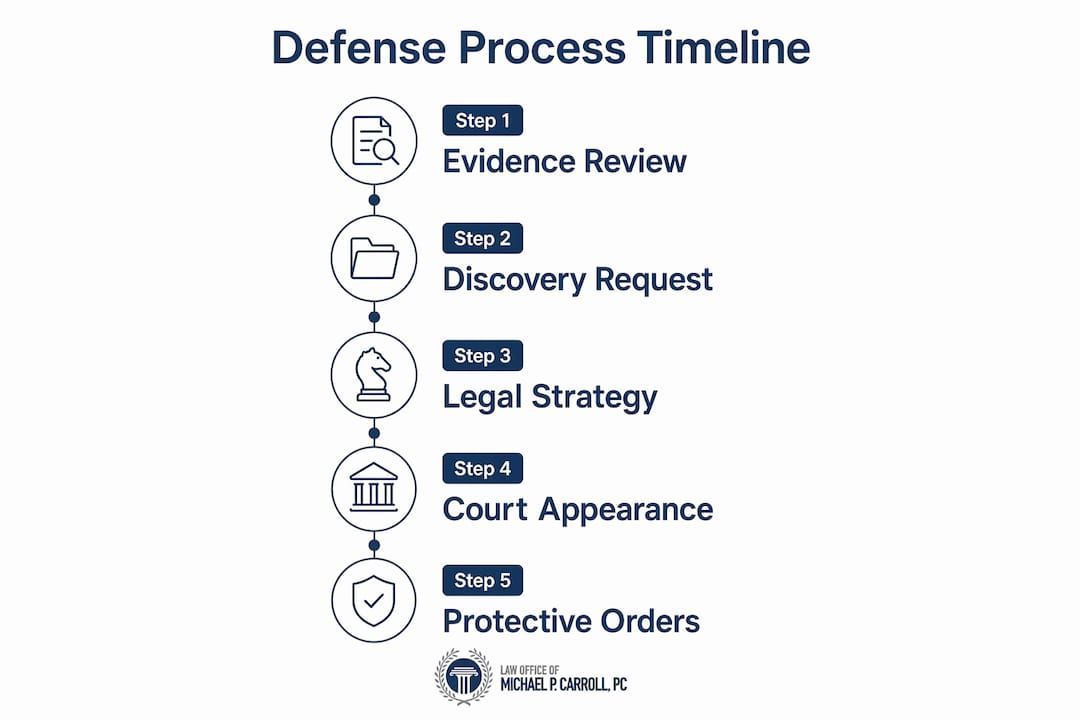
The first 72 hours after a domestic assault accusation are the most legally consequential. Many jurisdictions require mandatory arrests when officers find probable cause for domestic violence, regardless of whether the alleged victim wants the person arrested. Massachusetts follows this policy. The officer's judgment controls the arrest decision, not the complainant's wishes.

After arrest, you will be booked, fingerprinted, and photographed. An initial court appearance typically occurs within one to three days. At arraignment, the judge sets bail and almost always issues a protective order. These orders restrict all contact with the alleged victim, including through third parties and social media, and violations constitute a separate criminal offense.
| Stage | Typical timeline | What happens |
|---|---|---|
| Arrest | Within hours of complaint | Booking, fingerprinting, photographs |
| Arraignment | 1–3 days after arrest | Bail set, protective order issued |
| Protective order | Immediate upon arraignment | No contact with alleged victim |
| Firearm surrender | Within 24 hours of order | Mandatory under Massachusetts law |
| Next hearing | 2–6 weeks after arraignment | Pre-trial conference or motion hearings |
Protective orders can remove you from your own home within hours of release, even if you own the property. That restriction remains in force until a judge modifies or lifts it. Bail conditions may also prohibit firearm possession and require check-ins with pretrial services.
Pro Tip: Read every condition of your release order carefully and follow each one exactly. Violating bail conditions or a protective order leads to immediate re-arrest and additional criminal charges, which makes your original defense significantly harder.
What are the collateral consequences of a domestic assault conviction?
A conviction for domestic assault carries consequences that extend well past any sentence the court imposes. Understanding these consequences before accepting any plea deal is not optional. It is the difference between a manageable outcome and a permanent legal disability.
The most significant federal consequence is the firearm ban under the Lautenberg Amendment. A misdemeanor domestic violence conviction triggers a lifetime prohibition on possessing firearms under 18 U.S.C. 922(g)(9), with no exceptions and no waivers. This ban applies to law enforcement officers, military personnel, and private citizens equally.
For non-citizens, the stakes are even higher. Federal immigration law lists domestic violence as a deportable offense under 8 U.S.C. 1227(a)(2)(E). A plea deal that resolves a criminal case quickly can simultaneously trigger removal proceedings and permanently bar naturalization. This is why non-citizen defendants need both a criminal defense attorney and an immigration attorney working together from the start.
Beyond firearms and immigration, convictions affect:
- Employment: Many licensed professions in Massachusetts, including nursing, teaching, and law enforcement, require background checks that disqualify applicants with domestic violence records.
- Child custody: Family courts treat domestic assault convictions as direct evidence of risk to children, often resulting in supervised visitation or loss of custody.
- Housing: Landlords routinely screen for violent offense convictions, and federally subsidized housing programs bar residents with domestic violence records.
- Record sealing: Massachusetts law limits the ability to seal domestic violence convictions, meaning the record follows you for years even after completing a sentence.
The charge you plead to matters as much as whether you plead at all. Pleading to a lesser offense like disorderly conduct avoids the Lautenberg firearm ban and may reduce immigration exposure. An experienced attorney maps these consequences before any plea negotiation begins.
How do you build a strong domestic assault defense?
Building a strong criminal defense for domestic disputes requires deliberate preparation starting on the day of the arrest. The steps below are not suggestions. Each one directly affects the strength of your case.
- Preserve all communications. Save every text message, email, voicemail, and social media exchange between you and the alleged victim. These records often contradict the prosecution's narrative and establish context the police report omits.
- Do not contact the alleged victim. Attempting to influence a victim can result in witness tampering charges. Prosecutors pursue cases even when victims recant, using 911 recordings and body camera footage as independent evidence.
- Hire a criminal defense attorney immediately. Early legal consultation shapes every decision that follows, from what you say during booking to how you respond at arraignment. Delay costs you options.
- Coordinate immigration counsel if you are not a U.S. citizen. Non-citizen defendants require dual counsel because criminal and immigration law intersect at every stage of a domestic assault case. A plea that looks favorable in criminal court can be catastrophic in immigration proceedings.
- Understand the discovery process. Your attorney will request police reports, 911 call recordings, body camera footage, and witness lists. Reviewing this material thoroughly identifies the inconsistencies that form the core of your defense.
- Do not assume the victim controls the case. Prosecutors control the direction of domestic violence cases, not the alleged victim. Charges proceed based on available evidence even when the complainant refuses to cooperate. Acting on the misconception that the victim can simply "drop charges" leads to costly strategic errors.
Many domestic assault cases resolve through plea negotiations to lesser charges, which avoids the harshest collateral consequences. Plea deals to lesser offenses are common precisely because the collateral consequences of a full conviction, including firearm bans and immigration jeopardy, are so severe. The goal of any defense strategy is to reach the best available outcome given the specific facts, not simply to fight every charge to trial.
Key Takeaways
A strong domestic assault defense requires early legal action, thorough evidence review, and a clear understanding of the collateral consequences that extend far beyond any criminal sentence.
| Point | Details |
|---|---|
| Engage counsel immediately | Early legal consultation shapes every decision from arraignment through plea negotiations. |
| Know the collateral consequences | A misdemeanor conviction triggers a lifetime federal firearm ban and potential deportation for non-citizens. |
| Follow protective orders exactly | Violating any condition of a protective order results in immediate re-arrest and new charges. |
| Preserve all evidence | Text messages, emails, and recordings often contradict the prosecution's account and strengthen your defense. |
| Prosecutors control the case | Alleged victims cannot drop charges; prosecutors pursue cases using independent evidence even when complainants recant. |
What I've learned defending domestic assault cases in Massachusetts
The most damaging mistake I see accused individuals make is treating a domestic assault charge as a personal dispute rather than a criminal case. By the time someone contacts MPC Law, they have often already spoken to police without counsel, violated a protective order by accident, or assumed the alleged victim's change of heart would end the matter. None of those assumptions hold up in a Massachusetts courtroom.
What actually moves cases toward favorable outcomes is a methodical investigation that goes beyond the surface allegations. The police report is a starting point, not the whole story. Body camera footage frequently shows a scene that differs from the written narrative. Witness accounts shift between the initial statement and a formal interview. These gaps are where a defense is built, and finding them requires time, experience, and a willingness to challenge every assumption the prosecution makes.
The intersection of criminal and immigration law is where I see the most serious and irreversible harm. A defendant who accepts a plea without understanding its immigration consequences may resolve their criminal case in a single court appearance and then spend years fighting deportation. That outcome is avoidable with the right counsel from the beginning.
Protective orders also deserve more attention than most defendants give them. The restrictions are broader than people expect, covering indirect contact through friends and family, and the consequences of a violation are immediate and severe. Understanding the full scope of a restraining order from day one prevents a second arrest that complicates an already difficult defense.
Cases do resolve well. Charges get reduced. Evidence gets suppressed. Juries acquit. The path to those outcomes runs through informed, strategic decisions made early, not through hoping the situation resolves itself.
— MPC Law
Facing domestic assault charges in Massachusetts? MPC Law can help.
Domestic assault charges in Bristol, Norfolk, and Plymouth Counties carry serious consequences that require an experienced criminal defense attorney from the first day.

MPC Law has over a decade of experience handling criminal defense cases across southeastern Massachusetts, including domestic assault and battery charges. Michael P. Carroll works directly with every client, reviewing the specific facts of each case and building a defense strategy tailored to the evidence at hand. Whether your case involves a first-time accusation, a protective order dispute, or complex immigration considerations, MPC Law provides focused, direct representation. Contact MPC Law today to discuss your case and understand your options before your next court date.
FAQ
What is domestic assault legal defense?
Domestic assault legal defense is the set of legal strategies used to challenge criminal charges involving alleged assault between household or family members. Defense approaches include self-defense claims, alibi evidence, false accusation arguments, and challenges to the sufficiency of the prosecution's evidence.
Can the alleged victim drop domestic assault charges?
No. Prosecutors, not alleged victims, control whether charges proceed. Prosecutors pursue cases using independent evidence such as 911 recordings and body camera footage, even when the complainant recants or refuses to cooperate.
What is the Lautenberg Amendment and how does it affect me?
The Lautenberg Amendment, codified at 18 U.S.C. 922(g)(9), imposes a lifetime federal ban on firearm possession for anyone convicted of a misdemeanor domestic violence offense. The ban applies with no exceptions and no waivers, regardless of profession or prior record.
What happens if I violate a protective order?
Violating a protective order is a separate criminal offense that results in immediate re-arrest and additional charges. The restriction covers all forms of contact, including indirect communication through third parties and social media.
Do non-citizens face additional risks from a domestic assault conviction?
Yes. Federal immigration law under 8 U.S.C. 1227(a)(2)(E) classifies domestic violence as a deportable offense. Non-citizen defendants should retain both a criminal defense attorney and an immigration attorney from the start to avoid plea agreements that resolve the criminal case but trigger removal proceedings.