
Is a DUI a Felony in Massachusetts? 2026 Guide
Is a DUI a Felony in Massachusetts? 2026 Guide

TL;DR:
- A DUI in Massachusetts is usually a misdemeanor unless it involves serious injury, death, or repeated offenses. The third offense or any with serious harm automatically becomes a felony, with severe penalties including mandatory jail time and long license suspensions. Massachusetts counts all prior convictions forever under Melanie's Law, and the state's separate RMV record always reflects these prior offenses regardless of sealing criminal records.
A DUI in Massachusetts is not automatically a felony. Under Massachusetts General Laws Chapter 90 § 24, first and second offenses are misdemeanors. The charge becomes a felony starting with the third offense, or immediately if the incident causes serious injury or death. Massachusetts uses the term OUI (Operating Under the Influence) as the official legal classification, though DUI and OUI refer to the same offense under state law. Knowing exactly where your charge falls on this scale determines the severity of what you face, from jail time and fines to long-term record consequences.
Is a DUI a felony in Massachusetts? The legal threshold explained
The answer depends on two factors: your prior offense count and the circumstances of the incident. First and second OUI offenses are misdemeanors under Massachusetts law. The third offense is the first that carries automatic felony status, punishable by up to 5 years in state prison.
Two conditions can trigger felony charges even on a first or second offense:
- Serious bodily injury caused by OUI: Charged as a felony regardless of prior history.
- Death caused by OUI: Also charged as a felony from the first offense.
- Third or subsequent OUI conviction: Automatically classified as a felony under Chapter 90 § 24.
- Child endangerment while OUI: Carries enhanced penalties and can escalate charge severity.
Massachusetts enforces a lifetime lookback period under Melanie's Law, enacted in 2005. This means every prior OUI conviction counts toward your offense total, regardless of when it occurred or in which state. A conviction from 20 years ago still counts as a prior offense today. That single rule transforms what might seem like a second offense into a third, pushing the charge from misdemeanor to felony territory.
Pro Tip: If you received a "continuation without a finding" (CWOF) on a prior OUI charge, Massachusetts still counts it as a prior offense under Melanie's Law. Many people do not realize this until they face a new charge.
What are the penalties for misdemeanor vs. felony OUI in Massachusetts?
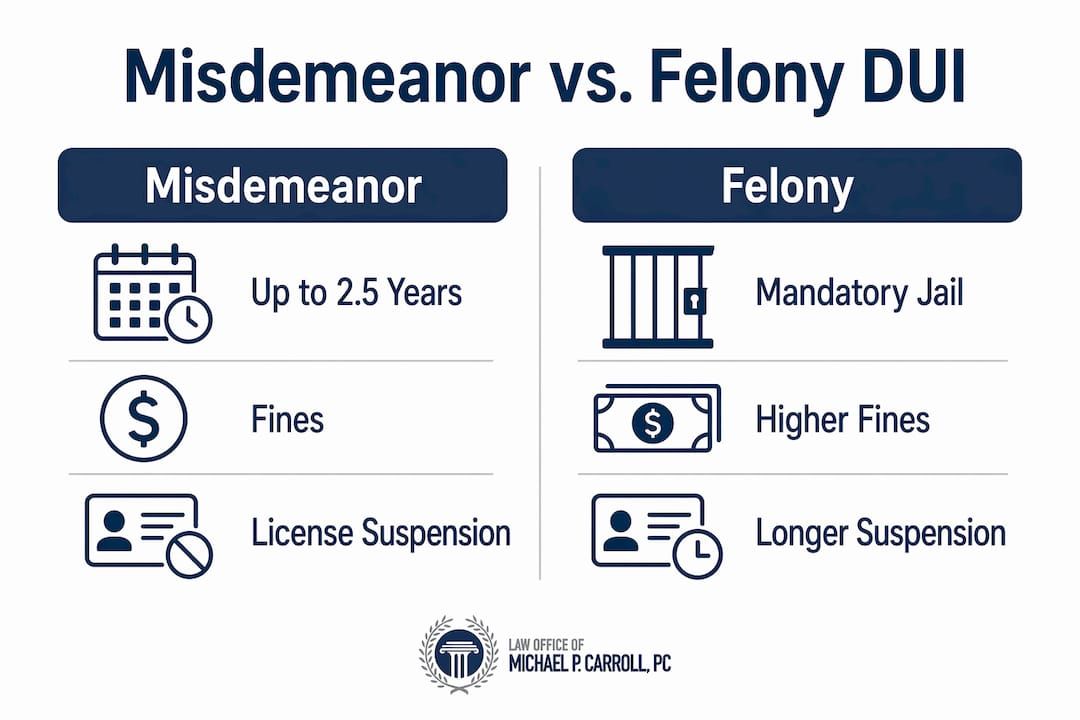
The gap between misdemeanor and felony penalties is significant. Misdemeanor OUI carries up to 2.5 years in a House of Correction. Felony OUI carries up to 5 years in state prison. Those are different facilities with different conditions, and the distinction follows you for life.

| Offense Level | Classification | Jail/Prison | Fine | License Suspension |
|---|---|---|---|---|
| First OUI | Misdemeanor | Up to 2.5 years (often probation) | $500–$5,000 | 1 year |
| Second OUI | Misdemeanor | 60 days–2.5 years | $600–$10,000 | 2 years |
| Third OUI | Felony | 150 days–5 years (mandatory minimum) | $1,000–$15,000 | 8 years |
| Fourth OUI and beyond | Felony | Mandatory minimum increases | Up to $50,000 | 10 years to lifetime |
Felony DUI penalties include mandatory minimum jail time, which courts cannot waive. A judge has no discretion to sentence below the floor. That mandatory minimum for a third offense is 150 days, and it must be served before any parole eligibility applies.
License suspensions for felony OUI are also far longer. An 8-year suspension on a third offense means years without a standard license. Hardship licenses exist but require meeting strict eligibility criteria, and felony charges affect hardship license eligibility in ways that misdemeanor charges do not.
Ignition Interlock Devices (IID) are mandatory for license reinstatement at the second offense and beyond. For felony-level offenses, the IID requirement extends for a longer period after reinstatement. Violating IID conditions resets the clock and can trigger additional license action by the Registry of Motor Vehicles (RMV).
Pro Tip: The fines listed by statute are not the full financial picture. Court fees, probation fees, IID installation and monitoring costs, and increased insurance premiums often exceed the statutory fine itself.
How does a DUI conviction affect your criminal and driving records?
Massachusetts maintains two separate records for OUI convictions, and they operate under completely different rules. Most people charged with OUI do not realize this distinction until it creates a serious problem.
Your CORI (Criminal Offender Record Information) is the criminal record maintained by the state. Misdemeanor OUI convictions can be sealed after 3 years. Felony OUI convictions require a 7-year waiting period before sealing eligibility. Sealing removes the conviction from most background checks, which matters for employment, housing, and professional licensing.
Your RMV driving record is an entirely different matter. DUI convictions remain on the RMV record permanently, regardless of whether the criminal record is sealed. This is the record that courts and prosecutors use to count prior offenses and determine felony classification. Sealing your CORI does not erase the RMV entry.
Key distinctions between the two records:
- CORI records affect employment background checks, housing applications, and professional licenses.
- RMV records affect future OUI charges, license reinstatement eligibility, and insurance rates.
- Sealing a CORI record does not affect the RMV record in any way.
- The RMV tracks OUI convictions separately from criminal courts, with its own permanent retention policy.
The practical consequence is stark. You could seal your criminal record after 3 years and still face a felony charge on a new OUI because the RMV record shows the prior conviction. The lifetime lookback under Melanie's Law applies to the driving record, not the criminal record.
Pro Tip: Before assuming your record is clean, request both your CORI report and your RMV driving record. They are separate documents and tell very different stories.
What steps should you take after a DUI charge in Massachusetts?
The most consequential decision after an OUI charge is how quickly you engage qualified legal counsel. Early consultation with an experienced OUI defense attorney gives you the best opportunity to challenge the charge before the case hardens.
-
Request your full record immediately. Obtain both your CORI and your RMV driving history. Your offense count determines whether you face a misdemeanor or felony, and you need accurate information before any court date.
-
Understand your prior offense history. Under Melanie's Law, prior OUIs from other states and prior CWOFs count. An attorney can review your full history and identify whether the felony threshold actually applies to your specific situation.
-
Challenge the felony classification if warranted. In some cases, prior convictions can be challenged on constitutional grounds, particularly if the original plea was not properly counseled. A successful challenge can reduce a felony charge to a misdemeanor.
-
Comply with all license and IID requirements. Failing to comply with RMV orders during a pending case creates additional legal exposure. Courts and prosecutors view compliance as a factor in sentencing.
-
Plan for the sealing timeline. If a conviction results, understanding the 3-year misdemeanor or 7-year felony waiting period for CORI sealing helps you plan for future employment and housing needs.
-
Engage counsel for RMV hearings. License suspension hearings at the RMV are separate from criminal proceedings. An attorney who handles both the criminal case and the RMV license recovery process gives you coordinated representation.
Pro Tip: Many people assume a first-time charge automatically means a light outcome. That assumption is dangerous. Even a first offense can escalate to felony status if injury occurred. Get legal advice before making any decisions about how to plead.
Key Takeaways
A DUI becomes a felony in Massachusetts at the third offense or when serious injury or death occurs, and the RMV's permanent record means prior convictions always count under Melanie's Law.
| Point | Details |
|---|---|
| Felony threshold | Third OUI offense or any OUI causing serious injury or death triggers felony classification. |
| Lifetime lookback | Melanie's Law counts all prior OUI convictions forever, regardless of age or state. |
| Felony penalties | Third offense carries 150 days mandatory minimum, up to 5 years, and an 8-year license suspension. |
| Two separate records | Sealing your CORI does not remove the OUI from your permanent RMV driving record. |
| Sealing timelines | Misdemeanor OUI is sealable after 3 years; felony OUI requires a 7-year wait. |
What I've learned defending OUI cases in Massachusetts
After more than a decade handling OUI cases across Bristol, Norfolk, and Plymouth Counties, the most damaging misconception I see is this: clients believe that because they sealed their criminal record, their slate is clean. It is not. The RMV record is permanent and completely independent of the CORI. When a new charge arrives, prosecutors pull the driving record, not the sealed criminal file. That prior conviction is right there, and it counts.
The second pattern I see consistently is clients who do not know about the CWOF trap. A continuation without a finding feels like a win at the time. No conviction, no guilty plea. But Massachusetts counts it as a prior offense for OUI purposes. I have represented clients who accepted a CWOF on a first charge, picked up a second OUI years later, and found themselves facing what the law treats as a third offense because of Melanie's Law. The felony threshold arrived faster than anyone expected.
The lifetime lookback is the defining feature of Massachusetts OUI law. It rewards people who stay clean and punishes those who do not, with no statute of limitations. A DUI from 1998 is as relevant today as one from last year. That reality shapes every defense strategy I build. The goal is not just to resolve the current charge. It is to protect the client's record from compounding consequences that follow them indefinitely.
— MPC Law
Facing a DUI charge in Massachusetts? MPC Law can help.
A felony OUI charge carries consequences that reach far beyond the courtroom. License suspensions, mandatory jail time, and a permanent RMV record can affect your employment, your family, and your future for years.

MPC Law, the Law Office of Michael P. Carroll PC, has over a decade of focused experience defending misdemeanor and felony DUI and OUI cases across Bristol, Norfolk, and Plymouth Counties. Michael P. Carroll handles every case personally, from the initial criminal defense strategy through RMV hearings and record sealing support. If you are facing an OUI charge and need to understand your options, contact MPC Law directly for a consultation grounded in real experience with Massachusetts courts.
FAQ
Is a first-time DUI a felony in Massachusetts?
No. A first-time OUI in Massachusetts is a misdemeanor under Chapter 90 § 24, unless the incident caused serious injury or death, which triggers felony charges regardless of offense count.
Is an OUI the same as a DUI in Massachusetts?
Yes. Massachusetts uses the term OUI (Operating Under the Influence) as the official legal classification. DUI and OUI refer to the same offense under state law.
How many DUI offenses trigger a felony in Massachusetts?
The third OUI offense is the first to carry automatic felony status, with a mandatory minimum of 150 days in jail and up to 5 years in state prison.
Does sealing my criminal record remove a DUI from my driving record?
No. Sealing your CORI removes the conviction from most background checks, but the RMV maintains a permanent, separate driving record that is unaffected by criminal record sealing.
What is Melanie's Law and how does it affect felony classification?
Melanie's Law established a lifetime lookback period in Massachusetts, meaning all prior OUI convictions count toward your offense total regardless of when or where they occurred.