
Domestic Charge in Massachusetts: What You Need to Know
Domestic Charge in Massachusetts: What You Need to Know

TL;DR:
- A domestic charge is a criminal accusation for abuse, violence, or coercion within a recognized domestic relationship. Even minor offensive touching qualifies under federal law, and prosecutors can pursue charges without requiring visible injury. Early legal intervention and understanding specific charges are essential to protect rights and avoid long-term consequences.
A domestic charge is a formal criminal accusation alleging abuse, violence, or coercive conduct committed by one person against another within a qualifying domestic relationship. Under federal law (34 U.S.C. § 12291), even slight offensive touching qualifies as physical force, meaning visible injury is not required for charges to proceed. Massachusetts courts treat these accusations seriously, and the consequences extend far beyond a court date. Whether you are facing an accusation or trying to understand what a loved one is going through, knowing the legal framework is the first step toward protecting your rights.
What behaviors and relationships trigger a domestic charge?

A domestic charge arises when alleged abusive conduct occurs within a legally recognized domestic relationship. The relationship between the parties is what separates a domestic violence charge from a general assault charge, and that distinction carries enormous legal weight.
Federal law defines qualifying relationships to include spouses, former spouses, intimate partners, co-parents, and cohabitants. Massachusetts state statutes mirror this broad definition. The U.S. Supreme Court in United States v. Castleman ruled that "physical force" includes even slight offensive touching, which significantly broadens the scope of conduct that qualifies.
Behaviors that can trigger a domestic charge include:
- Physical violence: hitting, pushing, kicking, or any unwanted physical contact
- Offensive touching: grabbing, restraining, or blocking movement without consent
- Coercive control: using threats, isolation, or intimidation to dominate a partner
- Emotional abuse: sustained patterns of humiliation, manipulation, or psychological harm
- Economic abuse: controlling access to money, employment, or financial resources
- Stalking and harassment: repeated unwanted contact, surveillance, or following
Prosecutors do not require a pattern of behavior to file charges. A single incident can be enough. However, documented patterns of abuse often influence how charges are classified and how aggressively the state pursues the case.
How are domestic charges classified and what are the penalties?
Classification determines everything: the sentence range, the firearm consequences, and the immigration impact. A first-offense misdemeanor typically involves minimal physical injury and carries up to one year in jail. A felony charge applies when the conduct involves serious bodily harm, use of a weapon, strangulation, or a prior conviction.
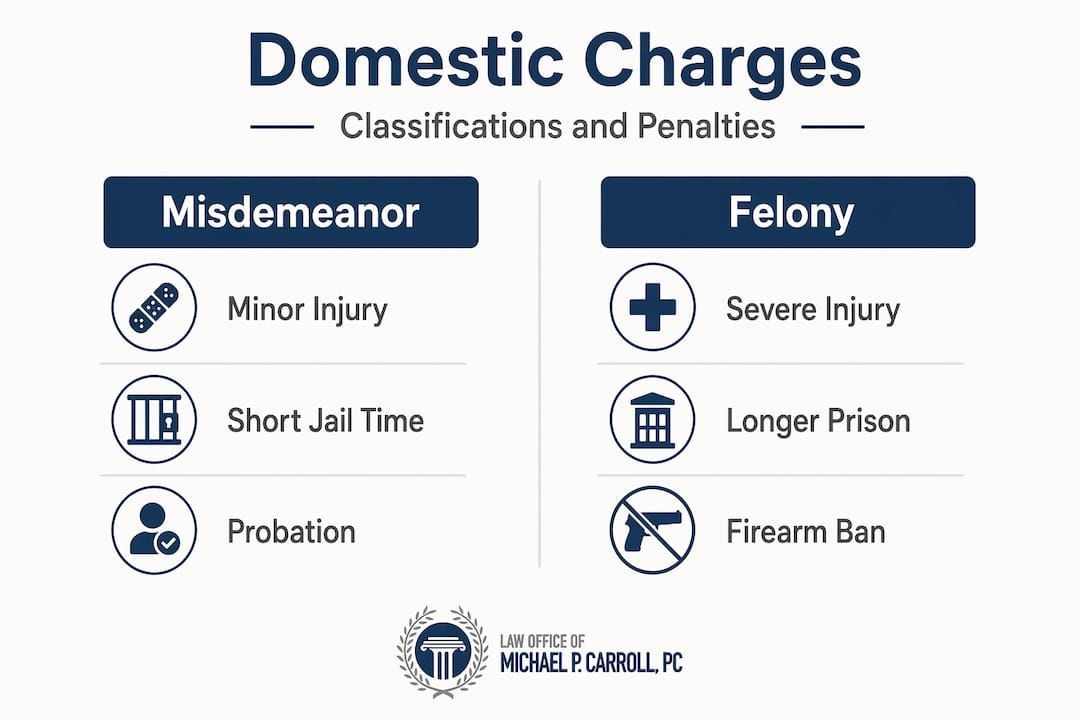
Aggravating factors push a charge from misdemeanor to felony territory. These include violating an active protective order, committing the offense in the presence of a child, and prior domestic violence convictions. Massachusetts courts take strangulation especially seriously, treating it as a standalone felony offense regardless of visible injury.
| Classification | Typical conduct | Common penalties |
|---|---|---|
| Misdemeanor (first offense) | Minor injury, no weapon, no prior record | Up to 1 year jail, fines, probation, counseling |
| Felony (aggravated) | Serious injury, weapon use, strangulation, repeat offense | State prison, longer probation, mandatory programs |
| Protective order violation | Any contact in violation of a court order | Separate criminal charge, immediate arrest |
Pro Tip: A misdemeanor conviction triggers a permanent federal firearm ban under the Lautenberg Amendment with no general waiver available. This applies to law enforcement officers, military personnel, hunters, and collectors alike.
The Lautenberg Amendment is one of the most overlooked consequences of a domestic violence conviction. Many defendants accept a plea to a misdemeanor without realizing they will permanently lose their right to possess a firearm. That single fact changes the calculus of any plea negotiation.
What defenses apply to domestic charges?
Effective defense against a domestic charge requires a case-specific strategy built on evidence, not general arguments. The four most common defense approaches are self-defense, evidentiary challenges, procedural errors, and diversion programs.
-
Assert self-defense with documented evidence. Self-defense requires proof of an immediate threat and a proportionate response. Photographs of injuries, medical records, and witness statements all support this claim. A successful self-defense argument can result in full dismissal or acquittal.
-
Challenge the evidence directly. Body camera footage, 911 call recordings, and prior inconsistent statements by the complainant are all subject to review. Gaps or contradictions in the evidence can undermine the prosecution's case before trial.
-
Identify procedural errors. An unlawful search, a warrantless arrest without probable cause, or a case of mistaken identity can each provide grounds to suppress evidence or dismiss charges entirely.
-
Pursue a diversion program. Diversion programs allow eligible first-time offenders to complete counseling and community service in exchange for dismissal and possible expungement. This path avoids a permanent conviction and its collateral consequences.
Pro Tip: The specific statute you are charged under matters more than the label "domestic violence." The statute determines your sentencing range, firearm eligibility, and immigration exposure. Review the exact charge with your attorney before making any decisions.
The statute-specific charge controls outcomes more than the general category. Two defendants both labeled "domestic violence offenders" can face dramatically different consequences depending on which statute applies. Defense strategy must be built around the elements of the specific charge, not the broader label.
How does the judicial process work for domestic charges?
The process moves quickly after an arrest, and understanding each stage helps you make better decisions under pressure.
Police in Massachusetts operate under mandatory arrest policies in many domestic situations. Officers arrest if any reasonable belief of domestic violence exists. Arraignment typically occurs within 48–72 hours of arrest. At arraignment, you enter a plea and the court sets bail conditions.
Key stages and conditions in the judicial process include:
- Arrest: Officers apply a low probable cause threshold; arrest is common even when both parties dispute the account
- Arraignment: Held within 48–72 hours; bail conditions are set and can include firearm surrender and GPS monitoring
- Protective orders: Issued at the first hearing regardless of whether the victim requests one; violation is a separate criminal offense
- No-contact provisions: Prohibit any communication with the alleged victim, including through third parties
- Case progression: Prosecutors control the case regardless of the victim's wishes; a victim cannot unilaterally drop charges
The no-contact order is one of the most disruptive consequences of an arrest. If you share a home or children with the alleged victim, the order can force you out of your residence and restrict access to your children before any conviction occurs. Violating the order, even accidentally, results in a separate criminal charge.
Understanding domestic assault and battery charges in Massachusetts specifically helps defendants recognize how local courts apply these rules in practice.
What are the long-term consequences beyond criminal penalties?
A conviction carries consequences that outlast any jail sentence or probation period. These collateral impacts affect nearly every area of life.
- Firearm rights: The Lautenberg Amendment imposes a permanent federal firearm ban for misdemeanor domestic violence convictions. No waiver exists, and the ban applies immediately upon conviction.
- Child custody: Courts apply a rebuttable presumption against awarding custody to a convicted parent. Family courts consider criminal evidence and protective orders even when no conviction has occurred.
- Immigration: Non-citizen defendants face deportation and inadmissibility grounds. Consulting an immigration attorney alongside a criminal defense attorney is critical for any non-citizen facing these charges.
- Employment: Background checks reveal domestic violence convictions. Professional licenses in fields such as nursing, law, and education can be suspended or revoked.
- Housing: Public housing authorities and many private landlords deny applications from individuals with domestic violence convictions on record.
The custody consequence surprises many defendants. Family courts do not wait for a criminal conviction. A protective order alone can shift custody arrangements and restrict visitation. Acting quickly with qualified legal counsel protects parental rights before the family court process accelerates.
Key Takeaways
A domestic charge carries permanent consequences that extend well beyond the courtroom, making early legal intervention the single most important step any defendant can take.
| Point | Details |
|---|---|
| Broad legal definition | Even slight offensive touching qualifies under federal law; visible injury is not required. |
| Classification drives penalties | Misdemeanor vs. felony status depends on injury severity, weapon use, strangulation, and prior offenses. |
| Firearm ban is permanent | The Lautenberg Amendment bans firearm possession after any misdemeanor domestic violence conviction, with no waiver. |
| Prosecutors control the case | Victims cannot drop charges; prosecution proceeds based on independent evidence. |
| Diversion avoids conviction | First-time offenders may qualify for diversion programs that lead to dismissal and possible expungement. |
What I have learned defending domestic charge cases in Massachusetts
The most damaging misconception I see is the belief that if the alleged victim refuses to cooperate, the case goes away. It does not. Prosecutors build cases on body camera footage, 911 recordings, medical records, and officer observations. A victim's recantation may actually hurt the defense if the prosecution uses it to argue witness intimidation.
The second misconception is that a misdemeanor plea is a safe, low-stakes resolution. For many clients, it is the worst possible outcome. The permanent firearm ban under the Lautenberg Amendment, the custody presumption, and the immigration exposure from a misdemeanor conviction can be more damaging than a short jail sentence that eventually ends. The label "misdemeanor" does not reflect the real-world impact.
What actually moves cases toward better outcomes is early evidence review. Body camera footage gets overwritten. Witnesses' memories fade. The sooner a defense attorney reviews the evidence, the more options remain available. Courtroom performance matters far less than the work done in the weeks before trial.
Diversion programs are underused by defendants who do not know they qualify. In Massachusetts, completing a certified batterers' intervention program and meeting other conditions can result in full dismissal. That outcome is worth far more than a negotiated guilty plea to a reduced charge. Knowing what programs are available in your specific county changes the conversation entirely.
— MPC Law
Facing a domestic charge? MPC Law can help.
A domestic charge can reshape your life within days of an arrest. Firearm rights, custody arrangements, housing, and employment all hang in the balance before a verdict is ever reached.

MPC Law defends clients across Bristol, Norfolk, and Plymouth Counties in Massachusetts. Michael P. Carroll works directly with every client, reviewing evidence, identifying procedural errors, and pursuing every available defense. If you are facing a domestic violence accusation, early consultation is the most effective step you can take. Contact MPC Law to discuss your case with an experienced criminal defense attorney who knows Massachusetts courts and the full scope of what is at stake.
FAQ
What is a domestic charge?
A domestic charge is a criminal accusation of abuse, violence, or coercive conduct committed against someone in a qualifying domestic relationship, such as a spouse, co-parent, or intimate partner. Under federal law, even slight offensive touching qualifies without requiring visible injury.
Can a victim drop a domestic charge in Massachusetts?
No. Prosecutors control the case and proceed based on independent evidence regardless of whether the victim cooperates or recants.
What is the Lautenberg Amendment?
The Lautenberg Amendment is a federal law that permanently bans firearm possession for anyone convicted of a misdemeanor domestic violence offense. No waiver exists, and the ban applies to civilians, law enforcement, and military personnel alike.
What happens at arraignment for a domestic charge?
Arraignment occurs within 48–72 hours of arrest. The court enters your plea, sets bail conditions, and typically issues a protective order that may prohibit all contact with the alleged victim.
Can a domestic charge be dismissed in Massachusetts?
Yes. Successful defenses include self-defense, evidentiary challenges, and procedural errors. First-time offenders may also qualify for diversion programs that lead to dismissal and possible expungement upon completion.