
What Happens at a Massachusetts Arraignment
What Happens at a Massachusetts Arraignment

At a Massachusetts arraignment, three things happen: the court formally reads the charges against you, you enter a plea (almost always not guilty), and a judge decides whether you go home or stay in custody. That's the whole day in one sentence. What makes it high-stakes is the third part — the bail and detention decision — because the wrong outcome there means you wait for trial behind bars.
Here's what the court does that day.
- Plea options: The clerk reads the charges aloud and asks for your plea. You can say not guilty, guilty, or nolo contendere (no contest). In most cases, not guilty is entered on your behalf.
- Bail, conditions of release, or a dangerousness hearing: The judge hears from the prosecutor and your attorney, reviews the probation report, and decides whether to release you on personal recognizance, set cash bail, impose conditions, or hold you pending a §58A dangerousness hearing under G.L. c. 276, §58A.
- Scheduling: The court sets the next date — a pretrial conference, a probable cause hearing, or a trial date, depending on the charges and court.
The three key players in the room: the Massachusetts Trial Court (the judge and clerk), the Commonwealth prosecutor presenting the charges, and the Committee for Public Counsel Services (CPCS) or your private attorney representing you.
Key Takeaways
At a Massachusetts arraignment, the three decisions made that day — plea, bail, and scheduling — shape everything that follows, and preparation before you walk into court is the single most effective thing you can do.
| Point | Details |
|---|---|
| Arraignment is the first court appearance | Charges are read, a plea is entered, and bail or detention is decided — guilt is not determined. |
| Plead not guilty to preserve rights | A not guilty plea keeps motions, discovery, and plea negotiations open; a guilty plea at arraignment closes them off. |
| Bail and §58A risk are immediate | Bring employment, housing, and treatment documents; the judge decides release or detention that day. |
| Arraignment creates a CORI entry | Unless the case was dismissed before arraignment, a public record is created at this hearing. |
| Contact an attorney before arraignment | Pre-arraignment preparation — documents, bail memo, CORI strategy — directly affects the outcome. |
Table of Contents
- What happens during a Massachusetts arraignment, step by step
- How bail and dangerousness hearings work under Massachusetts law
- How to get a lawyer at arraignment and what they can do for you
- Why most defendants plead not guilty at arraignment
- How arraignment creates a CORI record and what that means for you
- What happens after arraignment: the pretrial phase
- What to bring and how to act on arraignment day
- How an experienced Massachusetts criminal defense attorney prepares a client for arraignment
- What the conventional advice on arraignment gets wrong
- Sources
- FAQ
What happens during a Massachusetts arraignment, step by step
Your arraignment or first appearance in court is not a trial. No evidence is presented, no witnesses testify, and guilt is not decided. The proceeding is procedural — but what happens in those 15 to 30 minutes sets the tone for everything that follows.
Probation intake (before you enter the courtroom)
Before your case is called, a probation officer interviews you. This is not optional and it is not casual. The officer confirms your identity, runs a criminal history check through CORI and CARI (the Criminal/Juvenile Arraignment Records Index), and assesses whether you qualify for a court-appointed attorney. That report goes directly to the judge and is often the first document the judge reads when making bail decisions.
If you cannot afford a private attorney, the probation officer's indigency assessment determines whether the court will appoint one. Under G.L. c. 211D and Rule 3:10, the court charges a minimum counsel fee. If you cannot pay it, the court may order community service instead.
The courtroom sequence
- Your name is called. You approach the bar (the railing at the front of the courtroom) and stand before the judge.
- The clerk reads the charges. The specific offense, the statute allegedly violated, and the date of the alleged incident are read aloud.
- Counsel enters an appearance. Your attorney — private or court-appointed — tells the court they are representing you.
- You enter a plea. The clerk asks how you plead. In most arraignments, the clerk enters "not guilty" on your behalf even before you speak. You can also plead guilty or nolo contendere, though doing so at arraignment is rarely advisable.
- Bail argument. The prosecutor presents the Commonwealth's position on release. Your attorney responds with facts supporting release. The judge decides.
- Next date is set. The court schedules a pretrial conference, probable cause hearing, or trial date.
Terms you will hear that day
- Personal recognizance (PR): Released on your promise to return. No cash required.
- §58A dangerousness hearing: A special hearing the Commonwealth can request to detain you if the charge qualifies and the prosecutor argues you pose a danger to the community.
- CORI/CARI: Criminal Offender Record Information and the Criminal/Juvenile Arraignment Records Index — the databases probation checks before your case is called.
- Nolo contendere: A plea that accepts the punishment without admitting guilt. It still results in a conviction.
How bail and dangerousness hearings work under Massachusetts law
The bail decision is where arraignment gets complicated — and where having a prepared attorney matters most.
Under Massachusetts bail law, the judge weighs several factors: your criminal record, ties to the community (employment, family, housing), the nature and seriousness of the alleged offense, your history of appearing for court dates, and any risk you pose to a victim or the public. Probation's report is central to this analysis.
Possible outcomes at the bail stage
- Personal recognizance: You are released without posting money, on your word to return.
- Cash bail: You or a family member must post a set amount before you are released.
- Conditions of release: The court may impose GPS monitoring, no-contact orders, substance abuse treatment, or regular check-ins with probation.
- Detention pending a §58A hearing: If the Commonwealth moves for pretrial detention on an eligible offense, the court can hold you while the dangerousness hearing is scheduled.
§58A dangerousness hearings: the key mechanics
When the Commonwealth moves under G.L. c. 276, §58A, the following rules apply:
| Mechanic | Statutory rule |
|---|---|
| Who can request it | The Commonwealth, on eligible offenses (violent crimes, certain drug offenses, sex offenses, domestic violence charges) |
| Continuance for defendant | Up to 7 days to prepare |
| Continuance for Commonwealth | Up to 3 days |
| Detention pending hearing | Defendant may be held while the hearing is scheduled |
| Standard of proof | Clear and convincing evidence of dangerousness |
| Detention if found dangerous | For a statutory maximum period depending on offense category |
At the hearing itself, the court can consider hearsay — including police reports and victim statements. The hearing can also be reopened later if materially new information comes to light.
Pro Tip: The facts your attorney presents at the bail stage can change the outcome dramatically. Employment records, a lease showing stable housing, family support letters, enrollment in a treatment program, and a clean or limited record all carry weight. Prepare these documents before arraignment day, not after.
How to get a lawyer at arraignment and what they can do for you
You have a constitutional right to counsel at arraignment. If you cannot afford a private attorney, the court will appoint one through the Committee for Public Counsel Services (CPCS) or assign a duty counsel for the day.
The indigency check
The probation officer runs the indigency assessment before your case is called. The court applies a means test based on income and assets. If you qualify, a duty counsel — an attorney assigned to the courthouse that day — will meet with you briefly before your case is heard. That attorney can argue bail, enter an appearance, and help arrange follow-up representation through CPCS or a private referral.
If you cannot pay the minimum counsel fee, the court may order community service in lieu of payment. Courts can also allow payment over time.
What a duty counsel can realistically do
Duty counsel handles many defendants in a single morning. Their role at arraignment is specific:
- Review the charges and probation report quickly
- Argue for release or reasonable bail conditions
- Enter a formal appearance on your behalf
- Enter a not guilty plea
- Arrange next steps for ongoing representation
They will not have time to review discovery, investigate facts, or negotiate a plea that day. For anything beyond the arraignment itself, you need an attorney who has time to prepare your case fully.
Documents to bring that support your release
- Government-issued photo ID
- Recent pay stubs or a letter from your employer
- A copy of your lease or mortgage statement
- Enrollment paperwork from any treatment or counseling program
- Contact information for family members who can speak to your ties to the community
Pro Tip: If you have a private attorney, call them before arraignment day. A prepared attorney can draft a short bail memo, contact probation in advance, and walk into that courtroom with a release argument already organized. That preparation is often the difference between going home and waiting in a cell.
For immediate arraignment representation in Bristol, Norfolk, and Plymouth Counties, the Law Office of Michael P Carroll handles criminal defense cases from the first court appearance through trial.
Why most defendants plead not guilty at arraignment
Pleading not guilty at arraignment is not an admission of anything. It is a procedural choice that keeps every option open.
The three plea options and what each one means
- Not guilty: You deny the charges. The case proceeds to pretrial motions, discovery, and potentially trial. You preserve all rights, including the right to challenge evidence, file suppression motions, and negotiate a plea later on better terms.
- Guilty: You admit to the offense. The court can sentence you that day or schedule a sentencing hearing. A guilty plea at arraignment closes off discovery, motions, and any chance to see what the Commonwealth's evidence actually looks like.
- Nolo contendere: You accept the punishment without formally admitting guilt. It still results in a conviction and a CORI entry. It offers limited practical advantage over a guilty plea in most Massachusetts cases.
When a case can be resolved at arraignment
Occasionally, a prosecutor will offer a plea deal at arraignment — typically for minor infractions or cases where the facts are straightforward and the outcome is predictable. If you accept, the court processes a Tender of Plea and an Admission and Waiver of Rights form. You sign, the judge accepts the plea, and sentencing follows.
That said, accepting a plea at arraignment without reviewing discovery is a gamble. You have no idea yet what evidence the Commonwealth has, whether it was lawfully obtained, or whether a motion to suppress could change the outcome entirely.
Pro Tip: Practitioners routinely advise entering not guilty at arraignment even when a client plans to negotiate a plea later. A not guilty plea preserves your right to file motions, receive discovery, and evaluate the case before committing to anything. Never waive counsel and speak directly to a prosecutor at arraignment — anything you say can be used against you.
How arraignment creates a CORI record and what that means for you
Many people assume a criminal record only appears after a conviction. In Massachusetts, that assumption is wrong and costly.
Under 803 CMR 2, CORI is defined as records compiled by Massachusetts criminal justice agencies that concern an identifiable individual and relate to criminal charges, pretrial proceedings, sentencing, incarceration, or release. Arraignment generates a CORI entry unless the case was dismissed or a nolle prosequi was filed before arraignment took place.
What CORI includes and excludes
| Category | Included in CORI? |
|---|---|
| Charges read at arraignment | Yes |
| Arrests and pretrial proceedings | Yes |
| Cases dismissed before arraignment | No |
| Juvenile records (most cases) | No |
| Non-incarcerable offenses (certain minor violations) | Generally excluded |
| Convictions and sentences | Yes |
A name-based CORI check returns available Massachusetts arraignment information and can take up to ten business days to receive results. Employers, landlords, and licensing boards can request CORI checks, which means an arraignment alone — with no conviction — can show up on a background screen.
Protecting your record: what to know now
- If your case is dismissed before arraignment (for example, after a successful clerk magistrate hearing), no CORI entry is created. That is the strongest record protection available.
- After the case concludes, sealing or expungement is a separate legal process with its own eligibility rules and waiting periods.
- Challenging an inaccurate CORI entry is possible through the Criminal History Systems Board (CHSB).
Defense attorneys consistently point out that the strongest day to protect your record is before formal arraignment. A show-cause hearing at the clerk-magistrate level can sometimes prevent a public CORI entry from ever being created. If record preservation is a priority, get legal help before your arraignment date, not after.
What happens after arraignment: the pretrial phase
Arraignment is the starting line, not the finish. What comes next depends on the court, the charges, and the decisions made that day.
Common next events
- Pretrial conference: The first substantive meeting between your attorney and the prosecutor. Discovery is exchanged, and the parties discuss whether the case can be resolved short of trial.
- Probable cause hearing (District Court): For felony charges in District Court, the Commonwealth may need to establish probable cause before the case can proceed. This is a separate hearing, not a trial.
- Motion practice: Your attorney may file motions to suppress evidence, dismiss charges, or compel discovery. These are filed and argued before any trial date is set.
- Superior Court indictment track: If your case is indicted by a grand jury and transferred to Superior Court, the scheduling process is different and typically longer.
District Court vs. Superior Court: the key difference
District Court cases sometimes follow a probable cause track under Rule 7, where a probable cause hearing is scheduled before standard pretrial proceedings. Superior Court arraignments follow an indictment and a separate scheduling process with longer timelines and more formal discovery rules.
What to do immediately after arraignment
- Contact your attorney the same day and confirm the next court date.
- Collect and preserve any documents that support your defense (receipts, texts, photos, witness contact information).
- Do not contact alleged victims or witnesses, especially if a no-contact order was issued.
- If you were arrested in Massachusetts and have questions about the steps between arrest and arraignment, review those procedural details with your attorney.
- Note every condition of release and follow them exactly. A violation can result in immediate detention.
What to bring and how to act on arraignment day
Arraignment day is not the time to improvise. Courts move quickly, and small preparation gaps can have real consequences.
What to bring
- Government-issued photo ID (required for probation intake)
- Any custody or arrest paperwork you received at booking
- Evidence of community ties: pay stubs, lease, employer letter, treatment enrollment
- A notepad or paper to write down dates, conditions, and instructions
- Funds for bail only if you have been told in advance that bail is likely and you have arranged for a family member to post it
Courtroom conduct: what to do
- Arrive at least 30 minutes early. Plan for several hours — administrative processing, probation interviews, and a full docket can push your case late into the day.
- Dress professionally. Business casual at minimum. First impressions matter to judges.
- Address the judge as "Your Honor." Speak only when asked a direct question.
- Let your attorney do the talking. Do not volunteer information about the offense.
What not to do
- Do not discuss the charges with anyone in the courthouse hallway, waiting area, or holding cell. Conversations are not private.
- Do not make aggressive or dismissive statements in or near the courtroom. Demeanor affects bail decisions.
- Do not violate any existing restraining order to attend court. Arrive separately from any protected party.
- Do not lie to the court about your identity, address, or financial situation during the indigency check.
How an experienced Massachusetts criminal defense attorney prepares a client for arraignment
Arraignment preparation starts before the court date, not in the parking lot that morning. Here is what thorough preparation looks like in practice.
The attorney's pre-arraignment checklist
- Pre-arraignment interview: Review the charges, the circumstances of the arrest, and any prior record with the client before the court date.
- Document gathering: Collect pay stubs, a lease or mortgage statement, employer letters, and any treatment enrollment paperwork that supports a release argument.
- Probation history review: Identify any prior defaults, open cases, or conditions that could complicate bail.
- Bail memo: Draft a short, factual summary of the client's community ties, employment, and stability for the judge. Probation's report is often the only document the judge sees — a bail memo adds context that probation cannot provide.
- CORI strategy: If the case originated from a complaint, assess whether a clerk-magistrate hearing could prevent arraignment entirely and preserve the client's record.
A brief example of early preparation changing an outcome
Consider a client charged with a domestic assault offense where the Commonwealth moves for a §58A dangerousness hearing. Without preparation, the judge hears only the probation report and the prosecutor's account. With preparation, the attorney arrives with documentation of the client's stable employment, a letter from a treatment counselor, and a clear account of the client's ties to the community. That information can shift the bail argument from detention to release with conditions — a materially different outcome before a single motion is filed.
For clients facing domestic violence charges, the bail and dangerousness considerations are particularly acute, and early preparation is not optional.
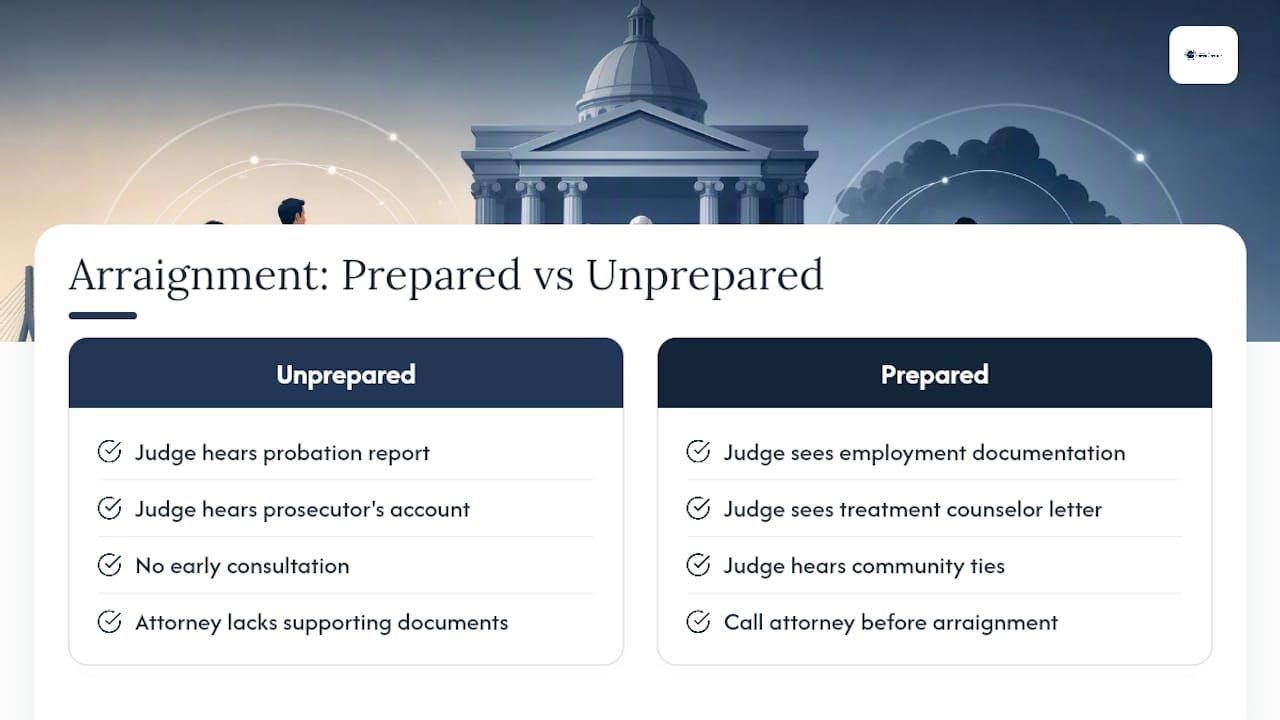
Pro Tip: Call an attorney before your arraignment date, not after. Even a single consultation the day before gives your attorney time to prepare a bail argument, gather documents, and walk into court ready — rather than scrambling to catch up at the bar.
If you are facing arraignment in Bristol, Norfolk, or Plymouth County, the Law Office of Michael P Carroll offers direct, experienced criminal defense representation from the first court appearance forward.

What the conventional advice on arraignment gets wrong
Most articles about arraignment focus on procedure — the sequence of events, the plea options, the bail factors. That information is accurate, but it misses the point that actually matters to someone going to court tomorrow.
The real risk at arraignment is not the procedure. It is the bail decision. Specifically, it is walking into that courtroom without the documents and preparation that change how a judge reads your situation. Probation's report is often the only narrative the judge has before your attorney speaks. If that report shows a prior record, open cases, or defaults, and your attorney has nothing to counter it with, the outcome is predictable.
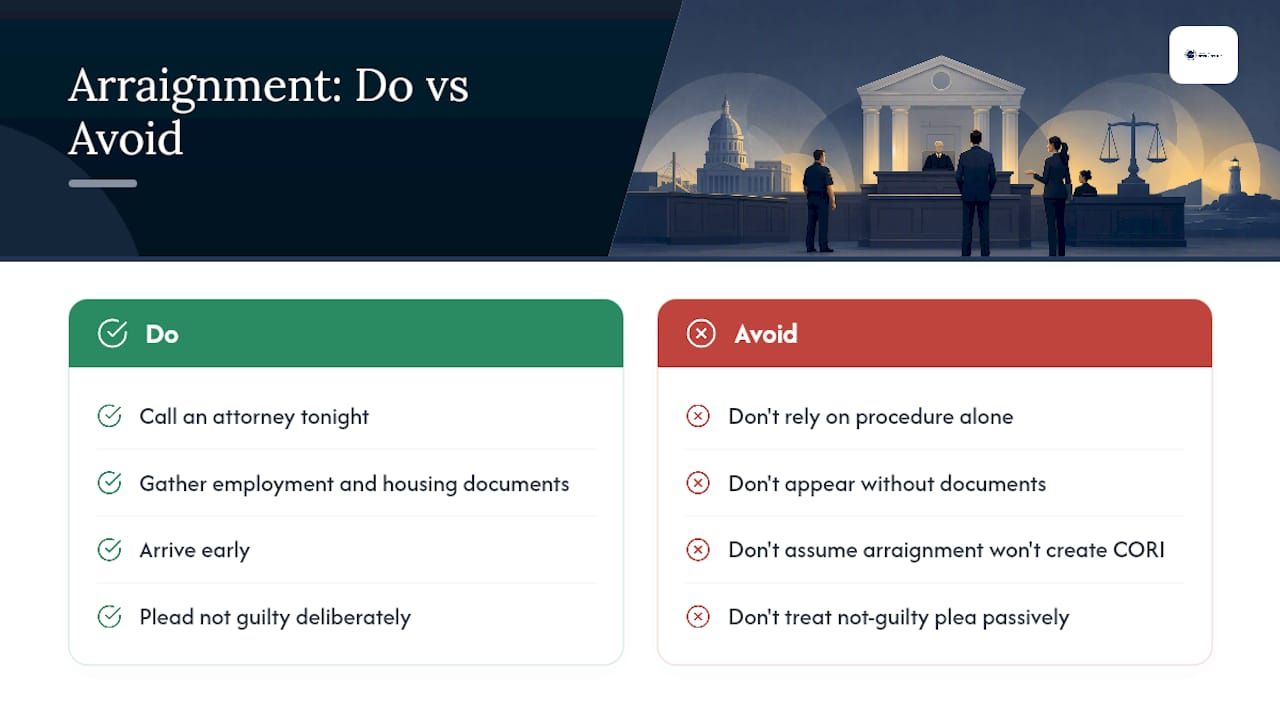
The second thing most guides understate is the CORI consequence. People focus on conviction as the moment a record is created. In Massachusetts, arraignment is that moment. A charge that is eventually dismissed still appears on a CORI check if it made it to arraignment. That distinction matters enormously for employment, housing, and licensing — and it is why the clerk-magistrate level, before arraignment, is where the most important record protection happens.
The third gap is the advice to "just plead not guilty and see what happens." That is correct as far as it goes, but it skips the more important point: the not guilty plea is not passive. It is the move that keeps every other option available. Discovery, suppression motions, plea negotiations on better terms — all of it flows from that single procedural choice. Treat it as a deliberate strategy, not a default.
If you are reading this the night before your arraignment, the most useful thing you can do right now is call an attorney, gather your employment and housing documents, and plan to arrive early. The procedure will take care of itself. The preparation is what you control.
This article is general information, not a substitute for advice from a qualified lawyer. Consult a qualified legal professional about your own circumstances before acting on anything here.
Sources
These official sources cover the specific rules, statutes, and procedures referenced throughout this article.
- Mass
FAQ
What is the purpose of a Massachusetts arraignment?
An arraignment is the first formal court appearance where charges are read, a plea is entered, and the court decides bail or detention. It is not a trial and does not determine guilt.
Can a case be dismissed at arraignment in Massachusetts?
A judge can dismiss a case at arraignment if the complaint is legally deficient, but this is uncommon. More often, dismissal happens later after motions or negotiations.
Does arraignment automatically create a criminal record in Massachusetts?
Yes. Under 803 CMR 2, arraignment creates a CORI entry unless the case was dismissed or a nolle prosequi was filed before arraignment occurred.
What happens if you cannot afford a lawyer at arraignment?
The probation officer conducts an indigency assessment before your case is called. If you qualify, the court appoints a duty counsel through CPCS to represent you at the arraignment.
How long does a Massachusetts arraignment take?
The hearing itself typically runs 15 to 30 minutes, but plan to be at the courthouse for several hours due to probation intake, docket processing, and other cases ahead of yours.