
Massachusetts Sentencing Hearing Prep for Defendants & Victims
Massachusetts Sentencing Hearing Prep for Defendants & Victims
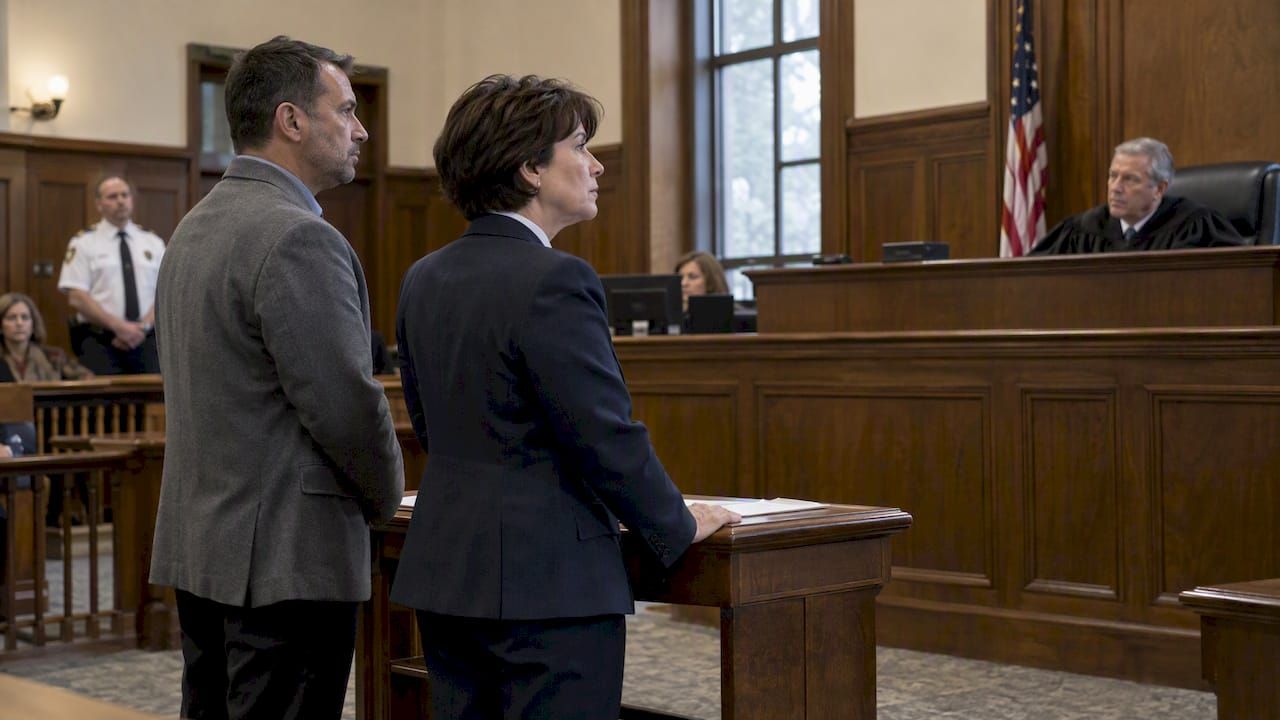
A sentencing hearing in Massachusetts is the court proceeding where a judge imposes a lawful sentence after a guilty plea, an admission to sufficient facts, or a verdict. The defendant and defense counsel may address the court, prosecutors speak on behalf of the Commonwealth, and victims may submit a Victim Impact Statement. The judge weighs statutory ranges and advisory sentencing guidelines before deciding. What follows covers timing, who gets to speak, how judges decide, sentence types, life-sentence procedures, and what happens afterward.
TL;DR:
- Sentencing hearings are scheduled after a guilty verdict, plea, or admission, often delayed for pre-sentence investigations, restitution, or negotiations.
- Both defendants and victims can speak at sentencing; defendants focus on mitigation and remorse, while victims describe personal impact through prepared statements.
- Judges use advisory sentencing guidelines based on offense severity and criminal history but retain discretion to impose any lawful sentence within the statutory range.
- Massachusetts offers multiple sentencing options, including probation, house of correction, or state prison, with specific procedures for restitution and pre-sentence investigations.
- Life-sentence hearings are conducted by the Parole Board focusing on eligibility for release, with victims able to submit impact statements separate from trial court procedures.
Table of Contents
- When does a sentencing hearing happen?
- Who speaks at sentencing and what rights apply?
- How do judges decide on a sentence?
- What sentencing options exist in Massachusetts?
- How do pre-sentence investigations and restitution work?
- How are life-sentence hearings different from standard sentencing?
- What happens after a sentence is imposed?
- A practitioner's checklist for preparing for sentencing
- What the research actually shows about sentencing preparation
- How we help with sentencing hearings in Massachusetts
- FAQ
- Sources
When does a sentencing hearing happen?
Sentencing follows a guilty verdict, a guilty finding after trial, a guilty plea, or an admission to sufficient facts. Massachusetts law requires that a defendant be sentenced without unreasonable delay, a protection built into Criminal Procedure Rule 28. In some cases, the judge imposes sentence the same day as the plea or verdict. In others, the court sets a future date to allow more preparation.
Parties sometimes agree to place a case "on file," meaning sentencing is deferred indefinitely subject to conditions, often used when a defendant has no other pending issues and the Commonwealth agrees further proceedings are unnecessary for now.
Common reasons sentencing gets pushed to a later date include:
- A pre-sentence investigation by the probation department that has not yet been completed.
- Restitution amounts that still need to be calculated or verified.
- Witnesses or victims who need more time to prepare statements.
- Negotiated terms between the defense and prosecution that require additional drafting or approval.
Readers who want background on how a case reaches this stage can review what happens at a Massachusetts arraignment, the proceeding that starts the clock on these timelines.
Who speaks at sentencing and what rights apply?
Massachusetts procedure gives both the defendant and the victim a formal voice before sentence is imposed. Under Rule 28, the court must give the defendant or defense counsel an opportunity to speak in mitigation, a right known as allocution. Judges often pay close attention to a defendant's own words, but statements that admit facts beyond what was proven at trial can create problems on appeal, so this moment benefits from preparation.
Victims also have a statutory right to present a Victim Impact Statement, orally or in writing, describing the physical, emotional, psychological, and financial effects of the crime and their views on an appropriate sentence. Victims may work with victim-witness advocates and the prosecutor to prepare this statement.
- Defendants should focus allocution on mitigation and remorse, not on re-arguing the facts of the case.
- Victims should describe personal impact rather than relitigating what happened at trial.
- Both sides benefit from coordinating with counsel or an advocate before the hearing date.
Pro Tip: Write out allocution or impact statements in advance and read them aloud once beforehand so the language feels natural rather than rehearsed in the courtroom.
How do judges decide on a sentence?
Massachusetts judges work from an advisory framework built by the Massachusetts Sentencing Commission, which scores offense seriousness and criminal history to produce a guideline range. Judges retain discretion to impose any lawful sentence within the statutory range for the offense, even outside the guideline's suggested cell.
A sentence can move above or below the guideline range based on factors judges weigh case by case, including:
- The defendant's role in the offense and any evidence of coercion or minimal participation.
- Prior record, including the nature and recency of past convictions.
- Harm to the victim, including physical injury or financial loss.
- Evidence of rehabilitation, treatment compliance, or stable employment.
The Sentencing Commission's guidelines are advisory, not mandatory, meaning a judge who departs from the recommended range is still acting within the law as long as the sentence falls inside the statutory maximum and minimum for the charge.
When a judge departs from the guideline range, sentencing best practices call for documenting the reasoning and running a bias check to confirm the decision rests on case facts rather than extraneous factors. These best practices for individualized sentencing also ask judges to weigh rehabilitation, deterrence, and incapacitation together rather than defaulting to the harshest available term.
What sentencing options exist in Massachusetts?
Massachusetts courts have several dispositions available, and the right one depends on the charge, the defendant's record, and the judge's assessment of risk and rehabilitation potential.
- Continuance without a finding (CWOF): the defendant admits to facts sufficient for a finding of guilt, but the case is continued without entering a conviction; successful compliance with conditions can lead to dismissal, while a violation can result in a guilty finding and sentencing on the original charge.
- Probation: supervision in the community under conditions, often paired with treatment, community service, or no-contact orders.
- House of correction: a sentence of up to two and a half years, typically for misdemeanors or less serious felonies, served without the two-thirds minimum rule that applies to state prison terms.
- State prison: reserved for more serious felonies; when a judge imposes a "Not Less Than, Not More Than" sentence, the minimum term is automatically set as a proportion of the maximum consistent with the Sentencing Commission's guidelines.
- Fines, restitution, and treatment conditions: often layered onto probation or a suspended sentence, used when the judge determines monetary or clinical conditions better serve the case than incarceration.
How do pre-sentence investigations and restitution work?
Judges sometimes order a pre-sentence investigation, a report prepared by the probation department that gathers background on the defendant's history, family circumstances, employment, and any treatment needs. This report gives the judge context beyond what the trial or plea record shows, and it often shapes whether probation, treatment, or incarceration fits the case.
When restitution is part of a sentence, Massachusetts practice ties the amount to the victim's actual loss, and the judge must consider the defendant's financial resources before setting payment terms, under the Sentencing Commission's restitution guidance. The defendant carries the burden of showing an inability to pay.
- A pre-sentence report typically covers criminal history, family ties, employment, and treatment history.
- Restitution is meant to reflect actual, provable loss, not a punitive add-on.
- Courts generally cannot jail a defendant solely for failing to pay a fine or restitution without first holding a hearing to determine whether the failure was willful.
This protection matters for defendants facing financial hardship, since poverty alone is not grounds for incarceration under Massachusetts practice.
How are life-sentence hearings different from standard sentencing?
Life-sentence hearings are not conducted by the trial court that imposed the original sentence. Instead, they fall under the jurisdiction of the Massachusetts Parole Board, which holds public hearings at its Central Office in Natick and publishes monthly hearing calendars.
These proceedings focus on parole eligibility rather than guilt or the terms of the original sentence. Victims may submit statements to the Parole Board as part of the record, similar in purpose to a Victim Impact Statement at trial-court sentencing but directed at a different decision-maker.
- Check the Parole Board's published calendar to confirm hearing dates and locations.
- Written statements can be submitted in advance for those who cannot attend in person.
- The standard applied at a parole hearing differs from the standard a trial judge applies at sentencing, since the focus shifts to readiness for release.
What happens after a sentence is imposed?
Once a judge imposes sentence, the outcome is recorded in MassCourts, the state's electronic case management system. Accurate entries matter because parole eligibility, future sentencing in other cases, and certain collateral consequences all depend on the record reflecting the sentence correctly.
A lawful sentence is difficult to appeal simply because a defendant disagrees with its severity, but Massachusetts law provides specific routes for relief, including motions for resentencing in limited circumstances and Rule 30 motions for postconviction relief when legal errors affected the outcome.
- Sentence credits, parole eligibility dates, and probation terms begin running once the sentence is entered.
- Violations of probation conditions can trigger a separate hearing, covered in more detail in what happens after a probation violation in Massachusetts.
- Appeals challenge legal errors in the process, not simply the length of a lawful sentence.
A practitioner's checklist for preparing for sentencing
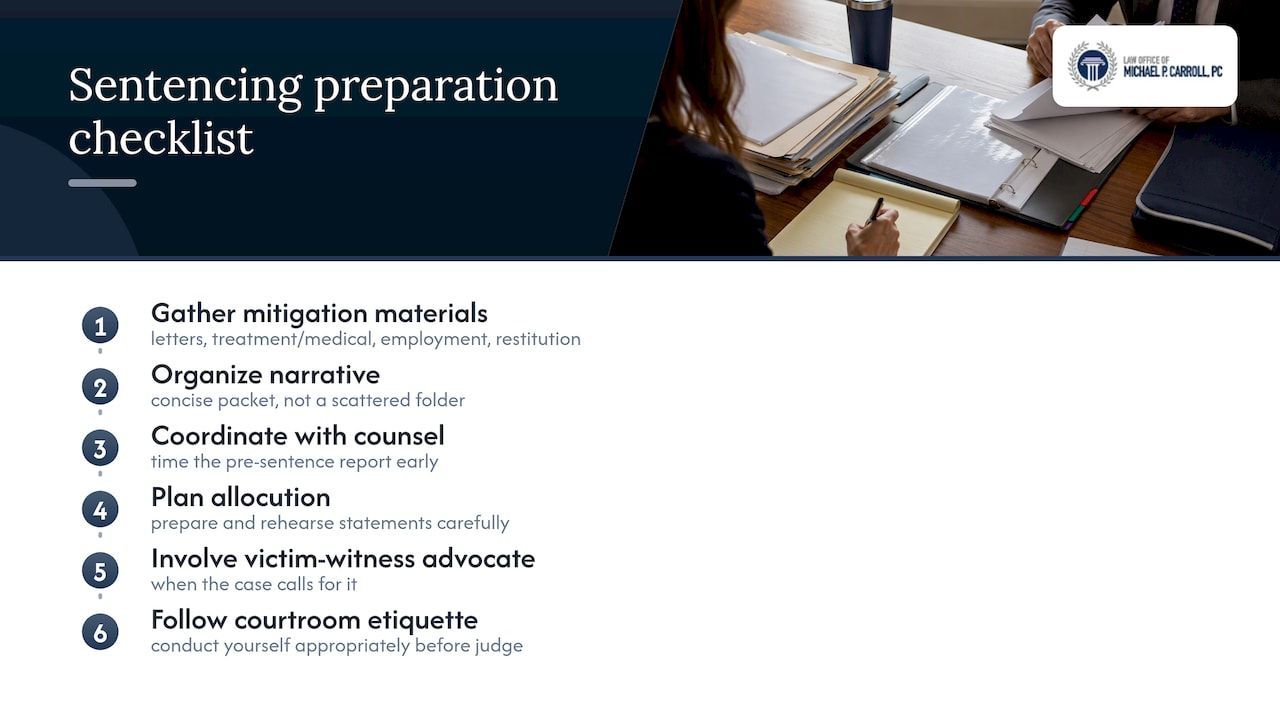
Preparation matters more than most defendants expect. A useful mitigation packet includes letters of support, treatment or medical records, proof of employment, and documentation addressing any restitution owed, organized into a concise narrative rather than a scattered folder of documents. Coordinate early with counsel to time the pre-sentence report, plan allocution carefully, and involve a victim-witness advocate when a case calls for it. Readers preparing for a courtroom appearance may also find practical value in this courtroom etiquette guide on conducting yourself appropriately before a judge.
What the research actually shows about sentencing preparation
Most of what gets written about sentencing hearings treats them as a formality after the real fight, the trial or plea negotiation, is over. That framing undersells how much a sentencing hearing itself can move an outcome. The guideline range sets a starting point, but the aggravating and mitigating factors a judge weighs are genuinely open to persuasion, and a well-documented mitigation packet often does more work than people assume.
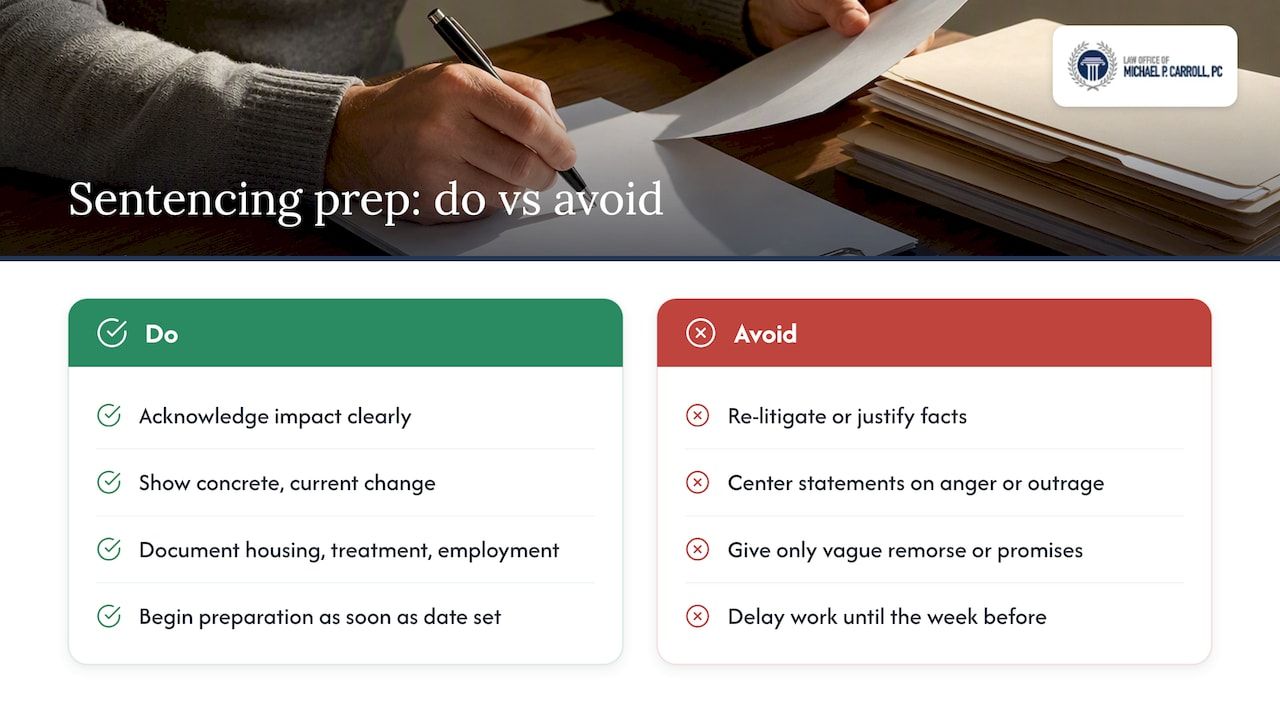
The bigger gap is between what defendants expect from allocution and what actually helps them. Many walk in planning to explain or justify what happened, when the stronger approach is almost always to acknowledge impact and show concrete change, stable housing, treatment, employment, without re-litigating facts the court has already decided. Victims face a mirror version of this problem: statements that focus on outrage tend to land less effectively than ones that describe specific, lasting harm.
If there is one priority, it is this: start preparing mitigation or impact materials the moment a sentencing date is set, not the week before.
— Michael Carroll
How we help with sentencing hearings in Massachusetts
We represent defendants directly through sentencing, building mitigation packets, preparing allocution, and negotiating with prosecutors on recommended dispositions. Because our practice is owner-operated, clients work directly with their attorney rather than being passed between staff.

- We prepare pre-sentence materials, including letters of support, treatment records, and restitution documentation.
- We coordinate timing with the probation department when a pre-sentence investigation is ordered.
- Materials you share with us for mitigation purposes stay protected by attorney-client privilege.
Visit our criminal law page to see the full range of matters we handle, or reach out to schedule a consultation ahead of an upcoming sentencing date.
This article is general information, not a substitute for advice from a qualified lawyer. Consult a qualified legal professional about your own circumstances before acting on anything here.
FAQ
What is the purpose of a sentencing hearing in Massachusetts?
A sentencing hearing is where a judge formally imposes a lawful sentence after a guilty plea, an admission to sufficient facts, or a verdict. The defendant may speak in mitigation under Rule 28, and victims may submit a statement before the judge decides.
Can a victim speak at a Massachusetts sentencing hearing?
Yes. Massachusetts victims have a statutory right to present a Victim Impact Statement, either orally or in writing, describing how the crime affected them and expressing their view on an appropriate sentence.
What is the difference between house of correction and state prison?
House of correction sentences apply mainly to misdemeanors and less serious felonies, typically lasting shorter terms than state prison sentences. For state prison sentences imposing a minimum and maximum term, the minimum is automatically set as a proportion of the maximum consistent with the Sentencing Commission's guidelines.
Are the Massachusetts sentencing guidelines mandatory?
No. The Sentencing Commission's guidelines are advisory, giving judges a recommended range based on offense seriousness and criminal history, but judges retain discretion to sentence anywhere within the statutory range for the charge.
Are life-sentence hearings the same as regular sentencing hearings?
No. Life-sentence hearings are handled by the Massachusetts Parole Board rather than the trial court, focus on parole eligibility rather than the original sentence, and follow a separate public hearing calendar.