
Expect $100–$1,200 Per Suspension: Massachusetts License Reinstatement
Expect $100–$1,200 Per Suspension: Massachusetts License Reinstatement

You can reinstate a suspended or revoked Massachusetts license once you satisfy three requirements: paying every reinstatement fee owed under MGL c.90 §33, completing whatever RMV-ordered classes, IID installation, or testing applies to your specific suspension, and attending a hearing if one is required. Start by checking myRMV for your exact account status, then gather your documents before you pay anything.
TL;DR:
- Reinstating a Massachusetts license requires paying all applicable fees, completing mandated programs, and attending hearings if necessary, with exact conditions shown on myRMV.
- Reinstatement fees range from $100 to $1,200 per suspension, with OUI offenses typically costing $500 to $1,200, depending on prior violations; fees must be paid in full before reinstatement.
- For OUI suspensions, a minimum of 730 days with an ignition interlock device is required after license reinstatement, with delays occurring if installation or program violations happen.
- Hardship licenses are available for qualifying drivers who need limited driving for work, school, or medical reasons, but approval depends on a hearing and supporting documentation.
- The process can take from a single day for simple violations to over two years for serious offenses involving interlock requirements, with out-of-state cases adding additional delays.
Table of Contents
- What Do You Need to Reinstate Your License in Massachusetts?
- What Does License Reinstatement Cost in Massachusetts?
- How Does the Ignition Interlock (IID) Requirement Work?
- Who Qualifies for a Hardship License in Massachusetts?
- Reinstatement Checklist: Five Steps to Get Your License Back
- How Do RMV Hearings for Reinstatement Work?
- How Long Does Reinstatement Actually Take?
- How Do You Check Your Suspension Status With the RMV?
- What Documents Do You Need for Your Specific Suspension Type?
- Can You Appeal a Massachusetts License Suspension?
- What Happens if You Drive on a Suspended License?
- When Does It Make Sense to Hire an Attorney for Reinstatement?
- How Law Office of Michael P Carroll Helps With Reinstatement
- Sources
- FAQ
What Do You Need to Reinstate Your License in Massachusetts?
Before you pay a dollar toward reinstatement, log into myRMV and pull your account status. It tells you exactly which suspensions are active, which fees are attached to each one, and whether a hearing or exam sits between you and a valid license. Guessing at this stage wastes time and, often, money.
Beyond your account check, most drivers need to assemble the following:
- Valid identification and proof of date of birth that meets RMV standards.
- A certified driving history or, for out-of-state violations, a current letter of reinstatement from the state where the offense occurred, dated within 30 days.
- Proof of enrollment or completion for any required program, such as the NSC driver retraining program, SCARR, driver attitudinal retraining, or DPH-approved alcohol and drug counseling.
- Confirmation of whether your license has been suspended or inactive for two years or longer, since that triggers a full written knowledge exam and road test before the RMV will reinstate you.
Which retraining program applies depends on your age and the underlying offense, and the RMV notice you received will specify the exact program name. Don't substitute a similar-sounding course; the RMV checks for the specific program listed on your file.
What Does License Reinstatement Cost in Massachusetts?
Every reinstatement fee in Massachusetts traces back to one statute: MGL c.90 §33. It gives the RMV authority to charge a fee for each active suspension or revocation on your record, which means a driver with two separate violations pays two separate fees, not one combined charge.
Reinstatement fees generally run from $100 to $1,200 per suspension , depending on the offense. A first OUI-related reinstatement typically runs $500, a second $700, and a third or subsequent offense $1,200. Many non-OUI surchargeable violations fall closer to the $100 end of that range.
A few practical points about payment:
- You can pay through myRMV, over the phone through the RMV Contact Center, or in person at a Service Center.
- The RMV does not offer payment plans, and it will not waive a fee. Every dollar owed on every active suspension has to be paid in full before reinstatement posts to your record.
- If you owe fees on more than one suspension, expect to pay each one separately before your license goes active again.
Budget for the full total up front. Drivers who assume they can pay one fee at a time often discover mid-process that a second, unrelated suspension is still sitting on the account.
How Does the Ignition Interlock (IID) Requirement Work?
For OUI-related suspensions, a hearings officer decides whether you need an ignition interlock device before your license comes back, and that decision usually can't be appealed away. If IID is required, here's the general sequence:
- A hearings officer approves your reinstatement subject to IID installation.
- You select an RMV-approved vendor and install the device within 30 days of that approval.
- The vendor notifies the RMV directly, which triggers the posting of your IID-restricted license.
- You drive with a "T" restriction on your license for a minimum of 730 days, and the device must be installed on any vehicle you drive or that's registered or titled to you.
- Once the minimum period passes without program violations, you can apply to have the restriction removed and receive a standard license.
Pro Tip: Days spent suspended or inactive never count toward the 730-day minimum. The clock only starts once your T-restricted license is actually issued, so delaying installation only delays your full reinstatement further.
Program violations, missed calibration appointments, or attempts to tamper with the device can reset your eligibility for removal, so treat the interlock period as a hard commitment, not a formality.
Who Qualifies for a Hardship License in Massachusetts?
A hardship license, often called a "Cinderella license," lets you drive under narrow, RMV-approved conditions while you're still working through full reinstatement. Common qualifying reasons include getting to and from work, attending school, or making documented medical appointments, and most categories carry a mandatory waiting period before you can even apply.
Issuance is entirely discretionary. The RMV doesn't guarantee a hardship license to anyone, and you have to attend a hearing at a designated RMV location to make your case. If approved, expect these typical conditions:
- An "H" restriction on your license limiting where and why you can drive.
- Strict hourly windows tied to your stated purpose (commute times, class schedules, appointment times).
- Immediate rescission if you're caught driving outside those approved hours or purposes.
Bring proof of your job, school enrollment, or medical need to the hearing, along with any documents showing your suspension timeline. A hardship application without solid supporting paperwork gets denied far more often than one that's fully documented, and our guide to hardship licenses after an OUI walks through what hearings officers actually look for.
Reinstatement Checklist: Five Steps to Get Your License Back
- Check myRMV. Confirm every active suspension, the fee tied to each one, and whether a hearing, test, or program completion is required.
- Gather your documents. Complete any required retraining program, obtain a certified driving history, or secure an out-of-state reinstatement letter dated within the last 30 days.
- Attend any required hearing. Bring originals, not copies, and make sure every document is current within that same 30-day window.
- Pay your fees. Use myRMV, the Contact Center, or a Service Center, and pay every active suspension fee in full since installment plans aren't an option.
- Handle IID and finalize. If interlock installation is required, arrange it with an approved vendor, then book a Service Center appointment to receive your updated license.
Each step depends on the one before it. Skipping ahead, say, trying to pay fees before your program completion posts, usually just means a rejected transaction and a second trip.
How Do RMV Hearings for Reinstatement Work?
You schedule most reinstatement hearings through myRMV or by contacting a Service Center directly. Once scheduled, a hearings officer typically issues a decision within about 7 to 10 days, though incomplete paperwork is the single most common cause of delay.
Bring these documents to every hearing:
- Certified driving history covering the relevant period.
- Court abstracts for any related criminal disposition.
- Out-of-state letters of reinstatement, if applicable, dated within 30 days.
- Proof of program completion and, where relevant, IID installation affidavits.
Documents older than 30 days get rejected outright in many categories, which forces a continuance. Bring everything current, complete, and in its original form to avoid losing weeks over a technicality.
How Long Does Reinstatement Actually Take?
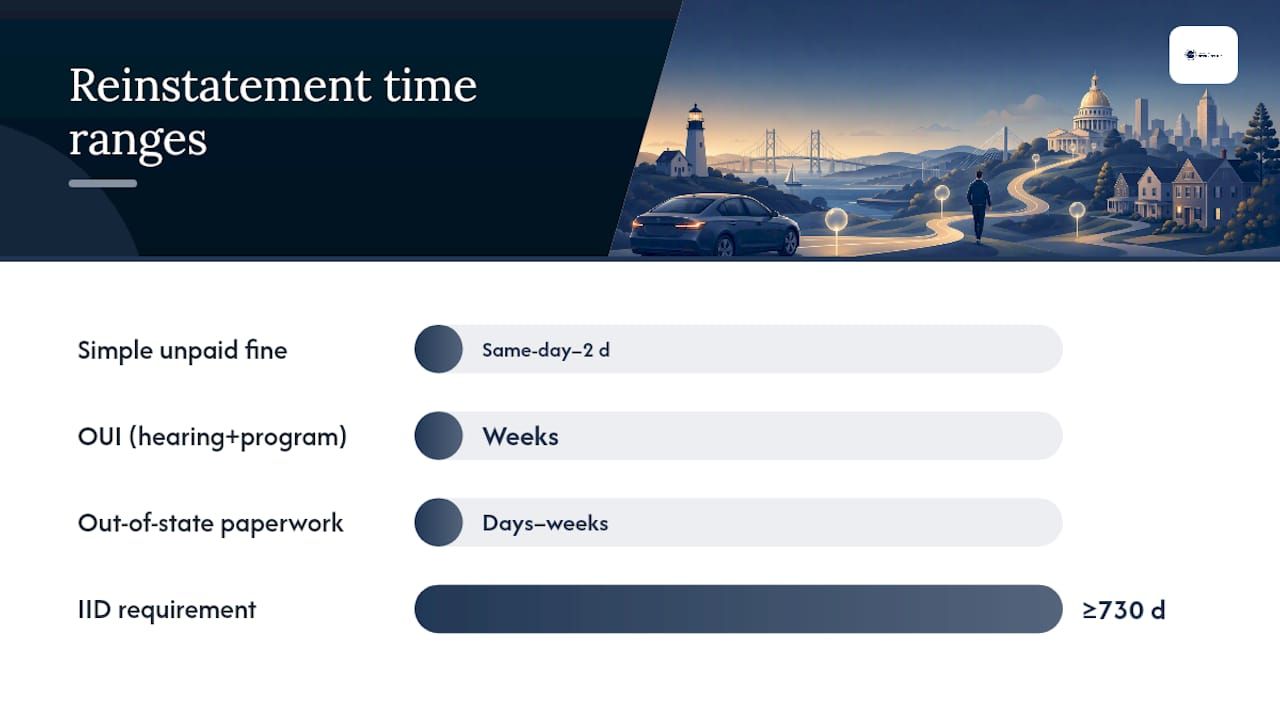
There's no single timeline, because it depends entirely on which category of suspension you're clearing. A straightforward, unpaid-fine suspension with no hearing requirement can resolve in a single visit: pay the fee through myRMV, and your license status often updates within a day or two.
OUI-related suspensions move slower. You typically need a hearing, a scheduled program completion, and sometimes IID installation before reinstatement posts, and each of those steps has its own waiting period layered on top of the others. A hearings officer's decision alone can take roughly 7 to 10 days, and that's before you factor in program enrollment windows that can run several weeks, and interlock installation timelines.
The 730-day IID minimum is the longest fixed clock in the entire system. If your reinstatement requires interlock, plan on at least two years from the date your T-restricted license is issued, not from the date your original suspension began, before you're eligible for a standard, unrestricted license again.
Out-of-state violations add another variable. Getting a certified letter of reinstatement from another state's motor vehicle agency can take days or weeks depending on that state's own processing speed, and Massachusetts requires that letter to be dated within 30 days of your Massachusetts hearing or transaction. If the out-of-state paperwork arrives late or expires before you use it, you start that clock over.
The realistic range spans from same-day resolution for simple fine-based suspensions to two-plus years for serious OUI-related revocations carrying interlock requirements. Knowing which bucket you fall into early saves you from either false optimism or unnecessary panic.
How Do You Check Your Suspension Status With the RMV?
The fastest way to check your status is myRMV, the RMV's online portal. Once logged in, your account shows every active suspension or revocation, the specific reason code for each, any outstanding fees attached, and whether a hearing or program completion is still pending.
If you'd rather talk to a person, or if your online account shows information that seems incomplete or outdated, the RMV Contact Center can look up your status by phone and confirm exactly what's still required. This matters more than it sounds: some suspensions carry multiple separate reason codes even though you assume they came from one incident, and an online summary occasionally undercounts them.
A third option is visiting a Service Center directly, useful if you're already planning to submit documents or pay a fee in person and want to confirm your full obligation list before you go. Bring identification either way.
Whichever method you use, check your status before assuming a suspension has run its course. Suspension end dates aren't always self-executing, meaning your license doesn't automatically become valid again just because a calendar date passed. Fees still need to be paid and, in many cases, a program or hearing requirement still needs to be closed out even after the underlying suspension period technically ends.
What Documents Do You Need for Your Specific Suspension Type?
Different violations trigger different paperwork, and mixing them up is one of the most common reasons reinstatement gets delayed.
For OUI and alcohol or drug-related suspensions , expect to need a certified driving history, court abstract documenting the disposition of your case, proof of completion for DPH-approved counseling or the NSC driver retraining program, and, if interlock applies, your vendor installation affidavit. These cases almost always require a hearing, so bring originals, not photocopies.
For unpaid fine or surchargeable-violation suspensions , the paperwork burden is far lighter. In many cases, you simply need to pay the outstanding fee, and reinstatement posts without a hearing at all. Check myRMV first, since some of these resolve entirely online.
For out-of-state suspensions , you'll need a certified letter of reinstatement from the state where the violation occurred, dated within 30 days, along with your Massachusetts driving history. If that letter expires before your Massachusetts hearing, you'll need to request a fresh one, which restarts the clock.
For suspensions tied to a breathalyzer refusal , the documentation often mirrors an OUI case even without a conviction, since refusal suspensions carry their own administrative track. Our breakdown of breathalyzer refusal penalties in Massachusetts covers how that track differs from a standard OUI suspension.
Matching the right document set to your specific suspension code before you show up saves an entire wasted trip.
Can You Appeal a Massachusetts License Suspension?
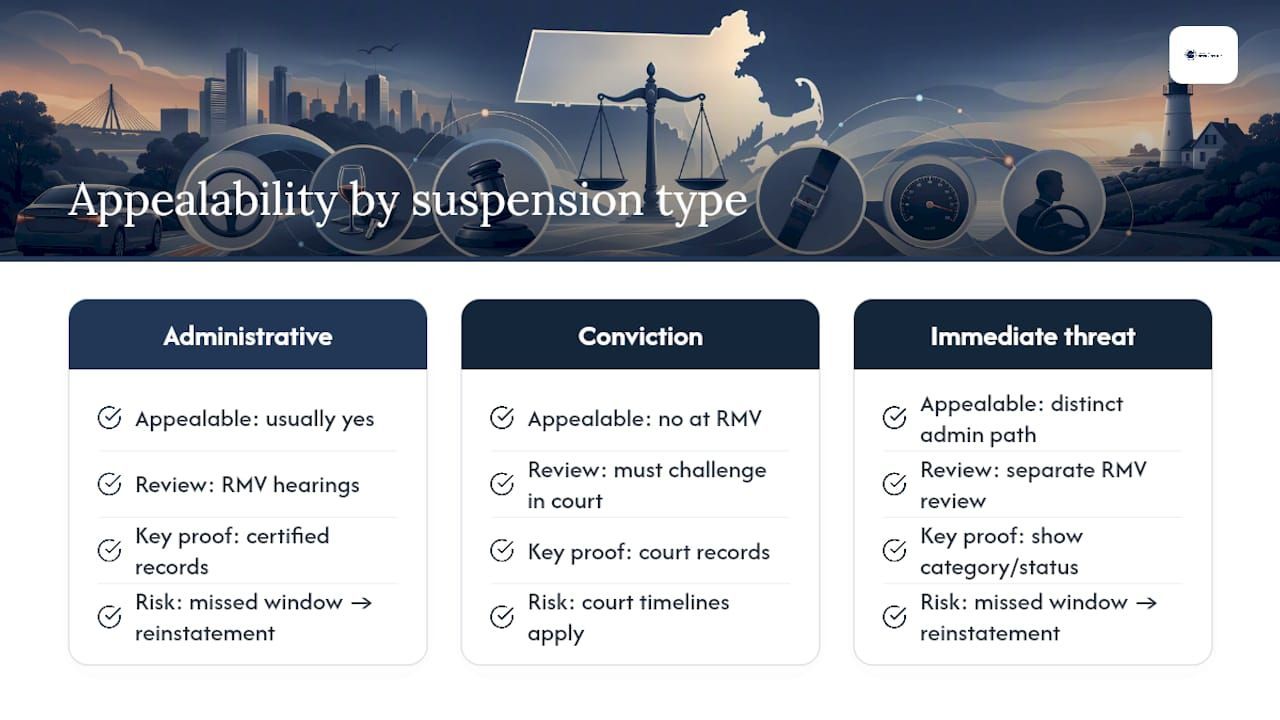
Yes, in most cases you can request a hearing to contest a suspension decision, though the process and odds of success depend heavily on the type of suspension involved. Administrative suspensions, including many tied to chemical test refusals or immediate threat determinations, generally allow you to request review through the RMV hearings process.
The strength of your appeal usually comes down to documentation. A hearings officer is evaluating whether the suspension was applied correctly and whether the circumstances justify any adjustment, not re-litigating the underlying criminal case. That means certified records, accurate abstracts, and a clear timeline matter more than argument alone.
Some suspensions, particularly those flowing directly from a criminal conviction, aren't appealable at the RMV level at all; the underlying conviction itself would need to be challenged in court instead. If you're facing an immediate threat suspension, that's an administrative action with its own distinct review path separate from a standard reinstatement hearing, and it's worth understanding which category you're in before you file anything.
Missing the appeal window is one of the most common and costly mistakes drivers make. Once that window closes, your only remaining path is often the standard reinstatement process, fees, programs, and all, with no shortcut back through an appeal.
What Happens if You Drive on a Suspended License?
Driving while your license is suspended or revoked, even for a single day during the reinstatement process, is its own separate criminal offense in Massachusetts. It doesn't matter whether you're one form away from full reinstatement; the RMV's records show suspended status until reinstatement actually posts, and that's what law enforcement checks.
A conviction for operating after suspension typically adds new fines, a new suspension period tacked onto whatever you were already working through, and in repeat or OUI-related cases, the possibility of jail time. It also resets your reinstatement clock, since you're now clearing a new suspension in addition to the original one.
If your suspension involves OUI or interlock requirements, driving without the device installed, or driving a vehicle that isn't fitted with your required IID, counts as a program violation that can extend your 730-day minimum or jeopardize your removal eligibility entirely. There's no gray area here: the restriction applies to any vehicle you drive, not just your own.
If you need to drive before reinstatement is complete, the hardship license process exists precisely for that gap. It's a legal path through documented need and an RMV hearing, not a shortcut around the suspension itself.
When Does It Make Sense to Hire an Attorney for Reinstatement?
Most straightforward fee-based suspensions don't need a lawyer. Complex cases do: out-of-state convictions that don't translate cleanly into Massachusetts categories, multiple overlapping suspensions, disputed chemical test results, IID eligibility disputes, or a hearing where your job depends on the outcome.
Michael P. Carroll has spent more than a decade handling OUI and DUI cases and representing clients at RMV hearings. That experience means organizing certified records, matching court abstracts to the right suspension code, and confirming program enrollment before you ever sit in front of a hearings officer, the kind of preparation that reduces continuances and denials.
— Michael Carroll
How Law Office of Michael P Carroll Helps With Reinstatement
If you'd rather not navigate hearings, IID disputes, and document deadlines alone, Law Office of Michael P Carroll gives you direct access to an attorney who has handled these RMV proceedings for over a decade, not a call center or a rotating case handler. That owner-operated model means the person preparing your hearing packet is the same person standing next to you when the hearings officer asks questions.

Services relevant to reinstatement include OUI and DUI defense, RMV hearing preparation and representation, and hardship license applications for clients who need to keep driving while a suspension resolves. Bring your RMV notices, any court paperwork related to the underlying offense, and your myRMV account status to a first meeting; that's usually enough for Michael to map out exactly what stands between you and a valid license. If your case involves a disputed OUI, a contested chemical test, or an IID eligibility question, visit the DUI Attorney page to schedule a consultation and get a clear read on your options before your next RMV hearing date.
This article is general information, not a substitute for advice from a qualified lawyer. Consult a qualified legal professional about your own circumstances before acting on anything here.
FAQ
How Do I Get My License Reinstated in Massachusetts?
Check myRMV for your account status, complete any required programs or hearings, pay every outstanding fee tied to each suspension, and update your license at a Service Center once payment posts.
How Much Is the Reinstatement Fee to Get My License Back?
Fees generally range from $100 to $1,200 per active suspension under MGL c.90 §33, with typical OUI-related fees running $500 for a first offense, $700 for a second, and $1,200 for a third or later offense.
How Much Does It Cost to Reinstate a Registration in Massachusetts?
Registration reinstatement fees are separate from license reinstatement fees and vary by the reason for suspension; check your myRMV account or contact the RMV Contact Center for the exact amount tied to your registration.
What Is a Cinderella License in Massachusetts?
A Cinderella license, formally called a hardship license, lets you drive during limited, RMV-approved hours for reasons like work, school, or medical appointments while your full reinstatement is still pending.
Do I Need a Lawyer to Reinstate My License?
Simple fee-based suspensions usually don't require one, but complex OUI cases, IID disputes, or hearings tied to your job may benefit from having an attorney like Michael P. Carroll organize your records and represent you.