
Massachusetts Attorney Explains 3 Ways Domestic Violence Charges End
Massachusetts Attorney Explains 3 Ways Domestic Violence Charges End

You cannot drop domestic violence charges in Massachusetts yourself, no matter what you or the alleged victim wants. The Commonwealth, through the local District Attorney's office, controls the prosecution once charges are filed, not the complaining witness. The only routes to ending a case are formal: a nolle prosequi filed by the prosecutor, a defense motion to dismiss, or dismissal for failure to prosecute. If you're facing these charges, your first move should be calling a defense attorney, not asking anyone to "drop it."
TL;DR:
- The prosecutor, not the victim, retains sole control over whether Massachusetts domestic violence charges are continued or dismissed through formal filings or court rulings.
- Dismissal options include filing a nolle prosequi, a motion to dismiss, or dismissal for failure to prosecute, all requiring official court procedures and documentation.
- Recantations or witness refusals typically do not end cases if supporting evidence like recordings, photos, or police reports remain intact.
- An active civil restraining order under Chapter 209A stays in effect independently of the criminal case and requires its own legal process to modify or lift.
- Victim requests to drop charges are considered but do not directly influence prosecution decisions, which depend on evidence, case strength, and safety concerns.
Table of Contents
- What Qualifies as a Domestic Violence Case in Massachusetts
- Who Actually Controls Whether the Charges Continue
- The Formal Paths to Dismissing a Case
- Recantation, Refusal to Testify, and the Fifth Amendment
- How 209A Orders and Firearm Rules Fit In
- Defenses, Likely Outcomes, and What Happens to Your Record
- What To Do Right Now if You're Facing Charges
- How I Approach These Cases After a Decade in Massachusetts Courts
- Get Direct Legal Help With Your Domestic Violence Case
- Sources
- FAQ
What Qualifies as a Domestic Violence Case in Massachusetts
Massachusetts law doesn't have a single "domestic violence" statute. Instead, ordinary criminal charges get a domestic label when they involve people in a defined relationship under Chapter 209A. That includes spouses and ex spouses, people who live together or used to, people in a substantive dating relationship, and parents who share a child, regardless of whether they ever married or lived together.
The underlying charges vary widely, but the most common ones are:
- Assault and battery, including on a family or household member
- Strangulation or suffocation
- Criminal harassment or stalking
- Violation of an abuse prevention order
The "domestic" tag matters procedurally. It typically triggers stricter bail conditions, a mandatory dangerousness assessment, and a parallel civil track under Chapter 209A that runs independently of the criminal case. A single incident can generate both a criminal docket number and a civil restraining order case, each with its own judge, hearings, and timeline.
Who Actually Controls Whether the Charges Continue
The District Attorney's office decides whether a domestic violence case moves forward, not the person who called the police and not the person who got arrested. Prosecutors represent the public interest in these cases, and a private citizen has no judicially recognized right to control whether another person is prosecuted. That single fact surprises most defendants and most alleged victims alike.
A judge generally can't dismiss a case just because the Commonwealth objects. Under Guideline 8:12, a court should override the prosecutor's wishes only when a defendant's constitutional or statutory rights were violated in a way that requires dismissal, not because the case seems weak or the alleged victim asked for it to end.
Prosecutors weigh several factors before deciding whether to proceed:
- Strength of the physical and testimonial evidence
- Consistency and credibility of statements given to police
- The defendant's prior record, including any history of similar conduct
- Safety concerns for the alleged victim, children, or the broader household
- Input from victim advocates or the alleged victim herself, weighed alongside other evidence
Prosecutors sometimes know things about a relationship's history that neither party has volunteered directly, and that background can push a case forward even when the named victim wants it to stop. Any dismissal request the Commonwealth does pursue has to follow a formal process: a written motion, entry in the court record, and compliance with Mass. R. Crim. P. 13 and 16. There's no informal off ramp.
The Formal Paths to Dismissing a Case
Three procedural tools end a Massachusetts domestic violence case before trial, and each works differently.
- Nolle prosequi. The prosecutor, not the defense, files this under Mass. R. Crim. P. 16 to formally end the case. If the Commonwealth wants to dismiss a domestic abuse case before trial, the court should require that motion be in writing with stated reasons, and it becomes part of the public record.
- Motion to dismiss. Defense counsel files this under Mass. R. Crim. P. 13, arguing a legal defect, such as insufficient evidence presented to the grand jury, a violation of the defendant's rights, or a fatally flawed complaint. This is an argument made to the judge, independent of what the alleged victim wants.
- Failure to prosecute. If the Commonwealth isn't ready to proceed, repeatedly, or at a critical hearing, without adequate justification, the court can dismiss the case on its own. Judges want to see on the record what efforts the prosecutor made to notify the named victim before treating a "not ready" answer as grounds for dismissal.
None of these mechanisms start with a phone call from the alleged victim saying she wants to withdraw her statement. They start with a filing, a hearing, and a judge's signature.
Recantation, Refusal to Testify, and the Fifth Amendment
A recanted statement rarely kills a domestic violence case on its own. If police body camera footage, 911 audio, photographs of injuries, or medical records corroborate the original account, the Commonwealth can often proceed even after the witness changes her story.
Here's what typically plays out when a witness becomes uncooperative:
- The prosecutor may seek to admit prior statements under hearsay exceptions like excited utterance
- The court may issue a summons or, in rare cases, a warrant to compel testimony
- Defense counsel can cross examine on inconsistencies between the recantation and the original statement
- A witness who invoked the Fifth Amendment in a related proceeding, such as a 209A hearing, isn't automatically excused from testifying at the criminal trial
That last point trips people up constantly. Massachusetts courts have made clear that invoking the privilege against self incrimination in one proceeding doesn't render a witness permanently unavailable in another; availability and waiver get assessed case by case, hearing by hearing.
Pro Tip: If you're pressuring or even gently encouraging the alleged victim to recant or refuse to testify, stop. That conduct can itself become a new criminal charge, witness intimidation, layered on top of what you're already facing.
How 209A Orders and Firearm Rules Fit In
A criminal domestic violence charge almost always travels alongside a civil 209A abuse prevention order, and resolving one doesn't automatically resolve the other. A judge can issue a temporary order the same day it's requested, then hold a full hearing within 10 court business days where the order can be extended, often up to a year.
- Extensions can be renewed repeatedly if the judge finds continued need
- An active 209A order or a domestic violence conviction typically triggers firearm license suspension and a surrender requirement under Chapter 209A
- Getting the criminal charge dismissed does not lift a 209A order automatically; that requires its own hearing
Firearm restrictions attached to a restraining order carry the same weight regardless of how the underlying criminal case turns out, and violating a 209A order is itself a separate crime.
Defenses, Likely Outcomes, and What Happens to Your Record
Every domestic violence case rests on its own facts, but a few defenses come up repeatedly. Self defense applies when the evidence shows the defendant reacted to an immediate threat rather than initiated the conflict. Lack of sufficient evidence applies when the Commonwealth can't corroborate the allegation beyond a single, now disputed, statement. Mistaken identity comes up more often than people expect, especially in incidents where police responded to a chaotic scene involving multiple people.
Cases in Massachusetts tend to resolve one of several ways:
- Outright dismissal or nolle prosequi: the case ends with no conviction and, depending on the disposition, may be eligible for record sealing after a waiting period
- Pretrial diversion or a continuance without a finding: the case is held open, often with conditions, and can result in eventual dismissal if conditions are met
- Guilty plea: results in a conviction, sentencing, and a permanent record unless later sealed under strict eligibility rules
- Trial: ends in acquittal, conviction, or occasionally a mistrial, with record consequences tied directly to the verdict
Sealing or expunging a domestic violence record in Massachusetts depends heavily on the disposition and the specific charge; some outcomes qualify quickly, others carry mandatory waiting periods or aren't eligible at all. Anyone weighing a plea should understand exactly what that disposition means for future record relief before agreeing to it. For a deeper look at how these cases get built and defended, see this overview of domestic assault defense strategy.
What To Do Right Now if You're Facing Charges
- Call a Massachusetts criminal defense attorney immediately. Every day matters for evidence preservation and bail arguments; don't wait for a court date to start building a defense.
- Write down your own timeline of the incident and the relationship history while your memory is fresh, and hand it to your attorney, not to the alleged victim or mutual friends.
- Preserve everything: text messages, call logs, photographs, and the names of anyone who witnessed the incident or the relationship dynamics beforehand.
- Comply strictly with bail conditions and no-contact orders , even if the alleged victim reaches out first. A violation here can add new charges on top of the original one. If you're unsure what your release conditions require, review this breakdown of bail conditions in domestic violence cases.
- Let your attorney handle communication with the DA's office , including any request for case review, submission of mitigating evidence, or negotiation toward diversion.
Pro Tip: Never contact the alleged victim yourself to discuss the case, even to apologize or ask her to "tell them the truth." Route everything through your attorney. A well meaning phone call can become the exhibit that sinks your defense.
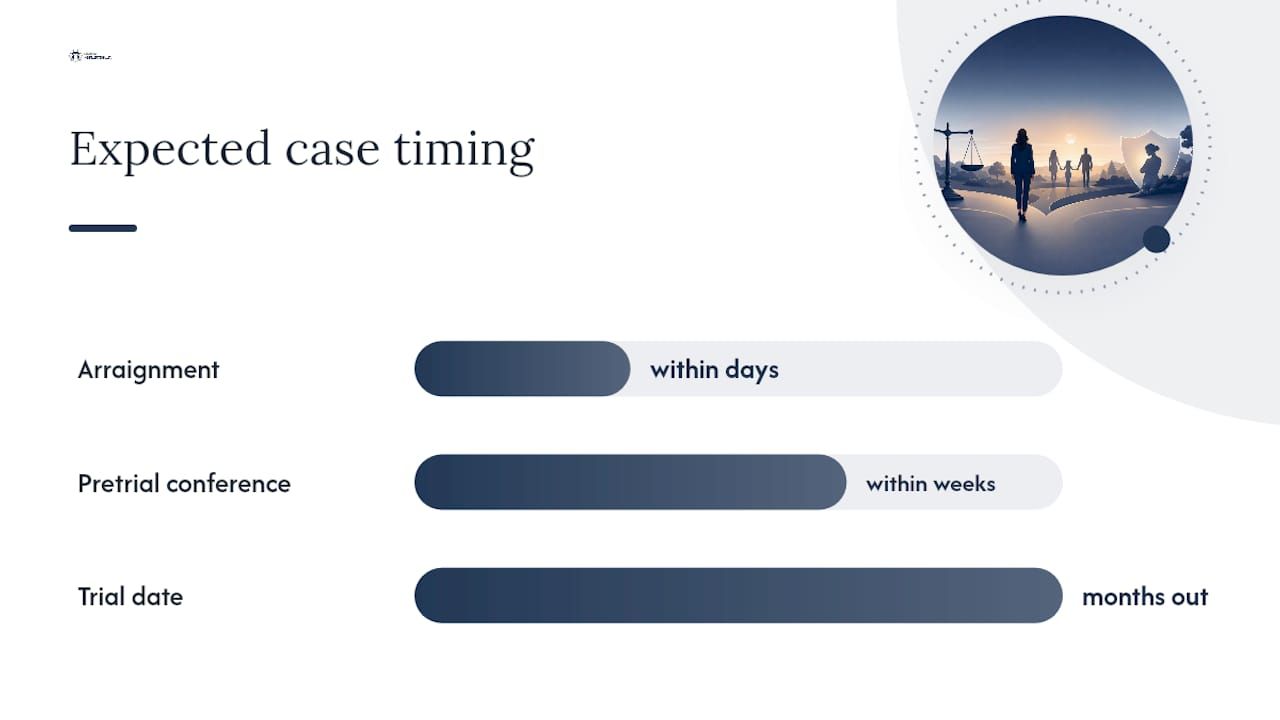
Timelines vary by county and court schedule, but expect an arraignment within days of arrest, a pretrial conference within weeks, and, if the case doesn't resolve earlier, a trial date set months out.
How I Approach These Cases After a Decade in Massachusetts Courts
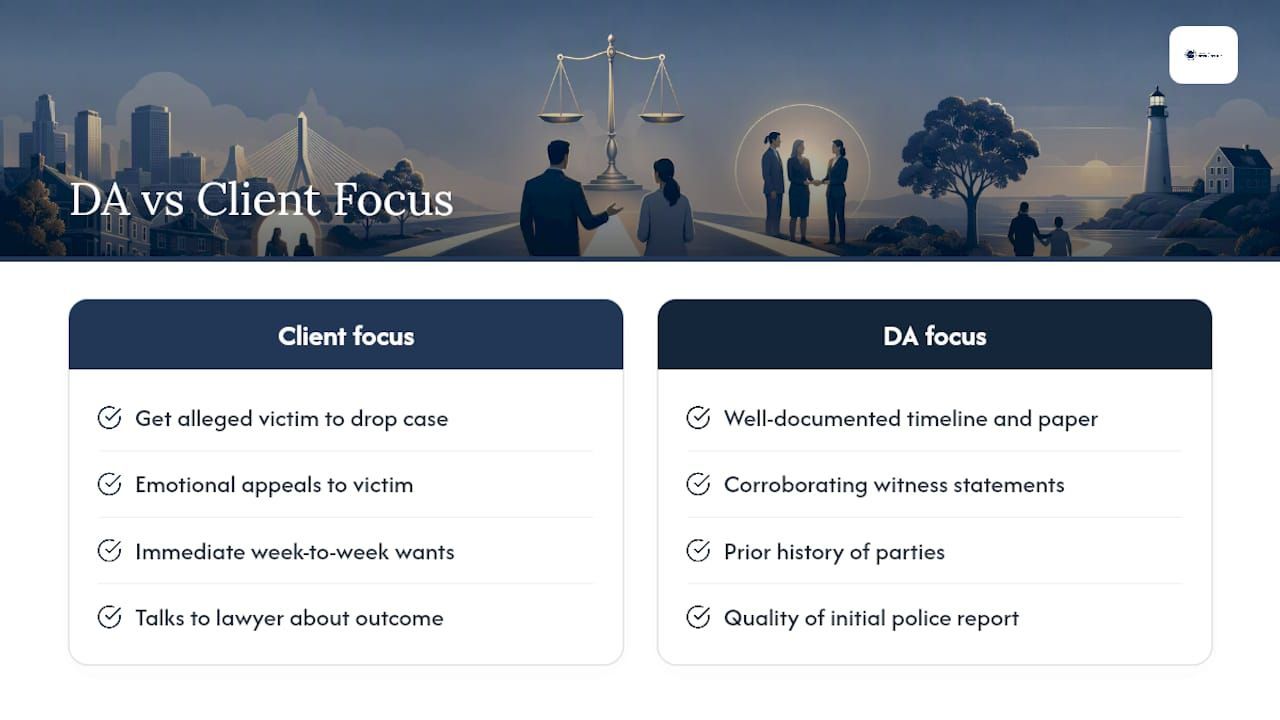
Clients almost always call me asking the same question: how do we get the alleged victim to drop this? I redirect that energy immediately, because it's aimed at the wrong target. The real work happens with the District Attorney's office, and it happens through paper: a well documented timeline, corroborating witness statements, inconsistencies in the original police report, and a clear-eyed argument about what the evidence can and can't prove at trial.
What clients underestimate is how much a DA's decision turns on details that have nothing to do with what the alleged victim wants that week. Prior history, the quality of the initial police report, and whether the evidence holds up under scrutiny matter more than an emotional appeal. Because I run this firm myself, clients deal directly with me, not a rotating cast of associates, and that continuity lets me spot the procedural openings, a weak probable cause finding, a missed notification requirement, a shaky corroborating witness, before they get lost in a crowded docket.
— Michael Carroll
Get Direct Legal Help With Your Domestic Violence Case
Wondering whether your Massachusetts domestic violence charge can be dismissed, reduced, or resolved through diversion is exactly the kind of question that needs a real conversation, not a generic answer. At some law offices, cases may be handled by multiple staff members; in contrast, you can work directly with an attorney throughout your case, from bail hearings through motions practice.

Legal services are provided for domestic assault and battery charges, related 209A abuse prevention order proceedings, and harassment prevention matters in Massachusetts, including Attleboro and surrounding areas. A consultation covers your specific charges, the evidence against you, realistic options for dismissal or diversion, and what to expect at your next hearing. If you're facing a domestic violence charge in Massachusetts, visit the criminal law practice page or reach out directly to schedule a consultation and start building your defense before your next court date.
This article is general information, not a substitute for advice from a qualified lawyer. Consult a qualified legal professional about your own circumstances before acting on anything here.
Sources
FAQ
Can a victim ask for domestic violence charges to be dropped in Massachusetts?
A victim can tell the prosecutor she wants the case dropped, but that request is only one factor the District Attorney weighs. The Commonwealth, not the victim, controls the prosecution decision.
How do you actually get domestic violence charges dismissed in Massachusetts?
Dismissal happens through a formal legal mechanism: the prosecutor files a nolle prosequi, defense counsel files a motion to dismiss under Mass. R. Crim. P. 13, or the court dismisses for failure to prosecute. There's no informal process that starts with the alleged victim's request alone.
Why do some domestic violence cases in Massachusetts get dropped?
Cases get dropped when the DA determines the evidence can't support a conviction, a key witness becomes unavailable without corroborating proof, or a legal defect in the charge or complaint gives grounds for a motion to dismiss. Victim cooperation matters but isn't the deciding factor on its own.
Can I withdraw my statement in a domestic violence case?
You can tell the prosecutor you want to withdraw your statement, but doing so rarely ends the case if other evidence, like photos, medical records, or 911 recordings, corroborates the original account. A prior statement can sometimes still be used even after a recantation, depending on how it was made and preserved.
Does an active 209A restraining order end when the criminal case is dismissed?
No. A 209A abuse prevention order under Chapter 209A runs on its own civil track and requires its own hearing to modify or terminate, regardless of what happens to the related criminal charge.