
Massachusetts OUI: The Clearance Letter for a Case From Another State
Massachusetts OUI: The Clearance Letter for a Case From Another State

Massachusetts can and will suspend your Massachusetts license for an out of state OUI, because state law treats that conviction as if it happened here. Your first move is to resolve the out of state matter and get a clearance letter or a current driving record to give the RMV. Until you do, you cannot legally drive on your Massachusetts license.
TL;DR:
- The RMV can suspend your license while the out of state case is pending, and paying fines or completing probation does not clear its file.
- Once the case closes, obtain a clearance letter or current driving record dated within 30 days and submit it to the RMV.
- Massachusetts counts out of state convictions, so a prior offense can make a later OUI a repeat offense, with longer suspension and interlock requirements.
- Out of state residents need an approved vendor reporting to Massachusetts to earn two year interlock credit; deferment pauses but does not erase the requirement.
- After the RMV officially suspends your license, reinstatement costs $100, and refusal cases, repeat offenses, or incomplete records may require a hearing.
Table of Contents
- Legal basis: Chapter 90 §22©, NDR, and reciprocal suspensions
- What triggers RMV action and what to gather right away
- How Massachusetts counts out-of-state offenses toward your record
- Ignition interlock rules for drivers living out of state
- Clearing a reciprocal suspension step by step
- Reinstatement fees, hearings, and realistic timelines
- CDL holders, drivers under 21, and chemical test refusals
- How an experienced Massachusetts OUI attorney helps
- Why the paperwork matters more than the panic
- Get help resolving your Massachusetts OUI suspension
- FAQ
- Sources
Legal basis: Chapter 90 §22©, NDR, and reciprocal suspensions
Massachusetts law does not distinguish between an OUI committed on the Mass Pike and one committed in Florida or Rhode Island. Under Massachusetts General Laws Chapter 90 Section 22, the Registry of Motor Vehicles may give an out of state conviction the same weight for suspension, revocation or reinstatement purposes as a conviction that occurred inside the commonwealth. The RMV typically learns about the conviction through the National Driver Register, a shared database that flags license actions across states, along with court abstracts and electronic notices from the convicting jurisdiction.
A few things follow from this setup:
- The RMV action is administrative, separate from whatever happens in the out of state criminal case.
- A suspension can take effect even while you are still fighting the charge in another state's court.
- Paying a fine or finishing probation elsewhere does not automatically clear your Massachusetts record.
That gap between the criminal case and the RMV's own file is where most license holders get stuck.
What triggers RMV action and what to gather right away
A Massachusetts reciprocal suspension usually starts with one of a few events: an official notice from the convicting state, a court abstract transmitted electronically, or an NDR match that surfaces during a routine license check. The RMV then mails a suspension notice to the address on file, and you can check your license status through the RMV's online services at any time rather than waiting on the mail.
As soon as you suspect a suspension is coming, collect:
- The docket number and court name from the out of state case.
- Contact information for that court's clerk or the state's DMV equivalent, since you will need them to request a clearance letter.
- Any paperwork showing the case is closed, whether through dismissal, program completion, or sentencing.
Having these ready before the notice even arrives saves weeks later.
How Massachusetts counts out-of-state offenses toward your record
Massachusetts does not treat your driving history as starting fresh at the state line. According to RMV guidance on alcohol and drug suspensions, the Registry counts OUI convictions and driver alcohol education program assignments from any jurisdiction when it calculates your suspension period. A first offense in Connecticut, in other words, can make a later Massachusetts charge look like a second offense in the eyes of the RMV.
This has real consequences:
- A second lifetime OUI, even if the first happened in another state years ago, typically carries a longer suspension and may require the ignition interlock device program.
- Program assignments, such as mandatory alcohol education completed out of state, still count against you here.
- A refusal to submit to a chemical test in another state factors into Massachusetts's calculation just as a refusal at home would.
For a fuller breakdown of how these totals affect sentencing and license actions, our overview of OUI penalties in Massachusetts walks through the escalating consequences by offense number.
Ignition interlock rules for drivers living out of state
Repeat OUI offenders in Massachusetts generally face a multi-year ignition interlock device requirement before full reinstatement, and the RMV adds a "T" restriction to the license until that requirement is satisfied. According to Mass.gov's Ignition Interlock Device Program guidance, drivers who live outside Massachusetts but carry this obligation have two paths: complete the two-year program using a vendor that meets Massachusetts standards, or apply for a deferment by submitting an Out-of-State Resident Affidavit along with proof of residency.
- The two-year clock only credits time properly reported by an approved vendor.
- A deferment pauses the requirement but does not erase it; you still need to complete the program eventually.
- Not every interlock vendor operating in another state is set up to report data in the format Massachusetts requires.
Pro Tip: Before enrolling with any out of state vendor, confirm in writing that they report compliance data to Massachusetts, or you risk losing months of credit you believed you had already earned. For more detail on costs and removal timelines, see our guide to ignition interlock requirements in Massachusetts.
Clearing a reciprocal suspension step by step
Once the out of state case is behind you, clearing the Massachusetts suspension is a documentation exercise, not a courtroom one.
- Resolve the underlying matter first, whether that means a court disposition, completed probation, or paid fines; the RMV will not accept an open case as grounds for clearance.
- Obtain a clearance letter or a current driving record from the convicting state, dated within 30 days, since Mass.gov's reciprocal suspension guidance treats anything older as stale.
- Submit that document through the Out of State Reciprocal Suspension Clearance Request process, either by uploading it online or presenting it at an RMV Service Center, and confirm the suspension has actually been lifted rather than assuming it was processed automatically.
Some cases require an in-person hearing before the suspension comes off, particularly when the RMV's file is incomplete or the conviction involved aggravating factors.
Reinstatement fees, hearings, and realistic timelines
Clearing the paperwork is only half the process; reinstating the license carries its own costs and, sometimes, its own hearing. Mass.gov guidance on out of state suspensions confirms a $100 reinstatement fee applies once a Massachusetts suspension has officially taken effect, on top of any interlock installation or monitoring fees tied to a parallel IID obligation.
- Bring the clearance letter, driving record, and any court disposition paperwork to a hearing if one is scheduled.
- An RMV hearings officer typically gets involved when the suspension involves a refusal, a repeat offense, or missing documentation.
- Administrative appeals through the RMV are separate from any appeal of the underlying criminal conviction in court, and the two processes do not resolve each other.
For a breakdown of typical costs across different suspension scenarios, our post on license reinstatement fees in Massachusetts lays out the ranges by case type.
CDL holders, drivers under 21, and chemical test refusals
Three groups face sharper consequences and should move faster than the general timeline above suggests.
- Commercial driver's license holders can face disqualification from an out of state OUI even when the violation occurred in a personal vehicle, and federal commercial driving standards reinforce those state-level rules, according to the Massachusetts RMV's CDL FAQs.
- Operators under 21 face a zero-tolerance policy, where a far lower blood alcohol threshold triggers license action, often resulting in a suspension that can run up to 180 days.
- Refusing a chemical test in another state carries its own administrative penalty there and still counts against you when Massachusetts calculates suspension length here, compounding rather than replacing the OUI consequence itself.
Our guide on avoiding a 180-day RMV suspension covers refusal consequences in more depth.
How an experienced Massachusetts OUI attorney helps
We help clients obtain the clearance letters and driving records the RMV requires, which saves them from navigating an unfamiliar jurisdiction's paperwork alone. We prepare clients for RMV hearings and related court matters, and we advise on ignition interlock compliance, including deferment documentation for clients who live outside Massachusetts. Clients work directly with the attorney handling their case rather than being passed between staff, which keeps communication focused and consistent from the first call through reinstatement.
Why the paperwork matters more than the panic
The biggest misconception we see is that fixing the out of state case automatically fixes the Massachusetts license. It does not. The RMV runs its own file, on its own timeline, and a closed court case sitting in another state's system does nothing until someone puts the right document in front of the Registry here.
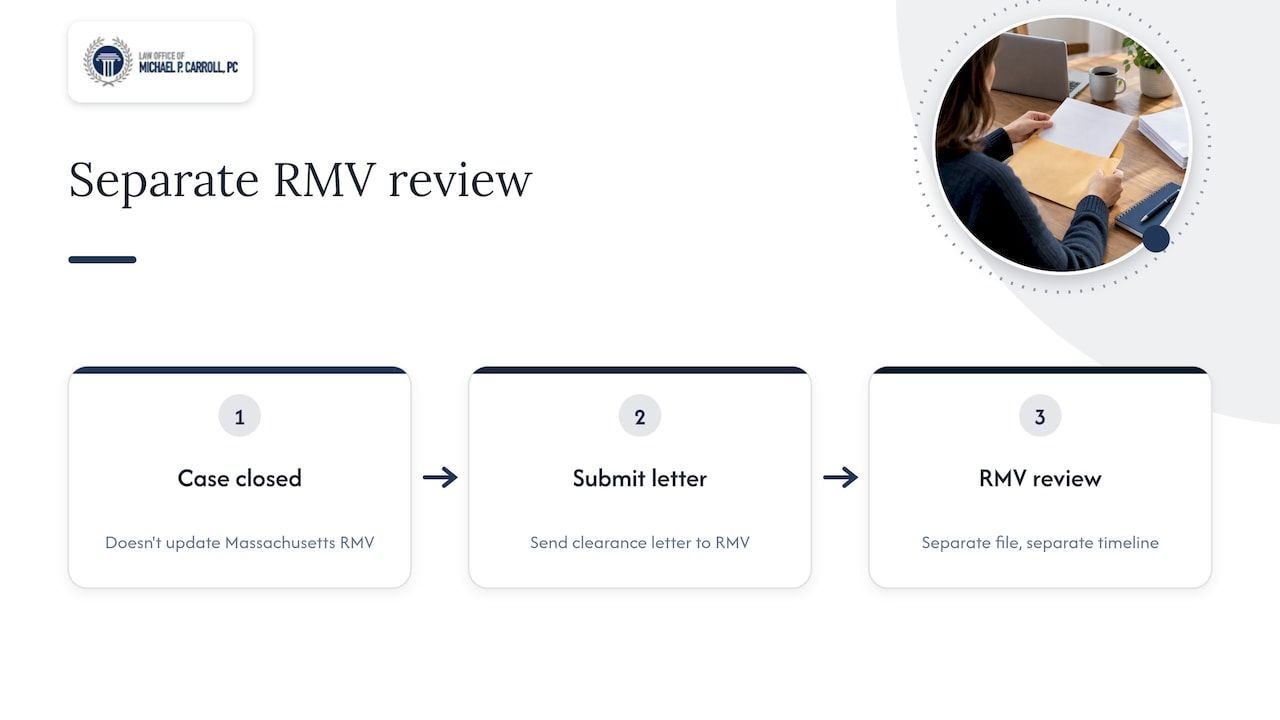
The conventional advice, wait for the suspension letter and figure it out then, costs people weeks of driving they could have kept. The better approach is to treat the out of state charge as a two-track problem from day one: the criminal case in that state, and the Massachusetts paperwork trail running in parallel. Readers juggling an interlock obligation while living out of state face the sharpest version of this problem, since a single incompatible vendor can erase months of program credit without anyone noticing until reinstatement day arrives.
Prioritize the clearance letter and the driving record before anything else. Everything downstream, the interlock deferment, the hearing, the reinstatement fee, moves faster once that document exists.
— Michael Carroll
Get help resolving your Massachusetts OUI suspension
We handle out of state OUI cases for Massachusetts license holders regularly, from coordinating clearance letters with courts in other states to representing clients at RMV hearings and advising on interlock deferment paperwork. Working directly with one attorney throughout your case means you are not re-explaining your situation to a new person every time you call.

If you are facing an out of state OUI that is affecting your Massachusetts license, reach out through our OUI attorney page to schedule a consultation and start resolving both sides of the problem at once.
This article is general information, not a substitute for advice from a qualified lawyer. Consult a qualified legal professional about your own circumstances before acting on anything here.
FAQ
What is a Cinderella license in MA?
A Cinderella license is a colloquial term some drivers use for a hardship or limited license, which allows restricted driving, often for work or medical appointments, during a suspension period. Eligibility depends on the type of suspension and offense history, and our guide to hardship licenses after an OUI explains the process in more detail.
Can out-of-state drug possession affect my Massachusetts license?
Yes, Massachusetts can apply the same reciprocal treatment to certain out of state drug offenses that it applies to OUI convictions, since Chapter 90 Section 22 covers a range of convictions beyond impaired driving. Whether a specific drug charge triggers suspension depends on the offense and how it was classified in the convicting state, so checking with the RMV or an attorney is the safest first step.
Do all states share driver information with each other?
Most states participate in the National Driver Register, which flags license actions across state lines, but participation and the specific data shared can vary. Because of this, drivers should not assume a suspension elsewhere went unnoticed in Massachusetts, nor assume every detail of an out of state case automatically reaches the RMV without someone submitting it.
What happens after two OUIs in Massachusetts?
A second OUI in Massachusetts, including one where the first offense happened in another state, generally triggers a longer license suspension and a mandatory ignition interlock device requirement under the IID program rules. The RMV counts prior out of state convictions when determining whether a new charge counts as a first or subsequent offense.
Recommended
This article is general information about Massachusetts law, not legal advice, and reading it does not make you a client of the Law Office of Michael P. Carroll, PC. Every case is different. If you are facing charges in Bristol, Norfolk or Plymouth County, call Mike to discuss your situation.