
258E Order Defense: Miss Court, Risk a Yearlong Order in Massachusetts
258E Order Defense: Miss Court, Risk a Yearlong Order in Massachusetts

A Chapter 258E order restricts where you can go and who you can contact the moment a judge signs it, and violating any term is a criminal offense that can lead to arrest. Courts typically set a hearing within 10 business days of a temporary order, and that hearing is your chance to challenge the plaintiff's case before any restriction extends for up to a year. The single most useful thing you can do right now is show up for that hearing with experienced Massachusetts counsel.
TL;DR:
- At the return hearing, usually within 10 business days, you can cross examine the plaintiff, present witnesses and records, and challenge each alleged incident.
- For an extension, the plaintiff must prove three separate, willful, malicious acts that caused fear or intimidation, unless a qualifying sex offense or stalking incident applies.
- Organize evidence by legal element, using dated messages, witness accounts, and records to contest intent, separate acts, actual fear, or the source of allegations.
- Do not rely on the plaintiff's permission to resume contact: only a judge can change the order in writing, and violations can trigger criminal prosecution.
- Unlike a 209A order, a 258E petition does not require a family or household relationship, so coworkers, neighbors, and strangers may be involved.
Table of Contents
- What Chapter 258E covers and how it differs from 209A
- How an order is issued: ex parte orders and the 10-day return hearing
- What the plaintiff must prove: statutory elements and the preponderance standard
- Common defenses and evidence that support them
- What occurs at the 10-day hearing: procedure, admissible evidence, and courtroom rights
- Consequences of extension or violation: criminal penalties and collateral effects
- Practical hearing prep: prioritized checklist and immediate steps
- Differences between domestic and non-domestic abuse restraining orders under Chapter 258E
- Process and criteria for obtaining a Chapter 258E order of protection in Massachusetts
- Role and procedures of Clerk Magistrate Hearings related to 258E orders
- Potential impact of 258E orders on child custody or visitation arrangements
- Steps to enforce or modify an existing Chapter 258E order
- Explanation of mutual restraining orders and their applicability under 258E
- Owner-run defense perspective: why early, direct attorney involvement matters
- How we defend 258E cases in Massachusetts
- FAQ
- Sources
What Chapter 258E covers and how it differs from 209A
Chapter 258E lets a judge grant protection to someone who claims harassment, stalking, sexual assault, or certain other criminal acts, regardless of whether the parties ever lived together, dated, or share a child. That is the key distinction from a 209A abuse prevention order, which requires a qualifying family or household relationship. A plaintiff can file a 258E petition in District Court, Boston Municipal Court, Superior Court, or Juvenile Court, and can seek emergency relief from a judge or through police after hours when the courts are closed.
- 258E applies to coworkers, neighbors, acquaintances, and strangers, not just family members.
- 209A requires a specific relationship (spouse, former spouse, dating partner, co-parent, or household member).
- 258E remedies can include no-contact terms, staying away from a home or workplace, and surrendering firearms.
How an order is issued: ex parte orders and the 10-day return hearing
Judges can issue a temporary, or ex parte, 258E order based solely on the plaintiff's sworn affidavit, without you present or even notified beforehand. That one-sided process exists because the law allows emergency protection when a plaintiff claims an immediate safety concern, but it means the first order you see may reflect only one side of the story.
- The plaintiff files a complaint and affidavit describing the alleged harassment.
- A judge reviews the paperwork and, if satisfied, issues a temporary order the same day.
- The court schedules a hearing, usually within 10 business days, where you can respond.
- If you miss that hearing, the judge can extend the order for up to one year without hearing your side.
The temporary order typically bars contact, orders you to stay away from the plaintiff's home or workplace, and can require surrendering firearms in the interim. Treat every term as enforceable the instant it's signed, even before you've had a chance to contest it.
What the plaintiff must prove: statutory elements and the preponderance standard
To keep a 258E order in place past the temporary stage, the plaintiff has to prove specific facts, not just general discomfort or a personality conflict.
- Three or more separate acts of willful and malicious conduct directed at the plaintiff.
- Intent behind those acts to cause fear, intimidation, abuse, or property damage.
- Actual fear or intimidation resulting from the conduct, not just annoyance.
- Alternatively, a single incident involving certain sex offenses or stalking can also qualify under the statute.
The plaintiff must prove the case by a preponderance of the evidence, meaning more likely than not, which is a lower bar than the "beyond a reasonable doubt" standard used in criminal trials, but it still requires real evidence tied to each element, not just an accusation. Under the standard outlined in Massachusetts court guidelines, a judge who finds even one element unsupported should deny or dissolve the order. That makes the statutory checklist itself your roadmap for a defense: find the element that's weakest and build your argument there.
Common defenses and evidence that support them
Every realistic defense in a 258E case ties back to one of the statutory elements the plaintiff has to prove. Generic denials rarely work; specific, documented rebuttals do.
- Challenge intent by producing texts, emails, or witness statements showing you acted without malice or for an unrelated reason.
- Argue the "three acts" requirement isn't met by showing the alleged incidents are really one continuous event or too vague to count separately.
- Raise constitutionally protected speech where the conduct involved public commentary or lawful expression, understanding this defense has real limits and doesn't cover threats or targeted harassment.
- Attack weak or secondhand evidence, including hearsay, missing dates, or a total absence of independent corroboration.
- Show mistaken identity or that the described conduct came from someone else entirely.
Appellate decisions have reversed 258E orders where the record didn't show a genuine pattern of willful and malicious acts. In F.W.T. v. F.T., the Appeals Court emphasized that judges must hold plaintiffs to the statute's two-layer intent requirement rather than extending orders based on ordinary interpersonal friction.
Pro Tip: Organize your evidence by statutory element, not just by date, so the judge can see exactly which part of the plaintiff's case falls short.
What occurs at the 10-day hearing: procedure, admissible evidence, and courtroom rights
The return hearing follows a predictable structure, and knowing the order of events helps you prepare instead of reacting on the fly.
- The plaintiff testifies first and presents evidence supporting the original complaint.
- You have the right to cross-examine the plaintiff and challenge inconsistencies directly.
- You present your own evidence and witnesses, and the plaintiff's attorney may cross-examine them.
- The judge rules on whether to extend, modify, or vacate the order based on the full record.
Bring organized exhibits: printed texts and emails with visible dates, police reports, and any video or photo evidence saved on a device you can show in court. A single chronological binder or folder, labeled by date, makes it far easier for the judge to follow your version of events and spot gaps in the plaintiff's timeline.
Pro Tip: Write a one-page factual timeline before the hearing and hand a copy to the clerk and the plaintiff's side so there's no confusion about which incidents you're addressing.
Consequences of extension or violation: criminal penalties and collateral effects
An extended 258E order isn't just inconvenient. Violating any term is a criminal act, and court guidance confirms that a plaintiff's consent to contact does not excuse a violation once the order is in effect.
- A violation can result in a criminal charge carrying fines and potential jail time.
- Courts may refer violations directly to the district attorney for prosecution, separate from the civil order itself.
- A 258E order can trigger administrative review of an existing firearm license or affect eligibility for a new one.
- The hearing transcript and any extended order become part of a record that can surface in background checks tied to employment or licensing.
Never assume an order has lapsed just because the plaintiff says it's fine to talk. The order stays in force until a judge modifies or terminates it in writing, and any contact before that happens can be prosecuted as a crime.
Practical hearing prep: prioritized checklist and immediate steps
Preparation in the days before a 258E hearing often determines the outcome more than anything said in the courtroom.
- Confirm the hearing date and time with the court clerk's office as soon as you receive notice.
- Contact a Massachusetts attorney immediately so there's time to review the complaint and plan a defense.
- Avoid any contact with the plaintiff, directly or through third parties, even if you believe it would help.
- Preserve every text, email, voicemail, and social media message related to the relationship or dispute.
- Build a written timeline of events and gather contact information for any witnesses who can corroborate your account.
- Discuss with your attorney whether a motion to impound sensitive records or a brief continuance makes sense for your case.
Pro Tip: Save screenshots of messages before you delete or archive any app, since a deleted conversation can look like evidence tampering even when that was never the intent.
Differences between domestic and non-domestic abuse restraining orders under Chapter 258E
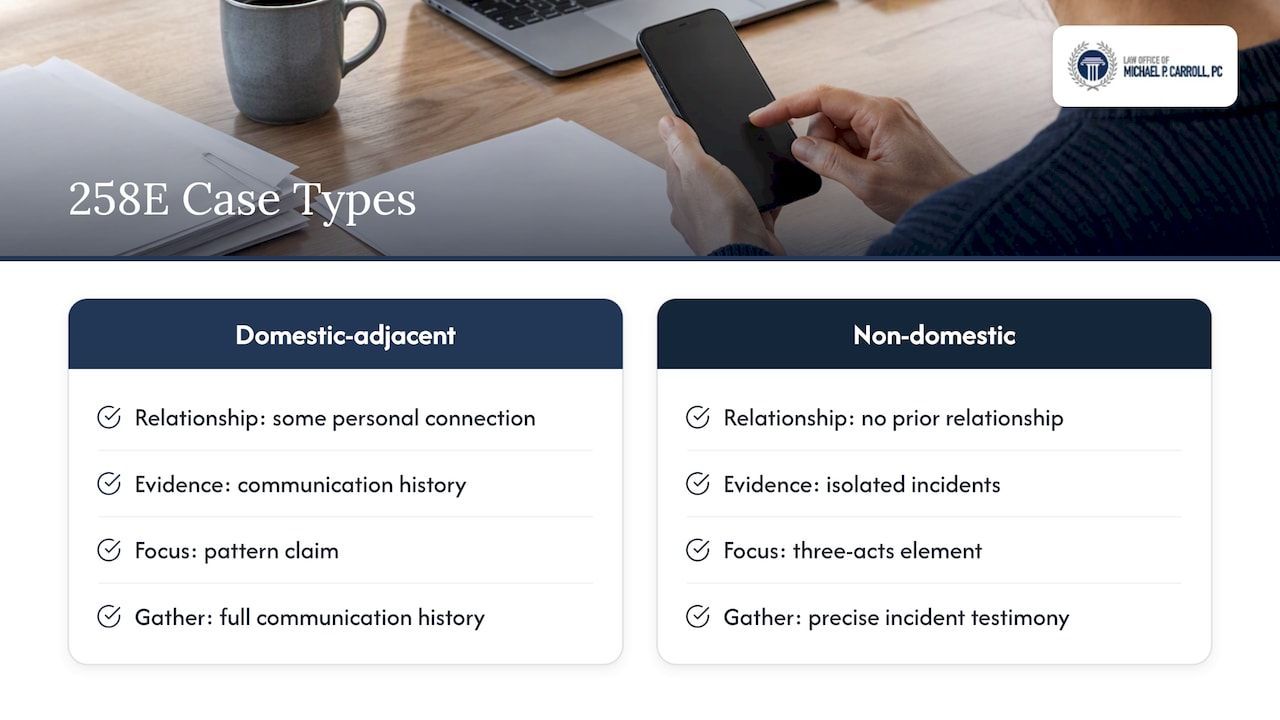
Massachusetts law treats 258E orders as a single statute, but the facts behind a petition often fall into one of two practical categories, and the distinction matters for how a case unfolds. A domestic-adjacent 258E case involves parties who have some personal connection, like former friends, roommates, or coworkers, but who don't meet the specific family or household definition required for a 209A order. A non-domestic case involves parties with no prior relationship at all, such as neighbors in a property dispute or someone alleging harassment by a stranger.
The statutory elements are identical either way: the plaintiff still has to show three willful and malicious acts (or a qualifying single incident) that caused fear or intimidation. What differs is the kind of evidence courts typically see. Domestic-adjacent cases often involve a history of communication, like group chats, shared social circles, or prior disputes, that can either support or undercut a pattern claim. Non-domestic cases more often turn on isolated incidents, like a confrontation at a shared property line or a single aggressive encounter, where the "three acts" element becomes the central battleground.
Because 258E doesn't carve out separate standards for domestic versus non-domestic situations, your defense strategy should focus on the same statutory checklist regardless of the relationship. The practical difference is in how you gather evidence: a domestic-adjacent case benefits from pulling a full communication history, while a non-domestic case often hinges on precise testimony about the handful of incidents actually alleged.
Process and criteria for obtaining a Chapter 258E order of protection in Massachusetts
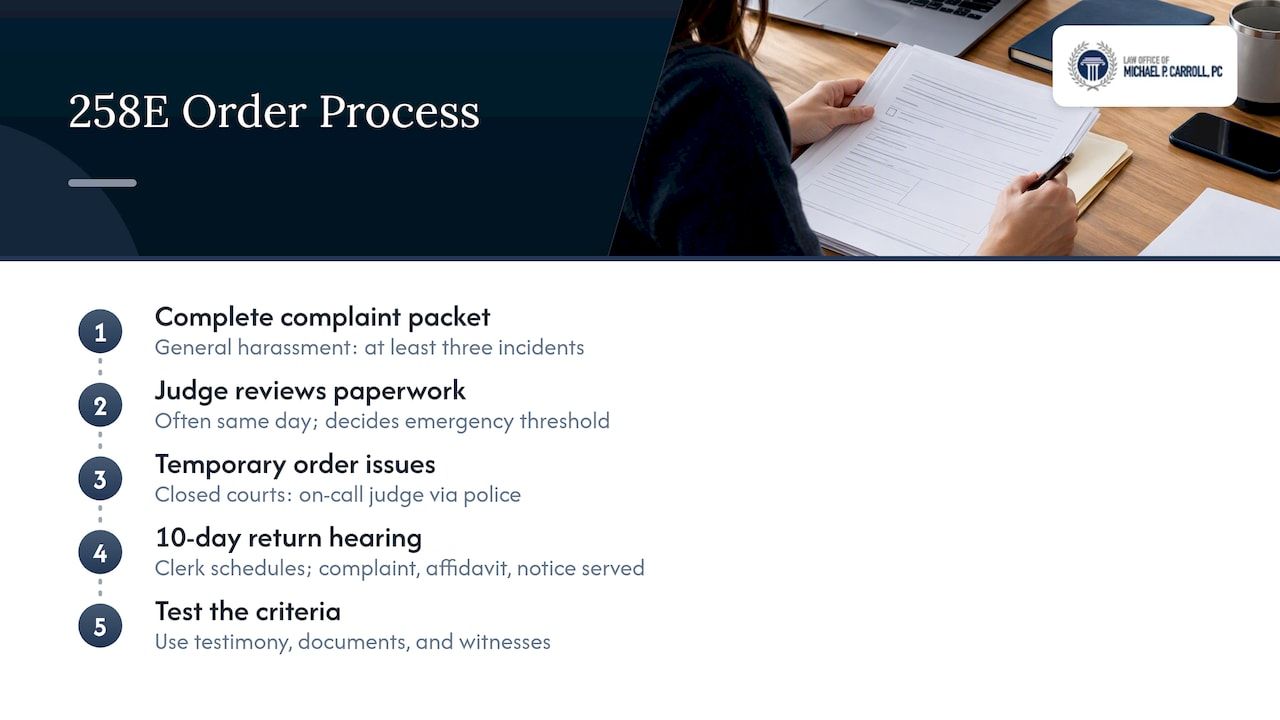
Understanding how a plaintiff obtains a 258E order in the first place helps you anticipate the case against you. A plaintiff starts by going to a courthouse, usually District Court, Boston Municipal Court, Superior Court, or Juvenile Court, and completing a complaint packet that includes a sworn affidavit describing the alleged conduct. When relying on the general harassment definition, the plaintiff has to describe at least three separate incidents in that affidavit, each tied to willful and malicious intent.
A judge reviews the paperwork, often the same day, and decides whether the allegations meet the legal threshold for an emergency order. If the courts are closed, a plaintiff can seek emergency relief from an on-call judge through local police. Once a temporary order issues, the clerk's office schedules the 10-day return hearing and arranges for you to be served with the complaint, affidavit, and notice of the hearing date.
The criteria a judge applies at the ex parte stage are deliberately low, since the plaintiff is the only party present. That's precisely why the return hearing exists: it gives you the chance to test those same criteria against a fuller record, including your own testimony, documents, and witnesses. A plaintiff who can't produce specific dates, methods, and effects for each alleged incident at the hearing often sees the order narrowed or dismissed.
Role and procedures of Clerk Magistrate Hearings related to 258E orders
A Clerk Magistrate Hearing is a separate, earlier-stage proceeding that can come before or alongside a 258E case, particularly when the underlying conduct might also support a criminal complaint, like harassment or stalking charges filed independently of the civil order. At this hearing, a clerk magistrate (not a judge) reviews whether there's probable cause to issue a criminal complaint against you based on the same conduct described in the 258E petition.
You have the right to appear with an attorney, present evidence, and argue against the issuance of a criminal complaint, which makes this hearing a critical early opportunity to limit your exposure before a case escalates. Because the clerk magistrate's standard is probable cause rather than preponderance of the evidence, the hearing is less formal than a full trial but still shapes what happens next: a finding of probable cause can lead to arraignment in criminal court, running on a separate track from the civil 258E proceeding.
Handling both tracks consistently matters. Statements made in a Clerk Magistrate Hearing can surface later in the 258E hearing or in a related criminal case, so coordinating your approach across both proceedings with the same attorney helps avoid contradictions that a plaintiff's counsel could use against you.
Potential impact of 258E orders on child custody or visitation arrangements
A 258E order itself doesn't automatically change custody or visitation rights, since it's a civil harassment order rather than a family court custody ruling. But in practice, an active or extended order can influence how a probate and family court judge views parenting time, particularly if the order involves the other parent, a current partner, or someone connected to the household where a child lives.
If the order restricts you from a shared residence or requires you to stay away from the plaintiff, and the plaintiff is also a co-parent or lives with your child, complying with the 258E order can create immediate practical conflicts with an existing custody schedule. Courts handling custody matters often want to know whether a 258E order exists and what it was based on, since allegations of harassment or intimidation can factor into a broader assessment of a child's best interests.
This is one of the clearest reasons to fight an unwarranted 258E order at the 10-day hearing rather than letting it extend by default. An order that gets dismissed or narrowed before it affects a full year of your life is far less likely to complicate a later custody dispute than one that sits on the record unchallenged.
Steps to enforce or modify an existing Chapter 258E order
Once a 258E order is in place, either party can ask the court to change its terms, but the process differs depending on whether you're the plaintiff seeking enforcement or the defendant seeking modification. A plaintiff who believes you violated the order's terms can contact police to request an arrest or file a report, which the district attorney's office can use to bring criminal charges independent of the civil order.
If you're the defendant and circumstances have changed, you can file a motion asking the court to modify or terminate the order before its expiration date. That motion typically needs to explain what's changed, like the end of a dispute, new evidence undermining the original complaint, or a demonstrated absence of further incidents, and the plaintiff gets notice and a chance to respond at a hearing.
Extensions follow a similar hearing process to the original 10-day hearing: the plaintiff has to again show, by a preponderance of the evidence, that continued protection is warranted. An order doesn't extend automatically forever; each extension period requires its own hearing where you can appear and contest the request. Keeping track of expiration dates and responding promptly to any extension notice is as important as the original defense.
Explanation of mutual restraining orders and their applicability under 258E
Unlike some other protective order statutes, Chapter 258E doesn't provide for a true "mutual" order in the sense of both parties restraining each other under a single filing. Each party who wants protection has to file a separate petition and meet the statutory burden independently, which means you can't simply ask a judge to convert a one-sided 258E complaint against you into a two-way order without filing your own case.
If you believe the plaintiff's own conduct toward you meets the statutory definition of harassment, your option is to file a separate 258E petition naming the plaintiff as the defendant, supported by your own evidence of three or more willful and malicious acts. Courts will typically hear and decide each petition on its own facts, even when they involve the same two people and overlapping incidents.
This distinction matters strategically. Raising "the plaintiff harassed me too" as a defense inside their case against you won't by itself result in protection for you. It may undercut their credibility or context, but getting your own enforceable order requires a filing and a hearing on your own claim, following the same process and standard of proof described earlier in this guide.
Owner-run defense perspective: why early, direct attorney involvement matters
The most common mistake we see in 258E cases isn't a weak defense. It's waiting too long to build one. Clients who call before the first hearing, not after an extension, give counsel time to pull communications, line up witnesses, and target the exact statutory element the plaintiff is least likely to prove. Readers preparing their own timeline may also find our no-contact order preparation checklist useful for organizing evidence before that first court date.
— Michael Carroll
How we defend 258E cases in Massachusetts
We represent defendants facing Chapter 258E harassment prevention orders in Massachusetts, and every case is handled directly by our lead attorney rather than being delegated to others. That owner-operated structure means the person who reviews your complaint, builds your timeline, and questions the plaintiff at your 10-day hearing is the same person you spoke with on day one.
Our work on 258E matters connects directly to the related proceedings that often accompany them:
- Harassment Prevention defense focused on the statutory elements covered in this guide.
- Restraining Orders representation for both 258E and related protective order matters.
- Clerk Magistrate and probable cause hearings when the same conduct could lead to a separate criminal complaint.
If you've been served with a 258E complaint, the clock on your hearing is already running. Contact our office for same-day advice and direct access to attorney Michael P. Carroll while there's still time to prepare your defense.
This article is general information, not a substitute for advice from a qualified lawyer. Consult a qualified legal professional about your own circumstances before acting on anything here.
FAQ
What is a 258E order in Massachusetts?
A 258E order is a civil harassment prevention order that restricts a defendant's contact with the plaintiff and can include staying away from a home or workplace. It covers harassment, stalking, and certain criminal acts regardless of whether the parties have a family or household relationship.
How do you prove someone is harassing you under 258E?
A plaintiff has to show, by a preponderance of the evidence, that the defendant committed three or more separate willful and malicious acts intended to cause fear, intimidation, abuse, or property damage, and that those acts actually caused fear or intimidation. A single qualifying incident involving certain sex offenses or stalking can also meet the standard.
What are the most common types of restraining orders issued in Massachusetts?
The two most common civil protective orders in Massachusetts are 209A abuse prevention orders, which require a family or household relationship, and 258E harassment prevention orders, which apply regardless of any personal relationship between the parties. Courts also handle related criminal no-contact orders issued as conditions in separate criminal cases.
Can you defend yourself in your home in Massachusetts?
Massachusetts law recognizes a right to use reasonable force to defend yourself or your home against an intruder, but that principle is separate from a 258E proceeding, which concerns harassment allegations rather than a physical confrontation in progress. If a self-defense incident is part of the facts underlying a 258E or criminal case, that's a matter to raise with an attorney reviewing the specific circumstances.
What happens if a 258E order is extended for a full year?
An extended order remains enforceable for up to a year, and violating any of its terms during that time is a criminal offense that can lead to arrest and prosecution separate from the civil order itself. You can petition the court to modify or terminate the order before it expires if circumstances change.
Recommended
This article is general information about Massachusetts law, not legal advice, and reading it does not make you a client of the Law Office of Michael P. Carroll, PC. Every case is different. If you are facing charges in Bristol, Norfolk or Plymouth County, call Mike to discuss your situation.