
Attorney Checklist: No Contact Orders in Massachusetts, 10 Day Prep
Attorney Checklist: No Contact Orders in Massachusetts, 10 Day Prep

In Massachusetts, a "no contact" order comes from one of two statutes: M.G.L. c. 209A for abuse between people with a qualifying relationship, or M.G.L. c. 258E for harassment with no relationship requirement at all. If you need protection right now, go to your local district court clerk's office during business hours, or call police after hours for emergency relief. Either path leads to a judge within days.
TL;DR:
- Filing a 209A order requires a qualifying relationship, such as cohabitation, blood relation, or a significant past dating relationship, while 258E applies to strangers and acquaintances.
- The court process involves submitting specific forms at the correct courthouse during business hours or calling police after hours for emergency orders; well-documented incident timelines strengthen your case.
- Orders typically prevent all contact and set distance restrictions, but only 209A can include custody and residence vacate provisions, while 258E offers limited monetary remedies.
- Police must arrest anyone violating a no contact order, and evidence like messages or photos should be kept immediately to support enforcement actions.
- Judges heavily rely on detailed affidavits and corroborating evidence at the return hearing, making proper preparation critical to the order's long-term enforceability.
Table of Contents
- No Contact Order Massachusetts: 209A vs. 258E Explained
- Who Can File: Eligibility Checklists and Real Examples
- How to File a No Contact Order in Massachusetts
- What a No Contact Order Actually Covers
- Enforcement: What Happens If Someone Violates the Order
- Preparing for the Return Hearing
- Modifying, Renewing, or Ending an Order
- An Attorney's Take on What Actually Protects You
- Get Help Filing or Defending a Protective Order
- Where to Verify These Rules Yourself
- Sources
- FAQ
No Contact Order Massachusetts: 209A vs. 258E Explained
Massachusetts law doesn't have a statute literally titled "no contact order." What courts actually issue are abuse prevention orders under 209A or harassment prevention orders under 258E, both of which can include a no contact provision as part of their relief.
A 209A order requires a qualifying relationship: family, household member, or someone you've had a substantial dating relationship with. "Abuse" under the statute means attempting to cause or causing physical harm, placing someone in fear of imminent serious physical harm, or forcing sexual relations through threat or force.
A 258E harassment prevention order has no relationship requirement. You need either three separate acts of willful, malicious conduct intended to cause fear, intimidation, or abuse, or a single act that qualifies as one of several enumerated crimes, including stalking or sexual assault. Only 209A can order someone to vacate a shared home or address custody. Both statutes are handled primarily in District Court, though 209A cases involving custody may move through Probate & Family Court, and Boston cases often go through Boston Municipal Court.
Who Can File: Eligibility Checklists and Real Examples
The right statute depends entirely on your relationship to the other person and the pattern of conduct you've experienced.
File under 209A if:
- You're married to, divorced from, or related by blood or marriage to the other person.
- You currently live with or previously lived with the person as a household member.
- You have a child in common, regardless of marital status.
- You've had a substantial dating relationship, even if it wasn't a long one.
File under 258E if:
- The other person is a stranger, acquaintance, coworker, or neighbor with no qualifying family or dating relationship.
- You've experienced three or more incidents of harassment, such as repeated unwanted texts, following, or showing up at your workplace.
- A single incident involved stalking, sexual assault, or another enumerated crime.
Some situations qualify for either. A recent ex who never lived with you and wasn't a "substantial" dating partner might only qualify for 258E, even though the conduct feels domestic. When in doubt, Massachusetts Legal Help and court clerks can help you sort out which form applies before you file.
How to File a No Contact Order in Massachusetts
Filing doesn't require a lawyer, but it does require the right paperwork and the right courthouse.
- Get the forms. Download the Complaint for Protection, the Plaintiff Confidential Information Form, and an affidavit from the Trial Court's harassment prevention order forms page or the 258E application packet.
- Choose the right court. 209A cases go to District Court, Boston Municipal Court, or Probate & Family Court if custody is involved. 258E cases go to District Court or Boston Municipal Court where you or the defendant lives.
- File during business hours or call police after hours. If you're in immediate danger outside court hours, contact local police, who can reach an on-call judge for an emergency, ex parte temporary order.
- Request confidentiality. The Plaintiff Confidential Information Form keeps your address off the public record if safety is a concern.
Pro Tip: Bring a written timeline to the clerk's office, not just your memory. Judges respond to specific dates and incidents, not general descriptions of "he's been harassing me for months."
Emergency orders from police contact are strictly temporary. You'll still need a full hearing once the court reopens.
What a No Contact Order Actually Covers
A standard no contact provision bars all calls, texts, emails, social media messages, and third-party contact attempts, meaning the other person can't send a message through a mutual friend either. Courts also set a specific distance requirement from your home, workplace, or school.
Beyond the no contact language, remedies split by statute:
- 209A-only remedies: an order to vacate a shared residence, temporary custody and visitation terms, and firearm surrender or license suspension.
- 258E remedies: no contact and stay-away provisions, plus limited monetary compensation for costs like lost wages or medical expenses tied to the harassment. It does not provide custody or vacate relief.
If your case involves children or a shared home, that's often the deciding factor for filing under 209A instead of 258E, since only 209A reaches those issues.
Enforcement: What Happens If Someone Violates the Order
Violating either a 209A or a 258E order is a criminal offense. Under both statutes, a violation can result in fines and jail time, and police are required to arrest when they have probable cause that a violation occurred.
Massachusetts law treats a violated no contact order as a criminal matter, not a civil dispute. Police who confirm an active order and a violation must make an arrest, no separate criminal complaint needed first.
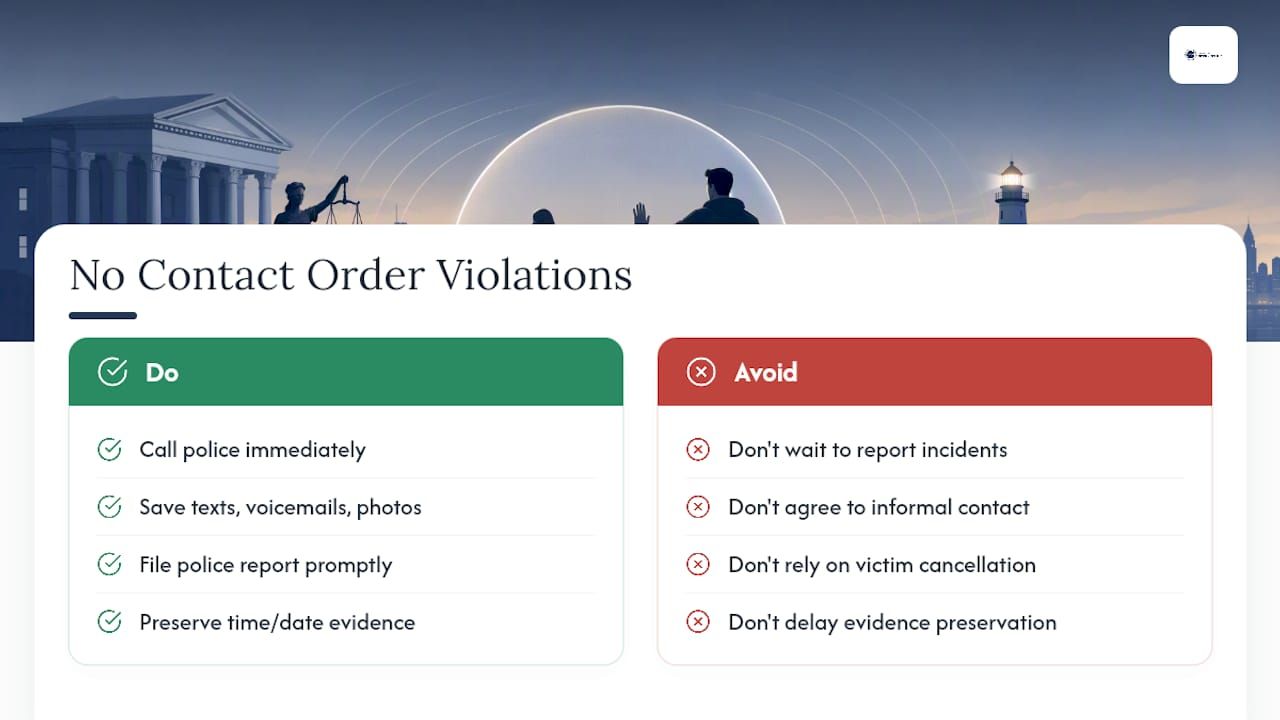
Document every violation: save texts, voicemails, photos of the person near a prohibited location, and call police immediately rather than waiting to report several incidents at once. Contemporaneous police reports carry far more weight at a violation hearing than a list you compile weeks later.
One misconception causes real harm: a protected person cannot legally cancel or loosen the order by agreeing informally to see the other person. Only a judge can modify or terminate an order, and the defendant can still be arrested for contact that happened with the plaintiff's blessing.
Preparing for the Return Hearing
After an ex parte temporary order, you'll return to court, typically within about ten court business days, for a hearing where the defendant can respond and the judge decides whether to extend the order, often for up to a year.
- Build a chronological affidavit. List dates, times, and specific acts rather than general impressions of feeling unsafe.
- Gather corroborating evidence. Screenshots, voicemails, photos, medical records, and police reports all strengthen your account.
- Line up witnesses. Anyone who saw an incident or received a distressed call from you can testify or provide a written statement.
- Plan for the courtroom itself. Arrive early, expect the defendant to be present, and consider bringing a support person or an advocate.
Pro Tip: Judges extending 209A and 258E orders lean heavily on well-organized affidavits with specific corroborating evidence, so treat that document as the centerpiece of your case, not an afterthought you fill out in the hallway.
Modifying, Renewing, or Ending an Order
Either party can file a motion to modify if circumstances change, such as needing to adjust the distance requirement or add a protected location. The protected person requests renewal before the current order expires, and judges frequently extend orders, sometimes permanently, when the underlying risk hasn't faded.
Nothing changes without a judge's signature. An informal understanding between the parties carries no legal weight and can leave the defendant facing arrest even after the plaintiff thought the matter was settled.
An Attorney's Take on What Actually Protects You
Most people treat filing the paperwork as the finish line. It isn't. The order is only as strong as the evidence behind it, and I've seen return hearings go sideways because a petitioner walked in with a memory instead of a record.
Here's my checklist for anyone in this position: secure your immediate safety first, file a police report the same day any incident happens, save every message before it disappears, and file the correct form for your relationship to the other person. If the facts are contested, if there's a parallel criminal charge, or if the other side has retained a lawyer, that's when representation stops being optional and starts being the difference between an order that holds up and one that gets picked apart on cross-examination.
Experienced attorneys have spent over a decade handling these cases across Massachusetts courts, and one pattern holds true regardless of which statute applies: judges reward preparation, not urgency alone.
— Michael Carroll
Get Help Filing or Defending a Protective Order
Other options exist for handling a protective order matter. Some people try to navigate the paperwork alone using court self-help forms, and others hire a large firm where a case gets passed between associates. Neither gives you what you actually need when a hearing is days away: someone who personally knows your file and answers the phone when you call.
The Law Office of Michael P Carroll works directly with clients on 209A and harassment prevention matters, whether you're seeking an order, responding to one, or facing a violation charge tied to a restraining order. A consultation covers your specific facts, which statute fits your situation, and what evidence you need before your return hearing. The firm serves clients throughout Bristol, Norfolk, and Plymouth Counties, including Quincy and the greater Attleboro area, and because Michael Carroll handles cases personally rather than routing them through junior staff, you get direct answers from the person actually appearing in court for you. Visit the criminal law practice page to schedule a consultation before your next court date.
Where to Verify These Rules Yourself
Read the statutes directly at M.G.L. c. 209A and the 258E harassment prevention order guide, and download official forms through the Trial Court's forms library.
This article is general information, not a substitute for advice from a qualified lawyer. Consult a qualified legal professional about your own circumstances before acting on anything here.
Sources
FAQ
What is worse, a no contact order or a restraining order?
They're not competing severities. A 209A restraining order and a 258E order both carry criminal penalties for violation; the difference is eligibility and available remedies, not which one is "worse" to have against you.
What is needed to get a no contact order in Massachusetts?
You need a qualifying relationship and evidence of abuse for a 209A order, or evidence of harassment (three acts or one enumerated crime) with no relationship requirement for a 258E order, filed with the appropriate court.
Can I get a stay-away order in Massachusetts?
Yes. Stay-away provisions are standard relief under both 209A and 258E, and can specify distance from your home, workplace, or school.
What counts as harassment under Massachusetts law?
Under 258E, harassment means three or more willful, malicious acts intended to cause fear or intimidation, or a single act that qualifies as an enumerated crime like stalking or sexual assault.