
How the 2026 Arias Ruling Changes MA Traffic Stop Rights
How the 2026 Arias Ruling Changes MA Traffic Stop Rights

In Massachusetts, drivers must identify themselves during a lawful traffic stop under G.L. c.90 §25, but passengers generally do not have to. You have the right to stay silent beyond that basic identification, police need consent, probable cause, or an emergency to search your vehicle, and every stop must be reasonable in length under recent Massachusetts Supreme Judicial Court rulings. Knowing where those lines sit protects you far better than guessing at them on the side of the road.
TL;DR:
- Passengers are generally not required to identify themselves during a traffic stop unless the officer has specific suspicion of a crime linked to that passenger.
- Warrantless car searches are only lawful if based on voluntary consent, probable cause, plain view, or exigent circumstances, and refusing consent is allowed.
- Officers need a reasonable safety concern to order a driver or passenger out of the vehicle, with routine violations rarely justifying such an order.
- Stops must be reasonable in duration, with delays beyond the purpose of the initial infraction potentially invalidating the seizure.
- Recording police during a stop is lawful if done openly, and filing a complaint with the Massachusetts POST Commission is recommended for misconduct.
Table of Contents
- Traffic Stop Rights in MA: What Drivers Must Legally Do
- Do Passengers Have to Show ID During a Massachusetts Traffic Stop?
- When Can Police Search Your Car in Massachusetts?
- Can Police Order You Out of the Car in Massachusetts?
- How Long Can a Traffic Stop Legally Last in Massachusetts?
- Recording Police and Filing a Complaint in Massachusetts
- What Happens If You Refuse to Identify Yourself or Refuse a Breathalyzer
- How to Protect Your Rights During a Massachusetts Traffic Stop
- What to Do If You're Arrested or Your Car Is Searched
- Your Rights During a DUI or OUI Investigation in Massachusetts
- Do Police Need a Reason to Use a Drug-Sniffing Dog on Your Car?
- What Happens to Your Car After an Arrest or Impound
- Commercial Vehicle Stops vs. Private Vehicle Stops in Massachusetts
- An Attorney's View on Defending Traffic Stop Cases
- How Law Office of Michael P Carroll Can Help After a Traffic Stop
- Sources
- FAQ
Traffic Stop Rights in MA: What Drivers Must Legally Do
Once a Massachusetts state trooper or local officer activates their lights behind you, a specific set of legal duties kicks in, and they're narrower than most drivers assume. Under G.L. c.90 §25, anyone operating or in charge of a motor vehicle must give their name and address and produce a license and registration when an officer asks. Refusing, or giving false information, can result in a fine. That's the entire scope of what the statute compels. It doesn't require you to answer questions about where you're coming from, where you're headed, or whether you've had anything to drink.
Here's how to handle the mechanics of the stop itself without creating problems for yourself:
- Pull over promptly and predictably. Use your turn signal, find a safe shoulder or side street, and stop in a well-lit spot when possible.
- Turn off the engine, keep your hands on the wheel, and turn on your interior dome light at night. Officers are trained to watch hands first; visible, still hands lower tension immediately.
- Narrate before you move. Say "My registration is in the glove box, I'm reaching for it now" before you reach for anything. Sudden movements toward a console or bag are the single biggest trigger for an officer to escalate.
- Hand over your license, registration, and insurance card when asked. This satisfies your statutory obligation completely.
- Answer identification questions, decline the rest. You can say, calmly, "I'd rather not answer questions beyond my identification." That's not obstruction. It's your right.
The mistake most drivers make isn't refusing to comply. It's over-complying, volunteering explanations, apologies, or theories about why they were speeding that later become evidence against them. An officer doesn't need you to admit anything. Everything you say is being weighed, whether the stop feels casual or not.
Do Passengers Have to Show ID During a Massachusetts Traffic Stop?
Passengers occupy a different legal position than drivers, and Massachusetts law draws that line sharply. The ACLU of Massachusetts states plainly that while drivers must identify themselves during a vehicle stop, passengers generally do not, unless the officer has independent reasonable suspicion that a specific passenger committed a crime, or is issuing that passenger a citation directly.
That distinction matters in practice:
- A passenger who is not suspected of anything can decline to give a name, and doing so is not, by itself, a basis for detention.
- Officers can still lawfully order passengers to step out of the vehicle for safety reasons, even without suspecting them of wrongdoing, under the Massachusetts standard set in Commonwealth v. Gonsalves.
- Passengers are not obligated to answer investigative questions. A simple, polite "Am I free to leave?" is a legally meaningful question. If the answer is yes, you can step away calmly.
- Seatbelt laws still apply to passengers in Massachusetts, and remaining buckled until told otherwise avoids an unrelated secondary violation.
- If told to exit, comply first and object later. Physically resisting an exit order, even one you believe is unlawful, creates separate legal exposure that a good suppression motion can't undo.
Massachusetts case law, including decisions addressing passenger encounters like Commonwealth v. Torres , has repeatedly protected the passenger's right to disengage from voluntary questioning. That right only holds up, though, if you exercise it clearly and without hostility.
When Can Police Search Your Car in Massachusetts?
Warrantless vehicle searches are presumptively unreasonable under both the Fourth Amendment and Article 14 of the Massachusetts Declaration of Rights, the state's own, often stronger, search and seizure protection outlined in Cornell Law's overview. Police get around that presumption through a handful of established exceptions, and understanding them changes how you respond in the moment.
The main paths to a lawful search are:
- Consent. If you say yes, the search is legal, even without probable cause. Massachusetts case law, including Commonwealth v. Buswell and Commonwealth v. Sanna , has scrutinized whether that consent was truly voluntary, but courts still start from what you actually said.
- Probable cause. The smell of marijuana or alcohol, visible contraband, or an admission during questioning can establish probable cause on the spot.
- Plain view. If an officer sees something illegal in open view from a lawful vantage point, no additional justification is needed to seize it.
- Exigent circumstances. Genuine emergencies, like a belief that evidence is about to be destroyed, can justify an immediate search.
If an officer asks to search your car, you're allowed to say no. Say it once, clearly: "I do not consent to a search." You don't need to argue or explain. Refusing consent is not obstruction, and it is not, by itself, suspicious.
Pro Tip: Silence isn't the same as consent, but ambiguous behavior can look like it in court. If you open a door, step back, or gesture toward the vehicle after an officer asks to search it, that can be read as implied permission. State your refusal out loud and keep your body language still.
Can Police Order You Out of the Car in Massachusetts?
Yes, but Massachusetts sets a real limit on when. Under Commonwealth v. Gonsalves , an officer generally needs a reasonable belief that safety is at risk before ordering a driver or passenger out of the vehicle during a routine stop. That's a meaningfully higher bar than some federal courts apply, and it reflects Article 14's broader protections for people inside their own vehicle.
What this looks like in practice:
- A routine equipment violation or expired inspection sticker, on its own, typically doesn't justify an exit order.
- Furtive movements, an odor of alcohol or marijuana, visible weapons, or erratic behavior can tip the balance toward a lawful order to exit.
- Courts weigh the officer's specific, articulable reasons, not just a general sense of caution, when reviewing whether an exit order was justified after the fact.
- If you're ordered out and think the order is baseless, step out anyway. Note the time, what was said, and any camera footage. That record is what a defense attorney uses later to challenge the stop.
Resisting an exit order in the moment almost never helps your case, even when the order turns out to be unjustified. The legal remedy comes afterward, in court, not on the roadside.
How Long Can a Traffic Stop Legally Last in Massachusetts?
Massachusetts courts don't just look at whether a stop was justified. They look at whether it happened at a reasonable time, and how long it dragged on. An officer who witnesses a civil infraction generally has authority to pull you over under Commonwealth v. Buckley , but that authority isn't unlimited once the infraction is over.
The SJC's 2026 decision in Commonwealth v. Arias addressed exactly this question, ruling that a stop separated from the observed infraction by an unreasonable delay, in that case, can render the seizure unconstitutional under Article 14, even though the underlying violation was real.
Courts apply a totality-of-the-circumstances test to judge reasonableness:
- Was there a legitimate safety reason for the delay, such as waiting for backup or a marked cruiser?
- Did the officer act as soon as it was practical to do so, or did the delay look strategic?
- Was the length of the eventual stop itself proportional to its stated purpose?
If your stop felt drawn out, or happened well after whatever the officer claims justified it, that gap is worth documenting. Note timestamps, radio chatter you can recall, and anything on dashcam or bodycam footage. That timeline is often the single most useful piece of evidence in a motion to suppress.
Recording Police and Filing a Complaint in Massachusetts
You may lawfully record police officers performing their duties in public in Massachusetts, including during your own traffic stop. Keep the camera visible, stay in your seat unless instructed otherwise, and don't let recording become a distraction that reads as noncompliance.
- Record openly, not covertly , and state that you're recording if it helps de-escalate rather than provoke.
- Preserve the footage immediately after the stop, back it up, and note the exact date and time before anything gets overwritten.
- File a complaint through the Massachusetts POST Commission , which maintains officer discipline records and complaint channels, or escalate to the U.S. Department of Justice for patterns suggesting systemic misconduct.
A complaint backed by timestamped video and a written timeline carries far more weight than a verbal account alone.
What Happens If You Refuse to Identify Yourself or Refuse a Breathalyzer
Refusing to provide your name, address, or license under G.L. c.90 §25 exposes you to a fine as a driver, distinct from any criminal charge tied to the underlying stop. That's a narrow, specific consequence, and it's separate from what happens if an officer suspects impaired driving.
Breathalyzer refusal runs on an entirely different track:
- Refusing a chemical test triggers an automatic RMV license suspension, handled administratively regardless of whether you're ever convicted of OUI.
- That administrative suspension proceeds independently of any criminal OUI case, meaning you can face license consequences even if the criminal charge is eventually dismissed or reduced.
- Appeal windows for RMV suspensions are short, and missing one can lock in a suspension you might otherwise have challenged. Our breakdown of breathalyzer refusal penalties in Massachusetts walks through those timelines in more detail.
- Because the administrative and criminal tracks run on separate clocks with separate rules, decisions made in the first 24 to 48 hours after a refusal often shape both cases.
Talking to an attorney immediately, before the RMV appeal window closes, is usually the single highest leverage move available to you.
How to Protect Your Rights During a Massachusetts Traffic Stop
Good outcomes in traffic stop cases are rarely about clever legal arguments in the moment. They're about staying calm, compliant on the basics, and firm on the rest.
- Pull over safely and quickly. Signal, find a safe spot, and stop the car.
- Keep your hands visible on the wheel, and turn on interior lights at night.
- Provide license, registration, and insurance when asked. This satisfies your legal obligation.
- State your boundaries clearly: "I'm going to remain silent, and I don't consent to any search." One sentence, calmly delivered, protects your position without confrontation.
- Comply with orders to exit or wait , even ones you disagree with, and save objections for your attorney.
- Write down what happened as soon as you're able , including times, what was said, and whether the encounter was recorded.
Pro Tip: Save your notes and any video to a cloud backup the same day. Officer memory and dashcam retention policies both work against you the longer you wait to preserve your own record.
What to Do If You're Arrested or Your Car Is Searched
If a traffic stop ends in an arrest, the decisions you make in the first hour matter more than almost anything that follows.
- Ask for an attorney immediately and stop answering questions beyond basic identification. Anything said afterward can be used against you.
- Don't consent to further searches after arrest, even if officers suggest cooperation will help you. It rarely changes the outcome and can waive rights you'd otherwise keep.
- Preserve everything , including any video you recorded, receipts showing your timeline, and the names of any witnesses.
- Understand that suppression motions exist for a reason. Massachusetts judges reviewing a motion to suppress examine the same factors discussed above: timing, the voluntariness of any consent, and whether the stop's duration matched its stated purpose.
- Bring your citation, any paperwork from the stop, and a written timeline to your first attorney meeting. Early, detailed information often opens up options that disappear after a few weeks. Our overview of the OUI case timeline in Massachusetts shows how quickly certain deadlines arrive.
Your Rights During a DUI or OUI Investigation in Massachusetts
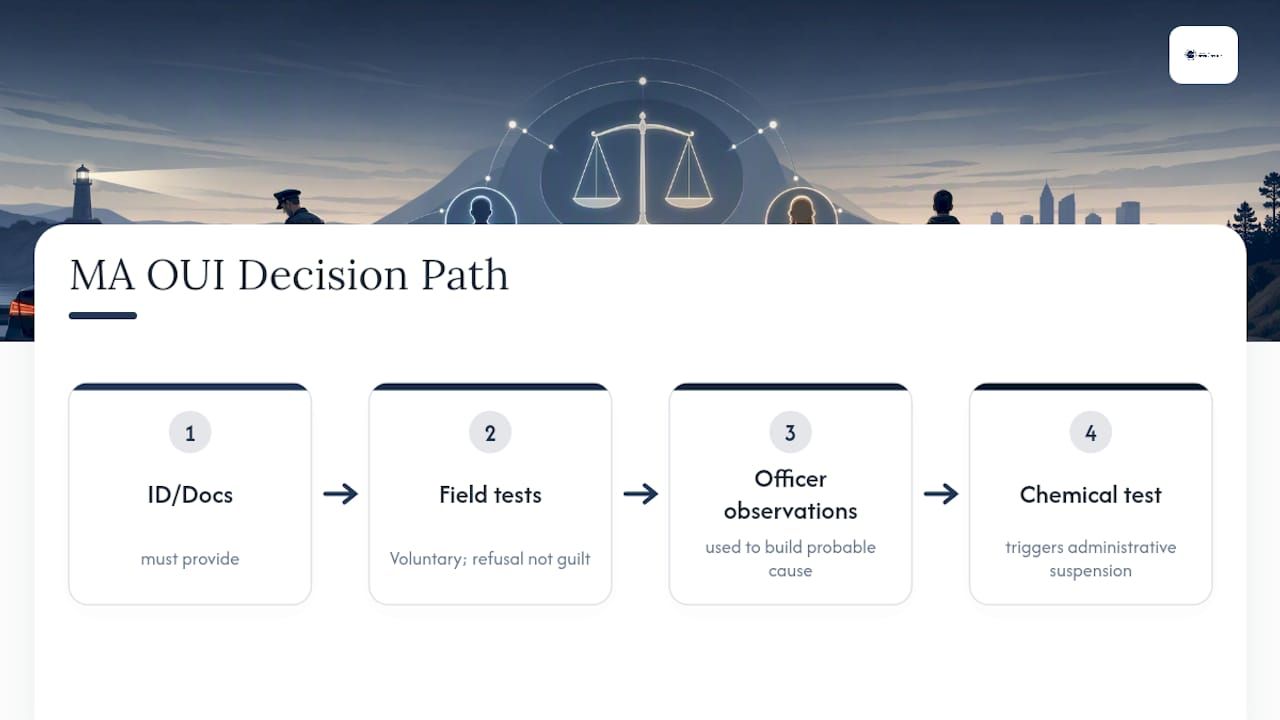
An OUI stop layers additional questions onto a standard traffic stop, and drivers often don't realize where their obligations actually end. You must provide license and registration, same as any stop. You are not required to perform field sobriety tests, and you are not required to answer questions about how much you've had to drink or where you're coming from.
Field sobriety tests are voluntary in Massachusetts, and refusing them cannot be used as direct evidence of guilt at trial, though officers will still use their own observations, your speech, balance, and appearance, to build probable cause for an arrest regardless.
Chemical testing, breath or blood, works differently once you're arrested. Refusal doesn't stop the case from proceeding, but it does trigger the administrative license suspension described earlier, layered on top of whatever criminal OUI charge follows. Massachusetts also allows prosecutors to introduce a chemical test refusal in certain license-related proceedings, even though it can't be used as evidence of guilt in the criminal trial itself.
The practical takeaway: identify yourself, decline field sobriety tests if you choose to, and understand that whatever you decide about a breathalyzer carries consequences on a completely separate administrative timeline. Our guide on Massachusetts drunk driving laws and RMV suspensions breaks down how those suspension periods actually run.
Do Police Need a Reason to Use a Drug-Sniffing Dog on Your Car?
A K9 sniff around the exterior of your vehicle during a lawful traffic stop generally doesn't require independent suspicion, since courts have long treated an exterior sniff as something short of a search. The catch is timing: the sniff has to happen within the reasonable duration of the stop itself, not after the original purpose of the stop is finished.
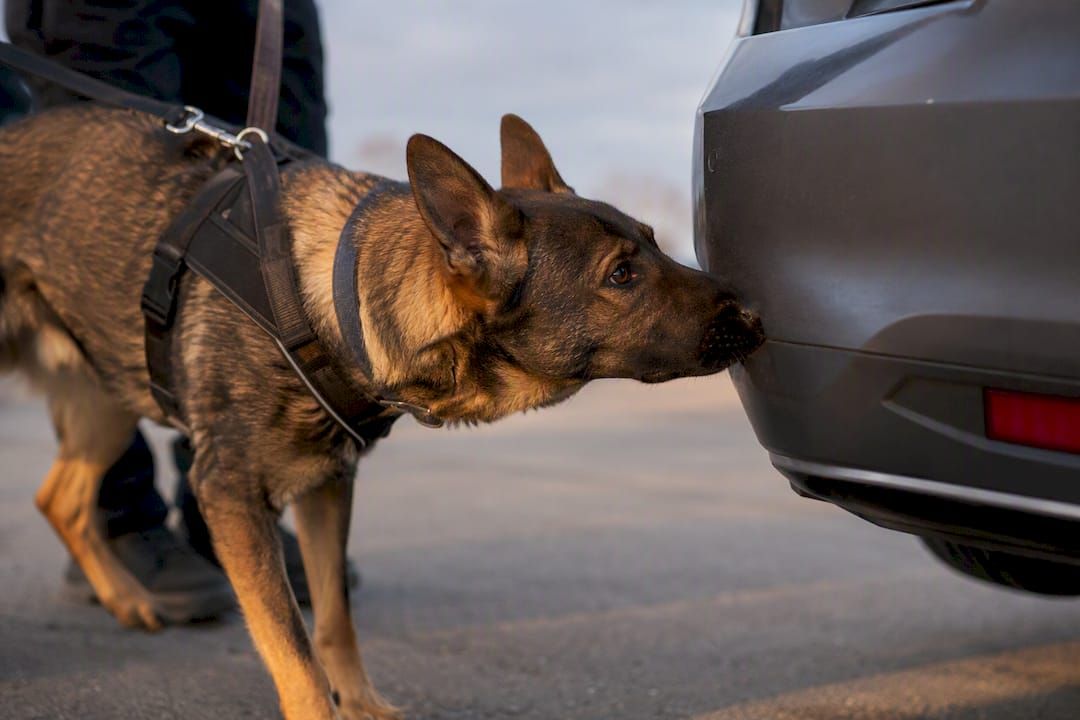
This connects directly to the delay and reasonableness principles discussed earlier. If an officer finishes writing your citation and then holds you for ten extra minutes waiting for a K9 unit with no independent suspicion of drugs, that extension can itself become the basis for a suppression argument. The stop has to remain tied to its original purpose, or be extended only with new, articulable suspicion.
If a dog alerts, that alert typically establishes probable cause to search the vehicle without your consent. Whether that alert was reliable, whether the dog was properly certified, and whether the stop had already run past its reasonable length before the dog arrived, are all questions a defense attorney will examine closely. None of that gets resolved on the roadside. Your best move in the moment is the same as any search scenario: don't consent, don't argue, and remember exactly how long you were held and why.
What Happens to Your Car After an Arrest or Impound
Once you're arrested during a traffic stop, your vehicle typically doesn't stay parked on the roadside. Police will usually impound it, and that triggers a separate search process distinct from the search-incident-to-arrest rules that apply to your person.
Massachusetts allows what's known as an inventory search when a vehicle is impounded, cataloging its contents under standardized department procedure rather than as a search for evidence of a crime. Because inventory searches don't require a warrant or probable cause, they've become a common route through which additional evidence surfaces after an arrest. The legal question that matters most here is whether the department actually followed its own written inventory policy, or used the process as a pretext for an investigative search it couldn't otherwise justify.
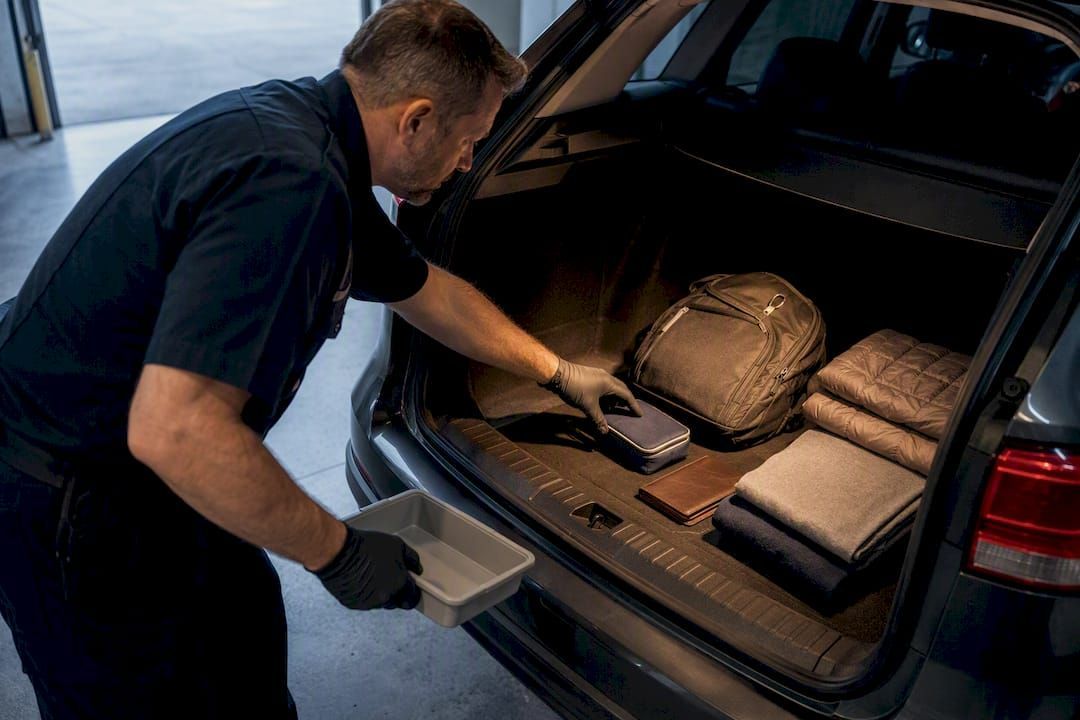
If your car was searched after impound, ask your attorney to request the department's inventory search policy and the specific report from your vehicle. Deviations from standard procedure, missing documentation, or searches that go well beyond what a routine inventory would cover are all grounds a defense attorney can use to challenge what was found.
Commercial Vehicle Stops vs. Private Vehicle Stops in Massachusetts
Commercial drivers face a noticeably different rulebook than private drivers during a traffic stop, largely because commercial vehicles operate under a heavier layer of federal and state regulation.
Massachusetts and federal Department of Transportation rules give officers, particularly those with commercial vehicle enforcement authority, expanded ability to conduct safety inspections that go beyond what's allowed for a private car. That includes reviewing logbooks, cargo manifests, and vehicle maintenance records without the same probable cause threshold that would apply to searching a private vehicle's trunk or glove box.
Commercial drivers also operate under a lower legal blood alcohol threshold than private drivers, and a violation can carry consequences for a commercial driver's license that go well beyond a standard suspension. The stakes around identification and cooperation during a commercial stop are correspondingly higher, since a commercial license represents a driver's livelihood in a way a personal license typically doesn't.
If you drive commercially and get pulled over, the core rights discussed throughout this guide, silence beyond identification, the right to refuse consent to search areas outside the regulatory inspection scope, still apply. But the margin for error is thinner, and the regulatory framework layered on top means commercial drivers benefit even more from moving quickly to legal counsel after any stop that goes beyond a routine citation.
An Attorney's View on Defending Traffic Stop Cases
Most traffic stop cases aren't won or lost on dramatic arguments. They're won on details: does the officer's report match the dashcam timeline, was consent to a search actually voluntary or just an absence of objection, and did the stop's duration match its stated purpose. Those questions take real time to run down properly.
Working directly with one attorney throughout a case, rather than being handed between paralegals and associates, means evidence gets flagged and preserved before it disappears. Realistic outcomes get evaluated early, whether that means a suppression motion, a negotiated resolution, or preparing for a hearing, based on what the timeline and evidence actually support, not on a generic playbook.
— Michael Carroll
How Law Office of Michael P Carroll Can Help After a Traffic Stop
A public defender's caseload or a general practice attorney juggling unrelated matters can't give a traffic stop case the same close attention a dedicated defense practice can. Law Office of Michael P Carroll is built around direct access to attorney Michael P. Carroll himself, not a rotating team, which matters most in the first days after a stop when video, witness memory, and RMV appeal deadlines are all time-sensitive.

The firm handles DUI and OUI defense, breathalyzer refusal cases, clerk magistrate and probable cause hearings, and broader criminal defense matters stemming from a traffic stop that escalated further than expected. If you're heading into an initial consultation, bring your citation, any RMV paperwork, your own written timeline of the stop, and any video you preserved. That material lets Michael start evaluating suppression arguments and administrative deadlines from the first conversation, rather than starting from scratch weeks later. If you were stopped, searched, or arrested in Massachusetts, reach out promptly. RMV appeal windows and evidence preservation don't wait, and neither should you.
This article is general information, not a substitute for advice from a qualified lawyer. Consult a qualified legal professional about your own circumstances before acting on anything here.
Sources
FAQ
What Is the 3-Hour Rule in Massachusetts?
There is no fixed "3-hour rule" written into Massachusetts statute. What courts actually apply is a reasonableness standard, most recently addressed in Commonwealth v. Arias, where a stop separated from the observed infraction by an unjustified delay, in that case around 24 hours, was found unreasonable under the totality of the circumstances rather than any set number of hours.
What Are Your Legal Rights During a Traffic Stop in Massachusetts?
You must identify yourself as the driver under G.L. c.90 §25, but you can decline to answer further questions, refuse consent to a search, and, as a passenger, generally decline to identify yourself absent independent suspicion.
Do You Have to Roll Your Window Down for Police in Massachusetts?
Massachusetts law doesn't specify an exact window height, but you need to communicate clearly enough to provide your license, registration, and identification as required by statute, so lowering it enough to hand over documents and speak is standard practice.
What Does Holding Up Fingers Mean During a Police Stop?
This isn't a recognized legal signal or requirement under Massachusetts law. If you've seen this claim online, it's not accurate. Comply with an officer's actual verbal instructions and keep your hands visible instead of relying on informal hand gestures.
Can Police Search My Car Without a Warrant in Massachusetts?
Only under specific exceptions: your voluntary consent, probable cause based on plain view or something like the odor of a controlled substance, or genuine exigent circumstances, as outlined under both Fourth Amendment principles and stronger Massachusetts Article 14 protections.