
Don't Lose Your Gun Rights: What MA Domestic Violence Statutes Mean
Don't Lose Your Gun Rights: What MA Domestic Violence Statutes Mean

A first offense of assault and battery on a family or household member in Massachusetts carries a statutory maximum imprisonment in a house of correction and a fine, with repeat offenses carrying a higher maximum imprisonment term in state prison. Strangulation charges, restraining order violations, and firearm restrictions add layers most people never see coming until they're already in the system.
TL;DR:
- A second or subsequent domestic violence offense in Massachusetts can lead to imprisonment in state prison, significantly higher than the house of correction maximum for first offenses.
- Strangulation charges are automatically felony-level, with potential penalties up to five years, and prosecutors treat them aggressively due to perceived escalation of danger.
- Violating a restraining order carries criminal penalties, including fines and up to two and a half years in jail, along with possible GPS monitoring and exclusion zones.
- A conduct that results in a guilty plea or CWOF still triggers firearm prohibitions, immigration consequences, and can be treated as a conviction by licensing agencies.
- Early legal intervention is crucial because police and prosecutors act quickly, imposing restraining orders, bail conditions, and electronic monitoring before evidence is tested in court.
Table of Contents
- Massachusetts Statutes That Apply and the Penalties They Set
- What Happens Right After an Arrest in Massachusetts
- Sentencing, Mandatory Programs, and What They Cost
- Collateral Consequences That Outlast the Sentence
- What to Do Now and How Defense Options Compare
- A Practitioner's View on Owner-Operated Defense
- Talk to a Massachusetts Domestic Violence Defense Attorney
- Sources
- FAQ
Massachusetts Statutes That Apply and the Penalties They Set
Massachusetts domestic violence penalties don't come from one law. They come from a patchwork of statutes that overlap depending on the relationship between the parties, the severity of the alleged conduct, and whether a court order already existed.
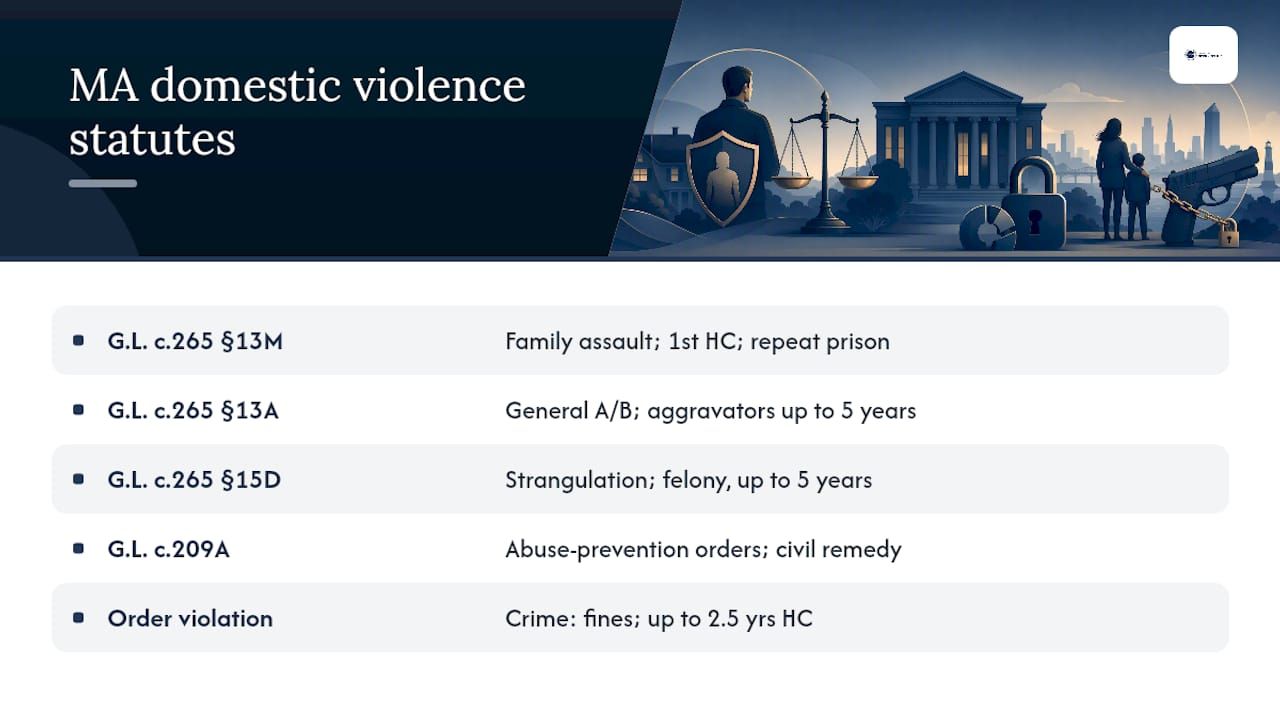
G.L. c. 265, § 13M covers assault and battery specifically against a family or household member, which includes spouses, former spouses, people who share a child, and people who currently or previously lived together. A first offense is punishable by imprisonment in a house of correction and a fine. A second or subsequent offense escalates sharply with a higher maximum imprisonment term in state prison. That jump from a house of correction to state prison is the single biggest reason repeat allegations get treated so differently by prosecutors and judges.
General assault and battery under G.L. c. 265, § 13A applies more broadly, but its aggravating factors matter here too. Serious bodily injury, an assault against someone who is pregnant, or a violation tied to an existing protective order can push the statutory maximum up to five years in state prison, even without a prior record.
Strangulation or suffocation under G.L. c. 265, § 15D is charged as a felony from the start, with exposure up to five years. Prosecutors treat this charge aggressively because it's often read as evidence of escalating danger, regardless of visible injury.
Separately, G.L. c. 209A governs abuse prevention orders, commonly called restraining orders. A criminal charge and a 209A order are not the same thing, but violating an order is its own crime, punishable by fines and up to two and a half years in a house of correction, with courts able to add exclusion zones, GPS monitoring, and restitution.
What Happens Right After an Arrest in Massachusetts
Police responding to a domestic disturbance in Massachusetts are directed to treat arrest as the preferred response once probable cause exists, and that standard applies with particular force when a 209A order has allegedly been violated. This is different from how officers might handle other disputes; there's little discretion once probable cause is established.
Once arrested, the clock starts moving fast. Massachusetts law limits station-house bail to roughly six hours after booking, and weekend or holiday arrests often mean sitting in custody until the next business day arraignment.
At arraignment, expect the court to impose conditions that reshape daily life immediately, sometimes before any evidence has been tested in court:
- No-contact orders that can bar communication with a spouse, partner, or even children in the household
- Stay-away conditions that prevent returning home, regardless of whose name is on the lease or deed
- Mandatory firearm surrender if weapons are registered to the defendant
- GPS monitoring or other electronic conditions in higher-risk cases
- A dangerousness hearing under G.L. c. 276, § 58A, which can result in pretrial detention
One detail catches people off guard every time: the alleged victim's wishes don't control the case. Prosecutors decide whether to proceed, and a victim asking to drop charges doesn't guarantee dismissal. That's precisely why retaining defense counsel early changes outcomes more than almost any other single decision in the process.
Sentencing, Mandatory Programs, and What They Cost
Sentencing outcomes in Massachusetts domestic violence sentencing guidelines cases range widely depending on prior record and the specific charge. Courts can impose straight probation, a Continuance Without a Finding (CWOF), time in a house of correction, or, for repeat or aggravated offenses, state prison.
Whatever the outcome, one requirement shows up almost every time: completion of a certified Intimate Partner Abuse Education (IPAE) program. Courts must order it for convictions and CWOFs alike unless they make specific written findings of good cause not to. The program itself typically runs alongside a $350 assessment under G.L. c. 209A, § 10, separate from the program's own fees, though indigent defendants can seek a waiver.
Smaller mandatory fines stack on top: a $25 fine and a $50 domestic violence prevention assessment are common additions that fund victim assistance services. None of these amounts sound severe individually, but combined with program costs, missed work, and legal fees, the financial weight adds up fast.
Probation conditions often include no-contact terms, exclusion zones around a home or workplace, and sometimes electronic monitoring. Violating any condition, even an unintentional one, can trigger a probation surrender hearing and reinstate the original sentencing exposure.
Collateral Consequences That Outlast the Sentence
The penalties on paper are only part of the story. Some of the harshest consequences of a Massachusetts domestic violence conviction happen outside the courtroom entirely, and they can attach even when someone accepts a CWOF specifically to avoid a criminal record.
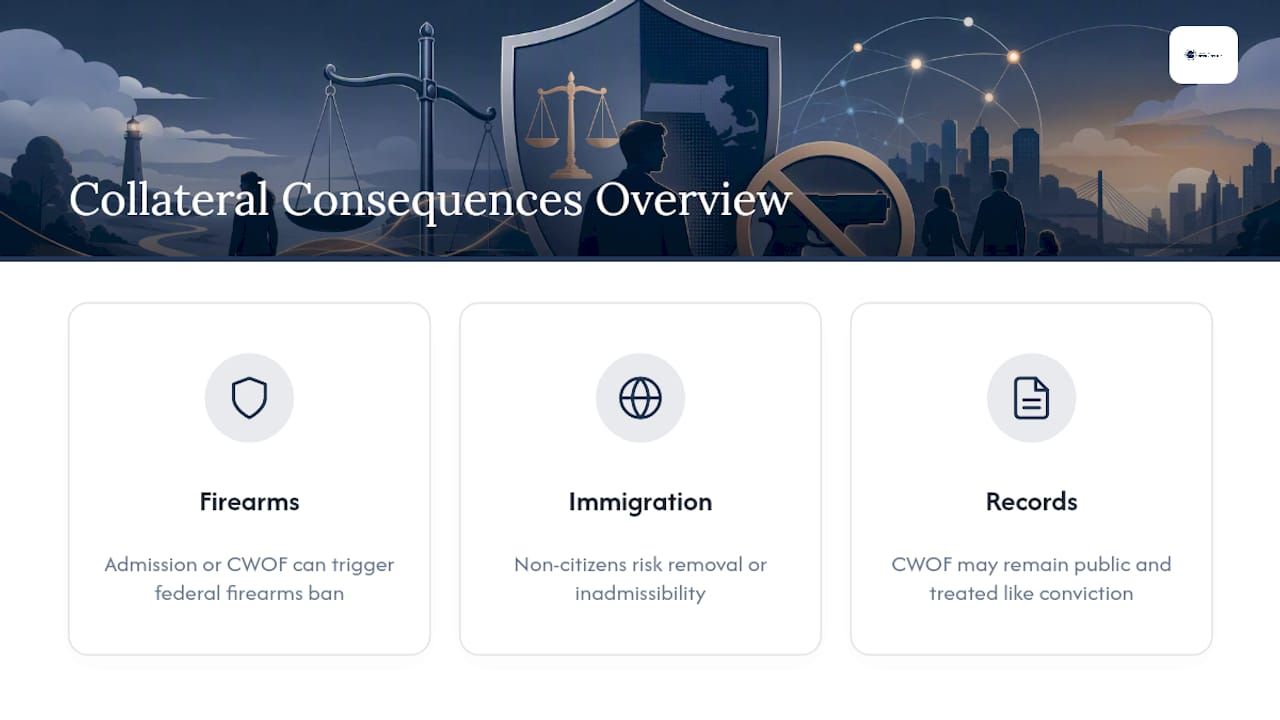
Firearms. A conviction or a CWOF for a qualifying domestic violence offense can trigger the federal firearms prohibition under 18 U.S.C. § 922(g)(9). This federal law doesn't care whether Massachusetts calls the outcome a "conviction." An admission of sufficient facts is often enough to trigger it, and reversing that prohibition later is extraordinarily difficult.
Immigration and licensing. Non-citizens face potential removal or inadmissibility consequences tied to domestic violence findings, and professionals holding state licenses, nursing, teaching, law, medicine, can face board review or discipline. Employers running background checks may see the case even without a formal conviction.
Records. A CWOF isn't automatically sealed and remains part of the public record for a period, and courts and licensing agencies frequently treat it the same as a conviction for collateral purposes. That gap between what a CWOF feels like (a second chance) and what it does (trigger firearm and immigration consequences) is where people get blindsided.
What to Do Now and How Defense Options Compare
The decisions made in the first 48 hours after a domestic violence charge often matter more than anything that happens at trial months later.
- Follow every court order exactly , even ones that feel unfair or based on exaggerated claims. A single violation, even a text message, can turn a manageable case into a custody risk.
- Avoid all contact with the alleged victim, including through third parties, social media, or mutual friends.
- Preserve evidence immediately: text threads, call logs, photos, and any witness names or contact information.
- Document your own condition if there's a competing narrative about who did what, including injuries, timestamps, and location data.
- Comply with firearm surrender orders the moment they're issued rather than waiting for a follow-up notice.
Understanding the tradeoffs between a CWOF, a guilty plea, and trial matters enormously here. A CWOF avoids a formal conviction and often avoids jail, but as noted above, it can still trigger firearms and immigration consequences nearly identical to a conviction. A guilty plea creates a permanent record but may come with negotiated terms. Trial preserves the presumption of innocence but carries the highest exposure if the prosecution proves its case. Common defense strategies include challenging probable cause at the arrest stage, contesting witness credibility, and, in some cases, self-defense.
Pro Tip: Bring everything to your first attorney meeting, don't wait to organize it later. Court paperwork, witness names and numbers, any texts or emails, medical records if injuries were documented, and a written timeline of events while your memory is still fresh. Cases are frequently won or lost on details that get fuzzy after a few weeks.
A Practitioner's View on Owner-Operated Defense
Every domestic violence case turns on the same question: what does this specific client stand to lose, a firearm, immigration status, a professional license, custody time, and how does that shape the plea-versus-trial decision? Clients have the opportunity to work directly with a single attorney from arraignment through resolution. That continuity matters most in the earliest hours, when release conditions and charging decisions get set. Early advocacy on bail arguments, pretrial motions, and diversion options often shapes the entire trajectory of a case more than anything argued later.
— Michael Carroll
Talk to a Massachusetts Domestic Violence Defense Attorney
If you're facing a domestic assault charge or a 209A restraining order in Massachusetts, the choices you make in the first few days shape everything that follows, including whether you keep your firearm rights, your job, or your immigration status intact. The Law Office of Michael P. Carroll PC is the direct alternative to a rotating-associate law firm: you work with attorney Michael Carroll personally, from your first call through resolution, with no handoff to a junior associate you've never met.

The firm handles domestic assault and battery defense and restraining order matters throughout Attleboro and the surrounding Massachusetts communities. If you're facing arraignment, a dangerousness hearing, or a clerk magistrate hearing, visit the criminal defense consultation page to schedule a case review and get a clear read on your options before your next court date.
This article is general information, not a substitute for advice from a qualified lawyer. Consult a qualified legal professional about your own circumstances before acting on anything here.
Sources
FAQ
What's the maximum penalty for a first domestic violence offense in MA?
A first offense under G.L. c. 265, § 13M carries statutory maximum penalties including imprisonment in a house of correction and a fine.
Does a CWOF avoid a criminal record for domestic violence charges?
A CWOF avoids a formal conviction on paper, but it can still trigger the federal firearms prohibition and be treated like a conviction by immigration and licensing authorities.
Can I lose my firearm rights over a domestic violence CWOF?
Yes. Under 18 U.S.C. § 922(g)(9), an admission of sufficient facts in a CWOF can trigger the same federal firearms prohibition as a conviction.
Is a domestic violence education program mandatory in Massachusetts?
Courts must order completion of a certified Intimate Partner Abuse Education program for most convictions and CWOFs, along with a $350 assessment, unless the court finds good cause to waive it.
What happens if I violate a 209A restraining order?
Violating a 209A order is a separate crime punishable by fines and up to two and a half years in a house of correction, with courts able to add GPS monitoring or exclusion zones.
Should I hire a lawyer before my arraignment on a domestic charge?
Yes. Prosecutors control the case regardless of the alleged victim's wishes, so early representation from a firm like the Law Office of Michael P. Carroll PC can shape bail conditions and charging decisions from the start.