
Can't Be Forced to Give Blood in a Massachusetts OUI, Except for §24L
Can't Be Forced to Give Blood in a Massachusetts OUI, Except for §24L

No. In an ordinary Massachusetts OUI prosecution, police cannot force a blood test without your consent, and a warrant does not change that. Refuse, and you face an RMV administrative suspension separate from any criminal case. There are narrow exceptions for aggravated OUI charges, and the case law shaping all of this keeps evolving. If you're facing a blood-test issue right now, document everything and talk to counsel before you say another word.
TL;DR:
- A police warrant does not permit mandatory blood draws without driver consent in ordinary Massachusetts OUI cases.
- Warrant-admissible blood tests typically only apply to aggravated charges involving bodily injury under §24L, not standard prosecutions.
- Challenges to blood test evidence often focus on forged consent, chain-of-custody issues, or laboratory calibration errors, which can lead to suppression.
- Refusing a blood test does not prove guilt but results in immediate RMV license suspension, which can be challenged within a narrow deadline.
- Analyzing the case's legal details, including charge type and consent record, is essential to mount a strong defense against blood-alcohol evidence.
Table of Contents
- What Does Massachusetts Law Say About Blood Test OUI Massachusetts Cases?
- How Have Massachusetts Courts Interpreted the Consent Requirement?
- How Is Blood Collected and Tested in a Massachusetts OUI Case?
- Does Refusing a Blood Test Count as Consent or Guilt in Massachusetts?
- When Can Police Get a Blood Sample Without Your Consent?
- How Do Lawyers Challenge Blood Test Evidence in Massachusetts OUI Cases?
- What Should You Do Right After an OUI Arrest Involving a Blood Test?
- What an Owner-Operated OUI Defense Practice Sees in These Cases
- Get Help Reviewing Your Blood Test Evidence
- Sources
- FAQ
What Does Massachusetts Law Say About Blood Test OUI Massachusetts Cases?
The blood test OUI Massachusetts framework starts with one statute: G.L. c. 90, § 24. Under § 24(1)(e), a chemical test result is admissible in a standard §24(1)(a) OUI prosecution only if the test was "made by or at the direction of a police officer" with the driver's consent. No consent, no admissible result, regardless of how the sample was obtained.
Section 24(1)(f)(1) covers the flip side: refuse a test and you lose your license administratively, whether or not you're ever convicted.
- First-time refusal: a suspension period governed by statute
- Prior OUI offenders: suspension periods may be extended depending on the offense history
- Drivers under 21: refusal carries its own extended suspension track, distinct from the adult penalty schedule (detailed in our breakdown of underage OUI suspension risk)
Blood must be drawn by a physician, registered nurse, or certified medical technician, per the statute's own procedural safeguards. And you're entitled to seek an independent test at your own expense once the state has its sample. Mass.gov's own guidance on alcohol and drug suspensions for drivers over 21 walks through the administrative side in more detail.
How Have Massachusetts Courts Interpreted the Consent Requirement?
Three Supreme Judicial Court decisions define the current landscape, and they don't all point the same direction.
- Bohigian (2020) : The SJC held that §24(1)(e) creates a firm bar against blood draws without consent in ordinary OUI prosecutions. A search warrant does not fix the problem. If the driver never consented, the test result stays out, warrant or no warrant.
- Moreau : Appellate courts applying Bohigian have confirmed that the consent requirement travels with the test, not the draw. A hospital can draw blood for medical reasons, but once police direct that sample toward a BAC analysis, the same consent rule kicks in.
- Zucchino : Here's where it gets more complicated. The SJC clarified that §24(1)(e)'s consent requirement is tied specifically to §24(1)(a) prosecutions. In aggravated OUI cases under §24L, such as OUI causing serious bodily injury, warrant-based testing can be admitted even without the driver's consent.
The takeaway: the statute is not a blanket shield in every case. Which case law applies often depends on what charge the Commonwealth actually files.
How Is Blood Collected and Tested in a Massachusetts OUI Case?
Two very different paths lead to a blood sample in an OUI case, and the difference matters legally.
A hospital blood draw happens because you're being treated after a crash or medical event, with no police involvement at that stage. A police-directed draw happens because an officer asked for the sample, or later directs a lab to test blood the hospital already drew. Only a physician, registered nurse, or certified medical technician may perform the actual withdrawal under the statute.
- Draw : Blood is collected at a hospital or, less commonly, another authorized medical setting.
- Preservation : Police may send a preservation letter to the hospital, or seek a warrant, to keep the sample from being discarded before they can request testing.
- Transport and chain of custody : The sample moves from hospital storage to a state or private crime lab. Every handoff should be logged, sealed, and time-stamped.
- Lab analysis : The lab runs the blood-alcohol concentration test and generates a report, often weeks after the arrest.
Records worth pulling include the withdrawal log, custody transfer sheets, refrigeration and storage notes, and the lab's calibration and testing protocol. Gaps in any of these, a missing signature, an unexplained storage gap, an uncalibrated machine, become the raw material for a defense challenge.
Pro Tip: Ask your attorney to request the lab's full testing protocol and machine calibration logs early. Labs sometimes reuse or misplace these records, and a six-month delay in requesting them can mean they're gone.
Does Refusing a Blood Test Count as Consent or Guilt in Massachusetts?
Refusal is not evidence of guilt. Massachusetts law and Mass.gov's own suspension guidance both confirm that a jury never hears that you refused a test. But that legal firewall only protects you at trial. It does nothing to stop the RMV suspension clock, which starts immediately at the police station.
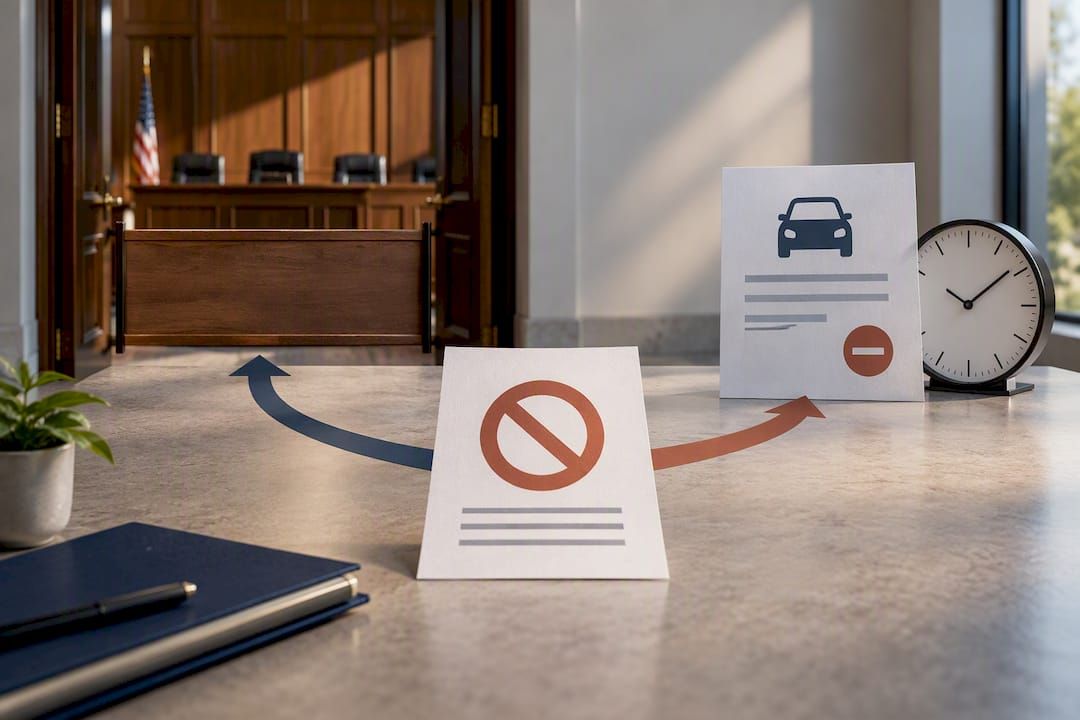
Courts separate two distinct legal questions when a blood sample was taken. The first is constitutional voluntariness under the Fourth Amendment, whether you were coerced, physically restrained, or too impaired to understand what you were agreeing to. The second is the statutory consent standard under §24(1)(e), which is narrower and, per Bohigian, essentially absolute for ordinary prosecutions.
Courts look at several things when weighing whether consent was real:
- The exact language police used when requesting the sample
- Whether you were handcuffed, injured, or receiving emergency treatment at the time
- Your level of intoxication and whether you could reasonably understand the request
- Whether officers documented an explicit "yes" or just assumed compliance
Legal commentary from the Boston Bar Journal makes a point worth remembering: the Commonwealth carries the burden of proving consent was voluntary. That burden doesn't shift to the defense. If the record is ambiguous about whether you agreed, that ambiguity works in your favor.
When Can Police Get a Blood Sample Without Your Consent?
Federal constitutional law allows nonconsensual blood draws in limited circumstances, most notably where police secure a warrant or face a genuine emergency (the exigent-circumstances doctrine from the U.S. Supreme Court's Schmerber and McNeely line of cases). Massachusetts law layers its own, stricter rule on top of that federal floor.
- In an ordinary §24(1)(a) prosecution, Bohigian held that a warrant does not override the statutory consent requirement. No consent means no admissible test, even with a signed warrant in hand.
- In an aggravated OUI case charged under §24L, serious bodily injury or worse, Zucchino allows warrant-based blood test results to come in without the driver's consent.
- The dividing line is the charge itself. The same blood sample can be admissible or inadmissible depending on whether the Commonwealth files under §24(1)(a) or §24L.
That distinction is exactly why the charge on your paperwork matters as much as the facts of your stop.
How Do Lawyers Challenge Blood Test Evidence in Massachusetts OUI Cases?
An experienced defense attorney treats a blood-alcohol result as a claim to test, not a fact to accept. There's a standard sequence to how that challenge unfolds.
- File a motion to suppress built on statutory nonconsent, involuntary consent, or an improperly executed warrant. Our guide to Massachusetts suppression motions covers common filing mistakes that waive otherwise strong arguments.
- Audit the chain of custody for gaps between the hospital draw and the crime lab report, missing signatures, unexplained storage delays, or mislabeled vials.
- Scrutinize the lab's methodology , including machine calibration records, technician certification, and whether the lab followed its own written protocol.
- Bring in a toxicologist or lab expert when the numbers themselves are suspect, blood degrades, ferments, or gets mishandled more often than most drivers assume.
- Negotiate from strength once a weakness surfaces , whether that means a motion hearing, a reduced charge, or in some cases outright dismissal.
Pro Tip: Never assume a lab report is airtight just because it has a number on it. Machines drift out of calibration, technicians make labeling errors, and blood samples that sit too long before analysis can show inflated readings from fermentation.
The insight from Bohigian that carries into daily defense work: because the statute treats consent as close to absolute for ordinary prosecutions, a lot of case-winning work happens in the paper trail, proving nonconsent or involuntariness, not just fighting the number on the lab report.
What Should You Do Right After an OUI Arrest Involving a Blood Test?
- Ask for a lawyer immediately and say nothing else about the stop, the draw, or your drinking that night.
- Write down everything you remember : names of officers, exact times, who physically drew your blood, any injuries, and any statements you or police made.
- Request hospital and lab records as soon as possible, and ask your attorney about sending a preservation letter to stop records from being purged.
- Ask about independent testing if timing allows. The statute gives you that right, but the window closes fast.
- Start the RMV suspension appeal clock immediately. Massachusetts gives you a narrow window to request a hearing, and missing it can mean driving without a license for months you didn't need to lose. Our overview of drunk driving suspension risk walks through the appeal timeline in more depth.
What an Owner-Operated OUI Defense Practice Sees in These Cases
Most blood-test cases turn on paper, not drama: an unclear consent record, a chain-of-custody gap, or a lab that skipped a calibration step. Those patterns show up again and again once you know where to look.
As the owner-operated practice behind every case file at Law Office of Michael P Carroll, I review the record personally rather than handing it to a junior associate. Clients should expect a realistic timeline: weeks for lab results, a tight RMV appeal window, and an outcome that depends less on courtroom theatrics than on whether the Commonwealth's paperwork actually holds up.
— Michael Carroll
Get Help Reviewing Your Blood Test Evidence
A DIY approach to an OUI blood test case means going up against a lab report, a police report, and an RMV suspension clock all at once, with no one checking whether the Commonwealth's paperwork actually holds up. Some criminal defense practices offer clients direct access to the lead attorney for a personal review of the consent record, the chain of custody, and the lab protocol behind your case.

That direct-access model means the person who reviews your blood draw records is the same person who argues your suppression motion and negotiates with the prosecutor. If you're facing a blood test OUI Massachusetts charge, start with a consultation through our OUI Attorney page or reach out through our DUI Attorney services to get your case reviewed before your RMV appeal window closes.
This article is general information, not a substitute for advice from a qualified lawyer. Consult a qualified legal professional about your own circumstances before acting on anything here.
Sources
FAQ
Is an OUI a Felony in Massachusetts?
A first or second OUI offense in Massachusetts is typically charged as a misdemeanor. It can become a felony when aggravating factors are present, such as a third or subsequent offense, serious bodily injury, or a fatality, which is when charges shift toward §24L territory.
What Shows Up on a DUI Blood Test?
A blood test measures your blood alcohol concentration (BAC) at the time the sample was drawn, and it can also detect certain drugs or metabolites depending on what the lab screens for. c. 90, § 24]( https://malegislature.gov/Laws/GeneralLaws/PartI/TitleXIV/Chapter90/Section24).
Is Massachusetts a Stop-and-ID State?
Massachusetts does not have a general stop-and-identify statute requiring pedestrians to show ID on request. During a traffic stop, however, drivers are required to produce a license and registration when an officer asks.
Do You Have to Take a Blood Test for a DUI in Massachusetts?
No, you cannot be physically forced to submit to a blood test in an ordinary OUI case, but refusing triggers an automatic RMV suspension under §24(1)(f)(1), starting at 180 days for a first refusal. That suspension is separate from, and happens regardless of, the outcome of your criminal case.