
Massachusetts CDL OUI Penalties: 2026 Changes and the Lifetime Waiver
Massachusetts CDL OUI Penalties: 2026 Changes and the Lifetime Waiver

If you hold a Massachusetts CDL, an OUI conviction or a chemical-test refusal triggers a mandatory commercial disqualification and immediate consequences at both the RMV and federal levels. A first major offense typically carries a one-year disqualification, with longer or lifetime terms for hazardous materials endorsements or repeat violations. Your first moves should be requesting an RMV record review, contacting a Massachusetts OUI attorney, and understanding how the federal Clearinghouse affects your ability to drive.
TL;DR:
- A 0.04% threshold applies while operating a commercial vehicle, but an OUI conviction or lawful test refusal can also disqualify you after a personal vehicle incident.
- A disqualification for refusing a test can survive a dismissal or acquittal, while an RMV hearing can correct factual errors but cannot reduce its term.
- State reinstatement does not clear a federal Clearinghouse ban; complete the SAP process and have your employer report your passing return to duty test.
- A second major offense brings a lifetime bar, though drivers may seek a waiver after 10 years without disqualifying convictions and a passed background check.
Table of Contents
- Massachusetts Statutory and RMV Rules for CDL Disqualification
- Refusing a Breath or Blood Test: What Happens to Your CDL
- The FMCSA Clearinghouse and the Road Back to Driving a CMV
- Reinstatement and the Lifetime Disqualification Waiver
- What an Experienced Massachusetts OUI Attorney Prioritizes First
- How We Help CDL Drivers Facing OUI and RMV Disqualification
- FAQ
- Sources
Massachusetts Statutory and RMV Rules for CDL Disqualification
Massachusetts law treats a commercial driver's license very differently from a standard operator's license once alcohol or drugs enter the picture. Under M.G.L. c.90F §9, the Registry of Motor Vehicles has no discretion once a disqualifying offense is reported: the disqualification is mandatory, not something a hearing officer can waive or reduce.
The federal standard underlying this rule sets the legal threshold for intoxication in a commercial motor vehicle at a blood alcohol concentration of 0.04%, half the 0.08% standard that applies to a civilian OUI in a passenger car. That lower threshold reflects the added risk of operating a loaded truck or bus, and it applies even when you are not driving for work at the time of arrest if you were behind the wheel of a CMV.
Several offenses trigger mandatory disqualification for a CDL holder:
- Operating a CMV with a BAC of 0.04% or higher
- A conviction for OUI, whether in a commercial or personal vehicle
- Refusing a chemical test after a lawful stop
- Leaving the scene of an accident or committing a felony involving a vehicle
A first major offense generally results in a disqualification lasting about one year; a second offense triggers a lifetime bar from operating a CMV. Drivers hauling hazardous materials face a three-year disqualification for a first offense involving that endorsement.
A 2024 amendment to state law changed how older convictions count. Under Chapter 313 of the Acts of 2024, most passenger-vehicle offenses committed before September 30, 2005, no longer trigger mandatory commercial disqualification, aligning Massachusetts more closely with federal rules. Certain serious convictions remain exceptions, so an older record should still be reviewed carefully before assuming it falls outside the disqualification rules.
Refusing a Breath or Blood Test: What Happens to Your CDL
Massachusetts operates under implied consent: accepting a CDL means agreeing to submit to chemical testing when lawfully stopped. Refusing that test does not avoid disqualification. It triggers one on its own, separate from whatever happens in criminal court.
Under Section 11 of Chapter 90F, the registrar must disqualify a CDL holder for one year upon receiving a sworn report of either a refusal or a BAC of 0.04% or higher while operating a CMV. Repeated refusals, or a refusal combined with a prior major offense, can extend that disqualification to a lifetime bar.
This administrative suspension runs on its own track, independent of any criminal case. Even if a later court proceeding results in a dismissal or acquittal, the refusal-based disqualification stands unless the RMV record itself is successfully challenged.
If you are facing a refusal-related suspension, move quickly:
- Request a copy of your RMV record and the sworn report submitted by the stopping officer
- Identify any factual errors, such as a wrong date, misidentified vehicle class, or incorrect prior history
- Request an RMV hearing limited to disputing the accuracy of that record
- Consult an attorney before your hearing date to assess whether the administrative record supports challenge
Pro Tip: RMV hearings for CDL disqualifications only address record accuracy, not whether the disqualification itself is fair, so your strongest argument is almost always a documented error in the report, not a plea for leniency.
For drivers weighing whether to challenge a refusal suspension, our overview of implied consent refusals in Massachusetts walks through the administrative process in more detail.
The FMCSA Clearinghouse and the Road Back to Driving a CMV
Separate from Massachusetts law, federal rules create another barrier to driving after an alcohol-related violation. The FMCSA Drug and Alcohol Clearinghouse is a federal database that records positive drug and alcohol tests, refusals, and related violations tied to federally regulated commercial driving.
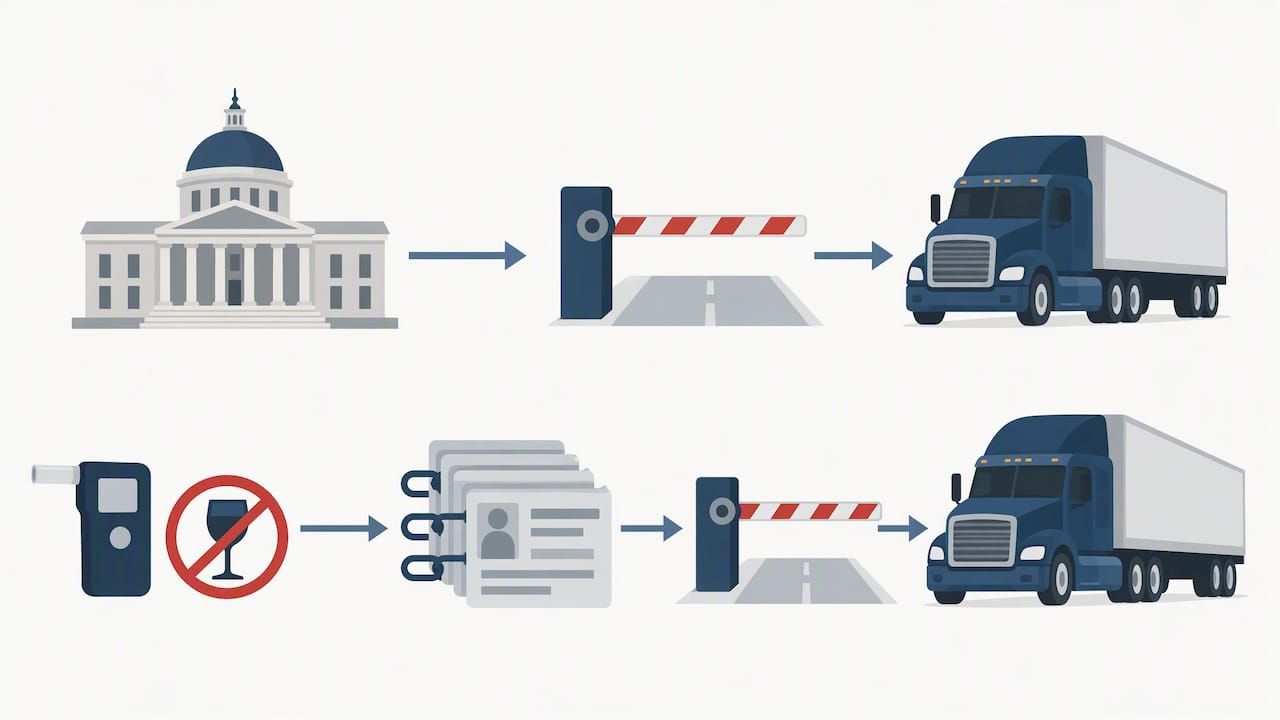
Once an employer reports a violation, the FMCSA marks your Clearinghouse status "prohibited," meaning you cannot legally operate a CMV in interstate commerce until you complete the return-to-duty process. That process runs through a DOT-qualified substance abuse professional, or SAP, who evaluates you and prescribes education or treatment.
The return-to-duty sequence generally follows this order:
- SAP evaluation and a written recommendation for treatment or education
- Completion of the prescribed program
- A return-to-duty test observed under federal rules
- A follow-up testing schedule set by the SAP, lasting up to several years
Massachusetts, like every state driver licensing agency, is now required under Clearinghouse II rules to query the database and downgrade a CDL when a driver shows as "prohibited," according to FMCSA Clearinghouse guidance. That downgrade happens independent of any state suspension, and it will not lift until the RTD process is complete and your employer reports the successful test. In practice, this means a driver can satisfy every state requirement and still be barred from CMV operation federally until the Clearinghouse record clears.
Reinstatement and the Lifetime Disqualification Waiver
Getting your CDL back after a disqualification involves more than waiting out the clock. The timeline typically runs through three stages: resolution of the criminal case, correction or confirmation of the RMV record, and completion of any court-ordered or federally required programs.
A few points matter most when planning reinstatement:
- RMV hearings for CDL matters are narrow: they confirm or correct the record, including proof of a not-guilty disposition, but they cannot shorten a statutory disqualification period
- Reinstatement after a related OUI suspension may require an ignition interlock device under Melanie's Law, along with any court-ordered programs
- Drivers facing a lifetime CDL disqualification can apply for relief through the Lifetime Disqualification Waiver Program after serving at least 10 years with no disqualifying convictions during that period and passing a criminal background check
The waiver program requires a documented 10-year clean period before an initial eligibility application can even be submitted , according to Mass.gov guidance on the program. Gathering court records and disposition documents early makes that eventual application far easier to assemble.
What an Experienced Massachusetts OUI Attorney Prioritizes First
The first priority in any CDL OUI case is locking down the record before it hardens against you: pulling the RMV report, documenting the exact charge and disposition, and flagging any error while memories and paperwork are still fresh. A refusal report filed incorrectly, or a disposition not yet updated after a dismissal, can keep a disqualification in place long after it should have ended.
Early counsel also matters because the window to challenge a test, a stop, or a refusal report narrows fast, and Clearinghouse and RTD steps often need to start in parallel with the criminal case rather than after it. Working directly with one attorney throughout, rather than being passed between staff, keeps those moving pieces coordinated instead of handled in isolation.
— Michael Carroll
How We Help CDL Drivers Facing OUI and RMV Disqualification
Our practice is built around direct, personalized representation: when you call, you work with the attorney handling your case personally from the first conversation through resolution.
For CDL holders, that means:
- Defending the underlying OUI or refusal charge in criminal court
- Challenging inaccurate RMV records that extend a disqualification unfairly
- Helping you understand and sequence the Clearinghouse and return-to-duty steps alongside your case
We offer OUI defense and broader DUI attorney services for drivers across Attleboro and the surrounding Massachusetts communities. If you have been arrested or received a refusal report, call for a consultation and bring your RMV paperwork, the police report if you have it, and any notice from your employer regarding Clearinghouse status.
This article is general information, not a substitute for advice from a qualified lawyer. Consult a qualified legal professional about your own circumstances before acting on anything here.
FAQ
What state is toughest on DUI?
Rankings of the toughest DUI states vary by source and the specific penalty measured, such as mandatory jail time, fines, or license suspension length.
What are the penalties for a second offense DUI in Massachusetts?
For a CDL holder, a second major offense, including a second OUI or a combination of an OUI and a refusal, results in a lifetime disqualification from operating a commercial motor vehicle. Separate criminal penalties, such as fines and potential jail time, apply on top of the CDL disqualification and depend on the specifics of each case.
How do I get my license back after a suspension in Massachusetts?
Reinstatement generally requires resolving the underlying criminal case, correcting or confirming your RMV record, and completing any court-ordered programs, which may include an ignition interlock device under Melanie's Law. For a CDL-specific lifetime disqualification, the Lifetime Disqualification Waiver Program allows an eligibility application after serving at least 10 years with a clean record and a passed criminal background check.
What is the penalty for driving without a license in Massachusetts?
Driving without a valid license or while a CDL is disqualified carries separate criminal penalties from the underlying OUI case, and compounds the risk for a commercial driver already facing RMV action. Because CDL disqualifications are mandatory and hardship licenses are not available for them, driving during a disqualification period is treated as a serious additional offense rather than a minor lapse.
Can a lawyer help with an RMV hearing for a CDL suspension?
An attorney can help you request and prepare for an RMV hearing, though these hearings are limited to correcting the record or proving a not-guilty disposition, not reducing a mandatory disqualification. We help clients identify record errors and coordinate that process alongside the criminal defense.
Sources
Recommended
This article is general information about Massachusetts law, not legal advice, and reading it does not make you a client of the Law Office of Michael P. Carroll, PC. Every case is different. If you are facing charges in Bristol, Norfolk or Plymouth County, call Mike to discuss your situation.