
Restitution in Massachusetts Criminal Cases: What to Expect
Restitution in Massachusetts Criminal Cases: What to Expect

If you are charged with a crime in Massachusetts that cost someone money, the judge can order you to repay the victim. That order is restitution. It is limited to the victim's actual economic loss caused by the offense, and the judge must look at what you can afford before setting a payment schedule. You also keep the right to challenge the amount.
This guide explains how restitution is decided, what each side has to prove, how your finances count, and what happens if you fall behind. It is written for defendants and families who are deciding what to do next.
TL;DR
- Restitution in Massachusetts covers the victim's documented economic loss that is causally tied to the crime. It is not a punishment add-on for pain or for the court's convenience.
- The Commonwealth must prove the loss and its amount by a preponderance of the evidence. You must prove, by the same standard, what you can pay without substantial hardship to you or your dependents.
- Missing payments does not automatically mean jail or a longer probation. As of December 2024, the Commonwealth must show the nonpayment was willful.
- If your finances change, you can ask the judge to redetermine your ability to pay before probation ends.
- What you say and agree to at the plea stage can lock in a number. Talk to a defense lawyer before you agree to any figure.
Table of Contents
- What restitution is, and what it is not
- When the court can order it
- What counts as a loss
- The restitution hearing
- Ability to pay: the protection that matters most
- If you cannot pay, or your situation changes
- Restitution in plea negotiations
- Federal cases are different
- Our perspective
- Get a lawyer to review the restitution claim
- FAQ
- Sources
What restitution is, and what it is not
Massachusetts treats restitution as a judicially determined penalty in the form of money or services imposed on a defendant for the benefit of the victim. It is part of a criminal sentence, not a separate civil lawsuit. The Sentencing Bench Book for the District Court and Boston Municipal Court explains that the judge's power to order it comes from the power to set conditions of probation.
That origin matters. Because restitution is tied to probation, it has to serve the goals of probation: rehabilitation and public protection. In Commonwealth v. Henry, the Supreme Judicial Court (SJC) addressed how restitution as a condition of probation must be determined. The practical message is that the court is not meant to act as a debt collector for the victim at the expense of your basic needs.
A few things restitution is not:
- Not a fine. Fines go to the state. Restitution goes to the victim.
- Not compensation for everything. It is limited to economic loss with a causal link to the offense.
- Not a guilty finding on its own. A judge can order restitution only after a conviction or a disposition that carries a sentence or probation condition. Your lawyer can tell you how your specific disposition affects this.
When the court can order it
Under Mass. R. Crim. P. 49, after a conviction at trial the Commonwealth may request restitution at any time before the sentencing hearing ends. After that, it needs the judge's permission and good cause. Victims have the right to ask that a sentence include restitution, and the prosecutor usually presents the request.
Restitution comes up most often in:
- Property crimes such as larceny, shoplifting, vandalism and breaking and entering
- Assault and battery cases with medical bills or lost wages
- Fraud and other white-collar cases
- Motor vehicle cases involving property damage or injury
- Some cases resolved by plea bargain, where the amount is negotiated
If your case may end without a conviction, for example through pretrial probation, ask your attorney how restitution would be handled. Resolutions short of a conviction can still carry conditions involving payment, and the terms are negotiated, so the details should be settled before you agree.
What counts as a loss
The SJC set the standard in Commonwealth v. McIntyre: restitution is limited to loss or damage that bears a significant causal relationship to the offense of conviction or the underlying conduct. The Commonwealth carries the burden of showing both the connection and the amount.
Typical categories of recoverable loss include:
- Medical and counseling expenses
- Property damage or the value of stolen property
- Lost wages
- Travel costs tied to court appearances
The Commonwealth has to back these up with documentation. Receipts, invoices, pay records and estimates are the usual proof. Losses that are speculative, unrelated to the charged conduct, or not economic generally fall outside restitution.
Worked example
Suppose a person is convicted of malicious destruction of property after damaging a neighbor's fence. The neighbor submits a $1,800 replacement quote and says she also missed two days of work to deal with it. The prosecutor will have to show that the fence damage came from the conduct at issue and that the figure is reasonable. The lost wages require a pay record or employer letter. If the neighbor's quote includes upgrades beyond the original fence, your lawyer can argue that only the actual loss is recoverable.
This is an illustration, not a real case. Amounts and outcomes depend on the evidence and the judge.
The restitution hearing
The hearing does not need to be elaborate, but it has to be fair. According to the Sentencing Bench Book, judges conduct a flexible hearing, can consider reliable hearsay, and must give the defendant a meaningful chance to be heard and to test the evidence.
The Guide to Evidence adds a point many defendants miss. Hearsay can be used to prove loss, but an order cannot rest only on unreliable or unsubstantiated hearsay. A repair estimate may count even if the victim did the repairs, but you have the right to challenge the figures and question the victim about the amount.
A sensible approach to the hearing:
- Get the victim's claim in writing early. Ask for the itemized request and the supporting documents.
- Check each line. Is it tied to the charged conduct? Is it documented? Is it the actual loss, or a replacement upgrade?
- Prepare to cross-examine on amounts that do not add up.
- Bring your own financial proof for the ability-to-pay stage (see below).
Ability to pay: the protection that matters most
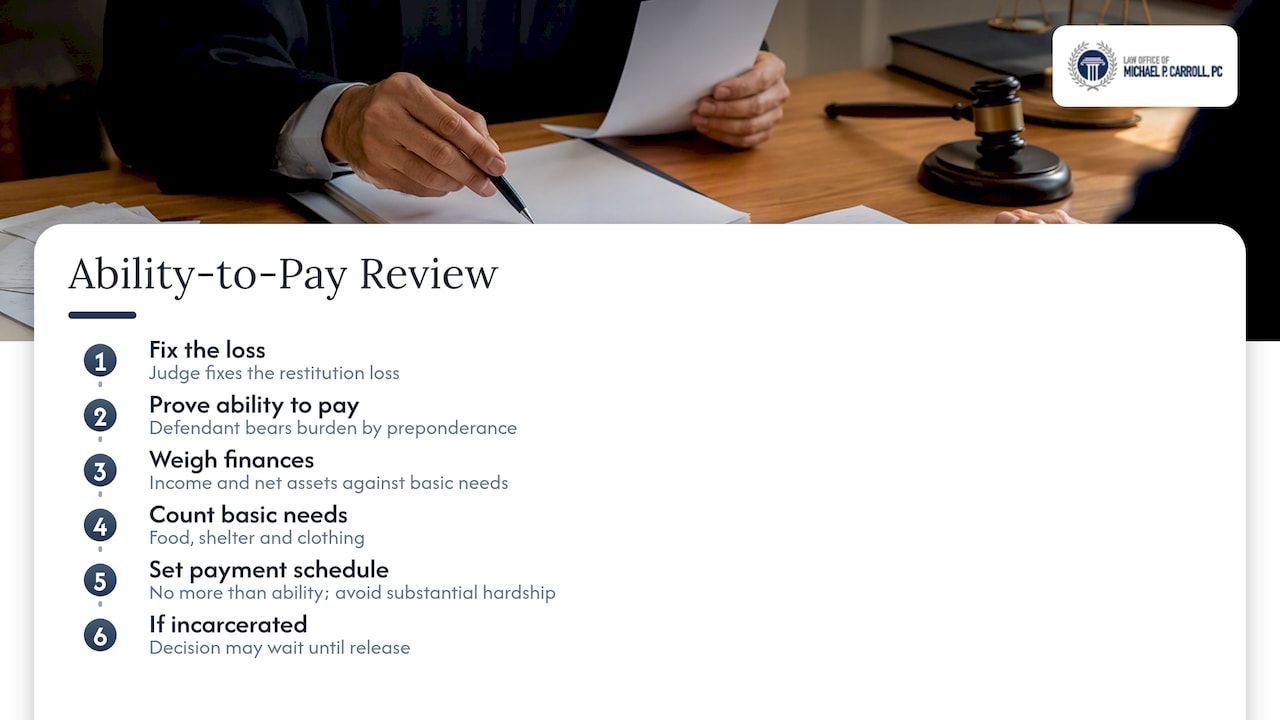
After the judge fixes the loss, Rule 49 requires an inquiry into what you can afford. The rule says the defendant bears the burden of showing by a preponderance of the evidence the amount he or she can pay without substantial financial hardship to the defendant or dependents. The judge must set a payment schedule that does not exceed that ability. If you are incarcerated or sentenced to incarceration, the judge may defer the ability-to-pay decision until after release.
The rule points the judge to your financial resources, meaning income and net assets, measured against your obligations, meaning minimum basic needs such as food, shelter and clothing. This follows the SJC's decision in Henry. A law review article, The Cost of Justice, describes Henry as barring judges from ordering defendants on probation to pay restitution beyond their means.
What to bring
Because the burden is yours, do not show up with only a verbal explanation. Gather:
- Recent pay stubs or proof of unemployment or disability income
- Rent or mortgage statements, utility bills, car and insurance payments
- Childcare, medical and child support costs
- Bank statements and a list of debts
- Any proof that you support dependents
If you are indigent, make that clear to the court. Under Rule 49 as summarized by practitioners, a finding of indigence calls for a careful look at whether a payment order would force you to choose between paying the court and meeting basic needs. A lawyer can present this in a way that is organized and persuasive.
Probation length comes first
There is a protection in the order of operations. According to the Sentencing Guidelines, if restitution is a condition of probation, the judge must first decide the length of probation, then set the amount. In Henry, the SJC held that probation length must rest on public safety and rehabilitation, not on how long it would take to pay. Stretching probation because you are poor and the debt is large treats defendants differently by wealth.
If a judge is using probation only to collect restitution, a brief term is the better practice. Do not accept a multi-year term on the assumption that it is routine.
If you cannot pay, or your situation changes
Life changes after sentencing. You may lose a job, get sick, or have a new child. Rule 49 lets either party or the probation service file a written motion to redetermine ability to pay at any time before probation ends. The judge can then adjust the payment schedule.
The same rule page states that as of December 2024, probation cannot be revoked or extended for unpaid restitution unless the Commonwealth proves a willful violation. If you show that you genuinely could not pay, you cannot be punished only for being poor.
Practical steps:
- Pay what you can, and keep proof. Partial, regular payments help show good faith.
- Do not ignore the schedule. File the motion before you fall far behind, not after a violation notice arrives.
- Keep records of job searches and expenses. They support a claim of inability to pay.
- Respond to any probation notice fast. See our guide to what to do after a probation violation notice because deadlines and hearings move quickly.
Restitution in plea negotiations
Most criminal cases end in a plea. Restitution is often part of the bargain, and the number can be negotiated. A few cautions:
- Do not agree to an amount you cannot document or afford just to close the case. A figure you accept in a plea can be hard to revisit.
- Ask whether the agreement includes a specific payment schedule and how long probation will last.
- Make sure the plea terms say what happens if you pay in full early.
- Understand how the disposition affects your record. Our overview of CORI reports and when to hire a lawyer covers what shows up later.
Your sentencing hearing is also where restitution is argued. Our sentencing hearing preparation guide explains how to prepare, whether you are the defendant or a family member.
Federal cases are different
This article covers state court in Massachusetts. If you are charged in federal court, restitution follows federal statutes and a different process. The U.S. Attorney's Office for the District of Massachusetts publishes restitution FAQs for victims under 18 U.S.C. § 3663. If your charge is federal, tell your lawyer right away because the strategy differs.
Our perspective
We see the same mistake again and again. People hear "restitution" and assume it is a fixed bill that someone else calculates. It is not. It is a number the Commonwealth has to prove, and a payment plan the court has to fit to your life.
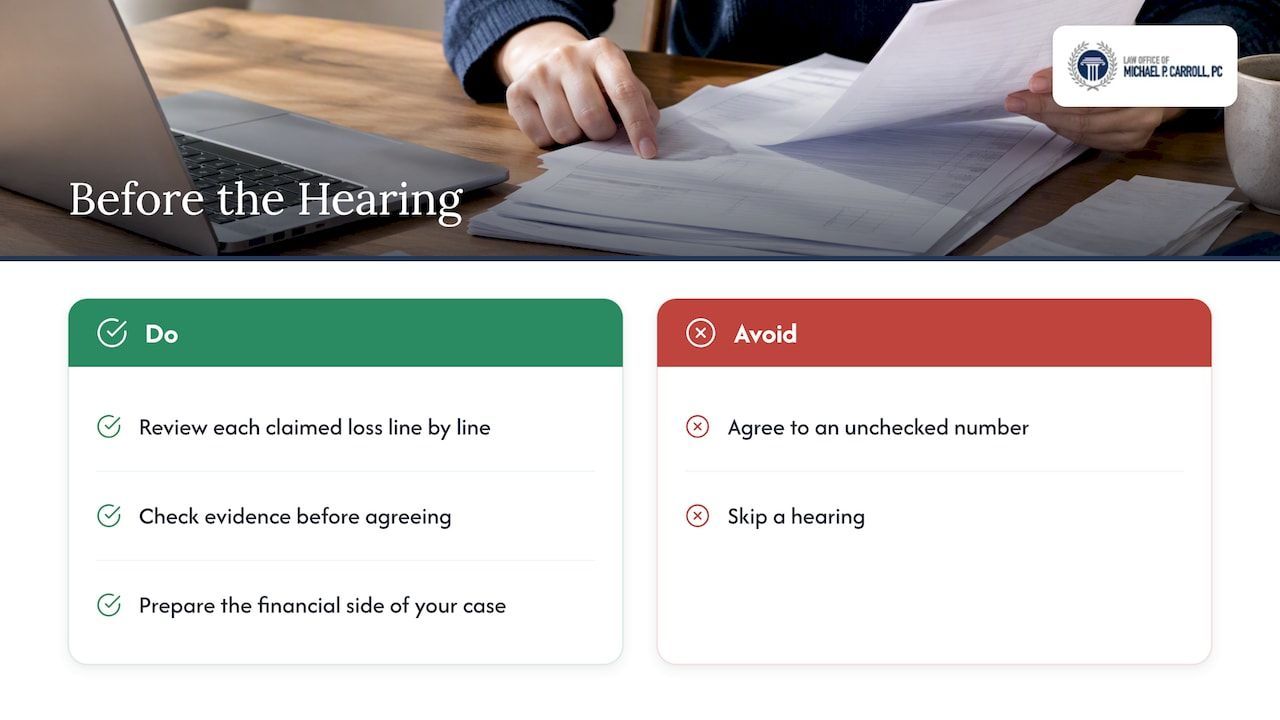
At this firm, clients work directly with Michael Carroll, so the person who reads the victim's documentation is the person who stands next to you at the hearing. We look at each claimed loss line by line. We ask whether it is documented, whether it is connected to the charge, and whether the number reflects actual loss. Then we prepare the financial side of your case as carefully as the legal side, because the burden on ability to pay is yours.
We also push back on the idea that restitution should be a reason for long probation. Probation has to be set for reasons of rehabilitation and public safety. A payment schedule should fit what you can afford, not the reverse.
If you take one thing from this page, let it be this: do not agree to a number, and do not skip a hearing, until someone has checked the evidence.
— Michael Carroll
Get a lawyer to review the restitution claim
If you are charged with a crime that involves a victim's financial loss, restitution can follow you for the length of your probation. We represent people facing misdemeanors, felonies, domestic assault and battery, and related charges in Attleboro and surrounding Massachusetts communities. Learn more about our criminal defense practice or about hearings such as clerk magistrate and probable cause hearings, then contact us to talk through your case.
FAQ
Can a judge order restitution if I am not convicted?
Restitution is imposed as part of a sentence or probation condition, so it ordinarily follows a conviction or a disposition with probation terms. Resolutions that do not involve a conviction can still carry payment conditions by agreement. Ask your lawyer how your specific disposition would work before you agree to anything.
Who has to prove the amount of restitution?
The Commonwealth must prove, by a preponderance of the evidence, that the loss was caused by the criminal conduct and how much it was. You then carry the burden of showing what you can afford to pay without substantial hardship to you or your dependents.
Will I go to jail if I miss a restitution payment?
Not automatically. As of December 2024, per Rule 49, probation cannot be revoked or extended for nonpayment unless the Commonwealth proves the nonpayment was willful. If you cannot pay because of real hardship, you can ask for a redetermination of your ability to pay before probation ends.
Can the victim just submit a number and have it approved?
No. The victim can submit estimates, receipts and other documents, and the judge may consider reliable hearsay. You have the right to challenge the figures and to question the victim about the amount, and the order cannot rest only on unreliable hearsay.
Does restitution replace a civil lawsuit?
Restitution is part of a criminal sentence, not a civil judgment. Whether a victim can pursue other remedies separately is a question for a lawyer who has your full facts.
Sources
- Mass. R. Crim. P. 49: Restitution, Mass.gov
- Section 1114. Restitution, Massachusetts Guide to Evidence
- The Boston Municipal Court and District Court Sentencing Bench Book, Mass.gov
- Commonwealth v. Henry, 475 Mass. 117
- Commonwealth v. McIntyre, 436 Mass. 829
- Sentencing Guidelines: Step 7, Chapter 7, Mass.gov
- The Cost of Justice: A Criminal Defendant's Ability to Pay After Commonwealth v. Henry, SSRN
Recommended
This article is general information about Massachusetts law, not legal advice, and reading it does not make you a client of the Law Office of Michael P. Carroll, PC. Every case is different. If you are facing charges in Bristol, Norfolk or Plymouth County, call Mike to discuss your situation.