
Massachusetts CORI: Get Your Report, $25 Fee, When to Hire a Lawyer
Massachusetts CORI: Get Your Report, $25 Fee, When to Hire a Lawyer

You can request your own Massachusetts CORI online through iCORI if you have a valid Massachusetts driver's license or state ID, or by mailing a notarized Personal Request Form if you don't. The standard fee is $25, with a waiver available for those who qualify as indigent. If you find an error, note that trial courts create these records, not the state agency handling the request, so corrections must be made through the court; complaints about improper access can be filed with the Department of Criminal Justice Information Services.
TL;DR:
- Most criminal records show charges and convictions from age 18, with misdemeanors dropping off after five years and felonies after ten under standard access.
- The $25 fee applies for online requests, which are processed within minutes to a few days, while mail requests may take up to ten business days.
- Corrections to errors must be made through the court where the case originated, not by the agency handling the CORI request.
- Broader access under required agencies can reveal records beyond the standard retention periods and include more serious offenses indefinitely.
- Sealing a record is more broadly accessible, generally after three years for misdemeanors and seven for felonies, but expungement may be limited to specific cases like certain pre-21 offenses or proven errors.
Table of Contents
- How to request your CORI online or by mail
- What shows up on your CORI and who sees what
- Fees, processing times, and how self-audits work
- Sealing vs expungement: which one applies to you
- How to fix errors or report improper access to your record
- What employers and landlords can and can't ask about your CORI
- When a Massachusetts criminal defense attorney can help with CORI issues
- A practical priority order for handling your CORI
- Getting legal help with sealing, corrections, or complaints
- Where to find the official forms and guidance
- Sources
- FAQ
How to request your CORI online or by mail
Getting your own CORI is more straightforward than most people expect, once you know which path applies to you.
- Go to iCORI and register using your Massachusetts driver's license or state ID number.
- Select "Personal - Self" as the request type, then add the request to your cart.
- Pay the fee electronically at checkout and submit.
- View your results once processing completes, keeping in mind that iCORI stores your results for six months for later reference.
If you don't have a Massachusetts ID, download the Personal Request Form, have it notarized, and mail it with a money order or cashier's check (personal checks and cash are generally not accepted for paper requests). If you can't afford the fee, you can request a waiver by submitting an Affidavit of Indigency along with your personal CORI request.
Pro Tip: Keep a photocopy of your notarized form and your mailing receipt. If your request is delayed, those copies are the first thing you'll need to sort it out.
What shows up on your CORI and who sees what
Your Massachusetts CORI reflects adult criminal court appearances within the state, starting from age 18. It does not include out-of-state charges or juvenile records in most cases.
What appears, and to whom, depends heavily on who is asking.
- Standard access applies to most employers and covers pending charges, misdemeanor convictions for 5 years, and felony convictions for 10 years.
- Required access applies to statutorily defined agencies, such as licensing boards or elder care organizations, and can reveal records going back to age 18.
- Certain serious offenses , regardless of category, remain visible indefinitely under Massachusetts CORI regulations.
Under 803 CMR 2, misdemeanors typically drop off standard CORI checks after 5 years and felonies after 10, though required-access agencies may still see them. That gap between what a landlord sees and what a hospital or school sees surprises a lot of people who assume a "clean" CORI means the same thing to everyone.
Fees, processing times, and how self-audits work
The $25 fee applies whether you request online or by mail, though payment methods differ: iCORI takes electronic payment, while paper requests need a money order or cashier's check.
Turnaround varies by method and volume.
- Most iCORI requests return results within minutes to a few days.
- One self-audit is free every 90 days , showing which non-law-enforcement agencies have requested your CORI.
- Additional self-audits within that window cost $25 each , per DCJIS rules.
If your request seems delayed past the standard window, check your iCORI account status first. For mailed requests, confirm your notarization was valid and your payment method was accepted before assuming something went wrong.
Sealing vs expungement: which one applies to you
Sealing and expungement solve different problems, and confusing them leads to wasted time. Sealing limits who can see a record without removing it. Expungement destroys the record entirely, but only in narrow circumstances.
- Check your waiting period. Most misdemeanor convictions become eligible for sealing after 3 years, and most felonies after 7, provided you have no new convictions during that window, according to Mass.gov's sealing guidance.
- Determine if you qualify for expungement instead. This applies only in specific situations: time-based eligibility for certain offenses committed before age 21, or non-time-based cases involving proven errors, identity theft, or offenses no longer considered criminal.
- Gather your documents. You'll want your CORI report, court disposition records, and any evidence supporting your petition.
- File with the appropriate court or the probation office handling the original case.
Our guide to record sealing in Massachusetts walks through the eligibility details step by step, and our piece on expungement in Massachusetts covers the narrower expungement track in more depth. If you're dealing with an OUI specifically, our post on removing an OUI from your record addresses how offense type affects your options.
Pro Tip: Don't assume expungement is the better outcome just because it sounds more permanent. Sealing is available to far more people and often achieves the practical result you're after: keeping the record out of view for employers and landlords.
How to fix errors or report improper access to your record
If your CORI contains wrong information, such as a misfiled disposition or a case that belongs to someone else, contact the trial court where the case originated. DCJIS distributes CORI data but cannot change what's in the underlying court record.
If instead you believe someone accessed your CORI without proper authorization, that's a different process.
- File a CORI Regulatory Violations Complaint with DCJIS, available both online and by mail.
- DCJIS investigates violations under its regulatory authority and notifies you of the outcome, but again, cannot alter court-generated data itself.
- Include supporting documents , such as your CORI report, any correspondence with the requesting party, and dates of the suspected violation.
- An attorney can help when the case involves contested facts, multiple agencies, or a court filing to correct the underlying record.
What employers and landlords can and can't ask about your CORI
Massachusetts law limits when and how organizations can use your CORI against you. Employers generally cannot ask about criminal history on an initial written application, with narrow statutory exceptions.
- Public and subsidized housing authorities typically have required access, meaning broader visibility into your history than a private landlord.
- Market-rate landlords operate under standard access, similar to most employers.
- Before any adverse action based on your CORI, such as a job or housing denial, you're entitled to a copy of the report and a chance to dispute inaccuracies.
- No employer or landlord can legally require you to hand over your own personal CORI as a condition of applying.
When a Massachusetts criminal defense attorney can help with CORI issues
Some CORI problems resolve with a form and a stamp. Others don't. A contested record correction, a complicated sealing petition involving multiple offense types, or a job denial that seems to violate CORI notice rules are situations where legal guidance changes the outcome.
An attorney can file the necessary motions, represent you at a sealing or correction hearing, assemble the court records DCJIS can't touch, and help you decide whether sealing, a complaint, or litigation makes more sense given your timeline. Attorney Michael P. Carroll has spent more than a decade handling Massachusetts criminal defense matters, working directly with clients on cases that intersect with record issues like these.
A practical priority order for handling your CORI
Get your CORI first, confirm every entry is accurate, then decide: sealing for most eligible convictions, a complaint for improper access, or legal help for anything contested. Keep every form, receipt, and tracking number. Use the official Mass.gov resources listed below before acting on anything else.
— Michael Carroll
Getting legal help with sealing, corrections, or complaints
If your CORI review turns up a record you believe should be sealed, an entry that needs correcting through the court, or a denial that raises questions about how an employer or landlord used your information, the Law Office of Michael P. Carroll can help you sort out the next step. Clients receive personalized attention throughout their case, which matters when a sealing petition or record dispute needs consistent handling from start to finish.

- Record sealing petitions for eligible misdemeanor and felony convictions.
- Court representation for hearings tied to record corrections or contested sealing petitions.
- Assistance navigating DCJIS complaints when improper access or agency error is involved.
| What you might need | Where to start |
|---|---|
| Sealing a past conviction | Criminal Law services |
| Representation at a hearing | Clerk Magistrate and Probable Cause Hearings |
| A charge tied to your CORI issue | DUI Attorney |
Bring your CORI report, any court paperwork, and a timeline of what happened to your first consultation. Reach out through Mpclaw to schedule a conversation about your specific situation.
Where to find the official forms and guidance
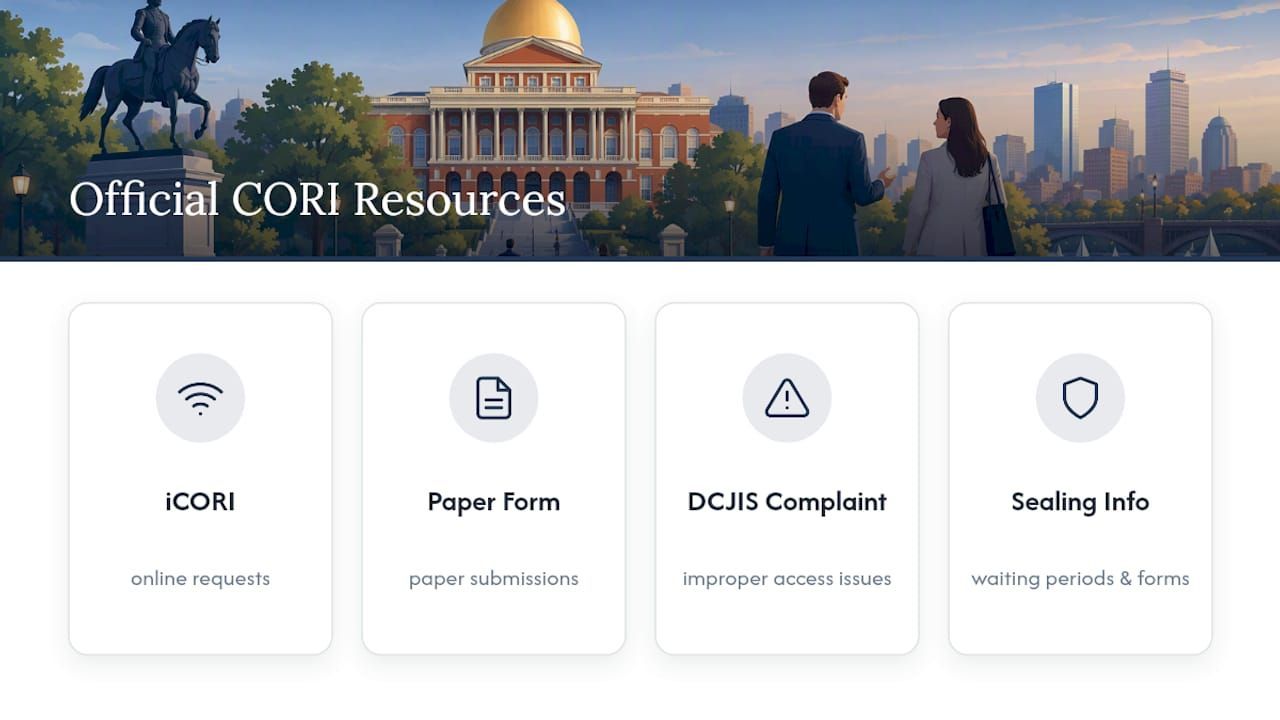
Start with iCORI for online requests and the Personal CORI Request Form for paper submissions. Use the DCJIS complaint page for improper access issues and the sealing eligibility page for waiting periods and forms.
This article is general information, not a substitute for advice from a qualified lawyer. Consult a qualified legal professional about your own circumstances before acting on anything here.
FAQ
Can I run a CORI report on myself in Massachusetts?
Yes, you can request your own CORI through iCORI if you have a valid Massachusetts driver's license or state ID, or by mailing a notarized Personal Request Form if you don't. The standard fee is $25, with a waiver available for those who qualify.
What shows up on a CORI check in Massachusetts?
A Massachusetts CORI shows adult criminal court appearances within the state starting from age 18, not out-of-state charges. What a specific requester can see depends on whether they have standard or required access under state CORI regulations.
How many years does a CORI check go back in Massachusetts?
Under standard access, misdemeanor convictions generally remain visible for 5 years and felony convictions for 10 years after disposition, per Massachusetts CORI rules. Required-access agencies, and certain serious offenses, may see records further back or indefinitely.
How much does a CORI check cost in MA?
A personal CORI request costs $25 whether submitted online through iCORI or by mail, according to official Mass.gov guidance. Those who qualify as indigent can request a fee waiver by submitting an Affidavit of Indigency with their request.