
Minor in Possession in Massachusetts: Penalties and Defense
Minor in Possession in Massachusetts: Penalties and Defense
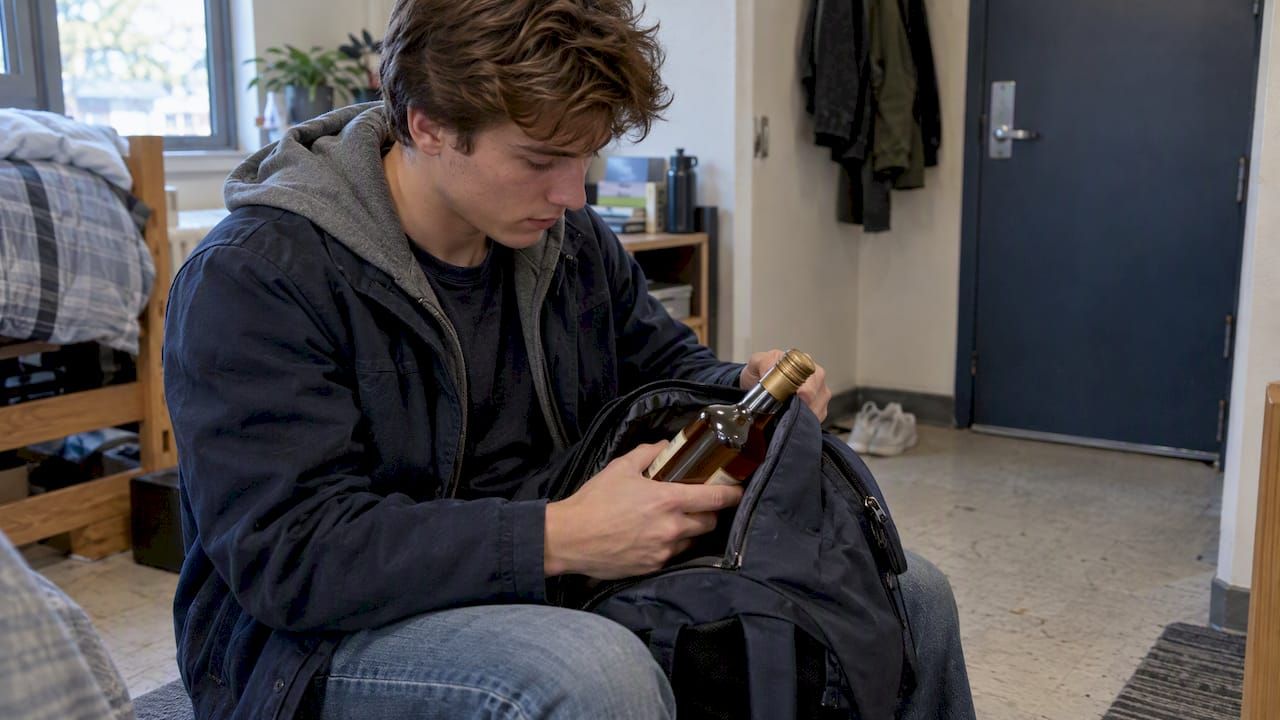
If you are under 21 and police say you had alcohol, the fine is the smallest part of the problem. In Massachusetts, a conviction for underage possession carries a fine of up to $50 for a first offense and a mandatory 90-day loss of your driver's license. A deadline as short as 4 days can decide whether you ever get a chance to argue the case before a clerk magistrate. This guide explains what the law says, what happens in court, and what to do in the first days after a citation or an arrest.
The offense is usually called "minor in possession," or MIP. Massachusetts does not use that label in the statute. The charge is brought under G.L. c. 138, § 34C, and the court paperwork will cite that section.
TL;DR
- Under G.L. c. 138, § 34C, a person under 21 who knowingly possesses, transports or carries alcohol faces a fine of up to $50 for a first offense and up to $150 for a second or later offense.
- A conviction is reported to the Registry of Motor Vehicles (RMV), which must suspend your license for 90 days. That suspension often hurts more than the fine.
- If you received a criminal citation, your request for a clerk magistrate hearing must reach the court within 4 days of the violation.
- Outcomes such as diversion or a continuance without a finding (CWOF) can keep a conviction, and the suspension that follows it, off your record. They are discretionary and vary by county and court.
- Do not talk your way out of it with police or plead at arraignment before you understand the license consequence.
Table of Contents
- What the law actually says
- Penalties: the fine is the small part
- Minor in possession versus underage OUI
- The 4-day deadline most people miss
- What happens if you are arrested or summonsed
- Ways these cases are resolved
- Common situations and how they play out
- How a license suspension is handled afterward
- Our perspective
- If you were just cited or arrested
- FAQ
- Sources
What the law actually says
Section 34C applies to anyone under 21 who is not accompanied by a parent or legal guardian and who knowingly possesses, transports or carries alcohol on their person. Three details matter in practice.
"Knowingly" is an element. The Commonwealth has to prove you knew the alcohol was there. A passenger in a car where someone else's bottle sits in the back seat is in a very different position from the person holding it.
"Possess, transport or carry" is broad. A can in a backpack, a bottle in a coat pocket and a case in your trunk can all qualify. You do not have to be drinking, and you do not have to be intoxicated.
The statute permits a warrantless arrest. An officer may arrest a person for violating this section without a warrant. Most underage possession cases begin with a criminal citation or a summons rather than a booking, but an arrest is legally possible, especially when a stop involves a vehicle or a fight.
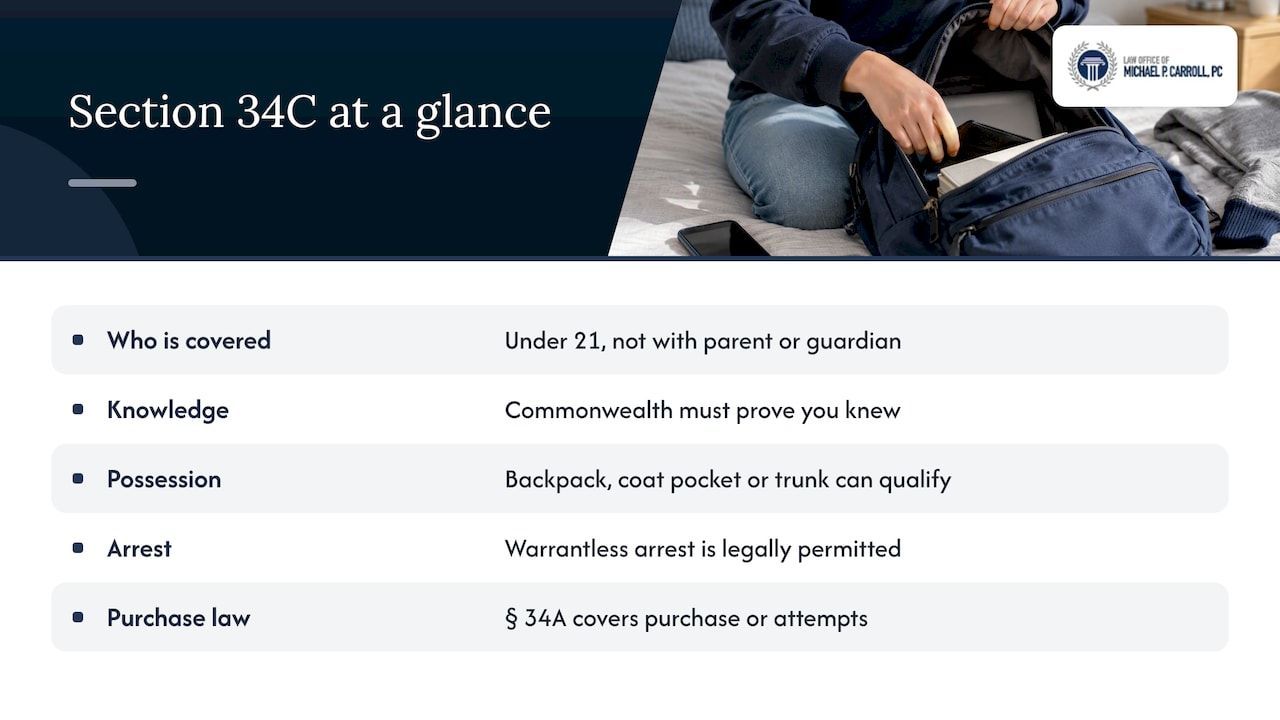
A separate statute, G.L. c. 138, § 34A, covers people under 21 who purchase or try to purchase alcohol, including arrangements to have someone else buy it. Fake ID cases usually arrive under that section or alongside § 34C, so read every charge on your paperwork.
Penalties: the fine is the small part
| Consequence | First offense | Second or later offense |
|---|---|---|
| Fine | Up to $50 | Up to $150 |
| License | 90-day suspension on conviction | 90-day suspension on conviction |
| Record | Criminal record entry if convicted | Same |
The fine and suspension figures come from the statute itself, which tells the court to report a conviction to the registrar and tells the registrar to suspend the license for ninety days.
That suspension is what changes the stakes. Think about what 90 days without a license means for a college student with a commute, an apprentice who drives to job sites, or a parent who relies on a teenager to get to work. The cost of the suspension, plus the later cost of getting the license back, can dwarf a $50 fine. For a rough sense of reinstatement costs, see our guide to license reinstatement in Massachusetts.
Why a guilty plea is risky
Many young defendants hear "it's only a $50 fine" and plead guilty to get it over with. The court then reports the conviction to the RMV, and the 90-day suspension follows. The RMV is an administrative body that enforces what the court found. If you think the finding was wrong, you cannot argue that to an RMV hearings officer. It has to be addressed in the court where the conviction happened.
The practical lesson: the only point at which you can reliably avoid the suspension is the court stage, before a conviction is entered.
If a juvenile license is involved
Drivers under 18 are junior operators, and the RMV says junior operator suspensions are mandatory under state law and cannot be altered by the RMV. If you hold a junior operator license, the stakes of the court result are even higher, because there is no administrative second chance.
Minor in possession versus underage OUI
Possessing alcohol and driving after drinking are different offenses with different penalties. If a traffic stop produced both, the possession charge is the lesser problem.
Under the RMV's rules, if you are under 21, are arrested for operating under the influence and register a blood alcohol concentration of 0.02% or higher, the RMV suspends your license for 30 days. That is on top of whatever the court does with the criminal charge, and the clock for challenging it is short. Our articles on underage OUI and the 180-day suspension risk and the 15-day RMV appeal window walk through those deadlines.
If you were stopped while driving, treat the case as an OUI case first. Our OUI attorney page explains how we approach those charges.
The 4-day deadline most people miss
In many underage possession cases, the officer does not arrest you. You receive a criminal citation instead. Mass.gov explains that for a misdemeanor citation, you are generally entitled to a show cause hearing before a clerk magistrate, where the magistrate decides whether there is probable cause to issue a criminal complaint. To get that hearing, your written request must arrive at the court within 4 days of the date of the violation.
Why it matters: a clerk magistrate hearing is a private, informal proceeding that happens before charges are formally entered. If the magistrate does not find probable cause, or agrees to hold the case without issuing a complaint, there may be no criminal case at all. If you miss the window, a complaint can issue and you are formally charged without that early chance to argue for dismissal.
What to do with a citation:
- Read the citation today. Note the violation date, the court named on it and any hearing information.
- Count four days from the violation date , not from the day you opened the envelope or the day you told your parents.
- Send the written request to the clerk magistrate of the court named on the citation , using a method that proves it arrived, and keep a copy.
- Call a defense attorney before the hearing. A magistrate hearing is short. What you say there can be used against you, and preparation is worth far more than improvisation.
We handle these hearings regularly. Our page on clerk magistrate hearings, probable cause hearings and notices of hearing describes what the process looks like.
What happens if you are arrested or summonsed
If you were arrested, or a complaint issues after a hearing or summons, the case moves to an arraignment. Mass.gov advises that you go to court on the date listed and arrive on time, because missing it can lead to a default or warrant. The same page explains the rights that apply whether you were summonsed or arrested.
At arraignment, the judge reads the charge, and you enter a plea of not guilty if you are not ready to resolve the case. This is not the moment to admit anything. A not-guilty plea at arraignment is routine and keeps every option open: a motion to dismiss, a negotiated resolution, or a trial.
Adult court or juvenile court
Where your case is heard depends on your age. The state's juvenile justice materials explain that the Juvenile Court handles delinquency matters, while adult criminal complaints go through the adult court system. Juvenile matters are generally less public than adult ones. If you are 17 or 18, or the parent of someone that age, confirm early which court has the case and what that means for privacy. Our criminal law page covers juvenile delinquency matters as well.
Ways these cases are resolved
No one outcome fits every case. These are the paths we look at, in the order a defense usually considers them.
Dismissal at the clerk magistrate stage
If you filed on time, the best outcome is that no complaint issues. A magistrate may find no probable cause, or may decline to issue the complaint after hearing from both sides. Facts that help: the alcohol was not yours, you did not know it was there, or the officer's account does not hold together.
Diversion
Some district attorney offices run diversion for first-time, non-violent offenders. In programs such as those described for Bristol County and Plymouth County, participants can postpone arraignment, commonly for about 90 to 120 days, while they finish requirements like community service or alcohol education. If completed, the charge is dismissed before it becomes part of a formal record.
Two cautions. Diversion is discretionary, varies by county and is not a right. And it generally needs the prosecution's agreement before the case moves forward, which is why early, proactive advocacy matters. Do not assume your court offers it, and do not assume you will qualify without a request being made for you.
Continuance without a finding (CWOF)
A CWOF is a disposition in which you admit there are facts that would support a finding, the court continues the case for a period of probation or compliance, and then dismisses it if you meet the conditions. Because there is no conviction entered, defense strategy often aims for a CWOF or diversion specifically to avoid the formal conviction and the suspension that follows it. Whether a particular judge and prosecutor will agree, and on what conditions, depends on your history and the facts.
Trial
The Commonwealth has to prove each element: that you were under 21, that you were not with a parent or guardian, that you possessed, transported or carried alcohol, and that you knew it. Summaries of the elements track the statute's text. Weak points in the Commonwealth's case commonly include knowledge, whether the item was actually alcohol, who controlled the bag or car, and whether the stop or search was lawful.
Common situations and how they play out
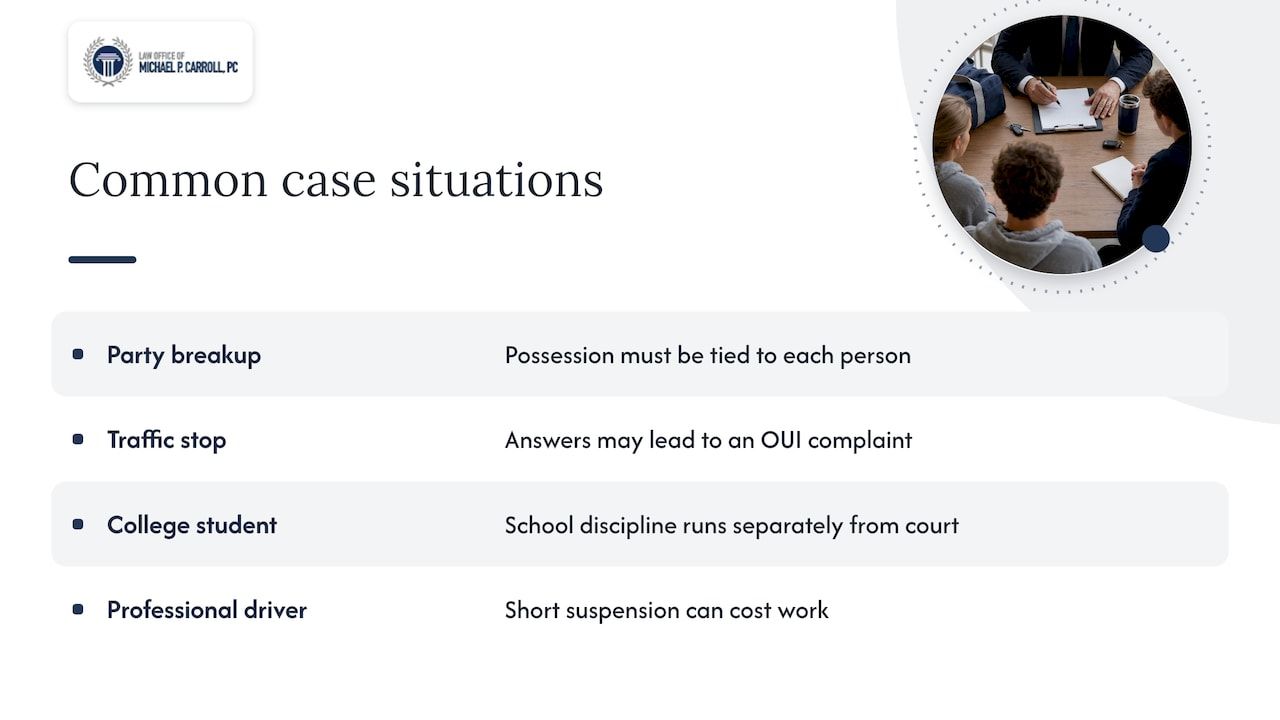
The party that got broken up. Officers arrive, several people under 21 are standing around cups and bottles. Possession has to be tied to each person individually. "Everyone there had it" is not proof that you knowingly carried alcohol.
The traffic stop. A driver under 21 is pulled over and an officer finds a bottle in the car. Beyond the possession charge, expect questions about whether you were drinking. Do not answer them without advice, because your answers can lead to an OUI complaint. Our guides to breathalyzer refusal and what happens after a failed test explain the next layer of risk.
The college student. Campus police may issue a citation, and the university can start its own disciplinary process separately from the court case. A court outcome does not automatically resolve the school's process, so tell your attorney about any school notice.
The commercial or professional driver. If your job depends on driving, even a short suspension can cost you work. That makes avoiding a conviction the priority, not just minimizing the fine.
How a license suspension is handled afterward
If you are convicted, the suspension is not something you negotiate with the RMV. The RMV's hearing process exists for suspensions, and the agency says it holds roughly 1,000 suspension hearings per week, but for this offense the statute directs a mandatory 90 days after the court reports the conviction. When the suspension ends you may still need to pay fees to restore the license. Our guide to driving on a suspended license explains why driving during a suspension turns a small case into a serious one.
Our perspective
We see two mistakes more than any others. The first is treating a $50 fine as a $50 problem. Families tell us they were going to just pay it and move on, and then learn the plea carries a 90-day suspension and a record entry. The second is waiting. The clerk magistrate deadline is measured in days, and by the time someone calls us on day six, the best early option may be gone.
Because this office is owner-operated, you work directly with Michael Carroll from the first call through the last court date. That matters in a case like this, where the facts are small but the details decide the result: who held the bag, what the officer actually saw, what was said at the scene, and whether the court will consider diversion or a CWOF. We read the report, look for weaknesses in how the stop or search happened, and prepare you for what to say and what not to say before any hearing.
If you are a parent, we also tell you plainly what your son or daughter should and should not discuss with police, school officials and friends until the case is resolved.
— Michael Carroll
If you were just cited or arrested
We represent clients charged with underage possession, underage OUI and related offenses across Attleboro and the surrounding Massachusetts communities. If you have a citation, a hearing notice or an arraignment date, bring the paperwork to a consultation. We can tell you the filing deadline, the likely exposure, and whether a clerk magistrate hearing, diversion or a CWOF is realistic in your court.
Start with our criminal defense practice page, or contact us through mpclaw.legal. Because deadlines can be as short as four days, call as soon as you have the citation.
FAQ
How long does a minor in possession charge stay on your record?
A conviction becomes part of your criminal record and does not disappear on its own. A dismissal, diversion or a CWOF that is successfully completed avoids a conviction, which is why resolving the case well at the start matters. Whether and when a record can later be sealed depends on the disposition and the current rules, so ask an attorney about your specific case.
What is the penalty for minor in possession of alcohol in Massachusetts?
The fine is up to $50 for a first offense and up to $150 for a second or later offense. A conviction also triggers a mandatory 90-day driver's license suspension reported to the RMV by the court. Both come from G.L. c. 138, § 34C.
Can I be charged if I did not drink anything?
Yes. The offense is possessing, transporting or carrying alcohol, not drinking it. But the prosecution must prove you knew you had it, and that is often the strongest point for the defense.
Do I need a lawyer for a $50 fine?
The fine is not the issue. The license suspension, the record and the short deadlines are. A lawyer can request the clerk magistrate hearing, push for diversion or a CWOF, and make sure you do not plead into a suspension.
Sources
- M.G.L. c. 138, § 34C, Massachusetts Legislature
- M.G.L. c. 138, § 34A, Massachusetts Legislature
- Respond to a criminal citation, Mass.gov
- Before your arraignment, Mass.gov
- Alcohol and drug suspensions for under 21 years of age, Mass.gov
- Types of RMV suspension hearings, Mass.gov
- Suspension hearings information, Mass.gov
- Overview of the Bristol County District Attorney's Office, Mass.gov
- Overview of the Plymouth County District Attorney's Office, Mass.gov
- Juvenile Justice Handbook, Mass.gov
Recommended
This article is general information about Massachusetts law, not legal advice, and reading it does not make you a client of the Law Office of Michael P. Carroll, PC. Every case is different. If you are facing charges in Bristol, Norfolk or Plymouth County, call Mike to discuss your situation.