
Stop the 60 Day Jail Risk: MA Suspended License RMV & Lawyer Help
Stop the 60 Day Jail Risk: MA Suspended License RMV & Lawyer Help

Operating a motor vehicle on a suspended license in Massachusetts is a criminal offense under G.L. c.90 §23, not a traffic ticket. A first offense can bring a fine within the statutory range and possible jail time up to 10 days; subsequent offenses carry a mandatory minimum jail sentence of at least several weeks. If you've been charged, or you're unsure whether your license is currently valid, check your Registry of Motor Vehicles (RMV) status today and talk to a lawyer before your court date.
TL;DR:
- Driving on a suspended license in Massachusetts can lead to jail time of at least 60 days for repeat offenses, with fines of up to $1,000.
- Convictions often result in suspension extensions, vehicle registration revocation, and additional registration surrender issues.
- License suspensions can be triggered by a wide range of violations, including DUI, unpaid fines, points accumulation, or out-of-state suspensions.
- Police can verify license status immediately during a traffic stop, making suspensions evident and charges almost inevitable if caught.
- To reinstate a license, drivers must check their RMV status, pay all fines, complete required programs, and possibly pass exams for longer suspensions.
Table of Contents
- What Are the Penalties for Driving on a Suspended License in Massachusetts?
- How Do Massachusetts License Suspensions Happen in the First Place?
- What Happens When Police Stop You With a Suspended License?
- How to Reinstate a Suspended License in Massachusetts
- How Do RMV Suspension Hearings and Appeals Work?
- What Should You Do Immediately After Being Charged?
- A Lawyer's Take on Suspended-License Cases
- Facing a Suspended-License Charge? Here's How We Help
- Sources
- FAQ
What Are the Penalties for Driving on a Suspended License in Massachusetts?
The statute treats a first offense very differently from a second or later one, and the gap is wide enough to change how a case gets defended.
- First offense: a fine of $500 to $1,000, up to 10 days in jail, or both.
- Second or subsequent offense: a mandatory minimum of 60 days in jail, up to one year, plus a $1,000 fine.
- Habitual traffic offender status: repeat violations can trigger enhanced mandatory sentences under separate paragraphs of Section 23, stacking additional time onto an already serious charge.
A conviction rarely ends with the fine. A conviction under the statute's first paragraph typically triggers an automatic RMV suspension extension of 60 additional days, while a second-paragraph conviction can add a full year on top of whatever suspension already existed.
Beyond the court penalties, the RMV can revoke your vehicle's registration or order the plates surrendered, particularly when the underlying suspension involved an OUI, a chemical-test refusal, or unpaid fines. That combination, a criminal record plus a longer suspension plus a registration problem, is why so many people who thought they were "just driving to work" end up dealing with the RMV for months after the court case closes.
How Do Massachusetts License Suspensions Happen in the First Place?
Not every suspension looks the same, and the type of suspension you have often determines what remedy is even available to you. Massachusetts license suspension laws cover a wide range of triggers, including:
- OUI convictions or chemical-test (breathalyzer) refusals
- Accumulated points or repeated moving violations
- Unpaid traffic fines, court fees, or child support arrears
- Court-ordered suspensions tied to a separate criminal case
- Out-of-state suspensions that Massachusetts recognizes reciprocally
- Junior operator law (JOL) violations for drivers under 18
- Commercial driver's license (CDL) disqualifications
The RMV mails notice to the address on file, and under Massachusetts law, receipt by an authorized agent at that address may suffice to establish notice for prosecution purposes, regardless of the individual's personal acknowledgment. That single fact surprises a lot of people, and it's exactly why confirming your address and checking your RMV record matters more than most drivers realize. CDL and JOL suspensions leave the RMV very little discretion; court-ordered suspensions, by contrast, sometimes bend depending on the underlying case's resolution.
What Happens When Police Stop You With a Suspended License?
Police officers run your plate the moment they pull up behind you, and modern RMV databases flag a suspension almost instantly. There's no realistic scenario where a suspended license stays hidden during a routine stop.
To convict you of operating after suspension, the Commonwealth has to prove three things: that you were operating the vehicle, that your license was suspended or revoked at the time, and that you had notice of the suspension. An RMV certificate showing your license was never restored is admissible evidence in court, which makes the notice question the real battleground in most cases.
- A citation and possible arrest, depending on the officer's discretion and any other charges involved
- Vehicle impoundment or a plate surrender in some cases
- A court date that can arrive faster than people expect, especially if bail conditions attach
How to Reinstate a Suspended License in Massachusetts
Getting back on the road legally follows a specific sequence, and skipping a step usually means starting over.
- Check your RMV status. Log into the RMV's online service center or visit a Service Center to find out exactly why you were suspended and what's required to clear it.
- Pay outstanding fines or obligations. Unpaid tickets, court fees, or child support arrears need to be resolved before the RMV will process reinstatement.
- Pay the reinstatement fee. Fees generally range from $100 to $1,200 depending on the violation, and the amounts themselves are set under G.L. c.90 §33.
- Complete any required program. The RMV may order National Safety Council driver retraining, the State Courts Against Road Rage (SCARR) program, attitudinal retraining, or DPH-approved drug and alcohol counseling, depending on the offense.
- Take the full exam if required. Longer suspensions typically require passing the learner's permit exam and road test before the RMV will reissue a license.
- Bring documentation. Certified driving histories, court abstracts, and proof of program completion all need to be current when you show up at the Service Center or a hearing.
Pro Tip: Call ahead or check the RMV's online portal before showing up. Reinstatement requirements vary by suspension type, and driving there only to learn you're missing one certificate wastes a trip you can't afford to keep repeating.
Our detailed breakdown of reinstatement fees walks through the fee ranges by violation type in more depth, and drivers coming off an OUI suspension may want to look at hardship license eligibility as a bridge while reinstatement is pending.
How Do RMV Suspension Hearings and Appeals Work?
If you believe a suspension was issued in error, or you need a hearing to argue for early reinstatement, the RMV handles a defined list of suspension categories, including alcohol and drug suspensions, ignition interlock disputes, chemical-test refusals, JOL suspensions, and out-of-state actions.
- Schedule hearings through the RMV's Online Service Center; many are now conducted by telephone rather than in person.
- Bring certified, current documents: a certified driving history, court abstracts, and, for out-of-state cases, a letter of reinstatement from the other state's licensing agency.
- Out-of-state paperwork must be recent and current; older documents risk rejection, so timeliness is essential.
- Appeals of certain RMV decisions go to the Board of Appeals, often within a 10-day window; other suspensions require appealing directly to court instead.
A successful hearing can shorten a suspension or clear the path to reinstatement immediately, but a missed deadline usually means waiting out the full term.
What Should You Do Immediately After Being Charged?
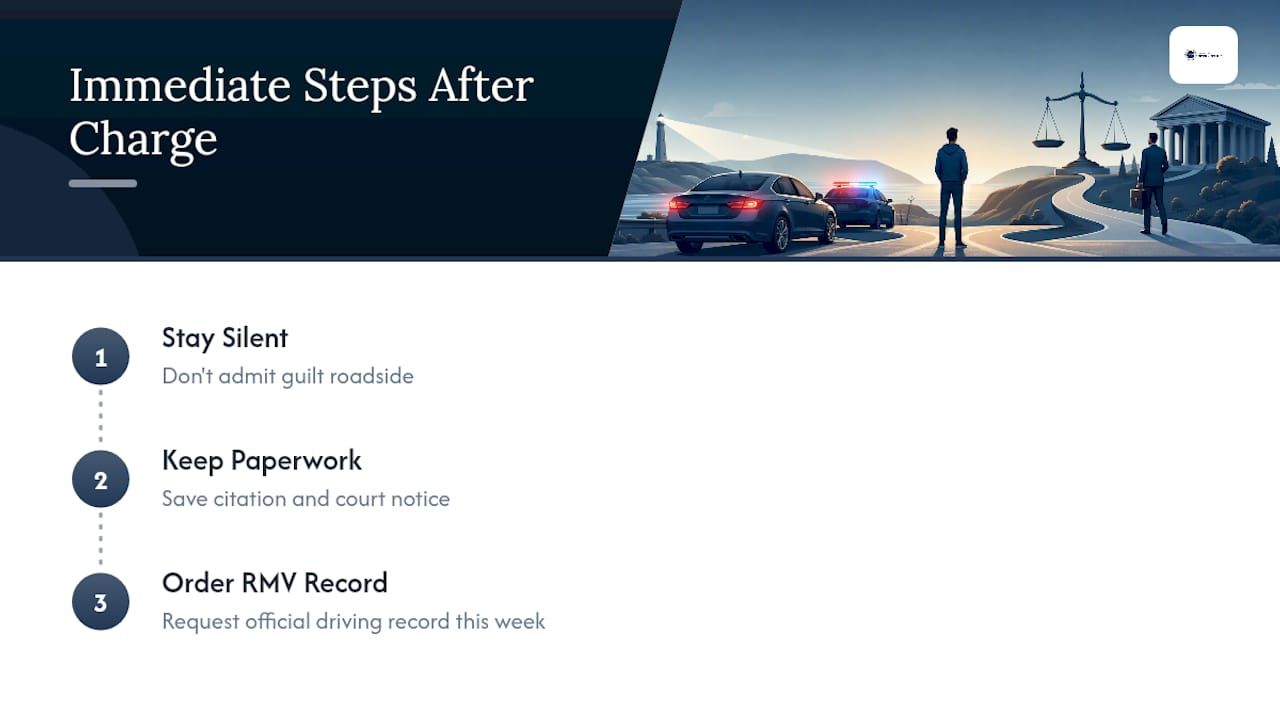
Don't say anything that sounds like an admission on the roadside. Get your paperwork, including the citation and any court notice, and request your official RMV driving record the same week.
Certain situations call for an attorney without much debate: any suspension connected to an OUI, an allegation that you're a habitual offender, a charge carrying mandatory jail time, or a job that depends on your ability to drive legally. An attorney can also handle RMV hearing prep and negotiate directly with prosecutors while you focus on work and family. Michael P. Carroll has spent over a decade defending Massachusetts drivers through exactly these situations.
Pro Tip: Never assume a suspended-license charge will "just go away" with a fine. Courts increasingly treat repeat operating-after-suspension charges as a pattern, and that pattern is what triggers the mandatory minimums.
A Lawyer's Take on Suspended-License Cases
People assume "I never got the letter" is a winning defense. It isn't automatic. Notice can be satisfied by mail delivery to your address of record, regardless of whether you read it. The smarter move is acting fast on both fronts, the RMV side and the court side, before one problem compounds the other.
— Michael Carroll
Facing a Suspended-License Charge? Here's How We Help
Our firm offers personalized legal support for drivers facing operating-after-suspension charges in Massachusetts, with direct involvement of the primary attorney throughout the case.

The firm handles criminal defense for operating after suspension, RMV hearing representation, reinstatement guidance, and OUI and DUI defense when the suspension traces back to an alcohol-related charge. If your case involves a breathalyzer refusal, our page on refusal penalties in Massachusetts covers how that intersects with a suspension.
Bring your citation, your RMV driving record, and any court paperwork to your first consultation. Call the Law Office of Michael P Carroll today, or visit our criminal law services page to schedule a consultation and find out exactly where your case stands.
Sources
This article is general information, not a substitute for advice from a qualified lawyer. Consult a qualified legal professional about your own circumstances before acting on anything here.
FAQ
What happens if you get caught driving on a suspended license in Massachusetts?
You'll face criminal charges under G.L. c.90 §23, with a first offense carrying a $500 to $1,000 fine or up to 10 days in jail. A second or later offense carries a mandatory minimum of 60 days in jail, and your suspension itself typically gets extended on conviction.
Should I plead guilty to driving on a suspended license?
Pleading guilty locks in a conviction and the mandatory suspension extension that comes with it, so it's rarely the right first move without talking to an attorney. The Commonwealth still has to prove operation, suspended status, and notice, and each of those elements can be contested depending on the facts.
How do I get my license reinstated after a suspension in Massachusetts?
Start by checking your status with the RMV, then pay any outstanding fines plus the reinstatement fee, which ranges from $100 to $1,200 depending on the violation. Some suspensions also require completing a program like NSC driver retraining, and suspensions of two years or more require passing a full exam and road test.
When police run your plates, can they see if your license is suspended?
Yes. Officers can check license status electronically the moment they run a plate, which is why suspended-license charges almost always follow directly from a routine traffic stop rather than a separate investigation.
Do I need a lawyer for a suspended-license charge in Massachusetts?
You don't legally need one, but cases involving OUI-related suspensions, habitual offender allegations, or mandatory jail exposure benefit significantly from representation. The Law Office of Michael P Carroll handles these charges directly with attorney Michael Carroll on every case, from arraignment through RMV hearings.