
Harassment Order vs. Restraining Order in Massachusetts
Harassment Order vs. Restraining Order in Massachusetts

In Massachusetts, "restraining order" usually means a 209A abuse prevention order, and "harassment order" means a 258E harassment prevention order. Both are civil protection orders from a judge, and both can lead to arrest and criminal charges if you violate them. The main difference is the relationship between the two people. A 209A order requires a family, household or intimate relationship. A 258E order does not.
This guide is written mostly for the person on the receiving end: you were served with an order, or you were told a hearing is coming, and you need to know what you're facing.
TL;DR
- 209A (abuse prevention, the "restraining order") requires a qualifying relationship: spouses, household members, relatives, parents of a child in common, or people in a substantial dating relationship.
- 258E (harassment prevention) has no relationship requirement. A neighbor, coworker, classmate or ex-friend can seek one.
- Both are enforced by police. A violation can mean arrest and a criminal case, even if the other person contacted you first.
- Both can be requested the same day and often start without you being present. You get your chance to respond at a later hearing, so prepare for it.
- A 258E order can also include money for the plaintiff's losses, which many defendants overlook.
Table of Contents
- Are they the same thing?
- The key difference: who can ask for which order
- Side-by-side comparison
- How the process works for both orders
- Why the defendant's stakes are high
- What if it could be either one?
- If you were served: the first steps
- What the hearing looks like
- Our perspective
- Get help with a restraining or harassment order
- Frequently asked questions
- Sources
Are they the same thing?
In everyday speech, yes. The Commonwealth's own protection order guide says abuse prevention orders are also called restraining orders or 209A orders, and harassment prevention orders are called 258E orders. In practice, people say "restraining order" for both.
Legally, they are two separate statutes with different standards. The chapter numbers matter because they decide which court can hear the case, what the other person must prove, and what the judge can order.
The key difference: who can ask for which order
209A: a qualifying relationship is required
According to the Trial Court's eligibility page for abuse prevention orders, a person can seek a 209A order against someone with whom they have a specific relationship. That means a current or former spouse, someone they live or lived with, a relative by blood or marriage, someone they share a child with, or someone they are or were in a serious dating or engagement relationship with.
The focus is abuse within that relationship, such as physical harm, an attempt to cause it, or putting someone in fear of imminent serious physical harm.
258E: no relationship needed
The harassment prevention eligibility page explains that, unlike 209A orders, harassment prevention orders are not limited to people with a particular relationship. A stranger, a neighbor, a coworker or a former friend can qualify.
The plaintiff has to show harassment as the statute defines it. According to Mass Legal Help, that means three or more willful and malicious acts aimed at the plaintiff, intended to cause fear, intimidation, abuse or property damage, that actually do so. A single act can also qualify if it is a crime such as stalking or sexual assault.
"Willful" means on purpose. "Malicious" means cruel, hostile or done in revenge. Those words give a defendant real room to argue.
Side-by-side comparison
| 209A abuse prevention order | 258E harassment prevention order | |
|---|---|---|
| Common name | Restraining order | Harassment order |
| Relationship required | Yes: family, household, intimate or shared child | No |
| Typical standard | Abuse, or fear of imminent serious physical harm | Three or more willful and malicious acts causing fear, intimidation, abuse or property damage, or one qualifying crime |
| Where to file | District, Superior, Boston Municipal or Probate and Family Court | District, Superior or Boston Municipal Court, but not Probate and Family Court |
| Filing fee | None | None |
| Money for plaintiff's losses | Not the same statutory remedy | Yes, listed in the statute |
| Violation | Arrest and criminal charge | Arrest and criminal charge |
The court point comes from the state's guidance. The Trial Court says the Probate and Family Court cannot issue harassment prevention orders, so a plaintiff who files there has picked the wrong venue.
How the process works for both orders
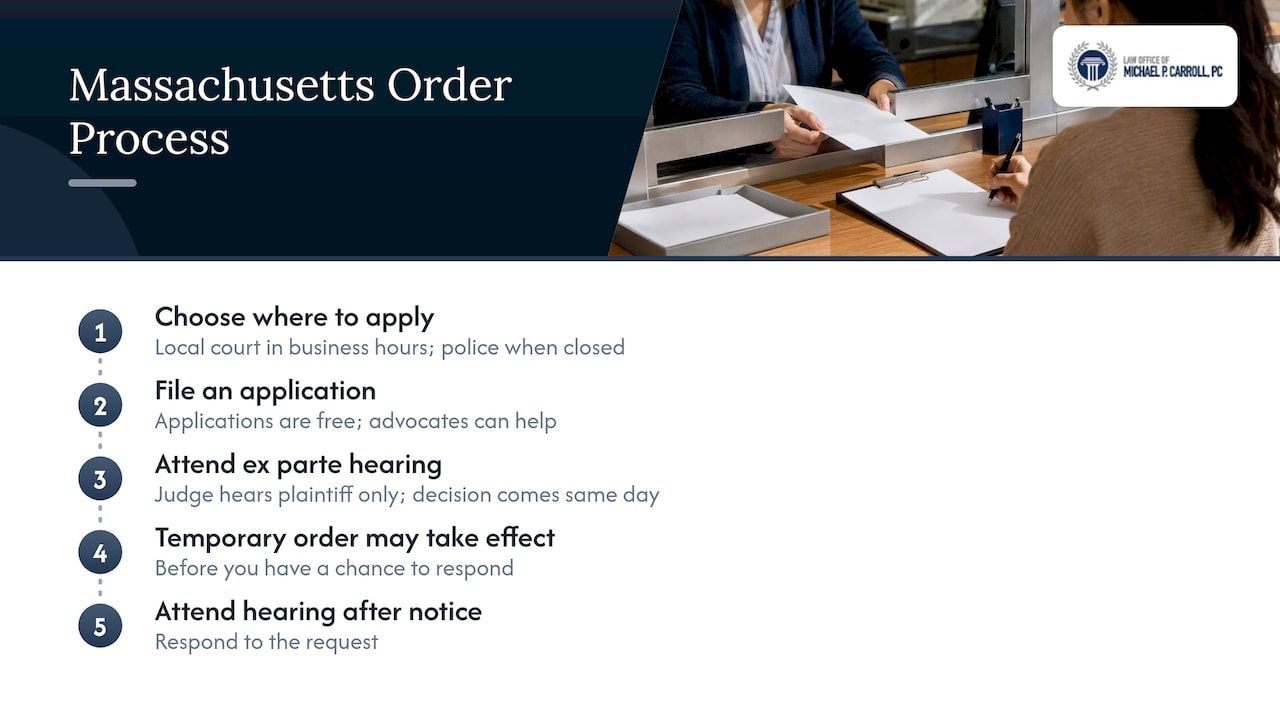
The steps are similar. The Trial Court says either order can be requested at a local court during business hours, usually without an appointment, or through the police when the court is closed. The steps to apply are to fill out an application and have an ex parte hearing before a judge, with a decision the same day. Applications are free, and advocates can help. A plaintiff whose request is denied can come back and ask again.
What "ex parte" means for you: the judge hears only the plaintiff. If the judge grants a temporary order, it can take effect before you have said a word. You then get a hearing after notice, where you can respond.
States handle emergency protection differently, which is why advice from another state can mislead you. Texas, for example, uses magistrate's orders for emergency protection after an arrest. The Massachusetts process above is the one that applies to you.
Why the defendant's stakes are high
A protection order is not just paper. According to the state's protection order process page, police can arrest a defendant who violates a 209A or 258E order, and criminal charges can follow. That includes orders to stay away, to have no contact and to stay out of the plaintiff's home or workplace. It can also include surrendering firearms.
The order also reaches indirect contact. A message through a friend, a relative or a neighbor, or a post that targets the plaintiff, can be treated as a violation. Our guide to restraining order violations in Massachusetts walks through what prosecutors look for.
The money provision in 258E
Under Chapter 258E, Section 3, a harassment prevention order can require the defendant to pay the plaintiff for direct losses. These include lost earnings, property damage, replacement locks, medical expenses and reasonable attorney's fees. Defendants often arrive at the hearing ready to argue about contact and never prepare for a claim for money. If a plaintiff brings receipts, you need a response to them.
What if it could be either one?
Some situations fit both statutes. Two people who dated, or an ex-partner who keeps showing up at work, may qualify under 209A or 258E. The Trial Court's domestic violence law page explains how the two laws differ and how to request an order under each. The plaintiff chooses.
For you, the label matters less than three questions:
- What exactly does the order say you must do or not do?
- When is the hearing after notice?
- Is a criminal case pending alongside it?
If the relationship qualifies for 209A and the plaintiff filed a 258E complaint, or the reverse, that can be worth raising. We look at that early.
If you were served: the first steps
Read the order the way a prosecutor would read it. Then:
- Follow every term, starting now. Don't contact the plaintiff, directly or through someone else, even if they reach out. Don't go to listed places, even by accident.
- Note the hearing date. Missing it can leave the order in place without your side being heard.
- Check how you were served. According to the state's guideline on service, the order after notice should be handed to the defendant in person by court personnel at the hearing. Alternative service, such as email or leaving papers at a workplace, takes a judge's explicit authorization after officers fail to serve in hand. Improper service is an issue to raise, not a reason to ignore the order.
- Gather evidence. Save texts, emails, call logs, photos, receipts and witness names. A harassment complaint depends on specific acts, so a timeline can show that the conduct was not willful and malicious, or that there were fewer than three incidents.
- Arrange firearms. If the order requires surrender, ask a lawyer before you act.
- Talk to a defense lawyer before the hearing. What you say can be used in a criminal case.
We cover the 209A version of these steps in what to do after you are given a 209A restraining order, and our no contact order checklist covers the days before a hearing.
What the hearing looks like
The hearing after notice is usually short. The Trial Court's guidelines for judicial practice say judges are expected to keep these proceedings flexible, because many people appear without lawyers. They apply evidence rules with the emotional nature of these cases in mind while staying fair to both sides.
Flexible does not mean casual. A judge hears testimony from both sides, looks at exhibits and decides whether to extend, modify or end the order. Having prepared, organized evidence, a clear account and a lawyer who knows the local judges changes how that hearing goes.
If an order is already in place and circumstances have changed, you may be able to ask for a change. See our guide to modifying a restraining order.
Our perspective
Most people who call us about one of these orders are not what the plaintiff's paperwork makes them sound like. They are a spouse in the middle of a bad separation, a neighbor in a long dispute, or a young adult who sent too many messages after a breakup. They are also frightened, because a single page from a court can affect their job, their housing, their firearms license and their record.
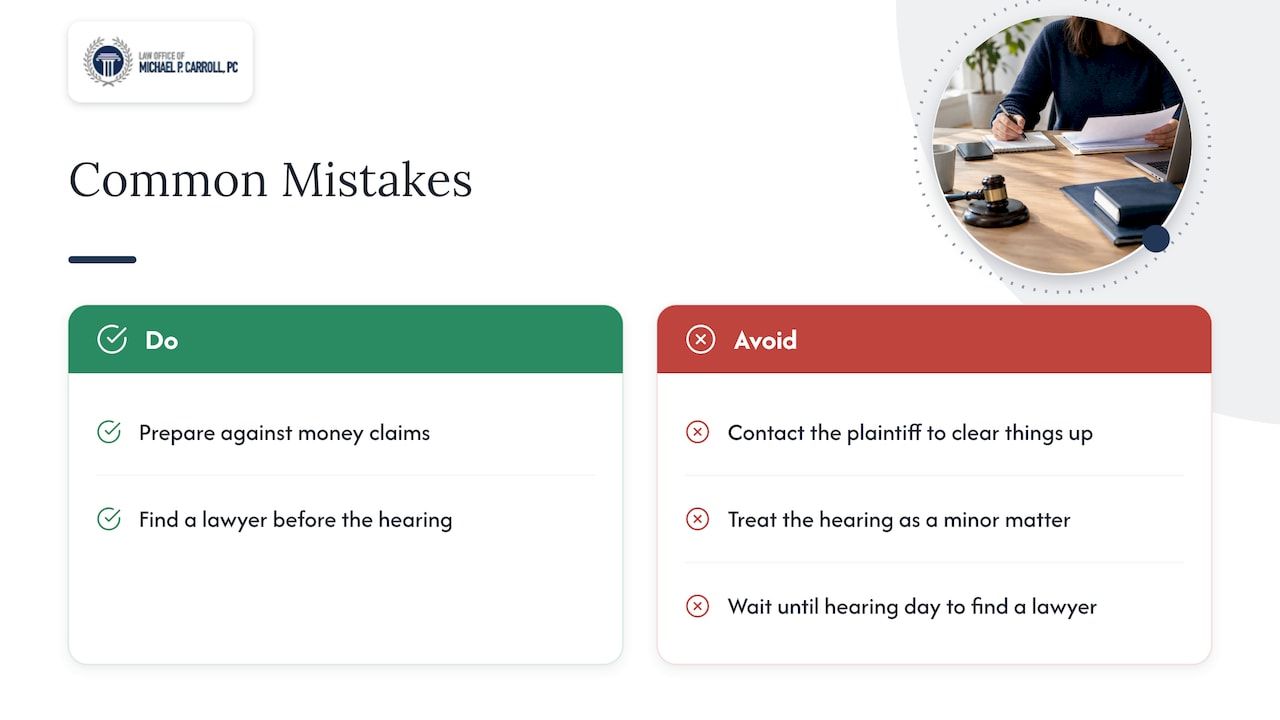
We see three mistakes again and again. First, people contact the plaintiff "just to clear things up," and that contact becomes the criminal charge. Second, they treat a 258E hearing as a minor matter and don't prepare against the money claims. Third, they wait until the day of the hearing to find a lawyer.
At this firm you work directly with Michael Carroll, not a rotating team. He reads the complaint and the affidavit, tests whether the facts fit the statute that was actually invoked, and builds the response around your situation. We don't promise an outcome in any case. We do promise that you will understand where you stand and what comes next.
— Michael Carroll
Get help with a restraining or harassment order
If you were served with a 209A or 258E order, or you've been told a hearing is coming, we can help. Our restraining orders page covers abuse prevention orders. Our harassment prevention page covers 258E cases. You can also read how same-day harassment order defense works. We represent clients in Attleboro and across Bristol, Plymouth and Norfolk counties. Contact us through our website as soon as you can, because the hearing date comes quickly.
Frequently asked questions
Is a harassment order the same as a restraining order?
Not legally. "Restraining order" usually means a 209A abuse prevention order, which needs a qualifying family, household or intimate relationship. A harassment prevention order under 258E needs no relationship. Both are enforceable by police.
What qualifies as harassment under a 258E order?
The plaintiff generally has to show three or more willful and malicious acts aimed at them that were meant to cause, and did cause, fear, intimidation, abuse or property damage. A single qualifying crime, such as stalking or sexual assault, can be enough. Whether the conduct meets that definition is often the central question at the hearing.
Can the Probate and Family Court issue a harassment prevention order?
No. The Trial Court says that court cannot issue 258E orders, though it handles 209A orders. A harassment complaint belongs in the District Court, Boston Municipal Court or Superior Court.
Does violating either order lead to criminal charges?
Yes. The state says police can arrest someone who violates a 209A or 258E order, and criminal charges can follow. Don't contact the plaintiff even if they contact you, and talk to a defense lawyer before you say anything about the allegations.
Sources
- Protection order process, Mass.gov
- Find out if you're eligible to request an abuse prevention order, Mass.gov
- Find out if you're eligible to request a harassment prevention order, Mass.gov
- Harassment Prevention (258E) Orders, Mass Legal Help
- Steps to apply for a protection order in court, Mass.gov
- M.G.L. c. 258E, Section 3
- Massachusetts law about domestic violence (209A), Mass.gov
- 209A Guideline 6:03: Service of initial orders after notice on the defendant, Mass.gov
- Texas magistrate's orders for emergency protection (CCP 17.292)
Recommended
This article is general information about Massachusetts law, not legal advice, and reading it does not make you a client of the Law Office of Michael P. Carroll, PC. Every case is different. If you are facing charges in Bristol, Norfolk or Plymouth County, call Mike to discuss your situation.