
What to Do After You Are Given a 209A Restraining Order
What to Do After You Are Given a 209A Restraining Order

TL;DR:
- Obey every term of a Massachusetts 209A restraining order and attend the scheduled hearing to protect your rights.
- The court allows a short window for contesting the order, making prompt legal action essential.
If you were just served with a 209A restraining order in Massachusetts, do two things right now: obey every term of the order, and show up to the 10-day hearing printed on your paperwork. Those two actions keep you out of criminal jeopardy and give you the first real opportunity to contest the order before a judge.
Under Mass. Gen. Laws Chapter 209A, a court can issue an ex parte order without you present. That temporary order lists a hearing date, usually within ten court business days, when both sides appear. That hearing is your window. Miss it, and the order almost certainly extends. Attend it prepared, and you have a genuine shot at dismissal or modification.
Urgent actions to take immediately:
- Read the order in full. Note every restriction: no contact, vacate premises, firearms surrender, temporary support, or custody terms.
- Write down the hearing date, time, and courtroom location printed on the order.
- Do not contact the protected person by any means, including through third parties or social media.
- Preserve all evidence: text messages, emails, call logs, photos, and witness contact information.
- Document when and how you were served (date, time, who served you).
- Contact a restraining order attorney or legal aid organization within 24 hours.
Pro Tip: If law enforcement or the plaintiff contacts you, say nothing beyond identifying yourself. You have Fifth Amendment rights in any proceeding where your testimony could be used against you, and anything you say before speaking with counsel can surface at the hearing.
Table of Contents
- What to do in the first 24–72 hours after service
- The 10-day hearing: what it is and what you can expect
- Your legal rights and common defenses at a 209A proceeding
- Consequences for violating a 209A order
- How to change, modify, or end a 209A order in Massachusetts
- What to bring to court: documents, evidence, and witnesses
- When to hire an attorney and how local counsel can help
- Key Takeaways
- What I tell clients who are served with a 209A
- How the Law Office of Michael P Carroll can help you
- Official Massachusetts resources and where to get forms or free legal help
- FAQ
What to do in the first 24–72 hours after service
The order is enforceable the moment you receive it. There is no grace period.
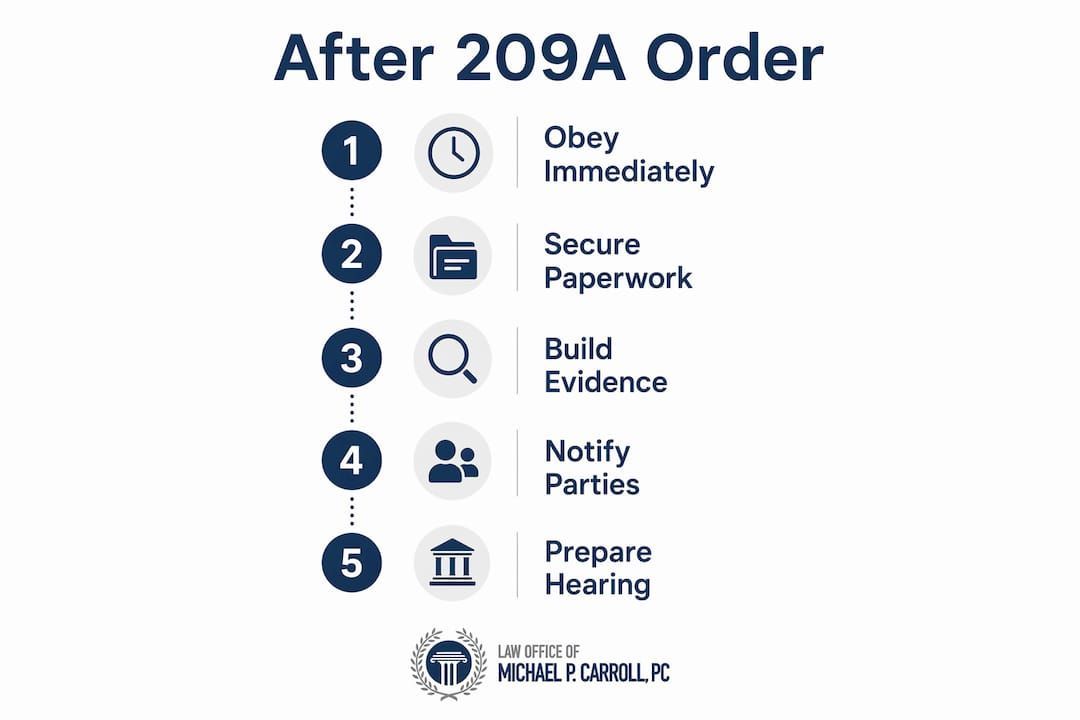
Obey every term immediately. If the order requires you to vacate a shared residence, leave. If it prohibits firearm possession, surrender them to police or a licensed dealer as directed. If it includes temporary child support or custody terms, follow those too. Violations trigger mandatory arrest under Massachusetts law, regardless of whether the protected person invited contact.
Secure and copy the paperwork. Take photos of every page of the order. Note the hearing date and location printed on the document. Store copies in at least two places.

Build your evidence file now, not later. Memory fades and metadata timestamps are time-sensitive. Screenshot text threads, save voicemails, export call logs, and write a contemporaneous account of events leading up to the order. Date and time every entry. Do not delete anything, even messages that seem unflattering.
Notify relevant third parties carefully. If the order affects your housing or employment, a brief written notice to your landlord or HR department may be appropriate. Keep copies of those communications.
Consult an attorney within 24 hours. The 10-day hearing timeline is short. Counsel needs time to review the order, assess your defenses, and prepare a strategy.
| Timeline | Action |
|---|---|
| Immediately | Obey all order terms; do not contact protected person |
| Within hours | Preserve and copy paperwork; document service details |
| Within 24 hours | Consult an attorney or contact legal aid |
| Days 2–3 | Gather evidence, identify witnesses, organize documents |
| Before hearing | Finalize hearing strategy with counsel; prepare exhibits |
Statistic: Violating a 209A order is a criminal offense in Massachusetts punishable by up to 2.5 years in a house of correction, and police are required by law to arrest when they determine a violation occurred.
The 10-day hearing: what it is and what you can expect
The ex parte order you received was issued without your input. The 10-day (two-party) hearing is the first time you get to speak. Under 209A Guideline 5:01, the proceeding is adversarial: the plaintiff bears the burden of proving abuse by a preponderance of the evidence, and you have the right to be heard, present evidence, and cross-examine.
Before the hearing begins, the clerk's office will check for outstanding warrants and pull Criminal Activity Record Information (CARI) for both parties. The judge will have that information before anyone speaks.
Typical hearing sequence:
- Preliminary matters: jurisdiction confirmed, safety arrangements noted, CARI reviewed.
- Plaintiff presents testimony and submits evidence.
- Defendant responds, presents evidence, and may cross-examine the plaintiff.
- Judge asks clarifying questions and makes findings.
- Judge issues an order: the ex parte order expires, the order is terminated, or the order is extended (often up to one year) with specific terms.
Possible outcomes:
- Ex parte order expires with no further action.
- Order terminated after hearing.
- Order continued for up to one year, with or without modifications.
- Order modified to include or remove custody, support, firearm prohibitions, or vacate terms.
The Massachusetts judicial practice guidelines note that judges have discretion to schedule the two-party hearing sooner than ten days when service is confirmed. Defendants who appear promptly and prepared have the strongest position to avoid an automatic extension.
Pro Tip: You may request a continuance if you need more time to prepare, but do so through counsel or in writing before the hearing date. Showing up and asking for a continuance cold is less persuasive than a timely written request with a stated reason.
Your legal rights and common defenses at a 209A proceeding
You have more procedural protection than most defendants realize going in.
Core rights at the hearing:
- Right to retain and be represented by counsel.
- Right to present evidence, call witnesses, and cross-examine the plaintiff.
- Fifth Amendment protection: you cannot be compelled to testify in ways that incriminate you in a related criminal matter.
- Right to request an interpreter or reasonable accommodations.
- Right to raise concerns about bias or safety to the judge.
Under Mass. Gen. Laws c. 209A § 1, the plaintiff must prove "abuse" between qualifying family or household members. That definition includes coercive control, a pattern of behavior intended to threaten, intimidate, harass, isolate, or control. Understanding exactly what the plaintiff must prove shapes your defense.
Common factual defenses include:
- Lack of a qualifying relationship (the parties do not meet the statutory definition of family or household members).
- Disputed account of events, supported by contemporaneous messages, photos, or witness testimony.
- Evidence of false allegations or a motive to fabricate (custody disputes, financial disputes).
- Alibi evidence: phone location data, receipts, or workplace records placing you elsewhere.
- Neutral third-party testimony contradicting the plaintiff's account.
For a deeper look at how domestic assault defense strategy applies to contested 209A proceedings, the firm's blog covers the specific rights defendants hold under Massachusetts law.
Critical point: Only a judge can change or terminate a 209A order. If the protected person tells you the order no longer applies, contacts you first, or says they "won't enforce it," that does not matter legally. You remain bound by the written order until a court modifies it in writing. Acting on a plaintiff's verbal assurance is one of the most common and costly mistakes defendants make.
Consequences for violating a 209A order
The enforcement mechanism for 209A orders is deliberately aggressive. Police are not required to investigate or weigh circumstances: under Massachusetts law, when an officer determines a violation occurred, arrest is mandatory. No warrant needed.
Actions that trigger arrest:
- Any direct contact with the protected person (calls, texts, emails, messages through third parties).
- Returning to a residence you were ordered to vacate.
- Appearing near the protected person's home, workplace, or school if the order prohibits it.
- Possessing a firearm when the order includes a prohibition.
Beyond arrest, a violation opens two separate tracks. Criminally, you face charges under the violation statute, punishable by up to 2.5 years in a house of correction. Civilly, the plaintiff can file a contempt petition, which can result in additional court orders, fines, or incarceration. Prosecutors take these cases seriously, and a violation on your record complicates any future motion to modify or terminate the order.
If you are accused of a violation, do not contact the protected person to "clear things up." Document your whereabouts with receipts, witnesses, or digital records. Get counsel immediately. The steps after an alleged violation are covered in more detail in the firm's overview of domestic charges in Massachusetts.
How to change, modify, or end a 209A order in Massachusetts
An order is not permanent by default, but changing it requires going back to court. You cannot negotiate a modification with the plaintiff directly.
Step-by-step process:
- File a Motion to Modify or Terminate with the same court that issued the order.
- Contact the clerk-magistrate's office at that court for the correct forms and filing procedures. Clerk-magistrate offices are the standard point of contact for these filings.
- Provide written notice to the plaintiff (or their attorney) of the motion and hearing date.
- Attach supporting evidence to the motion: a brief factual summary, proposed order language, and any exhibits.
- Attend the scheduled hearing and present your argument.
Under 209A Guideline 604, judges must make written findings on modification and termination motions. Courts are also alert to defendants who use modification motions as a vehicle for continued contact or harassment, so a motion without a sufficient preliminary showing can be denied on paper without a hearing.
Practical tips:
- Include proposed order language, not just a request to "end" the order. A specific, limited ask is more persuasive than a blanket termination request.
- If full termination is not realistic, consider requesting a modification (removing a vacate term, adjusting contact restrictions) as an intermediate step.
- A plaintiff's silence at a modification hearing should not be interpreted as consent; judges are trained to account for the possibility that silence reflects fear.
For a detailed walkthrough of the filing process, the firm's guide on modification of a restraining order covers the procedural requirements and what courts look for.
What to bring to court: documents, evidence, and witnesses
Walking into the 10-day hearing without organized materials is one of the most avoidable mistakes. Judges move quickly; you need to be ready to hand over exhibits and direct testimony efficiently.
Documentary evidence checklist:
- Copies of the 209A order and all service paperwork.
- Printed screenshots of text messages and social media exchanges (with timestamps visible).
- Email printouts with full headers.
- Phone records or call logs.
- Photos relevant to disputed events.
- Any prior police reports, medical records, or repair bills that contradict the plaintiff's account.
- Witness names, contact information, and brief written statements.
Witness strategy. Neutral third parties carry more weight than family members. A neighbor, coworker, or mutual acquaintance who can speak to specific events or the general nature of the relationship is more persuasive than a sibling who was not present. Prepare each witness with a clear, focused account of what they personally observed.
| Exhibit type | Preparation tip |
|---|---|
| Text/social media screenshots | Print with timestamps; highlight relevant messages |
| Phone records | Circle specific dates and times at issue |
| Witness statements | One page per witness; date, sign, and include contact info |
| Photos | Label each exhibit (Exhibit A, B, etc.); bring originals |
| Prior police reports | Obtain certified copies from the issuing department |

Prepare two to three copies of every exhibit: one for the judge, one for the plaintiff's side, and one for your file. Bring originals only when needed for authentication. Arrive at least 30 minutes early, bring a photo ID, and dress conservatively. If you are appearing without an attorney, bring a written list of the points you need to make so nerves do not cause you to skip something important.
When to hire an attorney and how local counsel can help
Hire counsel before the 10-day hearing, not after. The timeline is short, and the procedural decisions made in the first 48 hours shape everything that follows.
Situations where representation is strongly recommended:
- The order includes firearm restrictions (which can affect employment and licensing).
- Custody or child support terms are part of the order.
- You face related criminal charges or a pending arraignment.
- The factual dispute is complex or involves conflicting witness accounts.
- You have a prior record that could influence the judge's assessment.
What an attorney does before and at the hearing:
- Reviews the order and identifies procedural defects or overreach.
- Advises on Fifth Amendment exposure and what you can safely say.
- Collects and organizes admissible evidence.
- Prepares and files motions (continuance, dismissal, or modification).
- Cross-examines the plaintiff and challenges the burden of proof.
- Negotiates with prosecutors if criminal exposure exists alongside the civil order.
Questions to ask at your first consultation:
- How many 209A hearings have you handled in this court?
- What is the realistic range of outcomes given my specific facts?
- What is your fee structure and what does it cover?
- How will you communicate with me before the hearing?
On hiring counsel early: Retaining an attorney before the 10-day hearing gives counsel time to triage evidence, frame admissible defenses, and reduce the risk of procedural missteps that lead to automatic extensions. Showing up unrepresented and unprepared is the single most reliable path to a one-year order.
The Law Office of Michael P Carroll is an owner-operated firm serving clients in Attleboro and surrounding Massachusetts communities, including Bristol, Norfolk, and Plymouth Counties. Clients work directly with Michael Carroll, not a rotating associate, which means consistent communication and focused preparation for every court appearance. The firm handles restraining orders in Quincy, MA and nearby jurisdictions, and is experienced in the intersection of 209A proceedings and related criminal exposure.
Key Takeaways
Obeying the 209A order and attending the 10-day hearing are the two actions that protect you from criminal liability and preserve your right to contest the order.
| Point | Details |
|---|---|
| Obey immediately | Every term of the order is enforceable on receipt; violations trigger mandatory arrest. |
| Attend the 10-day hearing | Missing the hearing almost always results in the order being extended for up to one year. |
| Preserve evidence now | Timestamps and metadata are time-sensitive; screenshot and document everything before the hearing. |
| Get counsel early | An attorney hired before the hearing can shape evidence strategy and reduce procedural errors. |
| Law Office of Michael P Carroll | Provides owner-operated 209A defense in Attleboro and surrounding Massachusetts counties. |
What I tell clients who are served with a 209A
Most people who come to me after being served are focused on the injustice of the order. That reaction is understandable, but it is the wrong priority for the first 72 hours. The order exists. It is enforceable right now. The question is not whether it was fair; the question is what you do next.
The clients who fare best are the ones who treat the 10-day hearing like a real trial, not a formality. They bring organized evidence. They have thought through what the plaintiff is likely to say and prepared a coherent response. They understand that the judge has seen hundreds of these cases and is watching how both parties conduct themselves, not just what they say.
The most common mistake I see is defendants who contact the protected person before the hearing, either to apologize, to negotiate, or because the plaintiff reached out first. That contact is a violation regardless of who initiated it, and it hands the plaintiff's attorney a gift. The second most common mistake is arriving at the hearing with no evidence and no preparation, expecting the judge to see through the allegations on instinct alone. Judges cannot do that. They decide based on what is in front of them.
Get counsel early. Preserve your evidence. Say nothing to law enforcement or the plaintiff without an attorney present. Those three steps do more to protect your position than anything else you can do in the days after service.
How the Law Office of Michael P Carroll can help you
Facing a 209A hearing without representation puts you at a real disadvantage. The Law Office of Michael P Carroll provides direct, owner-operated criminal defense for clients across Bristol, Norfolk, and Plymouth Counties, with a specific focus on restraining orders, domestic matters, and related criminal exposure.

Michael Carroll handles 209A defense personally, from the initial case review through the 10-day hearing and any subsequent modification proceedings. The firm's approach is straightforward: review the order, assess the facts, identify the strongest defense, and prepare you for what the judge will ask. Clients in Attleboro, New Bedford, Quincy, and surrounding communities can reach the office directly to schedule a consultation.
Bring your restraining order paperwork, any evidence you have gathered, and a written account of the events leading up to the order. The first conversation focuses on your specific facts, not generic advice. For defendants facing potential criminal exposure alongside a civil 209A, the firm's criminal defense services cover the full range of related charges. Contact the Law Office of Michael P Carroll to schedule your consultation and get a clear picture of your options before the hearing.
Official Massachusetts resources and where to get forms or free legal help
- Abuse Prevention Orders for Defendants | Mass.gov: The Trial Court's official defendant-facing page. Explains what the order does, what happens if you violate it, and how to change or end it.
- Massachusetts law about defending against a c. 209A Order | Mass.gov: Compiles statutes, court cases, and Trial Court forms relevant to defendants. Links directly to the defendant notice form and MCLE practice guides.
- MassLegalHelp: Free plain-language guides on restraining orders, court procedures, and legal aid referrals for low-income residents.
- WomensLaw.org: Covers Massachusetts 209A procedures in accessible language; useful for understanding the plaintiff's perspective and what the court will be evaluating.
- Guidelines for Judicial Practice: Abuse Prevention Proceedings (c. 209A): The October 2025 edition of the official judicial practice guidelines. Authoritative on hearing procedures, judicial discretion, and modification standards.
- Clerk-magistrate's office at the issuing court: Your first stop for filing forms, hearing schedules, interpreter requests, and procedural questions. Hours vary by courthouse; call ahead.
This article provides general legal information about Massachusetts 209A proceedings. It is not legal advice for your specific situation. Confirm current procedures and your rights with the Massachusetts Trial Court or a qualified Massachusetts attorney.
FAQ
What happens if I miss the 10-day hearing?
If you were properly served and do not appear, the judge can extend the order, typically for up to one year, without hearing your side. Appearing is the only way to contest the order at that stage.
Can a restraining order backfire on the person who filed it?
It can, in limited circumstances. If the defendant presents credible evidence of false allegations or a fabricated account, the judge may deny the extension and the plaintiff's credibility is damaged in any related proceedings. Courts also take note when plaintiffs violate their own orders by initiating contact.
What do I say to get a 209A order dropped?
You do not simply ask; you present evidence. At the 10-day hearing, you or your attorney can challenge the plaintiff's account, introduce contradicting evidence, and argue that the legal standard for abuse under Chapter 209A has not been met. Preparation and evidence matter far more than what you say in the moment.
How long can a 209A order last?
An ex parte order lasts until the two-party hearing, generally up to ten court business days. After the hearing, an extended order typically runs up to one year and can be renewed. There is no statutory cap on renewals, so an order can remain in place for years if the plaintiff continues to seek extensions.
Can the protected person drop the restraining order?
Only a judge can terminate a 209A order. The plaintiff can file a motion to terminate, but the judge is not required to grant it and must make written findings. A plaintiff's request to drop the order does not release the defendant from its terms until the court issues a written modification or termination.