
Firearm Laws to Know in MA: What Residents Must Follow
Firearm Laws to Know in MA: What Residents Must Follow

TL;DR:
- Massachusetts residents must obtain the correct firearm license, register all firearms by October 28, 2026, and avoid possessing prohibited items. They must also follow strict storage, transport, and legal requirements, especially regarding ERPOs and gun restrictions. Failing to comply risks criminal penalties and loss of gun rights.
Every Massachusetts resident who owns or plans to own a firearm must hold the correct license (FID or LTC), register all firearms through the MIRCS portal by the registration deadline in 2026, avoid prohibited firearms and unserialized frames, follow strict storage and transport rules, and understand that an ERPO or domestic violence order can trigger prompt surrender of all firearms.
Here is the short compliance checklist:
- Get the right license. An FID covers long guns; an LTC is required for handguns, semiautomatics, and large-capacity firearms. Massachusetts law requires residents 15 and older to hold the appropriate license to possess, carry, or transport any firearm.
- Register through MIRCS. All firearms, including frames and receivers, must be registered in the MIRCS Unified Gun Portal by October 28, 2026.
- Do not possess prohibited items. Assault-style firearms, unserialized frames, large-capacity feeding devices (with limited exceptions), machine guns, and sawed-off shotguns are banned or tightly restricted.
- Follow transport and storage rules. Firearms not under your direct control must be unloaded and secured in a locked container.
- Know your disqualifiers. Felony convictions, certain misdemeanors, active restraining orders, mental health adjudications, and federal drug-user status (including marijuana) bar possession.
- Comply with ERPOs and DV orders immediately. A red flag or domestic violence order requires prompt surrender of all firearms.
The single most urgent action right now: Confirm your license type covers every firearm you own, and register all firearms in the MIRCS portal before the October 28, 2026 deadline. Failure to meet that deadline creates criminal exposure under Chapter 135, regardless of how the November 2026 ballot referendum resolves.
Verify current requirements at Mass.gov firearms pages and M.G.L. Ch. 140.
Table of Contents
- 1. Who needs an FID vs. an LTC, and how do you apply?
- 2. How do background checks and firearm transfers work in MA?
- 3. Who is barred from possessing firearms under MA and federal law?
- 4. What are the rules for carrying and transporting firearms in MA?
- 5. Are AR-15s and large-capacity magazines legal in MA?
- 6. Ghost guns and serialization: what does MA law require?
- 7. What are Massachusetts safe-storage requirements?
- 8. How do red flag laws and domestic violence orders affect your firearms?
- 9. What are the penalties for violating Massachusetts firearm laws?
- 10. If you are stopped or charged: what to do immediately
- Key Takeaways
- A defense attorney's perspective on MA gun law compliance
- Facing a firearm charge? Here is how the Law Office of Michael P Carroll can help
- Useful sources for staying current on MA firearm law
- FAQ
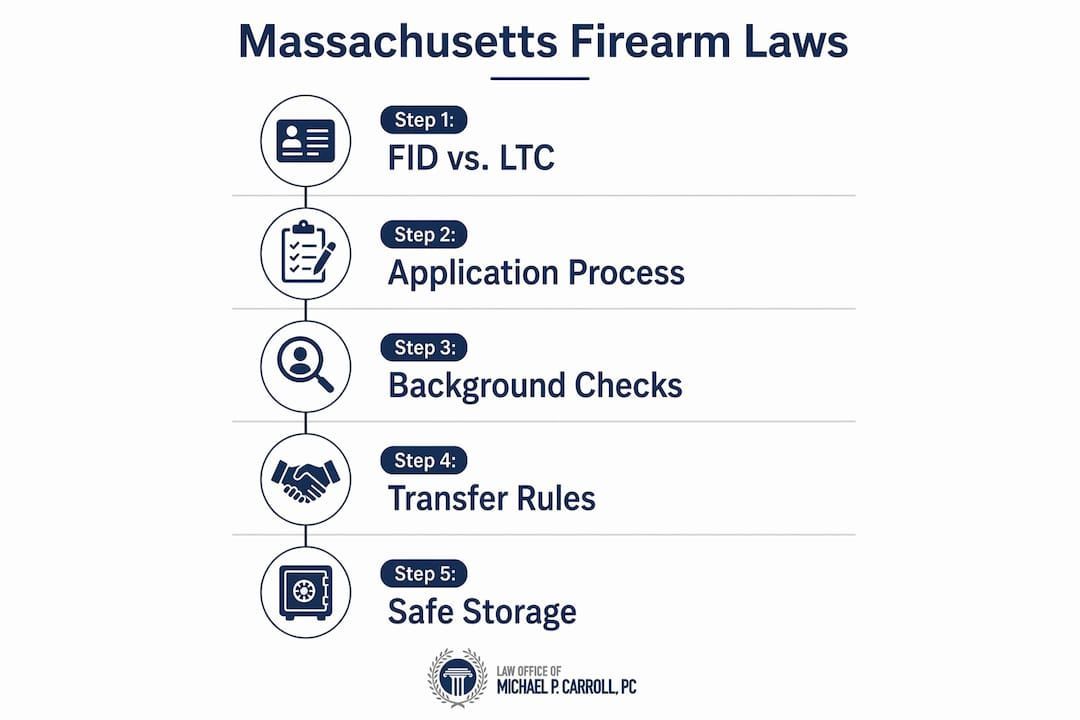
1. Who needs an FID vs. an LTC, and how do you apply?
The direct answer: an FID card covers non-large-capacity rifles and shotguns, plus chemical sprays. An LTC is required for handguns, semiautomatics, and any large-capacity firearm or feeding device. Under Chapter 135, the LTC is now a single consolidated class, eliminating the old Class A/B distinction.
Step-by-step application process
- Confirm residency and age. Residents must be at least 15 (with parental consent for minors) and apply through the police department in their city or town.
- Complete a Massachusetts Basic Firearms Safety (BFS) course. New applicants must submit a BFS certificate. Renewals do not require a new certificate but must submit a lost/stolen firearms affidavit.
- Submit your application package. Apply online via the MIRCS Unified Gun Portal or deliver it in person to your local licensing authority. Required documents include a completed resident application, the required application fee, your BFS certificate (new applicants), a valid ID, and any additional documentation your local authority requires.
- Fingerprinting and background check. Processing includes a state and federal NICS check, a fingerprint-based background check, and a Department of Mental Health check.
- Await notification. Your local licensing authority contacts you when the license is ready for pickup. Timelines vary by municipality.
- Renewal. Licenses are renewed through the same local authority. Submit the affidavit confirming no lost or stolen firearms since the last issuance.
Non-residents apply through the Firearms Records Bureau, not a local department. Non-resident licenses have a limited term with no grace period.
| Milestone | Date / Deadline |
|---|---|
| Chapter 135 enacted (most provisions effective) | October 2, 2024 |
| Grandfathering cutoff for assault-style firearms is set by statute with a specified date | |
| New BFS curriculum has a statutory effective date set in 2026 | |
| MIRCS registration deadline for all firearms is set in 2026 | |
| Ballot referendum on Chapter 135 repeal is scheduled with a specific date in 2026 |
Pro Tip: The live-fire component of the updated BFS course has a statutory effective date of April 2, 2026, but regulatory rollout has been delayed. If your FID or LTC was issued before the grandfathering cutoff date, you are statutorily exempt from the live-fire requirement — including at renewal. Confirm enforcement status with your local licensing officer before booking any training.
Local licensing authorities retain suitability discretion. Contact your municipal police licensing office early; small local practice differences affect processing timelines and what supporting evidence they expect.

2. How do background checks and firearm transfers work in MA?
Massachusetts requires a background check on every firearm transfer, whether through a dealer or between private parties. There is no private-sale loophole.
Dealer sales:
- The dealer runs a NICS check through the Bureau of Alcohol, Tobacco, Firearms and Explosives (ATF) before completing any transfer as required by law.
- The dealer records the transaction and reports acquisitions within required windows.
- The buyer must present a valid FID or LTC covering the firearm being purchased.
Private sales and transfers:
- Both parties must record the transfer through the MIRCS portal (or the FA-10 form process for transactions predating the portal's full rollout).
- The seller must verify the buyer holds a valid license.
- Transfers of unregistered or unserialized firearms are prohibited.
New residents:
- Anyone moving to Massachusetts with firearms must register those firearms through MIRCS and obtain the appropriate Massachusetts license. Possession without a valid MA license is a criminal offense regardless of what another state issued.
Gunsmiths and dealers have specific reporting windows for acquisitions and dispositions under M.G.L. Ch. 140. Confirm current timelines with Mass.gov firearms guidance or EOPSS Guidance #4, which addresses dealer and transfer recordkeeping under Chapter 135.
3. Who is barred from possessing firearms under MA and federal law?
Massachusetts and federal law both create categories of prohibited persons. If you fall into any of these, possessing a firearm is a crime under state law, federal law, or both.
Common disqualifying factors:
- Felony conviction (state or federal)
- Conviction for certain misdemeanors (including domestic assault and battery)
- Subject to an active restraining order or harassment prevention order
- Adjudicated as a person with a mental illness or committed to a mental health facility
- Unlawful user of a controlled substance under federal law (18 U.S.C. §922(g)(3))
- Dishonorably discharged from the military
- Fugitive from justice
- Renounced U.S. citizenship
The marijuana conflict is a real trap. Massachusetts permits medical and recreational marijuana use under state law. Federal law does not. Under 18 U.S.C. §922(g)(3), anyone who is an "unlawful user" of a controlled substance is prohibited from possessing firearms. Marijuana remains a Schedule I controlled substance under federal law, and Mass.gov explicitly warns that state authorization does not create a federal defense.
Federal law controls firearm possession, not state marijuana policy. A Massachusetts medical marijuana card does not protect you from federal prosecution for firearm possession. The ATF's position is that active marijuana users are prohibited persons, period. If you use marijuana regularly and own firearms, you are carrying federal criminal exposure that state law cannot eliminate.
If you are uncertain whether a prior conviction, order, or health adjudication disqualifies you, consult a criminal defense attorney before purchasing or possessing any firearm. The consequences of getting this wrong are severe.
4. What are the rules for carrying and transporting firearms in MA?
Carrying a firearm in Massachusetts requires the correct license. Open carry and concealed carry are both legally permitted for LTC holders, but the practical reality is that most carry in Massachusetts is concealed, and the LTC is the required credential for any handgun or semiautomatic carry.
Vehicle transport rules:
- An LTC holder may have a loaded handgun under direct personal control in a vehicle (e.g., on their person or within immediate reach).
- Anyone else, including FID holders transporting long guns, must keep firearms unloaded and secured in a locked container.
- Ammunition stored separately from the firearm is the safest practice.
Prohibited locations under Chapter 135 and existing statutes:
- Schools and school grounds (M.G.L. ch. 269 §10)
- Courthouses and judicial buildings
- Government administrative buildings
- Correctional facilities
- Ballot storage locations and polling places
- Any location where the property owner has posted a lawful prohibition
Chapter 135 added new prohibited-area categories through Section 10(k) and related provisions, with criminal penalties for carrying in those locations regardless of license status.
Practical scenarios:
Traveling through Massachusetts with a firearm secured in a locked container in your trunk, unloaded, with ammunition stored separately — that is compliant for most situations. Stopping for gas or food does not change the analysis as long as the firearm stays secured. Carrying a loaded handgun in your glove compartment without an LTC is a felony.
Shooting on private property is generally permitted if you have the landowner's permission and comply with local ordinances, but check your municipality's rules. There is no statewide blanket prohibition on discharging firearms on private land, though many towns have local bylaws that restrict it.
5. Are AR-15s and large-capacity magazines legal in MA?
Massachusetts prohibits assault-style firearms, untraceable firearms, and covert firearms under Chapter 135. The short answer on AR-15s: models manufactured after the August 1, 2024 grandfathering cutoff that meet the statutory definition of an assault-style firearm are prohibited. Models lawfully possessed before that date may be retained by the original owner under grandfathering provisions, but must be registered.
How the statute defines "assault-style":
Chapter 135 uses a functional-plus-list approach. A firearm qualifies as assault-style if it meets certain feature combinations (pistol grip, folding stock, flash suppressor, etc.) alongside a semiautomatic action, or if it appears on a named list of prohibited models. The specific statutory language in M.G.L. Ch. 140 §121 and related sections controls; the definition is more expansive than the pre-2024 version.
If you own a grandfathered model:
- Register it in the MIRCS portal by October 28, 2026.
- Do not transfer it to another private party in Massachusetts without complying with transfer rules.
- If the model requires serialization (e.g., it was home-built), pursue serialization through DCJIS before the deadline.
- If you are unsure whether your specific model qualifies as grandfathered, consult an attorney before the deadline.
Large-capacity feeding devices (magazines holding more than 10 rounds) are restricted. Devices manufactured before September 13, 1994 may be possessed by licensed owners under a grandfathering exception. Post-1994 large-capacity devices are generally prohibited for civilian possession.
6. Ghost guns and serialization: what does MA law require?
Under Chapter 135, frames and receivers without valid serial numbers are regulated as firearms. That covers 80% receivers, 3D-printed frames, and any privately made firearm (PMF) that lacks a manufacturer-assigned serial number.
Statutory definitions to know:
An "untraceable firearm" under Massachusetts law is any firearm that cannot be traced by law enforcement due to the absence of a serial number or because it was made from materials that defeat standard detection methods. An "unfinished frame or receiver" is any component that, with minimal additional work, can function as the frame or receiver of a firearm. Both categories are regulated under Chapter 135.
What you must and must not do:
- Do register any unserialized firearm you currently possess through the MIRCS portal and pursue serialization through DCJIS where required.
- Do contact DCJIS for guidance on the serialization process if you have a home-built firearm.
- Do not assemble, sell, or transfer an unserialized frame or receiver.
- Do not purchase an 80% receiver with the intent to complete it into a functional firearm without complying with serialization requirements.
Possession of an untraceable firearm carries mandatory minimum penalties under Chapter 135. The law treats unserialized firearms as a serious enforcement priority, and local police and state agencies are actively enforcing these provisions.
Pro Tip: If you inherited a firearm with no serial number or purchased one before serialization requirements took effect, do not assume you are grandfathered. Contact DCJIS or a firearms attorney before the October 28, 2026 deadline to confirm your compliance path.
7. What are Massachusetts safe-storage requirements?
State law requires that any firearm not under your direct personal control be stored in a locked container or secured with a tamper-resistant mechanical lock. That rule applies at home, in a vehicle, and anywhere else the firearm is not actively on your person or within your immediate control.
Storage rules in detail:
- Firearms must be stored in a locked container (gun safe, lockbox, or similar) or secured with a trigger lock or cable lock when not in use.
- When a minor or prohibited person lives in or regularly accesses the household, the storage obligation is heightened. Leaving a firearm accessible to a child or prohibited person is a criminal offense under M.G.L. Ch. 140 §131L.
- Ammunition stored separately from the firearm reduces both legal risk and accident risk.
- Muzzleloaders are an exception to certain storage requirements under state law, though safe handling practices still apply.
- Chapter 135 introduced tiered penalties for storage violations, with enhanced consequences when a minor gains access and uses the firearm to cause harm.
Recommended storage options: A UL-listed gun safe, a biometric lockbox for bedside access, or a cable lock through the action for long guns stored in a closet. The key is that the firearm cannot be accessed by an unauthorized person without defeating the locking mechanism.
Pro Tip: Document your storage setup. Photograph your safe or lockbox with a timestamp, keep the receipt for your storage device, and note the date you installed it. If a storage violation is ever alleged, contemporaneous evidence of compliant storage is your strongest defense.
8. How do red flag laws and domestic violence orders affect your firearms?
An Extreme Risk Protection Order (ERPO) or a domestic violence-related restraining order can require you to surrender all firearms immediately and bars possession while the order is in effect. Chapter 135 expanded ERPO eligibility significantly.
How the ERPO process works
- Petition filed. A family member, household member, law enforcement officer, or (under Chapter 135's expansion) a broader set of petitioners files a petition in District or Superior Court.
- Emergency order. A judge may issue an emergency ERPO ex parte (without you present) if there is probable cause to believe you pose a significant danger. This order takes effect immediately.
- Surrender. Upon service of the order, you must surrender all firearms, LTC/FID cards, and ammunition to local police or a licensed dealer within the timeframe specified in the order.
- Evidentiary hearing. A full hearing is scheduled, typically within 10 days, where you have the right to appear and contest the order.
- Final order. If the court finds clear and convincing evidence of significant danger, a final ERPO may be issued for up to one year, renewable.
- Return of firearms. When the order expires or is vacated, you may petition for return of surrendered firearms, subject to a background check confirming you are not otherwise prohibited.
Chapter 135 removed the requirement that the respondent hold an active firearms license before an ERPO can be issued, expanding the law's reach. Domestic violence restraining orders and harassment prevention orders under M.G.L. Ch. 209A and Ch. 258E also trigger firearm prohibitions and surrender requirements.
If you are subject to a domestic assault charge or a restraining order with firearm implications, consult a criminal defense attorney immediately. The window for contesting an emergency order is short, and missing the hearing date can result in a long-term order by default.
9. What are the penalties for violating Massachusetts firearm laws?
Violations range from misdemeanors to felonies with mandatory minimum sentences. Massachusetts courts cannot suspend, continue without a finding, or place on file many firearm offenses once a conviction occurs.
Common offenses and penalty ranges:
- Carrying without a license (first offense), M.G.L. ch. 269 §10(a): Felony; mandatory minimum 18 months, maximum 5 years in state prison.
- Possessing a large-capacity firearm without an LTC, M.G.L. ch. 269 §10(m): Felony; mandatory minimum 1 year (for LTC holders with FID only), minimum 2.5 years for others, maximum 10 years.
- Possessing a machine gun or sawed-off shotgun, M.G.L. ch. 269 §10©: Felony; mandatory minimum 18 months, maximum life in state prison.
- Carrying without a license, second offense: Mandatory minimum 5 years, maximum 7 years.
- Carrying without a license, third offense: Mandatory minimum 7 years, maximum 10 years.
- Firearms trafficking (10 or more firearms), M.G.L. ch. 269 §10E(3): Mandatory minimum 10 years, maximum life.
- Unlawful possession/transfer without complying with registration, M.G.L. ch. 269 §10(h)(1): Up to 2 years in a house of correction or a fine up to $500 for a first offense.
| Offense | Statute | Mandatory Minimum | Maximum |
|---|---|---|---|
| Carry without license (1st) | M.G.L. ch. 269 §10(a) | 18 months | 5 years (state prison) |
| Large-capacity firearm, no LTC | M.G.L. ch. 269 §10(m) | 1 year (FID holder); 2.5 years (others) | 10 years |
| Machine gun / sawed-off shotgun | M.G.L. ch. 269 §10© | 18 months | Life |
| Carry without license (3rd) | M.G.L. ch. 269 §10(d) | 7 years | 10 years |
Enforcement actors: Local police licensing authorities handle license issuance, revocation, and suitability reviews according to statute. The Department of Criminal Justice Information Services (DCJIS) administers MIRCS and the Firearms Records Bureau. State Police and local departments handle criminal enforcement. District Attorneys prosecute firearm offenses. License revocations can be appealed through the district court in your jurisdiction.
Understanding the difference between a felony and a misdemeanor matters here: many firearm offenses in Massachusetts are felonies with mandatory minimums that strip the court of discretion to impose a lighter sentence.
10. If you are stopped or charged: what to do immediately
If you are stopped, detained, or arrested in connection with a firearm, your actions in the first few minutes matter as much as anything that happens later.
- Stay calm and keep your hands visible. Do not reach for the firearm or any documentation without telling the officer what you are doing and waiting for permission.
- Invoke your right to remain silent. Politely state: "I am invoking my right to remain silent and would like to speak with an attorney before answering any questions." Say nothing further about the firearm, your license, or where you were going.
- Do not consent to a search. You may say: "I do not consent to a search." This does not prevent a lawful search, but it preserves your legal options. Never physically resist.
- Present your license if asked. You are required to present your FID or LTC upon lawful demand. Have it accessible. Do not volunteer additional information beyond what is legally required.
- Document everything as soon as possible. After the encounter, write down the officer's name and badge number, the time and location, and exactly what was said. Photograph any relevant scene details if safe to do so.
- Contact a criminal defense attorney immediately. Do not wait to see if charges are filed. Early legal intervention can affect whether charges are brought at all, what evidence is preserved, and how the case is framed from the start.
Pro Tip: Keep a copy of your firearms license and any registration documentation in a secure but accessible location. If you transport firearms regularly, a printed copy of the relevant MIRCS registration confirmation in your vehicle can resolve a routine stop quickly and professionally.
If you are facing a firearm-related criminal charge in Massachusetts, the mandatory minimums mean there is no room for a "wait and see" approach. Get counsel before your first court date.
Key Takeaways
Massachusetts firearm compliance requires the correct license, timely MIRCS registration by October 28, 2026, strict avoidance of prohibited firearms and unserialized frames, and immediate legal counsel if stopped or charged.
| Point | Details |
|---|---|
| License type determines what you can own | An LTC covers handguns and semiautomatics; an FID covers non-large-capacity long guns only. |
| MIRCS registration deadline is October 28, 2026 | All firearms, frames, and receivers must be registered in the portal or you face criminal exposure. |
| Federal marijuana law overrides state authorization | Active marijuana users are federally prohibited from possessing firearms regardless of a Massachusetts medical card. |
| Mandatory minimums leave no room for error | Carrying without a license carries a mandatory minimum sentence on a first offense; courts cannot suspend it. |
| Law Office of Michael P Carroll | Provides criminal defense for firearm charges, license appeals, and ERPO matters in Bristol, Norfolk, and Plymouth counties. |
A defense attorney's perspective on MA gun law compliance
Most people who end up charged with a firearm offense in Massachusetts did not set out to break the law. They owned a gun legally in another state, moved here, and did not realize Massachusetts requires its own license. Or they inherited a firearm and assumed the estate transfer was sufficient. Or they used marijuana legally under state law and had no idea federal law still classified them as a prohibited person.
The gap between what people assume and what the law actually requires is where most of these cases originate. Chapter 135 made that gap wider by adding registration deadlines, serialization requirements, new prohibited-area categories, and an expanded ERPO framework. The October 28, 2026 registration deadline is not a soft administrative target. It is a compliance date backed by criminal penalties, and the fact that a ballot referendum might repeal Chapter 135 in November does not reduce your exposure between now and then.
The practical priority for any Massachusetts gun owner right now is straightforward: confirm your license covers every firearm you own, register everything in MIRCS before the deadline, and store firearms in a locked container when they are not on your person. If you have any question about a specific firearm's status, a prior conviction's effect on your eligibility, or what a restraining order means for your license, get a legal opinion before you act. The mandatory minimums in this state are real, and they apply regardless of intent.
Facing a firearm charge? Here is how the Law Office of Michael P Carroll can help
When a firearm charge or license issue puts your freedom at risk, you need a defense attorney who knows Massachusetts criminal law and handles these cases personally, not a large firm where you become a file number.
The Law Office of Michael P Carroll represents clients in Bristol, Norfolk, and Plymouth counties on criminal defense matters including unlawful firearm possession, carrying without a license, ERPO proceedings, domestic violence charges with firearm implications, and license revocation appeals. Michael Carroll works directly with every client, which means you get focused attention from the attorney handling your case, not a paralegal relay.
If you were stopped with a firearm, received an ERPO petition, or had your license denied or revoked, the time to act is now. Mandatory minimums mean early intervention matters. Contact the Law Office of Michael P Carroll to schedule a consultation and get a clear picture of your options before your first court date.
Useful sources for staying current on MA firearm law
Massachusetts firearm law changed substantially with Chapter 135, and implementation continues through 2026. These are the sources worth bookmarking:
- Mass.gov firearms pages: The official hub for gun ownership rules, prohibited persons guidance, transport and storage rules, and links to the MIRCS portal. Start here for any compliance question.
- Apply for or renew a firearms license (Mass.gov): Step-by-step application instructions, fee schedules (specified fees apply for LTC and FID licenses; discounted fees may apply for applicants under 18 and retired law enforcement), and portal access.
- M.G.L. Ch. 140: The core statutory chapter governing licenses, definitions, storage, and registration. Sections 121, 129B, 131, and 131L are the most frequently cited for day-to-day compliance questions.
- M.G.L. ch. 269 §10: The criminal penalties chapter for unlawful possession, carrying, and large-capacity violations.
- EOPSS Guidance #4 (November 13, 2025): The operational guidance document covering BFS course updates, MIRCS system rollout, and licensing FAQs under Chapter 135. Download directly from Mass.gov.
- MIRCS Unified Gun Portal (DCJIS): The registration and licensing portal. All firearm registration, license applications, and transfer recording now run through this system.
- Your municipal police licensing authority: Local suitability determinations and processing practices vary. Contact your local licensing officer directly to confirm what documentation they require and current processing timelines.
Two dates every Massachusetts gun owner must know: October 28, 2026 is the MIRCS registration deadline for all firearms under Chapter 135. November 3, 2026 is the ballot referendum date on a potential repeal of Chapter 135. Until voters act, Chapter 135 is in full force. Comply now based on current law, not on what the referendum might produce.
FAQ
What licenses do you need to own a gun in Massachusetts?
Massachusetts requires either a Firearms Identification (FID) card for non-large-capacity rifles and shotguns, or a License to Carry (LTC) for handguns, semiautomatics, and large-capacity firearms. Both are issued by your local police department under M.G.L. Ch. 140.
Can you have an AR-15 in Massachusetts?
AR-15 models lawfully possessed before August 1, 2024 may be retained under Chapter 135's grandfathering provisions, but must be registered in the MIRCS portal by October 28, 2026. Models acquired after that date that meet the statutory definition of an assault-style firearm are prohibited.
Can you carry a gun in your car in MA?
An LTC holder may have a loaded handgun under direct personal control in a vehicle. Anyone else must transport firearms unloaded and secured in a locked container. Carrying in a vehicle without a valid license is a felony with an 18-month mandatory minimum.
What are the rules for shooting on your own property in MA?
There is no statewide prohibition on discharging firearms on private property with the landowner's permission, but many municipalities have local bylaws restricting it. Check your town's ordinances and confirm you are not within a prohibited distance of a dwelling or road.
What happens if you get an ERPO in Massachusetts?
An ERPO requires you to immediately surrender all firearms, ammunition, and your firearms license to local police or a licensed dealer. You have the right to a full evidentiary hearing, typically within 10 days, to contest the order. Consult a criminal defense attorney before or immediately after the hearing date.
This article provides general legal information about Massachusetts firearm laws and is not a substitute for advice from a licensed attorney about your specific situation. Laws change; confirm current requirements with Mass.gov, M.G.L. Ch. 140, and a qualified Massachusetts attorney before making any decisions about firearm ownership or possession.