
Clerk Magistrate Hearing in MA: What You Need to Know
Clerk Magistrate Hearing in MA: What You Need to Know

A Clerk Magistrate Hearing in Massachusetts is a statutory preliminary proceeding where a court clerk magistrate evaluates whether probable cause exists to issue a criminal complaint against you. Governed by M.G.L. c. 218, § 35A, this hearing functions as a legal gatekeeping step, not a trial. The clerk magistrate is a court official, not a judge, and the question before them is narrow: is there enough credible evidence to formally charge you?
The hearing applies primarily to misdemeanor cases where the accused has not been arrested. Its core purposes include:
- Preventing unfounded criminal complaints from entering the public record
- Giving the accused a chance to contest the complaint before formal charges are filed
- Controlling case flow in the District Court system
- Protecting the accused's rights at the earliest stage of the criminal process
- Allowing resolution of disputes without formal criminal proceedings when appropriate
Table of Contents
- What triggers a Clerk Magistrate Hearing in Massachusetts?
- What happens during a Clerk Magistrate Hearing?
- What are the possible outcomes and their legal implications?
- Common misconceptions about Clerk Magistrate Hearings
- How to prepare for your Clerk Magistrate Hearing
- What is the typical timeline of the Clerk Magistrate Hearing process?
- What rights do you have during the hearing?
- What comes next after the hearing?
- Facing a hearing? Law Office of Michael P Carroll can help
- FAQ
- Key Takeaways
What triggers a Clerk Magistrate Hearing in Massachusetts?
A complaint can be initiated by a police officer or a private citizen filing an application with the District Court. The procedural path differs depending on who files. When police file for a misdemeanor, the accused is generally entitled to a hearing under M.G.L. c. 218, § 35A. Private citizen complaints, by contrast, are scheduled at the magistrate's discretion, and private complainants have no right to a show cause hearing or to appeal a denial.
Key procedural facts about how cases reach the hearing:
- The accused typically receives at least seven days' notice by regular mail before the scheduled date
- Exceptions exist: if there is an imminent threat of bodily injury, risk of a crime being committed, or flight from Massachusetts, the court may skip the hearing entirely
- The accused is not legally required to attend, though absence carries real risk
- Cases flow from the complaint application to a magistrate review, then either a direct decision or a scheduled show cause hearing
- If no hearing notice arrives within a reasonable time after the complaint is filed, contacting the District Court clerk's office directly is the right move
What happens during a Clerk Magistrate Hearing?
The hearing is conducted by the clerk magistrate, who examines the complainant under oath before any complaint can be signed. The complainant presents their account and any supporting witnesses. The accused, if present, has the right to be represented by counsel and may present testimony and witnesses in opposition.

The magistrate has discretion to limit cross-examination and can restrict witness testimony that is cumulative or irrelevant. The standard for authorizing a complaint is probable cause: reasonably trustworthy information sufficient to believe the accused committed the offense. That is a lower bar than proof beyond a reasonable doubt, but it is not automatic.
Key procedural elements of the hearing:
- The complainant testifies under oath; the magistrate examines them before signing any complaint
- The accused may testify and present witnesses, though the magistrate controls the scope
- The hearing is generally not open to the public
- The magistrate cannot make credibility determinations, but can refuse to authorize a complaint if the accused presents evidence that completely undermines the complainant's allegations, such as a credible alibi
- Police reports and affidavits supporting the complaint are not always provided before the hearing date
Pro Tip: Request police reports and affidavits from the court before your hearing date. They are not automatically provided, and reviewing them early gives you and your attorney time to build a response.
What are the possible outcomes and their legal implications?
The magistrate reaches one of two decisions: no complaint is authorized, or a complaint is issued.
- No complaint authorized: The case typically ends without further criminal proceedings. No formal charge enters the public record, which is the best possible result at this stage.
- Complaint authorized: The magistrate issues either a summons or an arrest warrant. The accused then receives a date for arraignment, sometimes by mail. If that information does not arrive promptly, checking with the clerk's office is advisable.
The legal implications extend beyond the immediate outcome:
- An authorized complaint becomes part of the public record and can affect employment, professional licenses, and immigration status
- Bail and conditions of release may be set at arraignment
- Challenging a magistrate's finding of probable cause after a complaint issues requires a motion to dismiss, ideally filed before arraignment
- If a complaint is dismissed post-arraignment and then re-filed after a second probable cause finding, the accused ends up with two separate entries on their criminal offender record for the same incident
- Dismissal without prejudice allows police to file a corrected application, so winning on a technicality at arraignment is not always the clean victory it appears
Common misconceptions about Clerk Magistrate Hearings
Several misunderstandings lead people to either panic unnecessarily or, more dangerously, treat this hearing too casually.
- Misconception: It is a trial on guilt or innocence. The hearing only determines probable cause. The magistrate does not decide whether you are guilty.
- Misconception: You must attend or the hearing cannot proceed. Attendance is optional under M.G.L. c. 218, § 35A. However, if you do not appear, the complainant must still establish probable cause before any complaint can be authorized. Your absence does not guarantee a complaint issues.
- Misconception: The hearing is a formality. Treating it as such is a serious mistake. The Massachusetts Bar Association has noted that how you approach this hearing can mean the difference between a quick resolution and the creation of a needless criminal record.
- Misconception: The magistrate must authorize a complaint if probable cause exists. Unless the District Attorney's office has communicated a decision to prosecute, a magistrate may decline to authorize a complaint even when probable cause is technically present.
- Misconception: There is nothing you can do to influence the outcome. The accused can present evidence, witnesses, and legal arguments that may prevent a complaint from issuing entirely.
How to prepare for your Clerk Magistrate Hearing
Preparation starts the moment you receive the hearing notice. First, confirm the date, time, and location. If you have not received notice within a reasonable period after the complaint was filed, contact the District Court clerk's office immediately.
Steps that make a real difference:
- Request police reports and affidavits from the court as early as possible; they are not automatically shared
- Contact a criminal defense attorney who practices in Massachusetts before the hearing date, not after
- Identify and prepare any witnesses who can support your account
- Gather documentary evidence such as photos, receipts, communications, or records that contradict the complainant's allegations
- Consider whether testifying yourself is strategically sound, which is a decision best made with counsel
The attorney's role at this stage goes beyond courtroom advocacy. Counsel can contact the police prosecutor before the hearing to discuss the case and explore possible resolutions. Most magistrates are open to considering agreements reached between the parties, because resolving cases short of issuing complaints is one of the hearing's stated purposes.
Pro Tip: Engaging a criminal defense attorney before the hearing, not at arraignment, is the single most effective step you can take to avoid a formal criminal record. Once a complaint issues, your options narrow considerably.

What is the typical timeline of the Clerk Magistrate Hearing process?
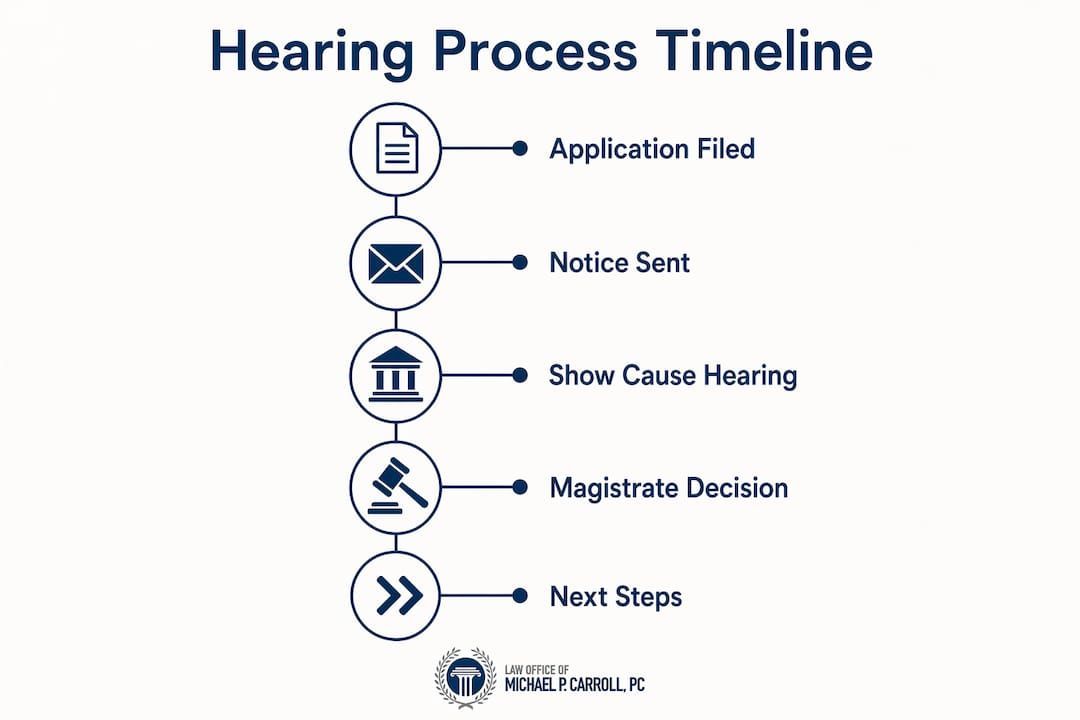
The process moves faster than most people expect, which is why early action matters.
Stage 1: Complaint application filed. A police officer or private citizen files an application with the District Court. The magistrate reviews it to determine whether to schedule a show cause hearing, authorize or deny the complaint immediately, or refer the matter elsewhere.
Stage 2: Notice sent to the accused. The court mails notice to the accused, generally allowing at least seven days before the scheduled hearing date. In exceptional cases, notice may be shorter and police may serve it directly.
Stage 3: Show cause hearing. The hearing is held before the clerk magistrate. Both sides present their accounts. The magistrate evaluates probable cause based solely on the evidence presented that day.
Stage 4: Magistrate's decision. The magistrate either authorizes the complaint or declines. This decision is typically made at the conclusion of the hearing.
Stage 5: Post-decision steps. If a complaint issues, the accused receives a summons or is subject to an arrest warrant and is given an arraignment date. If no complaint issues, the matter generally ends there.
The entire process from application to hearing decision can unfold within a few weeks, depending on court scheduling.
What rights do you have during the hearing?
The Clerk Magistrate Hearing is a statutory right under Massachusetts law, not a constitutional one, but that distinction does not diminish its practical protections.
You have the right to be represented by counsel at the hearing. You may present witnesses and offer testimony in your defense. The complainant must testify under oath, and the magistrate must examine them before signing any complaint. You are not required to attend, though appearing with prepared counsel is almost always the stronger position.
The magistrate cannot authorize a complaint without sufficient evidence, regardless of whether you show up. You also have the right to request that the proceedings be recorded by a stenographer at your own expense. Any challenge to the magistrate's probable cause finding after a complaint issues must come through a motion to dismiss, reviewed by a judge applying the same probable cause standard. A judge reviewing that motion may not consider facts or evidence that were not before the magistrate.
One right that often surprises people: if the accused presents evidence that completely undermines the complainant's allegations, such as a sound alibi or a legal defense, the magistrate may refuse to authorize a complaint even when some evidence of wrongdoing exists. That is a meaningful protection, and it is one that an experienced attorney knows how to use.
What comes next after the hearing?
If the magistrate does not authorize a complaint, the case ends. No arraignment, no public record of a charge. That is the outcome to work toward.
If a complaint is authorized, the next step is arraignment at the District Court. At arraignment, the formal charges are read, you enter a plea, and the court addresses bail and any conditions of release. This is also when a criminal record entry is created, which is why challenging the complaint before arraignment, through a pre-arraignment motion to dismiss, carries real strategic weight.
After arraignment, the case moves into the pretrial phase. Your attorney will file discovery requests, review the evidence, and assess whether motions to suppress or dismiss are viable. Depending on the charge, the case may be resolved through a plea agreement, a continuance without a finding, or proceed to trial. For charges involving domestic matters or harassment, additional proceedings such as restraining order hearings may run concurrently. The decisions made at and immediately after the Clerk Magistrate Hearing shape every stage that follows.
Facing a hearing? Law Office of Michael P Carroll can help
Receiving a hearing notice is unsettling, but it is also an opportunity. The Clerk Magistrate Hearing is one of the few points in the Massachusetts criminal process where the right legal move can stop a case before it ever becomes a formal charge.

Law Office of Michael P Carroll represents clients at Clerk Magistrate Hearings across Bristol, Norfolk, and Plymouth Counties. Michael Carroll works directly with each client, reviewing the complaint application, requesting police reports and affidavits, and contacting the police prosecutor before the hearing date when a pre-hearing resolution is possible. That direct, owner-operated approach means you are not handed off to a junior associate at the most critical moment. If you have received a hearing notice or believe a complaint may be filed against you, contact the Law Office of Michael P Carroll to discuss your options before the hearing date arrives.
FAQ
What does a Clerk Magistrate Hearing mean in Massachusetts?
A Clerk Magistrate Hearing, also called a show cause hearing, is a preliminary proceeding where a court clerk magistrate determines whether probable cause exists to issue a criminal complaint. It is governed by M.G.L. c. 218, § 35A and applies primarily to misdemeanor cases where the accused has not been arrested.
Do you have to attend a Clerk Magistrate Hearing?
Attendance is not legally required. However, the complainant must still establish probable cause even if you do not appear, and presenting your side through counsel gives you the best chance of preventing a complaint from issuing.
What happens if the magistrate authorizes the complaint?
A summons or arrest warrant is issued and the accused is given an arraignment date. The complaint becomes part of the public record, and the case proceeds through the District Court criminal process.
Can a Clerk Magistrate Hearing result in no charges?
Yes. If the magistrate finds no probable cause, or declines to authorize the complaint, the case typically ends without formal charges or a criminal record entry. This is the most favorable outcome and the primary reason to take the hearing seriously.
How can an attorney help at a Clerk Magistrate Hearing?
An attorney can request police reports before the hearing, contact the police prosecutor to explore pre-hearing resolutions, present witnesses and evidence, and advise whether testifying is strategically sound. Engaging criminal defense counsel before the hearing, not after, is the most effective way to protect your record.
Key Takeaways
A Clerk Magistrate Hearing in Massachusetts is a statutory gatekeeping proceeding under M.G.L. c. 218, § 35A where the outcome, no complaint or formal charge, depends entirely on the evidence and preparation brought to that single hearing.
| Point | Details |
|---|---|
| Statutory right, not constitutional | M.G.L. c. 218, § 35A grants accused misdemeanor defendants the right to oppose a complaint before it issues. |
| Seven days' notice standard | The court generally mails notice at least seven days before the hearing; contact the clerk's office if none arrives. |
| Probable cause is the only question | The magistrate decides only whether credible evidence supports the charge, not whether you are guilty. |
| Dismissal before arraignment matters | Challenging a complaint before arraignment avoids a criminal record entry; post-arraignment dismissals can create duplicate record entries. |
| Law Office of Michael P Carroll | Represents clients at Clerk Magistrate Hearings in Bristol, Norfolk, and Plymouth Counties, working directly with each client from complaint review through hearing day. |