
First DUI in Massachusetts: Penalties, License, and Next Steps
First DUI in Massachusetts: Penalties, License, and Next Steps

TL;DR:
- A first-offense OUI in Massachusetts is often resolved with a diversion or continuance without a criminal conviction if probation and education programs are completed. However, the RMV can suspend your license separately, and missing hearings can lead to automatic driving privilege loss regardless of case outcomes. Prompt legal action within 24–48 hours is crucial to protect your rights and minimize long-term consequences.
A first-offense OUI in Massachusetts — the state's term for what most people call a DUI — typically resolves through a 24D disposition or a Continuance Without a Finding (CWOF), which avoids a permanent criminal conviction if you complete probation and a Driver Alcohol Education Program. That is the good news. The bad news: the RMV can suspend your license on a separate administrative track before any court date, and missing the hearing deadline can cost you driving privileges even if the criminal case goes your way.
What a typical first-offense OUI looks like:
- A RMV license suspension of limited duration under a 24D disposition (assigned to a Driver Alcohol Education Program as a condition of probation)
- Probation lasting up to two years with program completion required
- A lengthy suspension if convicted without the 24D diversion
- Fines within a statutory range under MGL Chapter 90 §24 for a standard first offense
- Possible jail exposure up to two and a half years, though uncommon for clean first offenders
- Separate, longer RMV suspension if you refused chemical testing
Pro Tip: The RMV administrative process and the criminal court case run on completely separate clocks. Missing the RMV hearing window can lock in a suspension regardless of what happens in court. Contact an OUI attorney within 24–48 hours of arrest.
Table of Contents
- What are the criminal penalties for a first-offense DUI in Massachusetts?
- How does the RMV suspension process work after an OUI arrest?
- What happens if you refuse a breath or blood test in Massachusetts?
- What is the court process for a first-offense OUI in Massachusetts?
- What are the collateral consequences of a first OUI conviction?
- What defenses can reduce or avoid penalties for a first-offense OUI?
- What should you do immediately after an OUI arrest?
- How does Law Office of Michael P Carroll handle first-offense OUI cases?
- Key Takeaways
- Why early legal help changes the outcome
- Ready to protect your license and your record?
- Authoritative sources and further reading
- FAQ
What are the criminal penalties for a first-offense DUI in Massachusetts?
Massachusetts charges impaired driving as Operating Under the Influence (OUI), governed by MGL Chapter 90 §24. The statute sets the legal blood alcohol concentration (BAC) limit at 0.08% for drivers 21 and older. Driving at or above that threshold — or while impaired by marijuana, narcotics, or other substances — triggers the same charge.
For a first offense, the criminal penalties the court may impose are:
| Penalty | Statutory Range |
|---|---|
| Fine | A wide range set by statute |
| Imprisonment | Up to two and a half years (house of correction) |
| Probation | Up to two years (common under 24D) |
| License suspension (conviction) | Typically one year |
| License suspension (24D diversion) | 45–90 days |
Jail time for a clean first offense is rare. Judges routinely resolve these cases with probation, a fine, and program enrollment rather than incarceration. That said, aggravating factors change the picture fast. A BAC well above 0.08%, an accident, an injury, or a child passenger can push prosecutors toward harsher recommendations and reduce the likelihood of a 24D offer.
Statutory note: Under MGL c.90 §24D, a first offender who consents to probation and completes the Driver Alcohol Education Program avoids a permanent conviction on the criminal record. The court reports the disposition to the RMV, which then administers the 45–90 day suspension separately.
Most first-time defendants are eligible for a 24D disposition or CWOF, and securing either avoids a permanent conviction if probationary conditions are satisfied. Pleading guilty at arraignment without exploring these options is one of the most consequential mistakes a first offender can make.
How does the RMV suspension process work after an OUI arrest?
The RMV can act on your license before a judge rules on the criminal charge. These are administrative actions, not criminal penalties, and they operate on their own timeline with their own deadlines.
Key suspension scenarios for drivers 21 and older:
- BAC of 0.08% or greater (test taken): The RMV receives notice and can impose an administrative suspension independent of the court outcome.
- 24D disposition: Results in a 45–90 day suspension tied to enrollment in the Driver Alcohol Education Program.
- Conviction without 24D: Typically triggers a one-year suspension reported to the RMV by the court.
- Chemical test refusal: Triggers a 180-day RMV suspension under implied-consent rules.
Timeline from arrest to license reinstatement:
| Stage | Approximate Timing | What Happens |
|---|---|---|
| Arrest | Day 0 | License taken; temporary permit issued |
| RMV hearing request window | Days 1–— (verify current window with RMV) | Request an administrative hearing to challenge suspension |
| Arraignment | Typically 1–4 weeks | Criminal charges read; plea entered |
| 24D acceptance / CWOF | Pretrial stage | Court reports to RMV; 45–90 day suspension begins |
| Conviction without 24D | After court disposition | One-year RMV suspension begins |
| Chemical test refusal | Immediately following refusal | 180-day RMV suspension begins |
| Hardship license eligibility | After partial suspension served | Apply through RMV with IID if required |
| Full reinstatement | After suspension period + fees | License restored upon compliance |

Hardship (work) licenses are available to eligible drivers who need to travel for work, school, or medical appointments during a suspension. Eligibility depends on the type of suspension, whether you completed required programs, and whether an ignition interlock device (IID) is required. Failing to complete the Driver Alcohol Education Program can trigger immediate revocation of a hardship license.
Pro Tip: Bring all paperwork from your arrest — the citation, the temporary permit, and any chemical test documentation — to your first attorney meeting. The RMV hearing deadline is short, and your attorney needs those documents to file promptly.
What happens if you refuse a breath or blood test in Massachusetts?
Refusing a chemical test in Massachusetts is not a neutral choice. Under the state's implied-consent law, administrative RMV suspensions for refusal run separately from the criminal OUI charge and are often longer than the suspension you would face if you took the test and failed it.
For a first-offense refusal by a driver 21 or older, the RMV imposes a 180-day license suspension — independent of any court outcome. That suspension applies even if the criminal OUI charge is later dismissed or reduced. The refusal also cannot be used as direct evidence of guilt in the criminal case, but prosecutors are aware of it and it can influence how they approach plea negotiations.
The core tradeoff: Refusing the test removes a BAC number from the prosecutor's hands, which can complicate their case. But it guarantees a longer administrative suspension and gives the RMV grounds to act immediately. For most first offenders with a moderate BAC, the math rarely favors refusal — but the right answer depends on the specific facts of your stop, your BAC estimate, and your driving record.
The window to request an RMV administrative hearing after a refusal is narrow. Missing it means the suspension stands automatically. This is one of the clearest examples of why administrative and criminal deadlines require separate, prompt action — the two tracks do not wait for each other.
What is the court process for a first-offense OUI in Massachusetts?
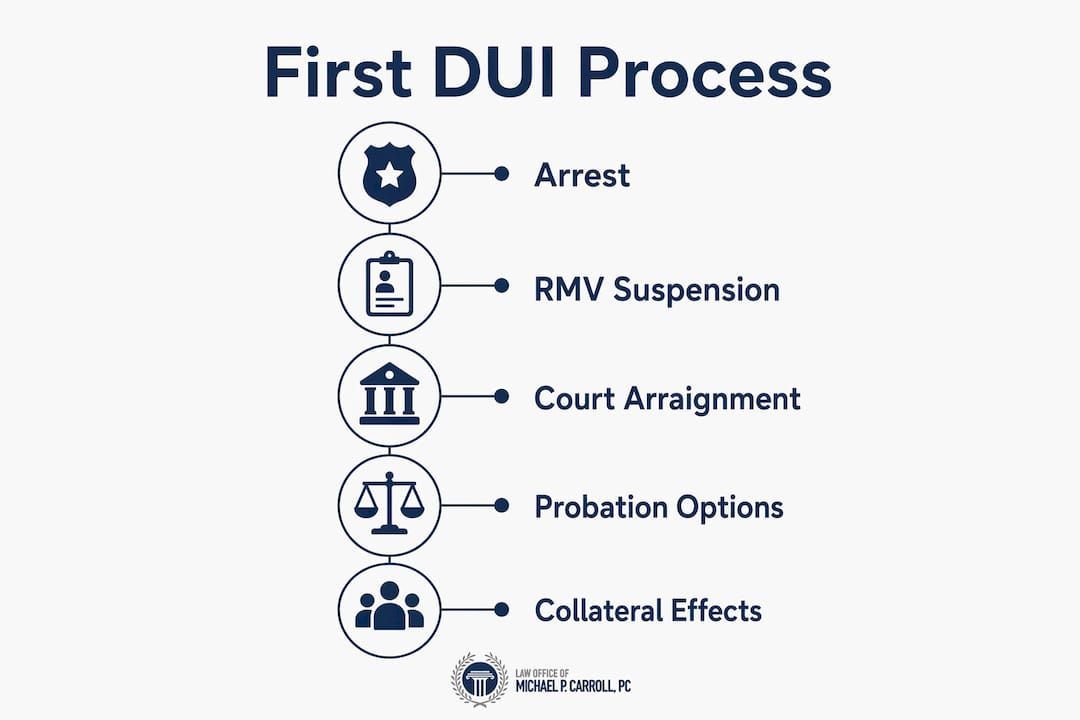
The criminal case moves through several defined stages. Knowing the sequence helps you understand when decisions happen and what your options are at each step.
Step-by-step court timeline:
- Arrest and booking — Police take your license and issue a temporary permit. The clock on RMV deadlines starts here.
- Arraignment — Usually within days to a few weeks. The charges are read, and you enter a plea. Most attorneys advise a not-guilty plea at this stage to preserve options.
- Pretrial conference — The defense reviews discovery (police report, video, breath test records, calibration logs). This is where defense strategy takes shape.
- Plea negotiations — The prosecutor may offer a 24D disposition or agree to a CWOF. Both are non-conviction outcomes if probation is completed successfully.
- Pretrial motions — Challenges to the stop, field sobriety tests, or chemical test results are filed here. A successful suppression motion can significantly weaken the prosecution's case.
- Resolution — Either a plea agreement (24D, CWOF, or guilty plea) or a trial. Most first-offense cases resolve at the plea stage.
| Stage | Typical Timing |
|---|---|
| Arraignment | 1–4 weeks after arrest |
| Pretrial conference | 4–8 weeks after arraignment |
| Motions / negotiations | 2–6 months after arraignment |
| Final resolution | 3–12 months total (varies by court) |
What accepting a 24D disposition looks like in practice: You agree to probation (up to two years), enrollment in a Driver Alcohol Education Program, and a 45–90 day license suspension. You pay fines and fees. If you complete all conditions, no conviction appears on your criminal record. The RMV still records the disposition on your driving record, but the criminal record stays clean.
A CWOF works similarly: the court continues the case without a finding of guilt. Complete probation, and the case is dismissed. Violate probation, and the court can enter a guilty finding.
Conviction without 24D means a one-year RMV suspension for a first offense. Refusing a chemical test triggers a 180-day suspension.
What are the collateral consequences of a first OUI conviction?
A first-offense OUI touches more than your license and your court date. Insurance, employment, and your long-term record all feel the impact.

Auto insurance is typically the most immediate financial hit. Massachusetts insurers can reclassify you as a high-risk driver after an OUI, and premium increases can be substantial. Some insurers require an SR-22 certificate of financial responsibility, though Massachusetts handles this differently from many other states — confirm current requirements with your insurer and attorney. An ignition interlock device, if required, adds installation and monthly monitoring costs on top of insurance changes.
Employment and professional licenses are a real concern for certain fields. A CWOF or 24D disposition does not produce a criminal conviction, but it does appear on your driving record and may show up in certain background checks depending on the employer and the type of check. Professions with licensing boards — nursing, law, teaching, commercial driving — may require disclosure even for non-conviction dispositions.
| Consequence | First Offense (24D/CWOF) | First Offense (Conviction) |
|---|---|---|
| Criminal record | No conviction if probation completed | Permanent conviction |
| Driving record | Disposition recorded by RMV; 45–90 day suspension | Conviction recorded; 1-year suspension |
| Insurance impact | Likely increase; varies by insurer | Significant increase; possible SR-22 |
| IID requirement | Possible for hardship license | May be required for reinstatement |
| Sealing eligibility | Available after waiting period | Available after waiting period |
On sealing: Massachusetts allows sealing of certain criminal records after a waiting period. A CWOF that is dismissed after probation may be sealable sooner than a conviction. A first-offense OUI is not a felony under Massachusetts law unless aggravating circumstances apply, which affects both the sealing timeline and the severity of long-term consequences. Consult an attorney about the specific waiting periods and eligibility rules for your disposition.
What defenses can reduce or avoid penalties for a first-offense OUI?
The most favorable outcomes for first offenders are non-conviction dispositions: a 24D, a CWOF, a reduction to a lesser charge, or an outright dismissal. Getting there usually depends on the strength of the evidence and the quality of the defense strategy.
Common defense approaches:
- Challenging the traffic stop: Police need reasonable suspicion to pull you over. If the stop was unlawful, evidence gathered afterward — including field sobriety tests and chemical test results — may be suppressed.
- Field sobriety test reliability: Standardized field sobriety tests (the walk-and-turn, one-leg stand, and horizontal gaze nystagmus) are subject to officer error, environmental conditions, and medical factors. A defense attorney will scrutinize the administration and scoring.
- Breath test calibration and administration: Breathalyzer results depend on proper device calibration and correct administration. Calibration logs and maintenance records are discoverable and worth examining in every case.
- Miranda and constitutional issues: Statements made during a custodial interrogation without proper Miranda warnings may be suppressible.
What actually moves prosecutors: BAC level, prior record, whether an accident or injury occurred, and whether the defendant cooperated. A low BAC, no accident, no priors, and a cooperative demeanor creates the strongest platform for a 24D offer or a CWOF. A BAC above 0.15% or an accident with injuries shifts the calculus considerably.
Pro Tip: Request the breath test calibration records and the arresting officer's body camera footage as early as possible. These are discoverable, and gaps or anomalies in either can change the outcome of a case that looks straightforward on paper.
What should you do immediately after an OUI arrest?
The first 48 hours after an OUI arrest matter more than most people realize. Here is what to do, in order of urgency.
- Contact an experienced OUI attorney immediately. The RMV administrative hearing deadline is short. An attorney can file the request, advise on the chemical test refusal implications, and begin evidence preservation before anything disappears.
- Do not make statements about the arrest to anyone other than your attorney. Anything you say to friends, family, or on social media can surface later.
- Preserve all paperwork from the arrest. Keep your citation, the temporary driving permit, any chemical test documentation, and the police report when you obtain it.
- Request the police report and any available video. Dashcam and body camera footage can be overwritten quickly. Your attorney should request preservation immediately.
- Note witness information. If anyone observed the stop or the events leading to it, write down names and contact information while memory is fresh.
- Collect any relevant medical records. If a medical condition affected your performance on field sobriety tests, documentation matters.
- Attend your arraignment. Missing it results in a default warrant. Your attorney will typically appear with you and advise on the plea.
- Begin the hardship license process if needed. If you depend on driving for work, discuss hardship license eligibility with your attorney at the first meeting.
The RMV administrative hearing and the arraignment are the two earliest hard deadlines. Neither waits for the other, and neither waits for you to feel ready.
How does Law Office of Michael P Carroll handle first-offense OUI cases?
The firm's first priority in any first-offense OUI case is preserving your driving privileges and pursuing the best available non-conviction disposition. That means filing for an RMV administrative hearing promptly, reviewing all discovery for suppression issues, and evaluating whether a 24D or CWOF is achievable given the facts.
At an initial consultation, you can expect a direct review of the arrest circumstances, the chemical test results or refusal, and the RMV timeline. Michael P. Carroll handles cases personally — this is an owner-operated firm, not a practice where you meet the attorney once and work with staff from there. That matters when decisions about plea offers and motion strategy need to happen quickly.
What the first consultation covers: The strength of the stop, the reliability of any chemical test evidence, your RMV suspension status and hearing options, and a realistic assessment of likely outcomes — including whether a 24D, CWOF, or a motion to suppress is the right path for your case.
With over a decade of OUI defense experience across Bristol, Norfolk, and Plymouth Counties, the firm has handled the full range of first-offense scenarios: low-BAC cases where a 24D was straightforward, high-BAC cases where suppression was the only viable path, and refusal cases where the administrative and criminal timelines required careful coordination. Understanding the cost of representation upfront is part of that first conversation.
Key Takeaways
A first-offense OUI in Massachusetts is serious, but a permanent criminal conviction is avoidable for most defendants who act quickly and pursue a 24D or CWOF disposition.
| Point | Details |
|---|---|
| 24D diversion is the primary goal | Completing the Driver Alcohol Education Program under §24D avoids a permanent conviction and limits suspension to 45–90 days. |
| RMV and court run separately | Missing the RMV administrative hearing deadline can lock in a suspension regardless of the criminal case outcome. |
| Test refusal carries its own penalty | A first-offense refusal triggers a 180-day administrative suspension, separate from any criminal charge. |
| Collateral consequences extend beyond court | Insurance costs, employment background checks, and professional licenses can all be affected even by a non-conviction disposition. |
| Law Office of Michael P Carroll | The firm pursues 24D/CWOF outcomes and RMV hearing advocacy for first offenders across Bristol, Norfolk, and Plymouth Counties. |
Why early legal help changes the outcome
Most people charged with a first OUI focus on the court date. The bigger risk, in my experience, is what happens before that date — specifically, the RMV administrative process and the decision about how to plead at arraignment.
Pleading guilty at arraignment without evaluating 24D or CWOF options is a mistake that cannot be undone. A permanent conviction on the criminal record follows you in ways a CWOF or a completed 24D does not: insurance classifications, professional licensing disclosures, and background checks all treat them differently. The window to pursue the better outcome is open at arraignment and closes the moment you enter a guilty plea.
The RMV piece is equally underestimated. Administrative suspensions move fast. The hearing window is short, the paperwork is specific, and the consequences of missing it are immediate. Clients who call within 24–48 hours of arrest give us the most options. Those who wait until after arraignment sometimes find the RMV issue has already been decided against them.
Early involvement also means earlier access to evidence. Calibration records, body camera footage, and dispatch logs are not kept indefinitely. Requesting them promptly is not just good practice — it is sometimes the difference between a suppression motion that works and one that cannot be filed because the evidence is gone.
Ready to protect your license and your record?
A first-offense OUI charge in Massachusetts is one of the most time-sensitive legal situations you will face. The RMV hearing deadline, the arraignment, and the decision about how to approach a 24D or CWOF all happen early — and each one affects what options remain.

Law Office of Michael P Carroll represents first-offense OUI defendants across Bristol, Norfolk, and Plymouth Counties, with direct access to Michael P. Carroll from the first call. There are no handoffs to junior staff on decisions that matter.
What to bring to your consultation:
- The citation and any paperwork from the arrest
- Your temporary driving permit
- Chemical test documentation (or refusal paperwork)
- Your current insurance information
- The police report, if you have already obtained it
Schedule a consultation through the OUI defense page or the DUI attorney page to discuss your case directly with Michael Carroll. The sooner you call, the more options remain on the table.
This article is general legal information, not legal advice for your specific situation. Laws and RMV procedures change; confirm current rules with a qualified Massachusetts OUI attorney.
Authoritative sources and further reading
The statutes and agency pages below are the primary sources for the information in this article.
| Source | What It Covers |
|---|---|
| MGL c.90 §24 (Mass.gov) | Full text of the OUI statute: BAC limits, penalties, and license revocation rules |
| MGL c.90 §24D (malegislature.gov) | 24D diversion: probation terms, education program, and 45–90 day suspension |
| §24D summary (Mass.gov) | Public-facing explanation of 24D and how it interacts with RMV reporting |
| RMV alcohol/drug suspensions (Mass.gov) | Administrative suspension rules, implied consent, and hardship license mechanics |
| MA impaired driving programs (Mass.gov) | Licensed Driver Alcohol Education Programs approved for 24D completion |
Firm resources for next steps:
- Is a DUI a Felony in Massachusetts? — When a first offense escalates and long-term record implications
- OUI Attorney — Bristol, Norfolk, Plymouth Counties — Services, consultation scheduling, and case evaluation
- DUI Attorney — Bristol, Norfolk, Plymouth Counties — Practice area overview and contact
FAQ
Is a first-time DUI a felony in Massachusetts?
No. A first-offense OUI in Massachusetts is a misdemeanor under MGL c.90 §24. It becomes a felony under specific aggravating circumstances, such as causing serious injury or death while impaired — see the firm's felony OUI guide for the full threshold breakdown.
What is the most common outcome for a first-offense OUI in Massachusetts?
Most first-time defendants resolve their case through a 24D disposition or a CWOF, both of which avoid a permanent criminal conviction if probation and the Driver Alcohol Education Program are completed successfully.
How long is your license suspended for a first OUI in Massachusetts?
Under a 24D disposition, the RMV suspension is 45–90 days. If convicted without the 24D diversion, the RMV suspension is one year for a first offense. A chemical test refusal triggers a 180-day administrative suspension.
What happens when you get a first DUI in Rhode Island?
Rhode Island's first-offense DUI carries fines, a license suspension that varies depending on BAC, community service, and a mandatory alcohol education program. Jail is possible but rarely imposed on a clean record. Refusing the chemical test adds a separate civil case at the Rhode Island Traffic Tribunal with a suspension period and a short deadline to request a hearing.
Can a first-offense OUI be sealed or expunged in Massachusetts?
Yes, under certain conditions. A CWOF that is dismissed after successful probation may be sealable, and Massachusetts law provides sealing options for qualifying offenses after a waiting period. The specific timeline depends on the disposition type and your record; consult a Massachusetts OUI attorney to confirm current eligibility rules for your case.