
Is Domestic Assault a Felony or Misdemeanor in Rhode Island?
Is Domestic Assault a Felony or Misdemeanor in Rhode Island?

TL;DR:
- Under Rhode Island law, a first domestic simple assault is a misdemeanor, but repeated violations escalate to a felony with mandatory minimum sentences.
- The statutes governing this include simple assault, felony assault, and the Domestic Violence Prevention Act, which layers on specific procedures and penalties for domestic cases.
Under Rhode Island law, a first-offense domestic simple assault is a misdemeanor, but repeat domestic violations under the Domestic Violence Prevention Act escalate to felony status. The three controlling statutes are R.I. Gen. Laws §11-5-3 (simple assault/battery), R.I. Gen. Laws §11-5-2 (felony assault), and the Domestic Violence Prevention Act at §12-29-5 (escalation and mandatory sentencing). A conviction, even a misdemeanor one, triggers mandatory batterer intervention programs, potential firearm prohibition, and a permanent notation on your record.
Table of Contents
- Which Rhode Island statutes govern domestic assault charges?
- What separates simple assault from felony assault under Rhode Island law?
- Who counts as a "domestic" party under Rhode Island law?
- How does a misdemeanor domestic charge escalate to a felony?
- What are the penalties, and what else happens after a conviction?
- What defenses apply, and what should you do right after an arrest?
- What does the Rhode Island court process look like?
- Why you should contact a Rhode Island defense attorney immediately
- Key Takeaways
- What defending these cases actually requires
- Facing a domestic assault charge in Rhode Island?
- Useful sources
- FAQ
Which Rhode Island statutes govern domestic assault charges?
Three code sections do most of the work here, and understanding what each one covers tells you a lot about how your case may be charged.
- R.I. Gen. Laws §11-5-3 (Simple Assault/Battery): The baseline misdemeanor statute. It sets the penalty ceiling at a jail term and fine limits consistent with misdemeanor offenses for a first offense. When the Domestic Violence Prevention Act applies, additional penalties attach beyond those baseline sanctions.
- R.I. Gen. Laws §11-5-2 (Felony Assault): Covers aggravated assaults involving a dangerous weapon, serious bodily injury, or intent to commit a felony. This statute governs the most serious assault charges and carries significantly higher incarceration ranges.
- R.I. Gen. Laws §12-29-5 (Domestic Violence Prevention Act — Penalties and Escalation): The domestic-specific layer. It controls repeat-offense escalation, mandatory minimum jail terms, batterer intervention requirements, and firearm prohibitions. The Domestic Violence Prevention Act lists felony assaults among the offenses counted as domestic violence, pulling §11-5-2 charges into its framework as well.
- R.I. Gen. Laws §12-29-2 (Definitions): Defines "domestic violence" and the qualifying relationships. This is the gateway provision that determines whether the Act applies to a given case at all.
§11-5-3 and §11-5-2 govern what the offense is and what the base penalties are. §12-29-5 then layers on domestic-specific procedures, mandatory minimums, and escalation rules whenever the relationship between the parties qualifies.
What separates simple assault from felony assault under Rhode Island law?
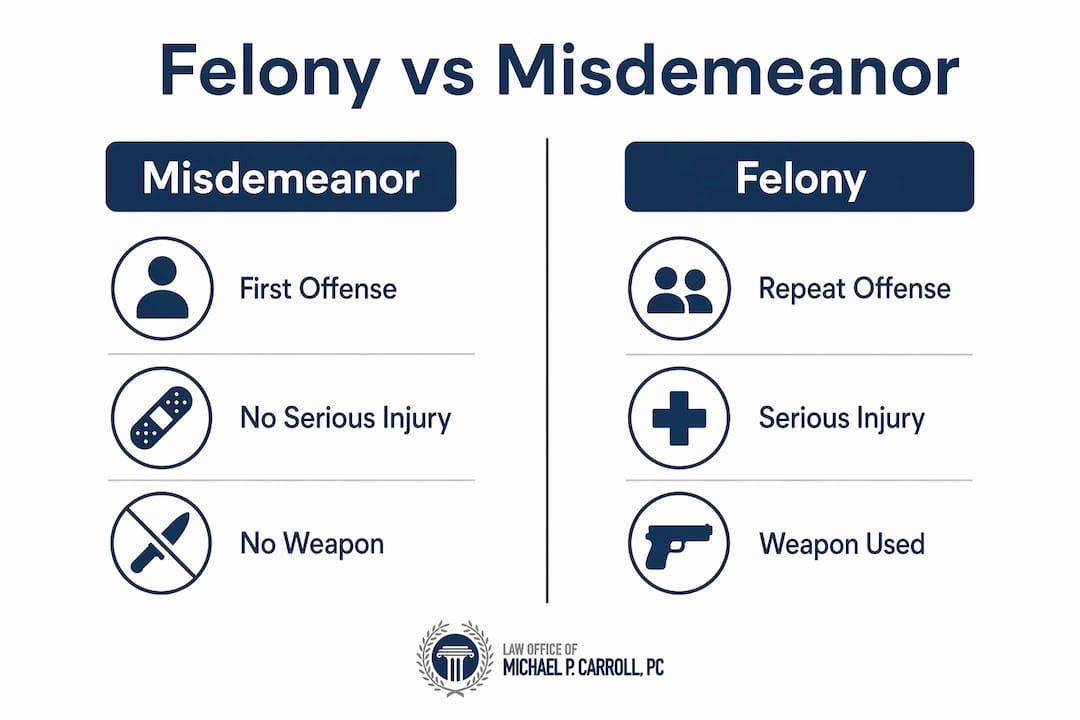
The distinction comes down to three factors: the presence of a weapon, the severity of injury, and the defendant's intent at the time of the act.

Simple assault under §11-5-3 requires proof that the defendant intentionally placed another person in reasonable fear of imminent bodily harm, or made unlawful physical contact. Typical fact patterns involve a push, a slap, a verbal threat accompanied by a threatening gesture, or a minor physical altercation with no significant injury. No weapon needs to be involved, and the injury, if any, is minor.
Felony assault under §11-5-2 requires something more: use of a dangerous weapon, infliction of serious bodily injury, or an assault committed with the intent to commit a separate felony. A punch that causes a broken bone, an attack with a kitchen knife, or an assault intended to facilitate a robbery all move the conduct into felony territory.
| Element | Simple Assault (§11-5-3) | Felony Assault (§11-5-2) |
|---|---|---|
| Actus reus | Threat or minor physical contact | Weapon use or serious physical harm |
| Mens rea | Intent to threaten or make contact | Intent to cause serious harm or commit a felony |
| Injury level | None required, or minor | Serious bodily injury typical |
| Weapon | Not required | Dangerous weapon often present |
| Sentencing range | Up to a year in jail and a monetary fine typical of misdemeanor offenses | 1–10 years |
A realistic example: a spouse shoves a partner during an argument, leaving a bruise. That is §11-5-3 territory. The same spouse strikes the partner with a glass bottle, causing lacerations requiring stitches. That fact pattern points toward §11-5-2. The line is not always clean, and prosecutors have discretion in how they charge, which is one reason early legal counsel matters.
Who counts as a "domestic" party under Rhode Island law?
Not every assault between people who know each other is a domestic assault. The Domestic Violence Prevention Act defines "domestic violence" to include simple assault when committed by one family or household member against another, and §12-29-2 sets out exactly who qualifies.
Qualifying relationships include:
- Spouses and former spouses
- Persons who share a child in common , regardless of whether they ever lived together
- Persons in a current or former dating or intimate relationship
- Family members related by blood or marriage (parents, siblings, in-laws)
- Persons who currently or formerly shared a household (roommates, for example)
Why does the "domestic" label matter so much? Because it triggers an entirely different procedural and sentencing track. The Domestic Violence Prevention Act creates mandatory arrest obligations where probable cause exists, requires special notations on complaint forms, and attaches mandatory programs and firearm consequences that do not apply to a generic assault between strangers.
A few practical examples: a fight between current roommates qualifies. An argument between ex-partners who share a child qualifies even if they never lived together. A dispute between adult siblings qualifies. A bar fight between two strangers does not, even if the injury is identical.
How does a misdemeanor domestic charge escalate to a felony?
This is where Rhode Island law gets particularly consequential, and where many people are caught off guard.

Under §12-29-5, the escalation works like this:
First domestic violation: Treated under the base misdemeanor statute (§11-5-3), with penalties consistent with misdemeanor classifications.
Second domestic violation: Carries a mandatory minimum jail term that cannot be suspended, up to the maximum allowed for misdemeanor offenses.
Third or subsequent domestic violation: Treated as a felony, punishable by jail terms that extend beyond misdemeanor limits and cannot be suspended.
What counts as a "prior violation" for escalation purposes? Any prior conviction or qualifying disposition under the Domestic Violence Prevention Act, regardless of which Rhode Island court handled it. Separate incidents on separate dates, charged separately, each count. The escalation clock does not reset.
Pro Tip: A nolo contendere plea or a deferred disposition under the Domestic Violence Prevention Act can still count as a qualifying prior for escalation purposes under §12-29-5. Before accepting any plea, make sure your attorney has evaluated how that disposition will affect your exposure if there is ever a future charge.
The practical implication: someone who pleaded nolo to a domestic simple assault five years ago and now faces a new domestic charge is already looking at a mandatory minimum jail term, not a first-offense misdemeanor. That prior plea changes everything.
What are the penalties, and what else happens after a conviction?
Sentencing ranges
| Offense | Statute | Incarceration | Fine |
|---|---|---|---|
| Simple assault/battery (first domestic) | §11-5-3 / §12-29-5 | Jail term consistent with misdemeanor status | Monetary fines typical for misdemeanor offenses |
| Second domestic violation | §12-29-5 | Mandatory jail term minimum with maximum aligned with misdemeanor limits | Statutory |
| Third/subsequent domestic violation | §12-29-5 | Jail term of one to ten years, unsuspendable | Statutory |
| Felony assault | §11-5-2 | Jail term of one to ten years | Statutory |
Collateral consequences
The sentence itself is often not the most damaging part of a domestic assault conviction. The collateral consequences can follow you for years:
- Batterer intervention program: Courts must order attendance at a certified program at the defendant's own expense. Failure to comply can trigger a probation violation.
- Firearm prohibition: On a felony domestic violence conviction, the court must note on the conviction record that the defendant is prohibited from purchasing, owning, carrying, or possessing firearms under §§11-47-5 and 11-47-5.3. The court must also inform the defendant and order the surrender of any firearms. Federal law under the Lautenberg Amendment creates a parallel prohibition even for misdemeanor domestic violence convictions.
- Restraining orders and no-contact conditions: Issued at or shortly after arraignment; violating them creates new criminal exposure.
- Child custody and visitation: A domestic violence conviction is a factor courts weigh in custody proceedings. It can restrict or condition parenting time.
- Immigration consequences: A domestic violence conviction can trigger removal proceedings, inadmissibility findings, or denial of naturalization for non-citizens. The USCIS policy manual addresses domestic violence offenses as grounds for immigration consequences.
- Employment and licensing: Many professional licenses, security clearances, and jobs requiring background checks are affected by a domestic violence conviction, particularly a felony.
Understanding the difference between a felony and misdemeanor matters enormously here, because the collateral consequences scale sharply with the charge level.
What defenses apply, and what should you do right after an arrest?
Immediate steps
- Do not speak to police without an attorney present. Anything you say will be used against you. Politely invoke your right to counsel and stop talking.
- Comply with any no-contact order. Violating it creates a separate criminal charge and destroys your credibility with the court.
- Preserve and document evidence. Take photographs of the scene, any injuries (yours or the other party's), and any property damage.
- Write down everything you remember. Dates, times, what was said, who was present. Memory fades quickly.
- Collect witness information. Names and contact details for anyone who saw or heard what happened.
- Secure your own medical records if you sought treatment for injuries.
- Contact a criminal defense attorney as soon as possible , ideally before your first court appearance.
Common defenses
Self-defense or defense of others is the most frequently raised defense in domestic assault cases. Rhode Island law permits the use of reasonable force to protect yourself or another person from imminent harm. The key word is "reasonable," and the facts have to support it.
Lack of intent matters in assault cases because the prosecution must prove the defendant acted intentionally. An accidental contact, even one that causes injury, is not assault.
Insufficient evidence is always in play. If the case rests entirely on the alleged victim's account with no corroborating physical evidence, witnesses, or prior consistent statements, a skilled attorney can challenge the credibility of that account.
Mistaken identity or false accusation arises in contentious separation or custody disputes. Defense counsel can investigate the accuser's motive, prior inconsistent statements, and the timeline of when allegations surfaced relative to other legal proceedings.
Procedural errors by law enforcement, including failure to follow mandatory arrest protocols or improper collection of evidence, can sometimes result in suppression of evidence or dismissal.
A defense attorney's investigation typically involves subpoenaing phone and GPS records, requesting surveillance footage from nearby cameras, interviewing neighbors or other witnesses, and reviewing the responding officers' reports for inconsistencies. For guidance on defending domestic assault charges, the approach is methodical and fact-specific.
What does the Rhode Island court process look like?
From arrest to resolution
Arrest: Police make an arrest based on probable cause. Under the Domestic Violence Prevention Act's mandatory arrest provisions, officers who find probable cause for a domestic violation are generally required to arrest. A no-contact order is typically issued at or immediately after arrest.
Initial appearance / bail hearing: Usually within 24 hours. The court sets bail conditions. A no-contact order almost always issues here, which can mean you cannot return to a shared home. Early counsel can sometimes negotiate bail terms or limited-contact arrangements when safety considerations permit.
Arraignment: You are formally charged and enter an initial plea. Misdemeanor domestic cases are arraigned in Rhode Island District Court. Felony charges, including third-or-subsequent domestic violations, go to Rhode Island Superior Court.
Pretrial phase: Motions practice, discovery, plea negotiations. This is where most cases are actually resolved. A prosecutor may agree to reduce a charge, offer a diversion program for first-time offenders, or dismiss if evidence is weak.
Disposition options:
- Dismissal: Charges dropped for insufficient evidence or after successful diversion.
- Plea to a reduced charge: Negotiated outcome, often with probation and mandatory programs.
- Diversion: Available for some first-time offenders; successful completion can result in dismissal.
- Probation: Common for first and second offenses; comes with program requirements and conditions.
- Jail sentence: Mandatory for second and subsequent domestic violations under §12-29-5.
- Trial: Full jury or bench trial in District or Superior Court.
For information on what to expect regarding bail in domestic violence cases, the practical details matter from day one.
Why you should contact a Rhode Island defense attorney immediately
The first 48 hours after a domestic assault arrest are the most consequential. Evidence disappears, witnesses' memories shift, and statements made without counsel can close off defenses that would otherwise be available.
An attorney can intervene at bail to argue for reasonable conditions, including modifications to a no-contact order that would otherwise force you out of your home. Early counsel also means someone is preserving evidence before it is lost, reviewing the police report for procedural errors, and evaluating whether the facts support a charge reduction or diversion.
For domestic cases specifically, the stakes extend well beyond the courtroom: your right to possess firearms, your standing in a custody proceeding, and your immigration status can all turn on how the criminal case resolves. A lawyer who understands the full picture of those consequences, not just the criminal sentence, is the one you want at the table from the start.
Key Takeaways
In Rhode Island, domestic assault starts as a misdemeanor under §11-5-3 but becomes a felony on a third or subsequent domestic violation under §12-29-5, with unsuspendable prison terms of one to ten years.
| Point | Details |
|---|---|
| Default charge level | First-offense domestic simple assault is a misdemeanor under R.I. Gen. Laws §11-5-3. |
| Felony escalation trigger | A third or subsequent domestic violation under §12-29-5 is a felony carrying one to ten years, unsuspendable. |
| Second-offense minimum | A second domestic violation carries a mandatory minimum jail term that cannot be suspended. |
| Key collateral consequences | Firearm prohibition, mandatory batterer intervention, custody risk, and immigration exposure all attach on conviction. |
| Law Office of Michael P Carroll | Provides criminal defense representation for domestic assault charges in Rhode Island and nearby Massachusetts matters. |
What defending these cases actually requires
Domestic assault cases are not just about what happened in the room. They are about what the record shows, what the prior history looks like, and what the collateral consequences will be five years from now. The cases that go sideways are usually the ones where someone tried to explain themselves to police, or accepted a plea without understanding that a nolo disposition still counts as a prior for escalation purposes. Careful fact-gathering, early evidence preservation, and a clear-eyed look at the escalation risk are what drive good outcomes here. The criminal charge is one piece; protecting your firearms rights, your custody position, and your employment record is the rest of the picture.
Facing a domestic assault charge in Rhode Island?
The Law Office of Michael P Carroll handles criminal defense for domestic assault and battery matters in Rhode Island and the surrounding Massachusetts area, including arraignment representation, bail hearings, pretrial motions, plea negotiation, and trial defense. If you have been arrested or charged, bring your police report, any court paperwork, and the names of any witnesses to your consultation. Everything you share is confidential.

Early contact gives your attorney the best chance to preserve evidence, challenge the charge before it hardens, and protect the collateral interests, firearms, custody, employment, that a conviction can affect for years. For criminal defense representation in Rhode Island and Massachusetts, contact the Law Office of Michael P Carroll to schedule a consultation.
Useful sources
- R.I. Gen. Laws §12-29-2 — Domestic Violence Prevention Act definitions
- R.I. Gen. Laws §12-29-5 — Penalties and escalation under the Domestic Violence Prevention Act
- R.I. Gen. Laws §11-5-3 — Simple assault/battery
- R.I. Gen. Laws §11-5-2 — Felony assault
- Rhode Island Courts — Domestic Violence Prevention Act guidance
- Rhode Island District Court
- Rhode Island Superior Court
- ATF — Misdemeanor crimes of domestic violence and federal firearms prohibitions
- USCIS Policy Manual — Immigration consequences of domestic violence
- Law Office of Michael P Carroll — Domestic assault and battery defense
- Law Office of Michael P Carroll — Criminal defense blog
FAQ
What is considered a domestic misdemeanor in Rhode Island?
A first-offense domestic simple assault or battery under R.I. Gen. Laws §11-5-3 is a misdemeanor punishable under law by jail and fine consistent with typical misdemeanor classifications.
At what point does a domestic assault become a felony?
Under §12-29-5 of the Domestic Violence Prevention Act, a third or subsequent domestic violence conviction is treated as a felony carrying jail terms unsuspendable by law.
What is the difference between simple assault and domestic assault?
Simple assault describes the underlying offense (intentional threat or unlawful contact); domestic assault means that same offense was committed between family or household members, which triggers the Domestic Violence Prevention Act's additional penalties, mandatory programs, and escalation rules.
What counts as a felony in Rhode Island generally?
Rhode Island classifies an offense as a felony when it carries a potential sentence of more than one year in state prison; felony assault under §11-5-2 and third-or-subsequent domestic violations under §12-29-5 both meet that threshold.