
Modification of a Restraining Order: Your Legal Guide
Modification of a Restraining Order: Your Legal Guide

TL;DR:
- A modification of a restraining order is a legal process where a court changes the terms of an existing protective order based on new circumstances. The restrained party must demonstrate a significant change in circumstances, while the protected party faces a lower burden to show their situation has improved; the court considers evidence like treatment completion and compliance records. Proper filing, timely attendance, and strong evidence are essential for a successful modification, as courts prioritize documented facts over emotional appeals.
A modification of a restraining order is a formal legal process in which a court changes the terms of an existing protective order based on new circumstances. Either the protected party or the restrained party can request this change, but courts apply strict standards before granting it. No restraining order is strictly permanent, and Massachusetts courts will consider a change when the facts that justified the original order have materially shifted. Understanding what the court requires, and what it will reject, is the difference between a successful motion and a wasted hearing.
What is a modification of a restraining order and who can request one?
A restraining order modification is the legal term for any court-approved change to an active protective order. That change can be narrow, such as allowing contact for child custody exchanges, or broad, such as removing all restrictions. Both the protected party and the restrained party have standing to file a motion to modify a restraining order, but the legal burden each faces differs significantly.

The restrained party carries the heavier load. Courts require that person to demonstrate a substantial change in circumstances since the original order was issued. That standard means the facts on the ground must have genuinely shifted, not merely that time has passed. A protected party seeking to modify or drop terms faces a lower practical bar, since the order was issued for their benefit.
Massachusetts courts handle restraining orders under Chapter 209A of the General Laws, which governs abuse prevention orders. Jurisdiction matters: the court that issued the original order typically retains authority to hear modification requests. Filing in the wrong court wastes time and can complicate your case.
The burden of proof in most U.S. jurisdictions, including Massachusetts, is the preponderance of evidence standard. That means the moving party must show the modification is more likely justified than not. Some jurisdictions apply a higher "clear and convincing" standard, particularly when the restrained party seeks to dissolve the order entirely. Knowing which standard applies to your specific motion shapes how you build your case.
Who is eligible to file and when can a motion be filed?
Eligibility to file a motion to modify a protection order is broad, but timing and documentation requirements are specific.
Who can file:
- The protected party, who may want to loosen or remove restrictions they no longer need
- The restrained party, who believes circumstances have changed enough to justify reduced restrictions
- A legal guardian or parent filing on behalf of a minor protected party
When to file:
- A motion can be filed at any time after the original order is issued
- Courts exercise discretion and may deny motions filed too soon after the original order without compelling new evidence
- Massachusetts courts generally expect a meaningful interval and demonstrable change before entertaining a modification request
What the motion must include:
- A written motion stating the specific relief requested
- A sworn affidavit describing the changed circumstances in concrete terms
- Proper legal service on the opposing party, giving them notice and an opportunity to respond
- Any supporting documentation, such as treatment completion certificates, compliance records, or changed living arrangements
Courts may waive filing fees for those who submit a financial hardship declaration alongside the motion. This option exists for people who cannot afford court costs but still need access to the process.
What is the step-by-step process for filing a restraining order modification?
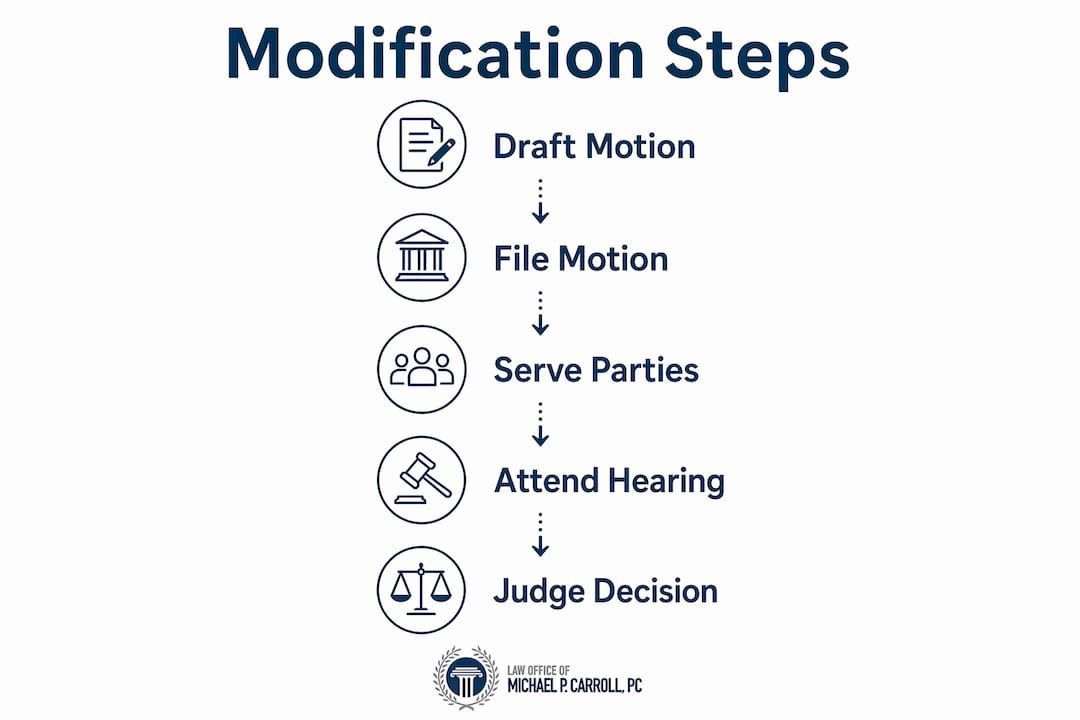
The formal process for a restraining order modification follows a clear sequence. Skipping any step can result in dismissal.
-
Prepare the written motion. State exactly what change you are requesting. Vague requests fail. If you want to modify a restraining order to allow peaceful contact for co-parenting, say that explicitly. If you want a restraining order change of address provision updated, specify the new address and the reason.
-
Draft a sworn affidavit. The affidavit is the factual backbone of your motion. It must describe what has changed since the original order, with dates, names, and verifiable details. Courts treat this document as testimony.
-
File the motion with the correct court. Submit the motion and affidavit to the court that issued the original order. Obtain a stamped copy for your records and confirm the filing fee or submit your hardship waiver at this stage.
-
Serve the opposing party. The other party must receive proper legal notice of your motion. Massachusetts rules require service in a manner the court recognizes as valid. Improper service can delay or void your hearing.
-
Attend the scheduled hearing. Absence at hearings almost always results in dismissal or denial of the motion. Courts treat no-shows as a forfeiture of the request. Attendance is non-negotiable.
-
Present your evidence. At the hearing, both parties may present testimony, documents, and witness statements. The judge evaluates the credibility of the evidence against the legal standard.
-
Receive the court's decision. The judge may grant the modification, deny it, or grant a partial change. The original order remains fully in effect until the court issues a written change.
| Step | Action Required | Key Consideration |
|---|---|---|
| Draft motion | State specific relief requested | Vague requests are routinely denied |
| Sworn affidavit | Detail changed circumstances with evidence | Must be notarized and factually specific |
| File with court | Submit to the issuing court | Confirm correct jurisdiction |
| Serve opposing party | Deliver notice per court rules | Invalid service delays the hearing |
| Attend hearing | Appear in person | No-shows result in automatic dismissal |
| Present evidence | Testimony, documents, records | Credibility and specificity matter most |
| Await ruling | Court issues written order | Original order stays active until then |
Pro Tip: File the restraining order modification form well before any deadline or urgency arises. Courts schedule hearings on their own timelines, and last-minute filings rarely receive expedited treatment.
What evidence do courts consider when deciding whether to modify a protection order?
Courts evaluate modification requests by weighing the original evidence of risk against current evidence of changed circumstances. The passage of time alone does not satisfy the substantial change standard. A judge who issued a 209A order based on documented abuse will not remove it simply because a year has elapsed.
Strong evidence for a modification includes:
- Completion of court-ordered or voluntary treatment programs, with certificates
- A documented history of compliance with the existing order, including no violations
- Changed living or employment circumstances that reduce the risk of contact
- A written statement from the protected party expressing changed concerns, if they support the modification
Weak or rejected evidence includes vague assertions that things are "better now," character letters without factual grounding, and emotional appeals about hardship. Judges decide on facts. Strong motions emphasize documented life changes, treatment completion, and compliance history.
Pro Tip: Avoid emotional language in your affidavit. Courts respond to verifiable facts, not personal appeals. Write as if you are presenting a report, not a plea.
The table below shows how courts typically categorize evidence by strength:
| Evidence Type | Strength | Why It Matters |
|---|---|---|
| Treatment completion certificate | Strong | Verifiable, objective, and directly addresses original risk |
| Compliance record with no violations | Strong | Demonstrates sustained behavioral change |
| Changed living arrangements | Moderate | Reduces opportunity for contact but does not address underlying risk |
| Protected party's written support | Moderate | Influential but not determinative; court weighs independently |
| Passage of time alone | Weak | Courts explicitly reject this as insufficient |
| Emotional appeals or character letters | Weak | Not factual evidence; judges discount them |
Carve-out modifications for specific contact, such as child custody exchanges, are more likely to be granted than requests to dissolve the order entirely. Judges find limited exceptions safer and more manageable than removing all protections.
What are common mistakes to avoid when seeking a restraining order change?
Most failed modification attempts share the same avoidable errors. Knowing them in advance protects your motion.
- Missing the hearing. Courts are strict. Absence at hearings results in automatic dismissal or default rulings against the absent party. Reschedule only with the court's permission and well in advance.
- Filing a vague motion. A motion that says "circumstances have changed" without specifics gives the court nothing to evaluate. Name the changes, date them, and attach supporting documents.
- Violating the existing order before the hearing. Filing a motion does not suspend or weaken the existing restraining order. Full compliance is required until a court grants a change. Any violation during the pendency of your motion will almost certainly destroy your credibility and your case.
- Expecting consent to decide the outcome. Even if the protected party supports the modification, the court makes the final decision. A judge can deny a modification over the protected party's objection if the evidence of ongoing risk is strong.
- Filing repeatedly without new evidence. Courts view repeated motions without new factual support as harassment. This can result in sanctions and makes future legitimate requests harder to pursue.
"Filing the motion does not suspend or weaken the existing restraining order. Full compliance is required until a court grants a change. Any contact or violation during this period can be used against you at the hearing and may result in new criminal charges."
Financial concerns should not stop you from filing a legitimate motion. Courts can waive fees for those who submit a pauper's affidavit. Ask the clerk's office for the correct form when you file.
Key Takeaways
A successful modification of a restraining order requires concrete evidence of a substantial change in circumstances, not just the passage of time or an emotional appeal to the court.
| Point | Details |
|---|---|
| Substantial change required | Courts demand verifiable new facts, not just time elapsed since the original order. |
| Original order stays active | Filing a motion does not pause the order; full compliance is mandatory until the court rules. |
| Attendance is mandatory | Missing your hearing results in automatic dismissal regardless of the strength of your motion. |
| Carve-outs succeed more often | Partial modifications for specific contact are granted more frequently than full order dissolutions. |
| Evidence quality determines outcome | Treatment records, compliance history, and documented life changes carry the most weight with judges. |
What I've learned about modification motions after years in Massachusetts courts
The single biggest mistake I see in modification requests is confusing sincerity with evidence. People file motions that are genuinely heartfelt and completely unsupported by facts. A judge sitting in a Massachusetts district court has seen hundreds of these cases. Sincerity does not move them. Documented change does.
The cases that succeed share a pattern. The moving party shows up with records, not feelings. They have a treatment certificate, a compliance log, a changed address, or a co-parenting plan that requires structured contact. They ask for something specific and limited, not a blank slate. Judges must state reasons for continuing, modifying, or revoking an order, which means they are accountable for their decisions. Give them a factual basis to rule in your favor, and they can do so. Give them only emotion, and they have no legal foundation to act on.
The other pattern I notice is that people underestimate how much the protected party's position matters, even when it is not legally determinative. A judge who hears that the protected party still fears contact will weigh that heavily. A judge who hears that both parties have moved on, have children together, and need a workable arrangement will look at the evidence differently. Context shapes judicial discretion, even when the legal standard is the same.
If you are considering a restraining order modification in Massachusetts, get the process right from the start. One poorly drafted motion can set back a legitimate case by months.
— MPC Law
Legal support for your restraining order modification in Massachusetts
Restraining order cases carry real consequences, and the modification process is more technical than it appears.

MPC Law serves clients across Bristol, Norfolk, and Plymouth Counties in Massachusetts, providing direct, owner-operated legal representation. When you work with MPC Law, you work with Michael P. Carroll directly, not a rotating associate. For modification matters, that means your motion is drafted with precision, your evidence is organized before the hearing, and you understand exactly what to expect in court. If you need a criminal defense attorney who handles protective order matters with the same rigor applied to serious criminal cases, MPC Law is ready to help. Contact the firm to discuss your situation and your options.
FAQ
What qualifies as a substantial change in circumstances?
A substantial change means verifiable new facts that did not exist when the original order was issued, such as completed treatment, changed living arrangements, or documented compliance. The passage of time alone does not qualify.
Can I drop a temporary restraining order before the court date?
The protected party can request to withdraw a temporary restraining order before the scheduled hearing, but the court has final authority and may decline to dismiss it if evidence of risk remains.
Does filing a motion to modify stop the restraining order?
No. Filing a motion does not suspend or weaken the existing order. Full compliance is required until the court issues a written ruling granting the change.
How long does the modification process take in Massachusetts?
Timelines vary by court and docket, but most hearings are scheduled within weeks of filing. Complex cases with contested evidence may require multiple court appearances before a final ruling.
What happens if the other party does not appear at the hearing?
If the restrained party filed the motion and fails to appear, the motion is typically dismissed. If the protected party fails to appear after proper notice, the court may proceed and rule on the available evidence.