
If Ordered to a Massachusetts Batterers Program: 80 Hours, $350
If Ordered to a Massachusetts Batterers Program: 80 Hours, $350

In Massachusetts, a "batterers program" means a Department of Public Health certified Intimate Partner Abuse Education Program, known as an IPAE program or IPAEP. When a court orders one, it carries a minimum of 80 hours of attendance and a mandatory assessment fee, which courts can reduce or waive for financial hardship on top of program fees. If you were just ordered into one, your first move is to read the exact language of your court order and contact probation or a certified provider before any deadline passes.
TL;DR:
- The minimum program duration is 80 hours, typically spread over several months with weekly group sessions lasting 90 minutes to two hours.
- Court-ordered fees include a $350 assessment, which can be waived or reduced for financial hardship if documented properly.
- Only certified programs approved by the Department of Public Health satisfy legal requirements, excluding online or generic anger management classes.
- Judges usually order participation following specific convictions such as domestic assault or strangulation, with discretion for individual circumstances.
- Completing the program involves ongoing attendance and compliance reporting, with missed sessions potentially leading to probation violations or reimposition of sentences.
Table of Contents
- What an intimate partner abuse education program actually is
- Who has to attend and the Massachusetts legal basis
- Program structure: 80 hours, intake, and weekly groups
- Costs, the $350 assessment, and ways to reduce the burden
- How to find and enroll in a certified provider
- What happens during the program
- Completion, documentation, and what noncompliance costs you
- Criteria used to determine court referral to an IPAE program
- Typical duration from court order to program completion with timeline overview
- Common challenges and responses within the program
- Resources for additional support services linked with IPAE
- Process and criteria for dismissal or appeal if ordered improperly
- Legal perspective on priorities after receiving an IPAEP order
- Getting help with an IPAEP order or the case behind it
- Sources
- FAQ
What an intimate partner abuse education program actually is
An IPAEP exists to reduce repeat violence between intimate partners through structured education and accountability, not punishment alone. The Massachusetts Department of Public Health certifies these programs and holds them to the Guidelines and Standards for the Certification of Intimate Partner Abuse Education Programs, which set minimum standards for structure, staffing, and reporting.
The field once called these "batterer intervention programs." The name changed to reflect a shift toward behavior change and education rather than a label that some providers felt discouraged engagement. Sessions run in groups, not one-on-one, because group settings let participants confront rationalizations in front of peers who have used similar excuses. Programs also coordinate with local domestic violence agencies as part of a broader community response, since an education program alone cannot address a victim's safety planning or support needs.
Who has to attend and the Massachusetts legal basis
Massachusetts law does not leave IPAEP referral to informal custom. Under G.L. c. 209A, Section 7, a judge must order completion of a certified IPAEP following certain convictions or continuances without a finding, unless the judge makes specific written findings of good cause explaining why the order is not appropriate.
The offenses that typically trigger this include domestic assault, assault and battery on a family or household member, and strangulation or suffocation involving an intimate partner. A 209A abuse prevention order itself can also come with a program requirement as a condition of the order, separate from any criminal sentence. Judges retain discretion over whether a particular certified program fits the defendant's circumstances, including language needs or scheduling conflicts, but the default under the statute is that the program is ordered unless the court documents a reason not to.
Program structure: 80 hours, intake, and weekly groups
The 80-hour minimum set by DPH covers the education curriculum itself, and programs typically begin with a separate intake and evaluation phase before group sessions start. Intake involves paperwork, a suitability assessment, and an agreement covering conduct expectations and information releases.
Once accepted, participants attend weekly group sessions, often 90 minutes to two hours each, moving through the required hours over several months. Curriculum themes generally cover recognizing controlling behavior, understanding the impact of abuse on partners and children, and building alternatives to coercion. Some certified providers offer tracks adapted for different languages or for younger participants, though availability varies by provider and region.
Costs, the $350 assessment, and ways to reduce the burden
Every IPAEP ordered under Chapter 209A carries a mandatory assessment fee, which courts can reduce or waive for financial hardship under Section 10, charged separately from whatever the program itself bills for the 80 hours of sessions. Courts can reduce or waive the assessment when a defendant demonstrates indigency or severe financial hardship, but that relief does not happen automatically.
- Programs commonly offer sliding-scale fees tied to income.
- Some certified providers accept community service in place of part of the fee.
- Courts can waive or reduce the $350 assessment on a documented indigency showing.
Pro Tip: Bring pay stubs, benefits letters, or a completed financial affidavit to your first probation check-in so a waiver request does not stall your enrollment deadline.
How to find and enroll in a certified provider
Certification matters because courts will not credit hours completed at an uncertified program, no matter how similar it looks. Start with the official list before signing up anywhere.
- Download the certified provider list from Mass.gov's IPAE program page and pick a location near you.
- Call the provider to confirm current certification, session schedule, and language options.
- Ask whether the group is structured for adults or includes a juvenile track, if that applies to your case.
- Bring your court paperwork to intake and ask the provider to send confirmation of enrollment to probation.
Skip generic anger management classes or online-only courses: courts routinely reject them because only DPH-certified IPAEPs satisfy a 209A order.
What happens during the program
Certified providers may contact your partner as part of the coordinated response, but DPH guidance frames this as optional on the partner's side, offered mainly to connect them with local victim services and explain what the process typically involves. Nothing requires the partner to participate.
Programs report attendance and compliance to probation or the court, and a pattern of missed sessions or early discharge for rule violations gets flagged. Expect ground rules against attending under the influence and requirements to speak honestly about the underlying incident. Providers also run ongoing suitability checks, since a participant who is disruptive or dishonest during intake can be found unsuitable for the group format.
Completion, documentation, and what noncompliance costs you
When you finish the required hours, the certified provider issues completion documentation that goes to the court or probation, closing out that condition of your sentence or order. Without it, the case stays open on that point.
Failing to attend, or getting discharged for noncompliance, can lead to probation violation proceedings and, in some cases, reimposition of a previously suspended sentence. If a real conflict comes up, such as a work schedule change or a documented medical issue, notify probation immediately and ask the provider about make-up sessions rather than simply missing them.
Criteria used to determine court referral to an IPAE program
Judges weigh several factors when deciding whether an IPAEP order applies and which provider fits. The underlying offense matters most: a conviction or continuance without a finding for domestic assault, assault and battery on a family or household member, or strangulation involving an intimate partner falls squarely within the referral pattern set out in G.L. c. 209A, Section 7.
Beyond the charge itself, courts consider the relationship between the parties, since Chapter 209A applies specifically to family or household members and intimate partners rather than to violence between strangers. A judge may also review any existing abuse prevention order, prior record, and whether a program condition already exists from a separate proceeding, to avoid duplicating requirements unnecessarily.
Practical fit plays a role too. A judge or probation officer may factor in language needs, disability accommodations, or the presence of a juvenile-specific track when directing a defendant toward a particular certified provider rather than leaving the choice entirely open. Because the statute presumes an IPAEP order should issue once a qualifying conviction or continuance without a finding is entered, a judge who declines to order one must state specific, written good-cause findings explaining the departure. That written record matters if the case is later reviewed or appealed, since it documents the reasoning a general docket entry would not capture.
Defendants sometimes ask whether a first offense changes the calculus. The statute does not carve out an automatic exception for a first qualifying offense, so the presumption in favor of ordering the program applies regardless of prior record, though the judge's discretion to find good cause remains available on a case-by-case basis.
Typical duration from court order to program completion with timeline overview
The clock on an IPAEP typically starts the day the court enters the order, but actual enrollment often takes a week or two while you locate a certified provider with openings and complete the intake paperwork. From there, the 80-hour requirement, delivered in weekly sessions of roughly 90 minutes to two hours, stretches the program itself across several months rather than weeks.
A realistic timeline looks like this: intake and evaluation in the first two to three weeks, followed by weekly group attendance that, depending on session length and provider scheduling, commonly runs somewhere in the range of six months to a year to reach the full 80 hours. Providers with longer sessions or more frequent meetings can compress that timeline, while providers offering only one weekly session extend it.
Missed sessions add time rather than simply disappearing from the count, since the hour requirement is fixed regardless of how many weeks it takes to accumulate them. A participant who misses several sessions for documented reasons, such as illness or a verified work conflict, can usually make them up, but each makeup session adds to the calendar even if it does not add to the total hour count owed.
Courts generally expect steady progress rather than a fixed completion date, so probation check-ins along the way matter as much as the eventual completion certificate. If your court order or probation conditions set an outside deadline for completion, that deadline controls, and falling behind pace early is easier to address with the provider and probation than trying to catch up near a cutoff date. Contacting probation as soon as a scheduling problem arises keeps the record clear and avoids a noncompliance finding over something that a brief extension could have resolved.
Common challenges and responses within the program
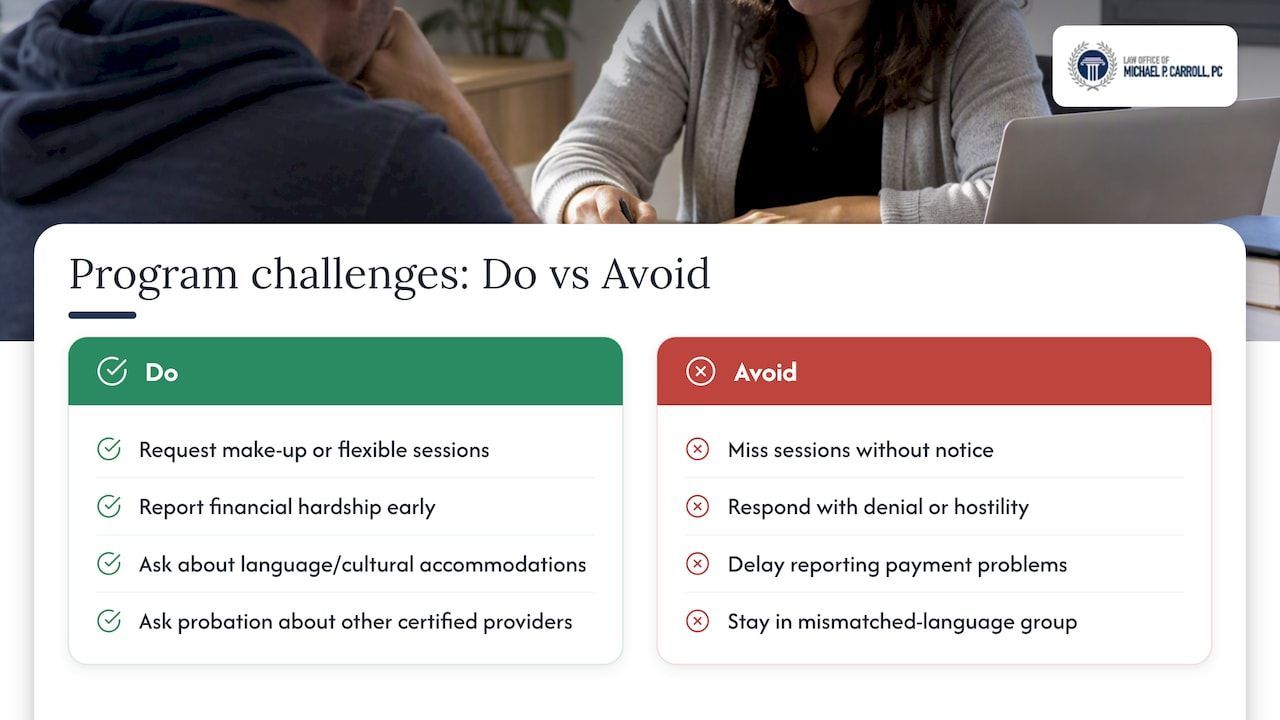
Scheduling conflicts are the most frequent obstacle, since a weekly group format collides with shift work, childcare, or transportation gaps in a way self-paced programs would not. Most certified providers build in some flexibility for make-up sessions, but that flexibility is not unlimited, and repeated absences without notice can trigger a suitability review rather than a simple reschedule.
Participants sometimes struggle with the content itself, particularly early sessions that ask them to describe the incident that led to the order. Facilitators are trained to work through resistance and minimization as part of the curriculum rather than treating it as a reason for immediate discharge, but ongoing denial or hostility toward the process can affect a provider's assessment of whether someone is engaging in good faith.
Cost is another recurring friction point. Between the $350 assessment and program fees, participants who did not request a sliding-scale rate or waiver at intake sometimes fall behind on payment, which can jeopardize continued enrollment. Raising financial hardship early, rather than after fees pile up, tends to produce better outcomes with both the provider and the court.
Finally, language and cultural barriers affect engagement for some participants, since not every certified provider offers non-English sessions or culturally specific programming. Where that mismatch exists, asking the provider directly about available accommodations, or asking probation about alternative certified providers in the region, is a more productive path than continuing in a group format that is not a good fit.
Resources for additional support services linked with IPAE
An IPAEP addresses the person ordered to attend, but the surrounding case often involves needs a 12-week or year-long education program does not cover. Certified providers coordinate with local domestic violence agencies as part of the state's coordinated community response model, which connects partners and families to victim services, though participation on the partner's side stays optional rather than mandatory.
For participants themselves, many regions have counseling resources separate from the IPAEP curriculum, useful for underlying issues like substance use or mental health concerns that intersect with but are distinct from the education program's scope. Housing instability sometimes accompanies a domestic violence case as well, particularly when a no-contact order requires one party to leave a shared residence; local housing authorities and legal aid organizations can help with that separate, practical problem.
None of these resources substitute for the certified program itself when a court has ordered one, and none of them extend or shorten the 80-hour requirement. They exist alongside the program to address the broader circumstances a criminal or 209A case tends to surface.
Process and criteria for dismissal or appeal if ordered improperly
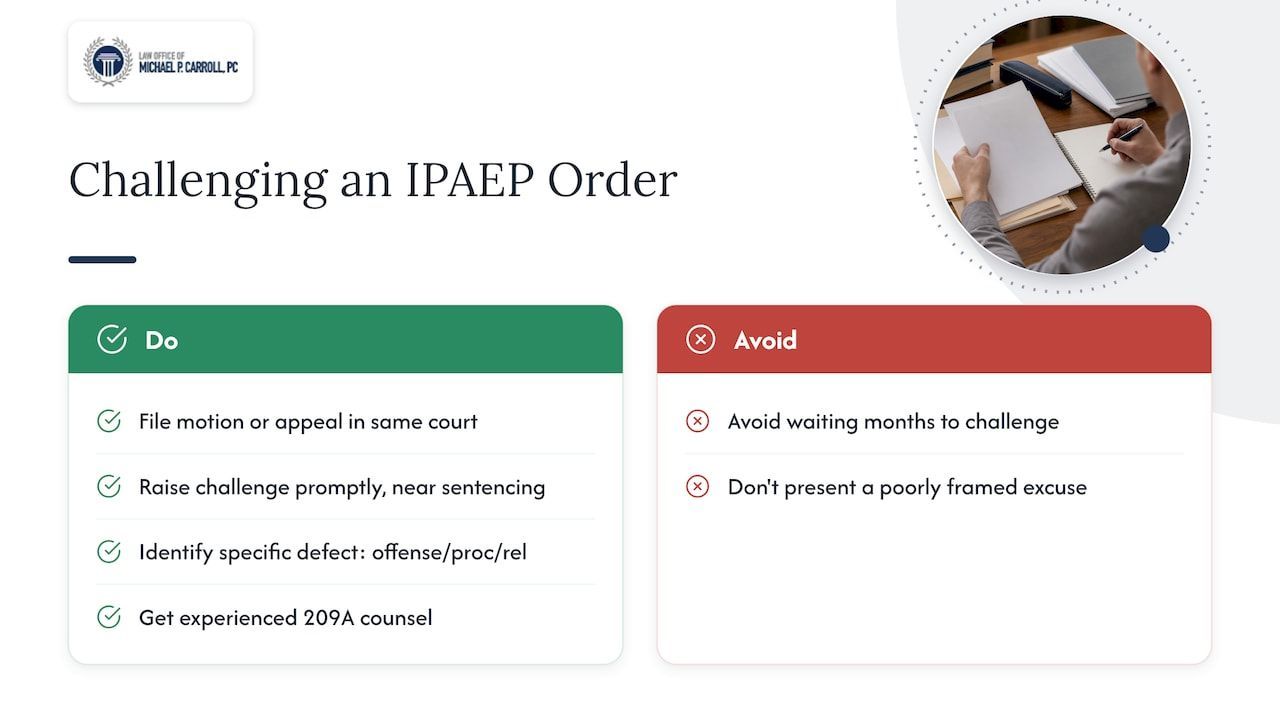
An IPAEP order is not automatically beyond challenge. Because G.L. c. 209A, Section 7 requires specific written good-cause findings when a judge declines to order the program, the flip side is that a defendant can argue the order itself was entered without proper basis, particularly if the underlying offense does not fit the statute's qualifying categories or if the relationship between the parties does not meet the family-or-household-member or intimate-partner definition Chapter 209A uses.
Raising this kind of challenge generally means filing a motion or pursuing an appeal through the same court that entered the order, laying out the specific defect: wrong offense category, procedural error, or a relationship that does not meet the statutory definition. Timing matters considerably, since courts expect these challenges raised promptly rather than after months of noncompliance, and waiting until a probation violation hearing to argue the underlying order was improper is a much weaker position than raising it at or near sentencing.
Because this kind of motion involves statutory interpretation and court procedure rather than a simple paperwork fix, most defendants benefit from experienced legal representation before filing anything. A poorly framed challenge can read as an attempt to avoid accountability rather than a legitimate procedural argument, which does not help a defendant's standing with the court. An attorney familiar with 209A practice can assess whether the order was entered correctly in the first place and, if not, identify the right procedural vehicle to raise it.
Legal perspective on priorities after receiving an IPAEP order
Your first priority after an IPAEP order should be documented compliance: confirm the certified provider, keep every intake and attendance record, and stay in direct contact with probation about scheduling. Program records can surface later in plea negotiations or sentencing discussions, so accuracy and follow-through matter beyond the immediate requirement. Getting legal advice early, before a fee dispute or attendance gap becomes a violation, tends to produce better outcomes than trying to fix it after the fact.
— Michael Carroll
Getting help with an IPAEP order or the case behind it
An IPAEP order rarely arrives on its own. It usually comes attached to a domestic assault charge, a 209A abuse prevention order, or probation conditions that carry real consequences if mishandled. Legal professionals work directly with clients on domestic assault and battery charges, restraining order matters, and the compliance hearings that follow when a probation condition is in dispute.

If you are trying to document indigency for a fee waiver, negotiate program terms with probation, or challenge an order you believe was entered incorrectly, working directly with an attorney who reviews the specifics of your case matters more than generic guidance. Contact the Law Office of Michael P. Carroll PC to schedule a consultation and go over your court paperwork before a deadline passes.
This article is general information, not a substitute for advice from a qualified lawyer. Consult a qualified legal professional about your own circumstances before acting on anything here.
Sources
FAQ
What happens in the batterers intervention program?
Participants attend certified group sessions covering accountability, recognizing controlling behavior, and the impact of abuse, building toward the 80-hour minimum DPH requires. Intake includes a suitability evaluation and signed agreements before group sessions begin, and providers report attendance and compliance to probation or the court.
How long is an abuse prevention order valid for in Massachusetts?
The duration of a 209A abuse prevention order is set by the judge case by case rather than by a single fixed statutory term, and it can be extended at a later hearing if circumstances warrant. An IPAEP condition attached to such an order runs on its own timeline tied to the 80-hour completion requirement, independent of when the protective order itself expires.
What state is number one in domestic violence?
National rankings on domestic violence rates vary by source, methodology, and year, and this article's scope is Massachusetts law and program requirements rather than interstate comparisons. For Massachusetts-specific rules on court-ordered programs and abuse prevention orders, Mass.gov's IPAE resources are the primary reference.
How effective are batterer programs?
Massachusetts requires certified IPAE programs specifically because unstructured or uncertified alternatives do not meet the state's accountability and safety standards. Effectiveness varies by individual engagement and circumstances, and DPH's Guidelines and Standards frame the program as one part of a broader coordinated community response rather than a standalone guarantee against reoffending.