
Win Release in 3–7 Days After Bail Revocation in Massachusetts
Win Release in 3–7 Days After Bail Revocation in Massachusetts

Massachusetts law allows a judge to revoke bail under G.L. c. 276, sections 58 and 58B, and once a revocation motion is filed the defendant typically faces detention at the first hearing unless the judge amends release conditions. Trial Court Guideline 8:07 governs how courts warn defendants and process these motions. Detention under a section 58 order caps at 60 days, while a section 58B order can run up to 90 days, not counting delays excluded under Rule 36(b)(2).
TL;DR:
- Massachusetts law allows up to 90 days of detention under section 58B for violations or new crimes, with delays extending this period.
- Revocation motions are typically filed after an arrest or police report, often leading to detention at the first hearing, sometimes without formal charges.
- The judge's decision can range from continuing or modifying release conditions to detaining the defendant, with detention being discretionary and less common.
- Defense responses should focus on immediate evidence of compliance, community ties, and proposing enforceable alternative conditions to avoid detention.
- Prosecutors have discretion to pursue revocation, but judges independently determine the outcome, considering less restrictive options first.
Table of Contents
- Which laws and official guidelines control bail revocation in Massachusetts
- What happens at a bail revocation hearing: procedure, rights, and timing
- Possible outcomes, timelines, and what triggers each outcome
- How to respond immediately and defense strategies at a revocation hearing
- Probation revocation vs. bail revocation: key differences and practical consequences
- Impact of bail revocation on pending criminal cases and pretrial release eligibility
- Role and influence of the District Attorney or Prosecutor in bail revocation proceedings
- Statistical data or typical frequency of bail revocations in Massachusetts for context
- What I've learned handling revocation cases in Massachusetts courts
- Getting help with a bail revocation motion in Massachusetts
- Key statutes, guidelines, and cases to consult
- Sources
- FAQ
Which laws and official guidelines control bail revocation in Massachusetts
Two statutes do the heavy lifting. General Laws chapter 276, section 58 lets a judge revoke release when a defendant is charged with committing a crime while already out on bail, and any resulting detention order is valid for 60 days. Section 58B goes further: a judge can revoke release on a finding of probable cause that the defendant committed a new crime while released, or on clear and convincing evidence that the defendant violated another condition of release. Detention under section 58B is capped at 90 days, excluding periods of delay defined under Mass. R. Crim. P. 36(b)(2). Certain offenses trigger a rebuttable presumption favoring detention, shifting the practical burden onto the defense to show conditions exist that would reasonably assure safety and appearance.
Trial Court Guideline 8:07 implements these statutes at the courtroom level. It requires judges to warn every defendant released on bail that committing a new offense can lead to revocation, and it sets out docketing and procedural expectations judges and clerks follow when a revocation motion is filed. In practice, this means:
- The warning is typically read into the record at the original bail hearing, not just at revocation.
- Clerks docket revocation motions separately from the underlying charge.
- Judges reference Guideline 8:07 when explaining the standard they are applying at the hearing.
What happens at a bail revocation hearing: procedure, rights, and timing
A defendant facing revocation has the right to counsel, and the hearing usually happens at the first court appearance after the motion is filed unless someone asks for more time. The mechanics follow a fairly predictable sequence:
- The Commonwealth or probation files the revocation motion, often tied to a new arrest or a reported violation.
- The court holds the hearing at first appearance, though either side can request a continuance.
- A defendant can get up to seven days; the Commonwealth or probation is limited to three business days under the statute governing continuances.
- During any continuance, the defendant is generally held without bail unless the judge finds conditions that will reasonably assure safety and appearance.
- The judge applies probable cause as the standard for a new-crime allegation, or clear and convincing evidence for other condition violations.
Formal charges do not need to be filed before the Commonwealth moves for revocation. An arrest and a police report alleging a new offense while on release is often enough to trigger the process, which surprises many defendants who assume they need to be formally charged first. That gap between arrest and formal charging is exactly why the first hearing matters so much: it is often the only chance to argue for release before weeks pass.
Possible outcomes, timelines, and what triggers each outcome
Once the hearing happens, a judge has a narrow set of options, and revocation is not automatic just because a violation occurred.
- Continue release on the existing conditions if the court finds no real change in risk.
- Amend conditions , adding electronic monitoring, curfews, or check-ins.
- Set or raise bail , converting a personal recognizance release into a monetary condition.
- Revoke bail and detain , up to 60 days under section 58 or 90 days under section 58B.
Detention under a section 58B order can run as long as 90 days, excluding delays defined by Rule 36(b)(2) , which means the clock can stop for defense-requested continuances, competency evaluations, and certain interlocutory appeals, often extending real-world detention well past the nominal cap.
If the new charge underlying the revocation gets dismissed, prior release is not automatically restored. Counsel typically has to file a motion asking the court to reinstate or amend conditions, arguing that the risk factor justifying detention no longer exists now that the new case is gone.
How to respond immediately and defense strategies at a revocation hearing
The first three to seven days after a revocation motion is filed decide most of what happens next, so speed matters more here than in almost any other stage of a criminal case.
- Call an attorney immediately , ideally before the first hearing, not after.
- Gather proof of compliance with existing bail conditions: check-in records, GPS monitoring logs, treatment attendance.
- Line up an employer or community contact willing to speak to stability and ties to the area.
- Collect documentary evidence relevant to the new allegation, including any exculpatory material.
On strategy, defense counsel generally has three levers: propose specific, enforceable alternate conditions such as electronic monitoring or supervised release; contest the probable cause finding directly when the new arrest is thin; or lean on community ties and lack of danger to argue detention isn't necessary. Judges tend to respond better to a written supervision plan with a named monitoring option than to a general promise to "do better." When a continuance is granted, use it to actually build that record: get the employer letter signed, confirm the treatment program enrollment, print the phone logs. A continuance without new evidence is a wasted week.
Pro Tip: Bring every document to the first meeting with counsel, not the hearing. An owner-operated practice like Michael P. Carroll's can review evidence and file responsive motions within the same short window the statute allows, rather than losing days to internal handoffs.
Probation revocation vs. bail revocation: key differences and practical consequences
Bail revocation and probation revocation share a courtroom but run on separate tracks with different stakes. Bail revocation concerns pretrial release on a pending case; probation revocation concerns a sentence already imposed, often suspended, where a violation can trigger execution of that sentence.
- Probation revocation requires a finding of probable cause before a probationer can be detained pending the final violation hearing, under Superior Court guidelines.
- If the court ultimately finds a violation, it can either continue probation on modified terms or revoke it and execute the suspended sentence.
- Forum matters: a District Court probation matter stays in District Court, while a Superior Court sentence with suspended time is reviewed there, and bail review motions generally follow the court that set the original conditions.
Someone facing both a new bail revocation and a probation violation on an older case is dealing with two separate proceedings, each with its own standard of proof and its own timeline. Related guidance on acting within 48 hours after a probation violation covers that track in more depth.
Impact of bail revocation on pending criminal cases and pretrial release eligibility
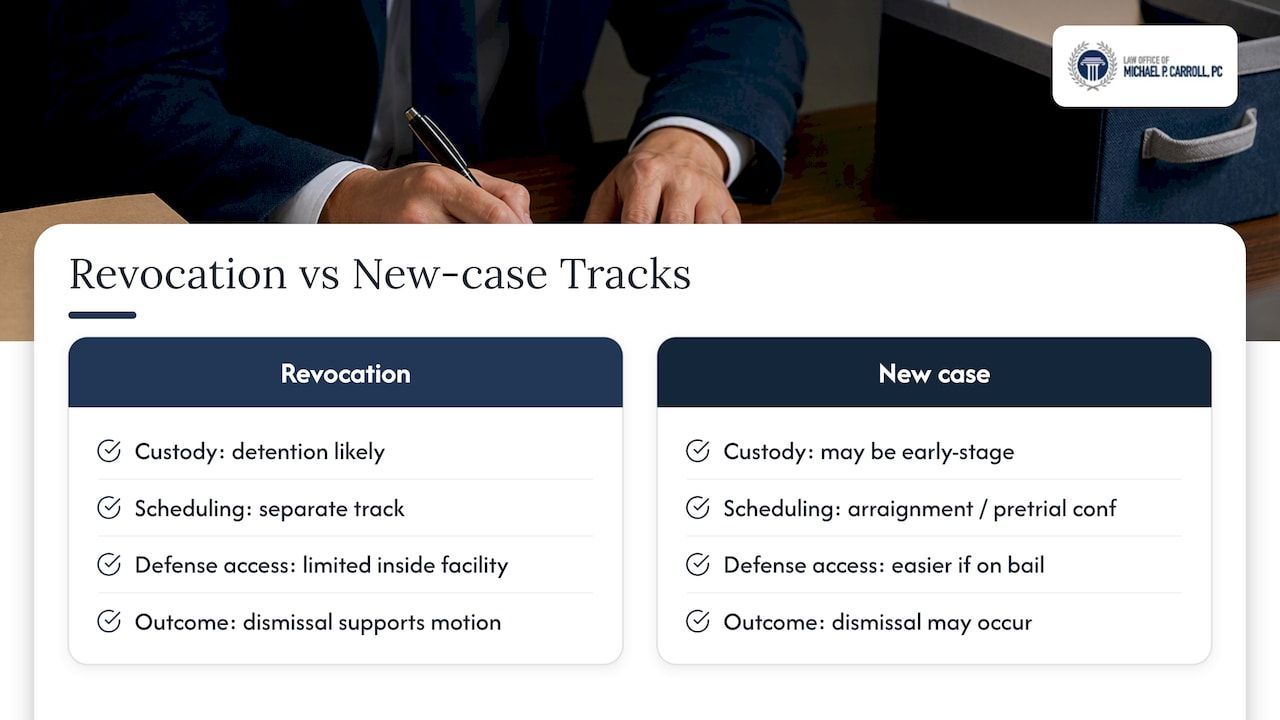
Revocation does not just affect custody status. It changes how the underlying criminal case moves forward and how the defendant is treated on any future release request. A detained defendant loses the practical ability to participate in case preparation the way someone free on bail can, and that limitation tends to slow plea negotiations and pretrial motion practice simply because meetings with counsel happen inside a facility on a schedule the defendant does not control.
Pretrial release eligibility on the original charge does not disappear because of a revocation order, but it becomes harder to reestablish. A judge who has already found probable cause of a new offense, or clear and convincing evidence of a violation, is unlikely to revert to the original conditions without a specific reason to trust the defendant again. That reason usually has to come from the defense, not from the passage of time alone.
The new case itself is also affected. Revocation proceedings run on their own track, separate from arraignment and pretrial conference on the new charge, which means a defendant can be detained on the revocation while the new case is still at an early procedural stage. If the new charge is eventually dismissed or resolved favorably, that outcome can support a motion to reinstate the original release, but it is not automatic relief. Counsel has to actively bring that development back to the judge who ordered detention and ask for reconsideration, framed around the risk factors the court originally cited.
Role and influence of the District Attorney or Prosecutor in bail revocation proceedings
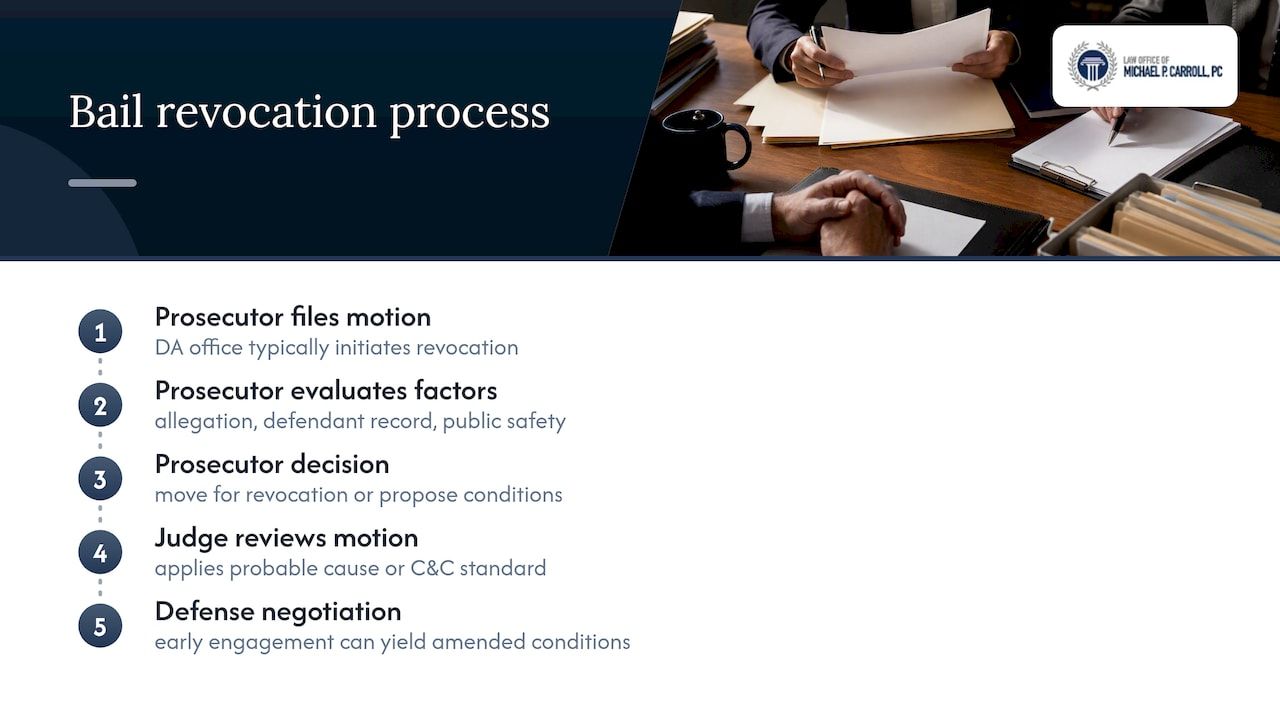
The District Attorney's office typically initiates the revocation motion, and prosecutors have real discretion over whether to pursue detention aggressively or to agree to amended conditions instead. That discretion shapes the hearing before it even starts.
A prosecutor deciding to move for revocation is weighing the strength of the new allegation, the defendant's record on the original case, and any public safety concerns raised by the arresting agency. Because the statute allows revocation on probable cause for a new crime, a relatively thin police report can be enough to support the motion, and prosecutors sometimes push forward even when the new charge is contested. That reality is part of why defense counsel benefits from engaging directly with the prosecutor's office early, before the hearing, when a negotiated set of amended conditions might resolve the matter without a contested detention fight.
At the same time, prosecutors do not have unilateral authority to revoke bail. The motion still has to go before a judge, who applies the probable cause or clear and convincing evidence standard independently. A prosecutor's recommendation carries weight, particularly when the office flags a specific safety concern, but Trial Court guidance on pretrial release alternatives directs judges to consider less restrictive options even when the Commonwealth is asking for detention. In practice, a well-prepared defense response can move a prosecutor toward agreeing to conditions rather than litigating a full detention hearing, particularly when the community ties and compliance record are strong.
Statistical data or typical frequency of bail revocations in Massachusetts for context
There is no comprehensive, publicly available count of how often Massachusetts courts revoke bail statewide in a given year, and readers should treat any specific frequency figure circulating online with caution unless it links to a named court or state data source. What is documented is the legal framework itself: the Josh J. v. Commonwealth decision from the Supreme Judicial Court confirmed that sections 58 and 58B operate as separate, coexisting tools the Commonwealth can use depending on the facts, and rejected the argument that the two-statute structure is ambiguous.
That case matters more than a raw frequency number would, because it tells you which statute is likely to apply to a given fact pattern. A defendant released under section 58 conditions can still be revoked under the broader section 58B standard if the facts support it, meaning the original release mechanism does not limit which revocation statute the Commonwealth can invoke later. Massachusetts guidance also frames revocation as discretionary rather than automatic, even where a violation is proven, which means the practical rate of full detention orders likely runs lower than the rate of revocation motions filed. Judges are directed to weigh less restrictive alternatives first. Anyone looking for a firm statewide percentage should look to future published Trial Court or Executive Office of Public Safety data rather than assume a number that has not been officially released.
What I've learned handling revocation cases in Massachusetts courts
Bail revocation hearings move fast, and the biggest mistake I see is defendants treating the first hearing like a formality instead of the moment that decides whether they spend the next 60 to 90 days in custody. The window to build a real record, employer letters, treatment proof, a written supervision plan, is measured in days, not weeks.
As an owner-operated practice, I review the motion and the underlying police report personally, usually within hours of a client's call, and file whatever responsive motion the continuance window allows. I tell clients directly what the likely range of outcomes looks like given the specific statute at issue, because vague reassurance does not help someone deciding whether to gather evidence tonight or wait until morning.
— Michael Carroll
Getting help with a bail revocation motion in Massachusetts
If you or someone in your family is facing a revocation motion, the fastest path to a better outcome is direct, personal contact with the attorney handling your case, not a call center. The Law Office of Michael P. Carroll PC works criminal defense matters directly with Michael, including revocation hearings, probation violation defense, and the underlying charges that often trigger them, from DUI and OUI to domestic assault allegations.

Before your hearing, gather your bail receipt, any proof of compliance with current conditions, and contact information for anyone who can speak to your stability. For urgent hearings, including clerk magistrate and probable cause matters, reach out through the criminal lawyer contact page to get a same-window response while the continuance clock is still running.
Key statutes, guidelines, and cases to consult
Bring these citations to your first meeting with counsel so the conversation starts from the same legal footing:
- G.L. c. 276, section 58B, the primary revocation statute and its 90-day cap.
- Trial Court Guideline 8:07, on required bail warnings and hearing procedure.
- Trial Court Guidelines for Pretrial Release, on alternatives to detention.
- Superior Court Guidelines for Probation Violation Proceedings.
- Josh J. v. Commonwealth, on how sections 58 and 58B relate.
For a comparative look at how another state's bail rules affect repeat offenders, see this California bail policy overview, which does not apply in Massachusetts but offers useful contrast.
This article is general information, not a substitute for advice from a qualified lawyer. Consult a qualified legal professional about your own circumstances before acting on anything here.
Sources
FAQ
What happens at a bail revocation hearing?
The judge reviews whether there is probable cause of a new crime or clear and convincing evidence of another violation, then decides whether to continue release, amend conditions, or detain the defendant. The hearing usually happens at the first court appearance unless a continuance is granted, with detention typically in effect during any continuance.
Is jail time mandatory after a bail revocation?
No. Massachusetts courts treat revocation as discretionary, and Trial Court guidance directs judges to weigh less restrictive alternatives, such as amended conditions or electronic monitoring, before ordering detention. A judge can also simply continue the existing release conditions if the facts don't support a higher risk finding.
Can you get your bail money back if your case is dismissed?
Generally, yes, cash bail is returned once a case concludes, though a revocation order tied to a separate new charge does not automatically restore release on the original case. Counsel typically needs to file a motion asking the court to reinstate or amend the original conditions once the new matter resolves.
Why would bail get revoked in Massachusetts?
Bail is most often revoked when a defendant is arrested for a new crime while already released on an earlier case, giving the court probable cause under section 58B. It can also be revoked on clear and convincing evidence of a different condition violation, such as missing required check-ins or violating a no-contact order.