
What to Do After a DUI Arrest in Rhode Island
What to Do After a DUI Arrest in Rhode Island

A DUI arrest sets two separate legal clocks running at once, and missing either deadline can cost you your license, your freedom, or both. Knowing what to do after a DUI arrest means acting within hours, not days. Rhode Island drivers face the same dual-track system as most states: an administrative process managed by the DMV and a criminal case handled by the courts. These tracks operate independently, carry different consequences, and demand different responses. The single most urgent action is requesting your DMV hearing before the deadline expires.
What are the first steps to take right after a DUI arrest?
The first 72 hours after a DUI arrest are the most legally consequential period of your case. Evidence disappears, deadlines tick down, and anything you say publicly can be used against you. Acting deliberately during this window protects your options later.
Write down everything you remember about the stop as soon as possible. Include the time, location, weather conditions, road conditions, what the officer said, how field sobriety tests were administered, and whether you were read your rights. Memory fades fast, and these details can become the foundation of your defense.
Preserve every piece of supporting evidence you can access. GPS data from your phone, receipts from restaurants or stores, and contact information for any witnesses all matter. Dashcam and body-worn camera footage is often the most important evidence in DUI cases but can be deleted within weeks due to law enforcement retention policies.
- Write a detailed account of the stop, including officer behavior and test instructions
- Save GPS history, receipts, or any digital record of your location that evening
- Collect witness names and contact details before people forget or disperse
- Research Rhode Island's DMV hearing request deadline immediately
- Set all social media accounts to private without posting anything about the arrest
Social media posts are monitored by prosecutors and insurers. Even vague status updates can be used against you in court or to deny insurance claims. Say nothing publicly.
Pro Tip: Write your account of the arrest in a private notes app or email it to yourself. This creates a timestamped record that your attorney can use to identify inconsistencies in the police report.

How does the two-track legal process work after a DUI arrest?
A DUI arrest triggers two completely separate legal proceedings. Most people focus only on the criminal case, which is a costly mistake. Understanding both tracks is the first step in building a real defense.
The administrative track is run by the Rhode Island Division of Motor Vehicles. It focuses exclusively on your driving privileges. If you fail or refuse a breathalyzer, the DMV can suspend your license independently of any criminal outcome. You must request a hearing to contest this suspension, and the deadline is strict.
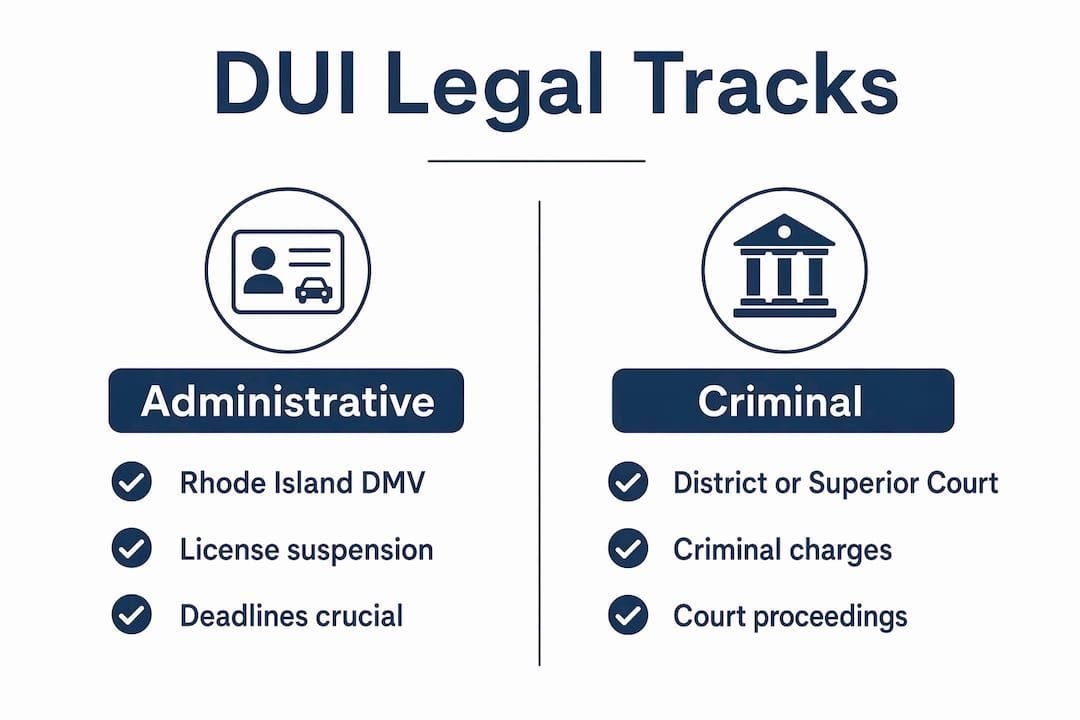
The criminal track runs through the Rhode Island District Court or Superior Court, depending on the severity of the charge. This is where fines, probation, jail time, and a criminal record are decided. A judge or jury determines guilt based on evidence, witness testimony, and legal arguments.
Winning a DMV hearing does not resolve criminal charges. Conversely, a criminal acquittal does not overturn an administrative license suspension. These two outcomes are entirely independent of each other.
| Track | Authority | Focus | Key Deadline |
|---|---|---|---|
| Administrative | Rhode Island DMV | License suspension | 7–15 days to request hearing |
| Criminal | District or Superior Court | Fines, jail, criminal record | Arraignment within 1–4 weeks |
| Both | Independent of each other | Separate outcomes | Missing either has permanent consequences |
The table above shows why you cannot afford to focus on one track and ignore the other. An attorney who handles both simultaneously gives you the best chance of protecting your license and your record.
What legal deadlines and documents must you handle after a DUI arrest?
The DMV hearing request deadline is the single most commonly missed deadline in DUI cases. Most states impose a strict deadline of 7 to 15 days after arrest to request an administrative hearing. Missing it results in automatic license suspension with no opportunity to appeal the timing.
Rhode Island follows a similar tight window. The suspension notice you receive at arrest contains the deadline, but it is often buried in paperwork and easy to overlook. Filing the request in writing, correctly, before the deadline is non-negotiable.
Here are the key documents and actions to manage in the days following your arrest:
- Suspension notice. Read it immediately. It contains your DMV hearing deadline and instructions for filing a request.
- Arrest report. Request a copy from the arresting agency. It documents the officer's observations, the basis for the stop, and test results.
- Breathalyzer calibration records. These logs show whether the device used was properly maintained and certified. Errors here can challenge test results.
- Dashcam and body camera footage. Submit a formal written request to the police department as soon as possible. Retention periods can be as short as 30 days.
- Arraignment notice. At arraignment, you will be formally charged and may receive an early plea offer. Never respond to a plea offer without legal counsel present.
Pro Tip: File your DMV hearing request by certified mail with return receipt. This creates a paper trail proving you met the deadline, which matters if the DMV claims it was not received.
Failing to file a DMV hearing request in writing within the required window results in automatic license suspension that cannot be reversed later. No exceptions apply.
How can an attorney help you after a DUI arrest?
A DUI defense attorney does not just show up to court. The attorney's work begins the moment you make contact, and the early actions often determine the outcome of the entire case.
The attorney's first task is filing the DMV hearing request before the deadline. This alone preserves your driving privileges while the case proceeds. Without that filing, your license is suspended automatically regardless of what happens in criminal court.
From there, the attorney reviews every piece of evidence for weaknesses. Defense attorneys review breathalyzer calibration logs, field sobriety test administration, and police reports for inconsistencies that can support suppression motions or challenge the prosecution's case. A Motion to Suppress, for example, can exclude evidence obtained through an unlawful stop or improper test procedure.
Key tasks a qualified DUI defense attorney handles:
- Requesting the DMV administrative hearing before the deadline expires
- Obtaining and reviewing dashcam footage, body camera video, and police reports
- Analyzing breathalyzer calibration records and field sobriety test procedures
- Filing pretrial motions, including Motions to Suppress unlawfully obtained evidence
- Negotiating plea agreements when the evidence warrants it
- Representing you at both the DMV hearing and all criminal court appearances
Early consultation matters because early legal intervention is critical to secure evidence before retention policies cause permanent loss. Ask any attorney you consult how many DUI cases they have handled, whether they handle both administrative and criminal tracks, and what their approach is to evidence review.
Mpclaw, the Law Office of Michael P. Carroll PC, handles both tracks and works directly with clients throughout the process. That owner-operated model means you speak with your attorney, not a case manager.
What common mistakes should you avoid after a DUI arrest?
The most damaging mistakes after a DUI arrest are not made in court. They happen in the first few days, before most people have even spoken to an attorney.
Ignoring the charge is the most serious error. A DUI in Rhode Island does not resolve itself. Fines for a first offense can range from $150 to over $1,250, and total costs often reach tens of thousands of dollars when you factor in insurance increases, ignition interlock device requirements, and DUI education programs. That financial reality alone demands immediate attention.
Missing the DMV hearing request deadline is the single most commonly missed step after a DUI arrest. Once the window closes, automatic license suspension takes effect and cannot be undone. No amount of legal skill reverses a missed administrative deadline.
Talking about the case is the second most common mistake. Telling friends, family, or coworkers what happened feels natural, but those conversations are not protected. Only communications with your attorney carry legal privilege. Defendants should avoid any public or social media discussion of their arrest, as these may undermine the defense and affect insurance claims.
Delaying contact with a DUI defense attorney compounds every other mistake. The longer you wait, the more evidence disappears and the fewer options remain. Contact an attorney within 24 hours of release if at all possible.
Key Takeaways
The most critical action after a DUI arrest is filing the DMV hearing request within 7–15 days, because missing it causes automatic license suspension that no court outcome can reverse.
| Point | Details |
|---|---|
| File the DMV hearing request immediately | The deadline is 7–15 days from arrest; missing it triggers automatic license suspension. |
| Document everything within 24 hours | Write down all arrest details, preserve receipts, GPS data, and witness contacts before memory fades. |
| Understand the two-track system | Administrative and criminal proceedings are independent; winning one does not resolve the other. |
| Request dashcam footage early | Retention policies can delete footage in weeks; a written request must go out immediately. |
| Avoid social media entirely | Prosecutors and insurers monitor posts; even vague updates can damage your defense and insurance claim. |
What I've seen happen when people wait too long
After more than a decade handling DUI and OUI cases in Massachusetts and the surrounding region, the pattern I see most often is not a bad arrest. It is a good case that fell apart because the client waited.
The dual-track system genuinely surprises most people. They focus entirely on the criminal charge and assume the license issue will sort itself out. It does not. The DMV operates on its own timeline, and by the time someone calls me after missing the administrative deadline, that part of the case is already over. The license is gone. We can still fight the criminal charge, but we lost a significant piece of leverage.
The first 72 hours are not just important. They are often the difference between a case with real options and one where you are managing damage. Dashcam footage gets deleted. Witnesses forget details. The police report hardens into the official narrative. Every day without an attorney is a day the prosecution's version of events goes unchallenged.
What I tell every new client is this: an arrest is not a conviction. A common misconception is equating the two. The legal process exists precisely to test the evidence, and the evidence in DUI cases is often more fragile than it looks. Breathalyzer calibration issues, improper field sobriety test instructions, and unlawful stops are real and defensible problems. But you need time and documentation to find them.
Call an attorney the same day you are released. Bring every document you received at arrest. Write down everything you remember before you sleep. Those three steps alone put you in a dramatically better position than most people who walk through my door.
— Rich
Facing a DUI charge? Here is how Mpclaw can help
Mpclaw, the Law Office of Michael P. Carroll PC, has spent over a decade defending clients against DUI, OUI, and DWI charges across Bristol, Norfolk, and Plymouth Counties in Massachusetts. The firm handles both the administrative DMV process and the criminal court case, so nothing falls through the cracks.
Michael P. Carroll works directly with every client, from the first call through the final resolution. That means you get consistent, focused representation from an attorney who knows your case. If you are facing a DUI charge in Massachusetts or a neighboring jurisdiction, the time to act is now. Contact Mpclaw to protect your driving privileges, preserve your defense options, and get clear answers about what comes next. The consultation starts the process that the deadline demands.
FAQ
What is the first thing to do after a DUI arrest?
Request your DMV administrative hearing in writing within 7–15 days of arrest and contact a DUI defense attorney immediately. Missing the DMV deadline results in automatic license suspension that cannot be reversed.
How long does a first DUI case take to resolve?
First-offense DUI cases generally resolve in 3–6 months, depending on court schedules, evidence review, and whether a plea or trial is pursued.
Can I lose my license even if I win the criminal case?
Yes. The administrative and criminal tracks are independent. A criminal acquittal does not overturn an administrative license suspension imposed by the DMV.
Should I accept an early plea offer at arraignment?
Never respond to a plea offer without an attorney present. Early plea offers arrive before evidence is fully assembled, and accepting one prematurely can waive defenses you have not yet discovered.
How much does a DUI conviction cost in total?
Fines alone range from $150 to over $1,250 for a first offense, but total costs including insurance increases, ignition interlock devices, and DUI education programs often reach tens of thousands of dollars.