
Massachusetts Statute of Limitations: 3, 6 Year Rules, With Citations
Massachusetts Statute of Limitations: 3, 6 Year Rules, With Citations

In Massachusetts, most personal injury lawsuits must be filed within a few years under M.G.L. c.260 §2A, most contract claims within several years under M.G.L. c.260 §2, and most crimes within a standard period unless a statute sets a longer or unlimited window under M.G.L. c.277 §63. Some offenses, including murder and certain child sex crimes, carry no deadline at all. Because tolling rules can pause these clocks and missing a deadline usually ends a case for good, anyone facing a close call should get a lawyer to check the exact dates immediately.
TL;DR:
- Most personal injury claims in Massachusetts must be filed within three years, but tolling due to concealment or defendant absence can extend this period.
- Contract disputes require filing within six years, with exceptions for certain old obligations that have a 20-year limit.
- Criminal prosecution for most offenses is limited to six years, but serious crimes like murder have no deadline, and sexual offenses often have delayed start dates.
- Prosecutions for sexual crimes can proceed beyond 27 years only if corroborating evidence is presented, and the clock pauses if the defendant leaves Massachusetts.
- Act promptly by identifying relevant dates, gathering documentation, and consulting a lawyer quickly if deadlines are near or passed.
Table of Contents
- How Massachusetts Statute of Limitations Deadlines Break Down by Case Type
- Civil Limitation Periods Under Massachusetts Chapter 260
- What Are the Criminal Statute of Limitations Rules in Massachusetts?
- Tolling and Delayed Accrual: When the Clock Stops or Never Starts
- What to Do If You Think a Deadline Is Close or Already Passed
- How I Evaluate Time-Bar Questions in Massachusetts Criminal Cases
- Get Help Reviewing Your Massachusetts Case Deadline
- Sources
- FAQ
How Massachusetts Statute of Limitations Deadlines Break Down by Case Type
Before diving into the statutory language, it helps to see the common deadlines side by side. Each period below traces back to a specific chapter and section of Massachusetts law, and the differences between them are not small. A three-year miss on a personal injury claim and a six-year miss on a contract dispute both end the same way: the court throws the case out, regardless of how strong it might have been.
| Case type | Limitation period | Statutory source |
|---|---|---|
| Personal injury (tort) | 3 years | M.G.L. c.260 §2A |
| Medical malpractice | 3 years (discovery rule may apply) | M.G.L. c.260 §4 |
| Breach of contract | 6 years | M.G.L. c.260 §2 |
| Contracts under seal, certain judgments | 20 years | M.G.L. c.260 §1 |
| Most misdemeanors | 6 years | M.G.L. c.277 §63 |
| Robbery and similar felonies | 10 years | M.G.L. c.277 §63 |
| Rape | 15 years | M.G.L. c.277 §63 |
| Murder; certain child sex offenses | No limit | M.G.L. c.277 §63 |
That last row deserves a footnote. When prosecutors bring an indictment for a sexual offense more than 27 years after it happened, the law requires independent corroborating evidence before the case can move forward. It is a safeguard built into the system precisely because memories fade and records disappear over decades, and lawmakers wanted a check against stale accusations built on nothing but recollection.
Civil Limitation Periods Under Massachusetts Chapter 260
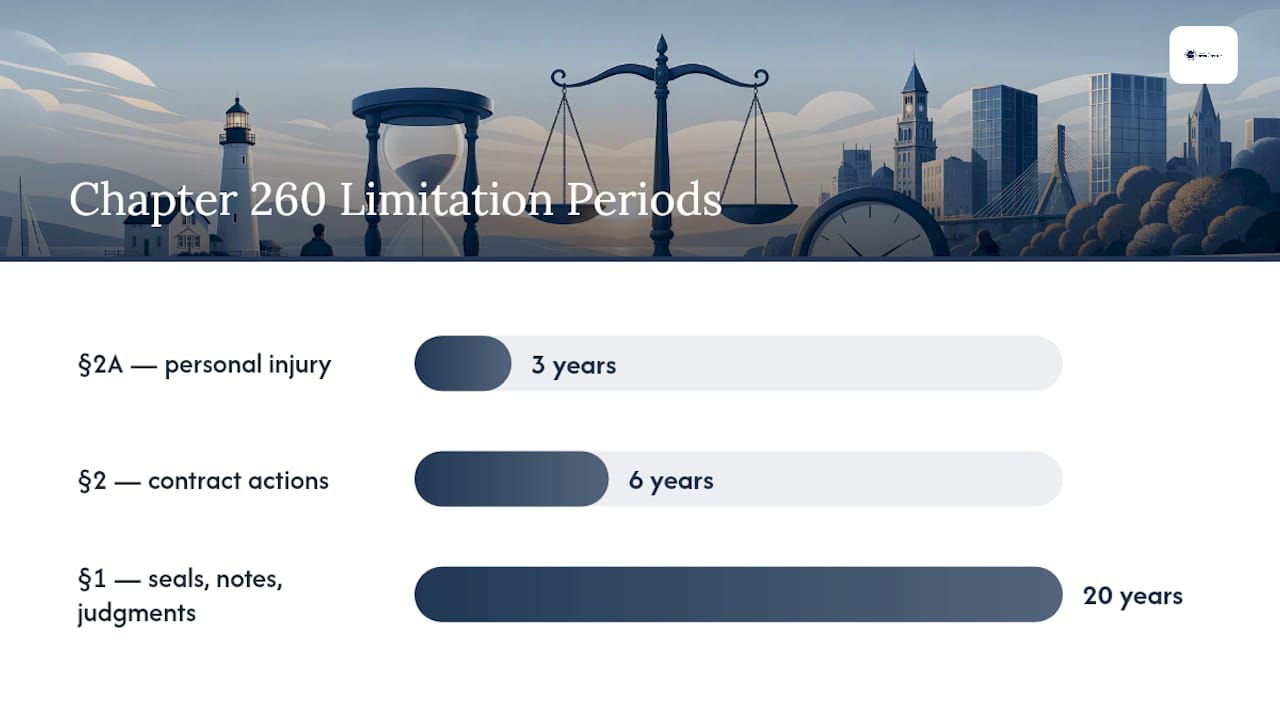
Chapter 260 of the Massachusetts General Laws is where nearly every civil deadline lives, and two sections do most of the work. Section 2A gives personal injury claims a three-year window, covering car accidents, slip-and-falls, dog bites, and most negligence claims you can imagine. Section 2 governs contract actions and gives plaintiffs six years, which covers everything from an unpaid invoice to a breached lease.
The distinction matters because the same set of facts can sometimes support both a tort claim and a contract claim, and the deadlines diverge. A contractor who botches a job might be sued for breach of contract within six years, but a claim that the same contractor's negligence caused physical injury falls under the three-year tort clock. Filing under the wrong theory, or waiting too long to sort out which one applies, can cost a plaintiff the entire case.
Chapter 260 also carves out a separate, longer category. Section 1 lists actions, mostly involving contracts under seal, certain promissory notes, and judgments of courts of record, that must be commenced within 20 years. These are rare in ordinary consumer disputes but matter in commercial litigation and estate matters where old obligations resurface.
Fraudulent concealment adds another layer. Section 12 of Chapter 260 tolls, or pauses, the limitation period when a defendant actively conceals the existence of a cause of action from the person who would otherwise sue. If a contractor deliberately hides a structural defect and a homeowner has no reasonable way to discover it, the clock does not start running until the concealment is uncovered.
Accrual is the concept that decides when any of these clocks actually starts, and it is not always the date of the injury itself. Massachusetts courts generally use two approaches:
- Occurrence rule : the clock starts the moment the harmful event happens, which is the default for most car accidents and straightforward injury claims.
- Discovery rule : the clock starts when the plaintiff knew, or reasonably should have known, that they were harmed and who caused it, which is common in medical malpractice and latent-defect cases.
A surgical error that is not discovered until a follow-up scan two years later illustrates the discovery rule well. The three-year clock on that malpractice claim typically starts at discovery, not at the original surgery date, though courts scrutinize how "discoverable" the injury reasonably was. Once a court determines a claim is time-barred, it will dismiss it regardless of merit. Judges do not weigh the strength of the evidence once the deadline has passed. The case simply ends.
What Are the Criminal Statute of Limitations Rules in Massachusetts?
Criminal deadlines in Massachusetts run through a single statute, M.G.L. c.277 §63, and the structure is tiered rather than uniform. Understanding which tier applies to a specific charge often determines whether prosecution is even possible.
- Six-year default. Most misdemeanors and many felonies fall under this baseline, covering the bulk of criminal charges Massachusetts prosecutors file every year, from larceny to many assault charges.
- Ten-year tier. Certain more serious felonies, including armed robbery, get an extended window under Section 63, reflecting the greater investigative complexity and harm involved.
- Fifteen-year tier. Rape carries this longer period, a deliberate legislative choice recognizing that victims of sexual assault often take years to come forward.
- No limitation at all. Murder can be prosecuted at any point, no matter how much time has passed. Certain child sex offenses also carry no deadline, a category the legislature has expanded over the years as understanding of delayed disclosure in child abuse cases has grown. FindLaw's summary of these tiers is a useful plain-language companion to the statutory text.
- Deferred start for child victims. When the victim of certain sexual offenses is under 16 at the time of the crime, the limitation period does not begin until the victim turns 16 or reports the offense to law enforcement, whichever happens first. That rule alone has allowed prosecutions decades after the underlying conduct.
Two additional wrinkles apply across every tier. First, indictments filed more than 27 years after a qualifying sexual offense require corroborating evidence beyond the complainant's testimony, an evidentiary check built directly into the delayed-disclosure framework. Second, Section 63 excludes from the calculation any period during which the defendant is "not usually and publicly a resident within the Commonwealth." In plain terms, if someone leaves Massachusetts and lives elsewhere, that time does not count toward the limitation clock. Prosecutors can effectively "pause" the deadline for as long as a defendant stays away.
Conspiracy and accessory charges do not get their own separate clock. They follow the timeframe of the underlying substantive offense, so a conspiracy to commit armed robbery carries the same 10-year period as the robbery charge itself.
Tolling and Delayed Accrual: When the Clock Stops or Never Starts
Tolling means the limitation period is legally paused, and Massachusetts recognizes several distinct grounds for it in both civil and criminal contexts.
- Defendant absence from the state. Under Section 63, time spent outside Massachusetts without a usual, public residence here does not count against the criminal statute of limitations.
- Fraudulent concealment. In civil cases, Section 12 of Chapter 260 pauses the clock when a defendant actively hides the facts giving rise to a claim.
- Minor victims of sexual offenses. The clock does not start until the victim turns 16 or reports the crime, whichever comes first, rather than at the moment the offense occurred.
- Discovery-rule accrual in civil cases. The clock can start later than the date of injury when the harm was not, and reasonably could not have been, discovered right away.
Pleading tolling is not a formality. A plaintiff or prosecutor invoking it typically has to allege specific facts, dates the defendant was out of state, exactly what was concealed and when it came to light, or when a minor victim reported the offense, rather than a vague assertion that "the deadline should not apply."
Here is how that plays out. Imagine a Massachusetts resident is defrauded by a contractor in 2019, but the contractor moves to Florida in 2020 and never returns. If the six-year contract clock (assuming a fraud-adjacent contract claim) would otherwise expire in 2025, the years the contractor spent living in Florida might not count against that deadline at all, depending on the specific residency facts and how courts have applied similar issues in analogous cases.
Pro Tip: If you think a defendant left Massachusetts at any point during the relevant period, start gathering proof now, leases, utility bills, out-of-state employment records. Residency gaps are often the difference between a case that survives and one that gets dismissed.
What to Do If You Think a Deadline Is Close or Already Passed
Acting fast rarely hurts and often helps, especially when you are not certain how much time is actually left.
- Pin down every relevant date. Write down when the injury, contract breach, or alleged crime occurred, and when it was discovered if that differs from when it happened.
- Check the statute directly. Read the specific section that applies to your situation rather than relying on general summaries, since exceptions and tiers change the outcome significantly.
- Preserve every document now. Medical records, contracts, emails, and police reports have a way of disappearing exactly when you need them most. Do not wait for a lawyer to ask before you start collecting them.
- Document any evidence of the other party's residency or absence. This matters most in cases where tolling might apply.
- Call an attorney immediately if a deadline is within months. Emergency civil pleadings exist for exactly this situation, and in criminal matters, early counsel can affect everything from a bail argument to a motion to dismiss.
Before an initial consultation, bring copies of any contracts, medical records, police reports, correspondence with the other party, and a written timeline of events. The more organized that information is, the faster an attorney can tell you where you actually stand.
How I Evaluate Time-Bar Questions in Massachusetts Criminal Cases
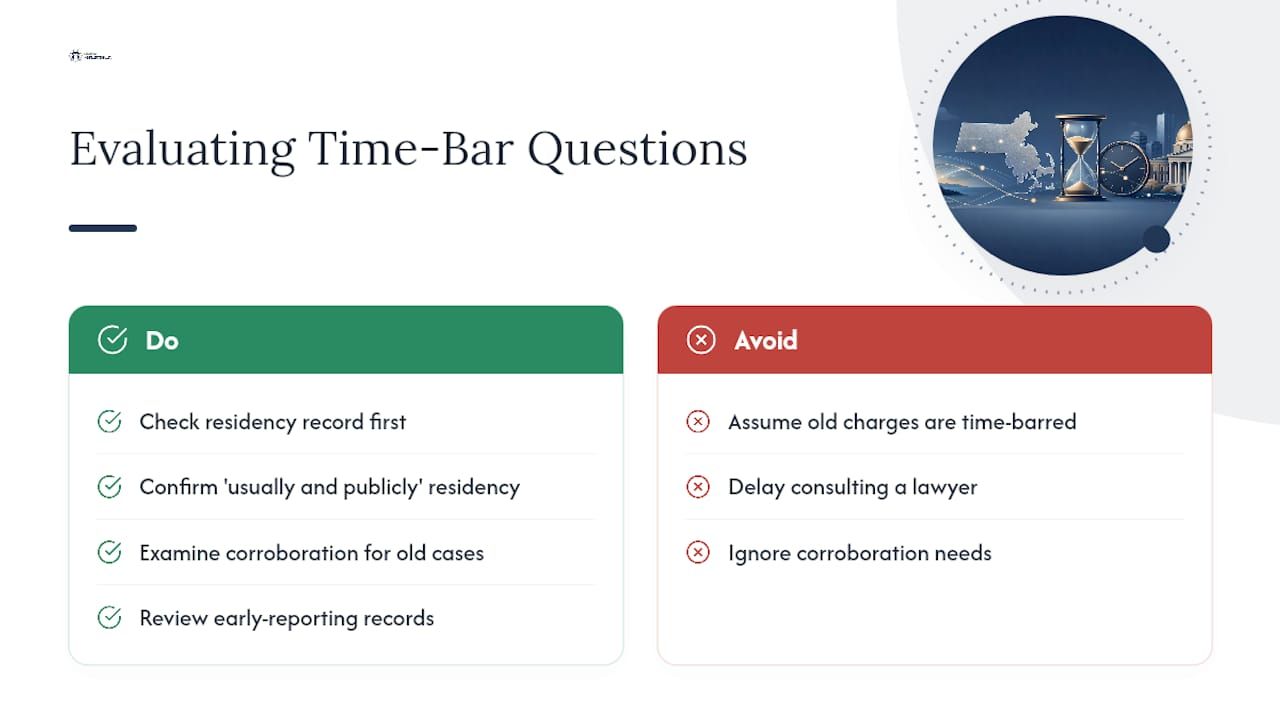
Statute of limitations questions rarely have a one-line answer, which is exactly why I dig into the residency record first. When a case turns on whether a defendant was "usually and publicly a resident" of Massachusetts during a given stretch, that determination often decides the entire prosecution. I also look closely at corroboration requirements in older cases and at early-reporting records, since those documents frequently clarify when a clock actually started running.
Clients on both sides of the docket benefit from getting this reviewed early. A potential civil claimant who waits to consult a lawyer can watch a valid claim expire through simple inattention. A criminal defendant who assumes an old charge is automatically time-barred can be badly surprised. Neither situation improves with delay.
— Michael Carroll
Get Help Reviewing Your Massachusetts Case Deadline
Reading the statute is one thing. Knowing exactly how it applies to your dates, your county, and your specific charge is another, and that gap is where cases get lost. Law Office of Michael P Carroll works directly with clients across Bristol, Norfolk, and Plymouth counties, including Quincy, on criminal defense matters ranging from OUI and DUI to domestic assault charges, harassment prevention orders, and felony cases where timing questions can make or break a defense.

A case review starts with the same information covered above: your charge or claim, the relevant dates, and any documentation you already have. From there, Michael Carroll can tell you directly whether a limitations issue is in play and what your realistic options are, no runaround, no junior associate handling your file instead of the attorney you hired. If you are facing a criminal charge anywhere in the firm's service area, or specifically need an OUI attorney, reach out now to get your dates reviewed before they become a bigger problem than the underlying charge itself.
Sources
Confirm any deadline against the primary statute rather than a summary, since exact wording controls outcomes. The civil limitations statute and its contract-claim counterpart are both part of Chapter 260 of the Massachusetts General Laws, the state's official legislative text. Criminal deadlines run through Chapter 277, Section 63, which lists every tier and exception in one place. For a plain-language overview of how these rules function in practice, Mass walks through the basics without the statutory jargon, and readers dealing with related bail or arraignment questions may also find this guide to bail eligibility useful for understanding what happens once charges are filed.
This article is general information, not a substitute for advice from a qualified lawyer. Consult a qualified legal professional about your own circumstances before acting on anything here.
FAQ
What Is the 3-Hour Rule in Massachusetts?
The "3-hour rule" refers to Massachusetts OUI law, which allows prosecutors to introduce a breath or blood test taken within three hours of driving as evidence of intoxication at the time of operation. It is not a statute of limitations rule; it concerns evidence timing, not filing deadlines.
What Crimes Have No Statute of Limitations in Massachusetts?
Murder can be prosecuted at any time under M.G.L. c.277 §63, and certain child sex offenses also carry no deadline. Most other felonies and misdemeanors fall into the 6, 10, or 15-year tiers.
What Is Excluded From the Statute of Limitations?
Massachusetts excludes any period when a criminal defendant is not usually and publicly a resident of the state, effectively pausing the clock while they are living elsewhere. Civil cases can similarly exclude time during fraudulent concealment of a claim under Chapter 260, Section 12.
How Long Do You Have to Sue Someone in Massachusetts?
Most personal injury lawsuits must be filed within three years under M.G.L. c.260 §2A, and most contract claims within several years under M.G.L. c.260 §2. Certain actions, like those involving contracts under seal, get up to 20 years.
Does a Criminal Charge Reset the Clock if I Leave and Return to Massachusetts?
Not automatically. Time spent outside Massachusetts without a usual, public residence there generally does not count toward the limitation period, so returning does not erase the time you were away; it simply resumes the clock from where it paused.